A good tarp is one of those pieces of gear that earns its keep fast. It can protect a tent floor, cover a pile of wet gear, create shade on a hot afternoon, or turn a rough-weather campsite into something a lot more comfortable. For campers who like practical gear that solves real problems, a tarp usually ends up doing far more than one job. 🏕️
The challenge is finding one that actually hits the sweet spot. Some tarps are built for ultralight backpacking and come with premium price tags to match. Others are cheap hardware-store options that work fine in the backyard but feel bulky and awkward once they’re part of a real camp setup.
That middle ground is exactly where the Stansport 10×12 Reinforced Multi-Purpose Tarp fits. It is simple, affordable, waterproof, and useful in a long list of outdoor situations. It is not fancy gear, and that is part of the appeal.
This review breaks down where the Stansport tarp works well, where it comes up short, and who will get the most value from it.
Quick Verdict: The Go-To Budget Workhorse
For campers who want an affordable tarp that can handle real outdoor use, the Stansport 10×12 Reinforced Multi-Purpose Tarp is a strong buy. It offers solid waterproofing, a practical size, and the kind of reinforced construction that matters most when the weather shifts or the setup gets pulled tight in wind. It works especially well for car camping, emergency backup use, simple shelter setups, and protecting gear around camp. 😊
It is not the best pick for ultralight backpackers, and the actual finished dimensions are slightly smaller than the advertised cut size. But for the price, it delivers the kind of reliability and versatility that makes a tarp worth carrying in the first place.
Best for: Car campers, family campers, emergency kits, van setups, and budget-conscious outdoor use.
Not ideal for: Ultralight backpackers or anyone who needs a true, exact 10×12 finished size.
Stansport 10×12 Tarp: Key Features Breakdown
A tarp looks simple on paper, but the details decide whether it feels dependable at camp or frustrating after a few uses. Here’s a closer look at what the Stansport tarp brings to the table.
| Feature | Specification | Why It Matters |
|---|---|---|
| Material | Rip-stop polyethylene, laminated on both sides | Provides excellent waterproofing and resists tearing and punctures. The lamination adds durability against sun and rain. |
| Dimensions | 10 ft x 12 ft (cut size) | A generous size that’s large enough for a small group shelter, a spacious tent footprint, or covering lots of gear. |
| Reinforcement | Rope-reinforced hem, double-reinforced corners | These are the high-stress areas. Reinforcement prevents grommets from tearing out under tension, greatly extending the tarp’s lifespan. |
| Grommets | Rust-resistant, located every 3-4 feet and on corners | Allows for countless setup configurations using ropes, poles, or stakes. Rust-resistance is crucial for longevity. |
| Weight | Approx. 2.5 lbs (40 oz) | Reasonably lightweight for its size and durability, making it manageable for short hikes, though a bit heavy for ultralight trekking. |
| Color | Brown / Green Reversible | Helps the tarp blend into natural woodland environments, which is great for a low-impact campsite aesthetic. |
The overall feature set makes sense for the kind of tarp this is trying to be. It is not built as a niche specialty shelter. It is built to be a practical, general-purpose workhorse that can move from one use to the next without much fuss.
Material and Durability: Built to Last
The Stansport tarp uses rip-stop polyethylene, which is one of the main reasons it makes sense as a budget-friendly outdoor tool. Polyethylene is not glamorous, but it has a long track record for being tough, waterproof, and able to handle messy use without much babying.
That matters in the real world. A tarp like this often ends up dragged over dirt, stretched between trees, packed wet, folded into a trunk, or thrown under a tent after a rushed arrival at camp. It needs to be the kind of gear that can take a little abuse and still keep doing its job.
The rip-stop construction helps with that. If the tarp gets nicked or stressed, the reinforced weave helps slow or stop that damage from spreading across the full panel. That does not make it indestructible, but it does make it more reassuring than a thin, generic tarp that feels like it could split once tension builds. 🌲
The double-sided lamination is also doing important work here. It seals out water completely, gives the tarp a durable outer layer, and makes cleanup easier after muddy or damp use. For campers using it as a footprint, gear cover, or rain fly, that waterproof barrier is one of the biggest reasons to choose this kind of material in the first place.
This is the kind of tarp that feels more functional than delicate. It is built for utility, and that is exactly what many campers need.
Reinforcements: Where It Counts Most
A tarp usually fails at the edges, corners, or grommets long before the middle panel becomes the problem. That is why the reinforcement details matter so much more than they might seem in a product listing.
The Stansport tarp uses a rope-reinforced hem, which helps distribute tension around the outer edge. Instead of relying on a plain folded seam, the hem has more structure and strength built into it. That becomes especially useful when the tarp is pitched tight for weather protection or tied off in less-than-perfect conditions.
The double-reinforced corners are another strong point. Corners take the most abuse in almost every shelter setup. They are the first places to get stressed during wind, hard staking angles, and repeated setup changes. Extra reinforcement here gives the tarp a better chance of holding up over time, especially for campers who use it often rather than once or twice a year. 👍
The rust-resistant grommets round out the design in a practical way. They are spaced frequently enough to support multiple pitching styles, which adds flexibility at camp. More attachment options usually means an easier time adapting to trees, poles, odd terrain, or changing weather.
For a tarp in this price range, those reinforcements are a meaningful part of the value.
A Note on “Cut Size” vs. “Finished Size”
This is one of the most important details to understand before buying the Stansport tarp, especially for anyone expecting exact measurements.
The listed 10 ft x 12 ft dimension refers to the cut size. That means the material was originally cut to those dimensions before the edges were folded over and finished into reinforced hems. Once that manufacturing process is complete, the tarp ends up a little smaller on each side.
So in practice, the finished tarp may measure something closer to 9’8″ x 11’8″.
For most campers, that is not a dealbreaker. A slightly smaller footprint rarely changes how well the tarp works under a tent, over a gear pile, or in a basic shelter setup. But it is still worth knowing ahead of time, because the difference can matter for very specific applications. ⛺
For example, if the tarp is being used for a custom awning setup, a tight-fit footprint, or a project where exact dimensions matter, that size reduction should be part of the decision. For general camping use, though, this is mostly just standard tarp industry reality rather than a red flag.
It is better to think of this as a useful heads-up than a flaw.
5 Practical Ways to Use Your Stansport Tarp
This is where the Stansport tarp really proves its value. A tarp that only works for one task tends to stay buried in a gear bin. A tarp that solves five or six common camp problems tends to come on almost every trip. 😊
1. The Essential Tent Footprint (Groundsheet)
This is one of the most practical ways to use a tarp this size. Under a tent, it adds a layer of protection between the tent floor and whatever is on the ground.
- It prevents punctures: Sharp gravel, small roots, sticks, and rough dirt are all hard on tent floors over time.
- It adds waterproofing: Wet ground can slowly work moisture upward, especially during steady rain or saturated conditions.
- It helps keep gear cleaner: Packing up after a damp weekend is much easier when the bottom of the tent is less muddy and abrasive.
Pro Tip: Fold the edges of the tarp under so they sit slightly inside the perimeter of the tent floor. If the tarp sticks out, rain can collect on it and funnel water under the tent instead of away from it.
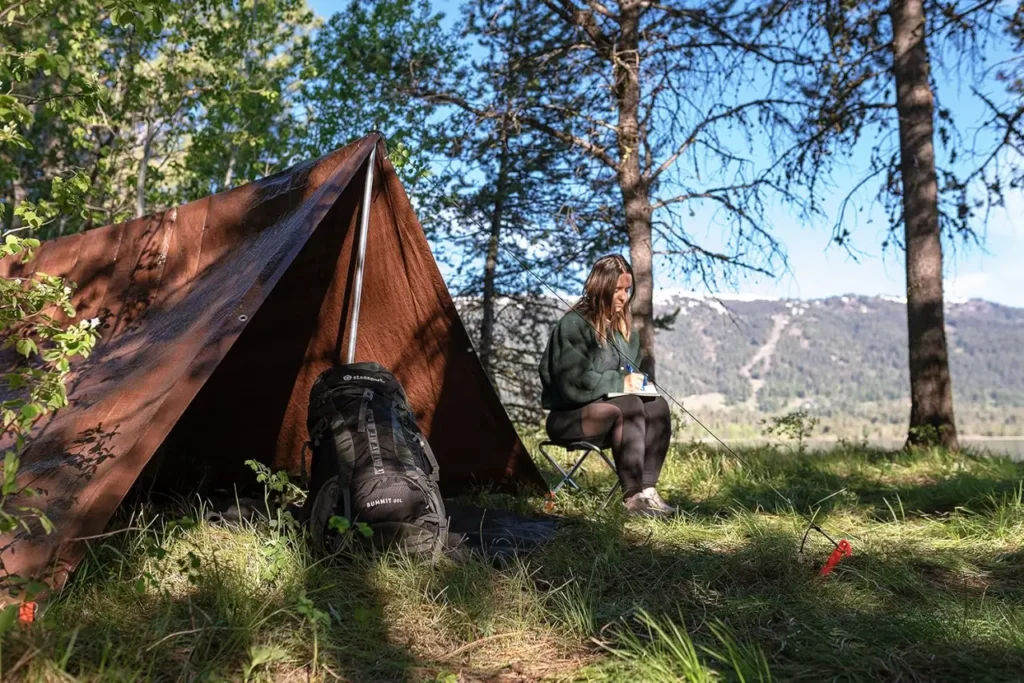
2. The Classic A-Frame Shelter
The Stansport tarp is large enough to create a simple A-frame shelter with very basic setup skills. Run a ridgeline between two trees, drape the tarp over it, and stake out the corners.
This setup works well for a basic rain shelter, a minimalist overnight pitch, or a backup covered area when camp space is limited. It gives solid weather protection from two sides and can feel surprisingly comfortable when pitched low and tight in rough conditions. 🌧️
The main advantage here is simplicity. A classic tarp pitch does not require a complicated system, and that makes it more approachable for beginners who want to learn shelter basics without spending much money.
3. The Lean-To Rain Fly
A lean-to pitch is one of the best quick-response setups when rain starts moving in and camp needs a dry zone fast.
- How to Set It Up: Attach one side of the tarp to trees or poles and angle the opposite side down toward the ground with stakes.
- Why It Works: It blocks rain and wind from one direction while keeping the front open for camp chairs, cooking, or gear access.
This is especially useful for car camping and shoulder-season trips, where having one dry, usable space can change the mood of camp entirely. It also works well near a fire ring when conditions allow safe positioning and airflow.
4. The Car Camping Awning
For car campers and van setups, the Stansport tarp can create a surprisingly useful covered living area.
Attach one side to a roof rack, open hatch, or side of the vehicle using appropriate tie-down methods, then support the other side with poles and stakes. The result is a simple awning for shade, rain protection, or a dry transition area while getting in and out of the vehicle. 🚙
This is one of the strongest use cases for the tarp because weight matters less in car camping, and versatility matters more. A basic tarp awning can cover camp chairs, a small table, muddy boots, or a cooking setup without requiring a purpose-built awning system.
5. The “Everything Else” Gear Cover
Sometimes the best use for a tarp is the least glamorous one.
- Covering firewood before overnight rain
- Protecting coolers and bins from dew
- Keeping bags dry outside the tent
- Creating a waterproof place to sit on wet ground
- Throwing over gear during a surprise storm
This is where the Stansport tarp earns its “workhorse” reputation. It is not just a shelter item. It is a problem-solver that helps camp stay functional when conditions are messy, damp, or unpredictable.
Stansport Tarp: The Pros and Cons
No tarp is perfect for every kind of outdoor use, and the Stansport tarp has a pretty clear set of strengths and tradeoffs.
Pros:
- Incredible value: It is one of the most affordable ways to add real shelter flexibility to a camping setup.
- Strong durability for the price: The rip-stop fabric, reinforced hem, and reinforced corners make it more dependable than many ultra-cheap tarps.
- Fully waterproof: Polyethylene construction does exactly what most campers want in bad weather: it keeps water out.
- Very versatile: It works as a footprint, shelter, awning, rain fly, emergency cover, and general camp utility layer.
- Practical size: The 10×12 cut size gives enough coverage for multiple camp uses without being overly small or restrictive.
Cons:
- Finished size is smaller than listed: That is standard for this kind of tarp, but it still catches some buyers off guard.
- Heavy for modern backpacking: At around 2.5 pounds, it is manageable for some short trips but not a lightweight choice by current backpacking standards.
- Can be noisy: Poly tarps tend to flap and crinkle more than specialized backpacking fabrics.
- Bulkier than premium tarp materials: It will not pack down like silnylon, silpoly, or Dyneema-based alternatives. 🎒
The important thing is that most of the drawbacks line up with what this tarp is trying to be. The tradeoffs are real, but they feel fair for the price and intended use.
How It Compares to the Alternatives
The Stansport tarp makes more sense when viewed as part of a broader tarp spectrum.
Alternative 1: The Upgraded Backpacking Tarp (e.g., Aqua Quest Safari)
These tarps are usually made with coated nylon or polyester fabrics like silnylon or silpoly.
- Pros: Lighter, softer, quieter, and much easier to pack small
- Cons: Considerably more expensive
- Choose this if: Weight and packed size matter more than price, especially for backpacking or long-distance carry
These options are better for hikers who count ounces carefully. But they are not always better for casual campers, vehicle-based trips, or backup utility use where durability and low cost matter more than refinement.
Alternative 2: The Heavy-Duty Hardware Store Tarp
These are the thick construction-style tarps often used for home or jobsite coverage.
- Pros: Tough, inexpensive, abrasion-resistant
- Cons: Heavy, bulky, and awkward for most outdoor trip use
- Choose this if: The tarp is staying close to home, at a basecamp, or in a more permanent setup
Compared with those, the Stansport tarp lands in a very practical middle lane. It offers a lot of the rugged, waterproof utility people expect from a poly tarp, but in a form that feels more realistic for regular camping use. 🌿
That middle position is one of its biggest advantages. It is not the lightest. It is not the most premium. It is simply one of the more balanced choices for people who want a capable tarp without overspending.
Who is the Stansport Tarp Best For?
The Stansport tarp can work for a lot of campers, but it stands out most for a few specific types of outdoor use.
- The Car Camper: This is arguably the best match. Weight and packed bulk are less important, while flexibility around camp matters a lot. A tarp like this can become a footprint, awning, rain fly, or gear cover on the same trip.
- The Budget-Minded Beginner: For someone building a first camping kit, it is hard to ignore how much utility this tarp adds for relatively little money.
- The Emergency-Preparedness Buyer: A durable waterproof tarp is useful well beyond campgrounds. It belongs in storm kits, vehicles, garages, and general backup gear collections.
- The Van-Lifer or Weekend Road Tripper: It is an easy way to create more livable outdoor space around a vehicle setup without committing to an expensive built-in awning system.
On the other hand, some buyers should probably skip it.
- Ultralight backpackers: There are much better options if low pack weight is the top priority.
- Buyers who need exact measurements: The cut-size-versus-finished-size issue makes this less ideal for precision use.
- Campers wanting quieter premium shelter fabric: Poly tarps work well, but they do not offer the feel or packed refinement of higher-end materials. 🙂
That split is what makes this tarp easy to judge honestly. It is great for the right user, and clearly less appealing for the wrong one.
Final Verdict: An Essential, No-Brainer Piece of Gear
The Stansport 10×12 Reinforced Multi-Purpose Tarp is not trying to be high-end shelter gear. It is trying to be useful, reliable, affordable, and ready for a long list of common outdoor problems. It succeeds on all four.
For car campers, general campers, van setups, emergency kits, and budget-conscious outdoor households, this tarp makes a lot of sense. It covers gear, protects tents, expands living space, and helps camp function better in bad weather. That kind of flexibility is hard to overstate once it becomes part of a regular setup. ⛺
Yes, it is a little heavier and bulkier than specialized tarp options. Yes, the finished size runs smaller than the listed cut size. But those tradeoffs feel reasonable when stacked against the price, durability, and range of uses.
For many campers, this is exactly the kind of gear worth buying: simple, dependable, and far more useful than it looks at first glance.
If the goal is an affordable tarp that can handle real-world camping tasks without much fuss, the Stansport tarp remains one of the smartest budget-friendly picks around.
Frequently Asked Questions (FAQ)
Is the Stansport tarp truly waterproof?
Yes. The laminated polyethylene construction is non-porous and designed to block water completely. In practical camp use, that means it works well for rain protection, ground coverage, and shielding gear from wet conditions. As with any tarp, performance still depends on setup. Water can pool if the pitch is too flat, and even a waterproof tarp can become frustrating if it is not angled properly for runoff. But in terms of material, yes, this tarp is truly waterproof. 🌧️
What is the difference between “cut size” and “finished size”?
“Cut size” refers to the size of the tarp material before manufacturing finishes are added. “Finished size” refers to the actual tarp after the edges are folded over and reinforced. That finishing process shortens the tarp a bit on each side. This is common across many poly tarps and is not unique to Stansport. It mostly matters when exact measurements are important, such as for a custom shelter fit or a precise footprint application.
Does the tarp come with ropes or stakes?
No. The tarp itself includes the reinforced material and grommet attachment points, but setup accessories like cordage, guylines, poles, or stakes need to be supplied separately. That is pretty normal for tarps in this category. For best results, it helps to keep a simple tarp kit with stakes and cord already packed so the tarp is easy to deploy when weather changes quickly.
How heavy is the 10×12 Stansport tarp?
It weighs approximately 2.5 pounds, or about 40 ounces. That puts it in a very manageable range for car camping, vehicle-based trips, short carry-ins, and general emergency use. It is not especially light by backpacking standards, but it is also not so heavy that it feels unreasonable for most non-ultralight applications. For many campers, that weight is a fair trade for low cost and durable waterproof coverage.
Can I use this for backpacking?
Yes, it can absolutely be used for backpacking, especially for short trips, budget kits, or minimalist shelter experimentation. But it is important to go in with realistic expectations. At around 2.5 pounds, it is heavy compared with dedicated backpacking tarps made from lighter technical fabrics. For beginners, occasional overnight trips, or simple emergency backup use, it can still make sense. For longer-distance hikers or anyone focused on low base weight, a lighter tarp will likely feel like a better long-term fit.
Affiliate Disclosure: GearForTheOutdoors.com participates in affiliate programs, including REI, Amazon, REI Outlet, Garage Grown Gear, evo, and other trusted partners. When you purchase through our links, we may earn a small commission at no extra cost to you. That helps support our content and keeps our recommendations useful, practical, and free.
Disclaimer: This post is for informational purposes only. Always verify current product details, fit, availability, safety information, and manufacturer warranties before purchase or use. Outdoor conditions and gear performance can vary depending on setup, weather, terrain, and experience level.