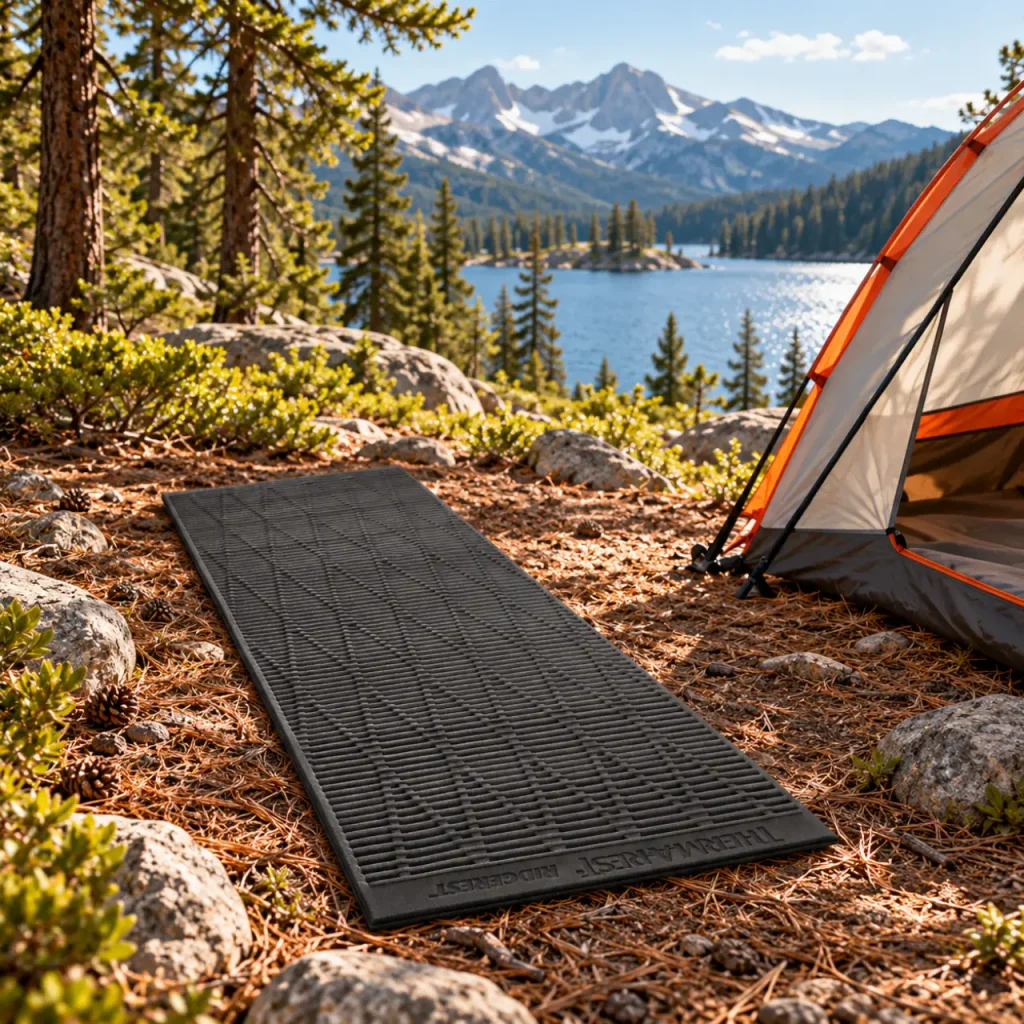
The Therm-a-Rest RidgeRest Classic is one of the simplest sleeping pads you can buy. It doesn’t inflate, can’t go flat from a puncture, and provides a dependable layer of insulation between your body and the ground. But does a thin foam pad still make sense when modern camping mattresses offer considerably more cushioning?
Yes—if durability, affordability, and simplicity matter more than sleeping on a soft surface.
With an R-value of 2.0 and just 0.63 inches of foam, the RidgeRest Classic is best suited to warm-weather camping, budget backpacking, and campers who prefer a firm sleeping surface. Its limited cushioning makes it less appealing for side sleepers or anyone looking for bed-like comfort.
For many car campers, however, its greatest value isn’t as a standalone mattress. Place it underneath an inflatable sleeping pad, and it becomes an additional insulation layer, a protective barrier against rough ground, and a backup if your main pad loses air.
That’s where this old-school foam pad continues to make a strong case for itself.
Therm-a-Rest RidgeRest Classic Specs at a Glance
The RidgeRest Classic uses closed-cell polyethylene foam with a distinctive pattern of raised ridges and recessed valleys. The design provides basic cushioning and traps air to help limit heat loss to the ground.
Unlike inflatable or self-inflating mattresses, it contains no valves or pressurized air chambers. Simply unroll it, position it inside your tent, and it’s ready for use.
| Specification | Regular | Large |
|---|---|---|
| Sleeping pad type | Closed-cell foam | Closed-cell foam |
| R-value | 2.0 | 2.0 |
| Weight | 14 oz | 1 lb. 3 oz. |
| Dimensions | 72 × 20 in. | 77 × 25 in. |
| Thickness | 0.63 in. | 0.63 in. |
| Packed dimensions | 20 × 8 in. | 25 × 8.5 in. |
| Material | Polyethylene foam | Polyethylene foam |
| Inflation required | No | No |
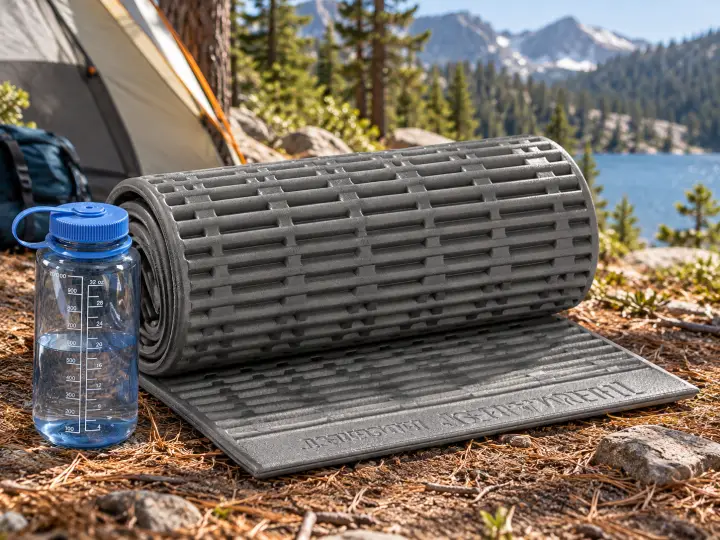
The Regular size weighs less than a pound, making it easy to carry, while the Large provides another five inches of length and width for taller campers or those who prefer more room.
That extra width matters when pairing it with another mattress. A 20-inch foam pad may leave the edges of a wider inflatable mattress without the same insulation and protection underneath.
The RidgeRest Classic remains part of Therm-a-Rest’s product lineup, although stock can vary by retailer and size. It’s worth checking availability before planning a sleep system around it.
Check out the Therm-a-Rest RidgeRest Classic on Amazon.
How Comfortable Is the RidgeRest Classic?
Comfort is the biggest compromise you’ll make with the RidgeRest Classic.
Its ridged foam surface takes some of the harshness out of sleeping on the ground, but at just over half an inch thick, it can’t provide the pressure relief of a thicker inflatable or self-inflating mattress.
You still feel the firmness of the ground beneath you, especially when your weight concentrates on your hips or shoulders.
Back Sleepers Have the Advantage
Back sleepers are generally better suited to the RidgeRest Classic because their body weight spreads across a larger surface.
If you’re comfortable sleeping on a firm mattress at home, the RidgeRest may provide enough cushioning for occasional overnight camping trips, particularly on a smooth campsite.
But firm doesn’t necessarily mean comfortable for everyone.
The foam has limited ability to absorb uneven ground, so site selection matters considerably more than it would with a thick air mattress.
For better results, choose a flat tent site, clear away rocks and sticks, and avoid positioning the pad directly over exposed roots.
Why Side Sleepers May Struggle
Side sleepers place much more pressure on their shoulders and hips.
The RidgeRest’s thin foam doesn’t leave much material between those pressure points and the ground. As a result, prolonged side sleeping can become uncomfortable, even when the campsite is relatively smooth.
Campers who regularly change sleeping positions may experience the same limitation.
The ridged surface adds a little cushioning, but it shouldn’t be confused with the deeper support of an inflatable mattress.
The comfort verdict: The RidgeRest Classic works best for people who tolerate firm sleeping surfaces. If you primarily sleep on your side or prioritize comfort during multi-night car camping trips, a thicker mattress is the better starting point.
Insulation: Is an R-Value of 2.0 Enough?
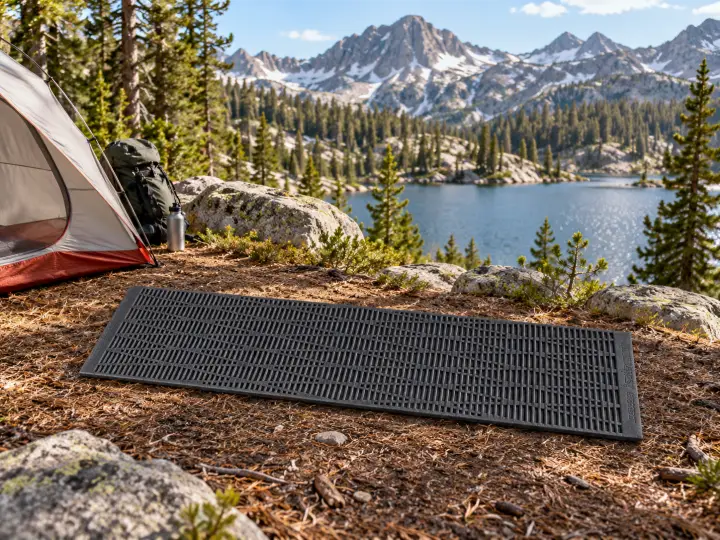
A sleeping pad does more than provide cushioning. It also limits the heat your body loses to the ground.
That insulation is measured by R-value. Higher R-values indicate greater resistance to heat transfer, making them increasingly important when camping on cold ground.
The RidgeRest Classic has an R-value of 2.0, which provides modest insulation for warm-weather camping and some mild shoulder-season conditions.
| Camping Conditions | RidgeRest Classic Suitability |
|---|---|
| Warm summer nights | A reasonable standalone choice |
| Mild spring and fall camping | Can work depending on ground temperatures and personal warmth needs |
| Cold-weather camping | Better paired with an additional insulated pad |
| Winter or snow camping | Insufficient as the sole ground insulation for most situations |
These are general guidelines, not fixed temperature ratings.
Ground temperature, campsite conditions, sleeping bag insulation, and individual cold tolerance all affect how warm you’ll feel overnight.
A sleeping bag alone won’t compensate for inadequate insulation underneath you. When you lie down, your body compresses much of the sleeping bag’s insulation, reducing its effectiveness against heat loss into the ground.
That’s why your sleeping pad’s R-value matters as much as its cushioning.
For summer camping, the RidgeRest Classic can provide enough insulation without adding unnecessary complexity. Once cold ground becomes a concern, its limitations become more significant.
Check out the Therm-a-Rest RidgeRest Classic on Amazon.
Why the RidgeRest Classic Works So Well Under an Inflatable Pad
One of the best reasons to own a RidgeRest Classic is to pair it with a more comfortable sleeping pad.
When two sleeping pads are stacked, their R-values are approximately additive. That means the RidgeRest can improve the insulation of a mattress you already own without requiring an entirely new cold-weather sleeping system.
For example:
| Sleeping Pad | R-Value |
|---|---|
| Primary insulated inflatable pad | 4.2 |
| Therm-a-Rest RidgeRest Classic | 2.0 |
| Approximate combined R-value | 6.2 |
A combined R-value around 6 can provide substantial ground insulation for colder conditions, although it doesn’t guarantee warmth in every winter environment. Your sleeping bag and the rest of your sleep system must also be appropriate for the weather.
For most setups, place the RidgeRest directly on the tent floor and position your inflatable mattress on top.
This arrangement provides three useful benefits:
- Additional insulation: The foam helps reduce heat loss into colder ground.
- Ground protection: It creates a barrier between your inflatable mattress and abrasive surfaces.
- Emergency backup: If your inflatable develops a leak, you still have an insulated foam surface beneath you.
That last advantage is easy to overlook.
A punctured inflatable pad can lose most of its cushioning during the night. With a RidgeRest underneath, you’ll still have a functional, though much firmer, sleeping surface.
Match the Foam Pad to Your Mattress Size
Before buying a RidgeRest specifically for layering, compare its dimensions with those of your primary mattress.
The Regular measures 72 × 20 inches, which works well beneath many standard-width sleeping pads.
But if you’re using a 25-inch-wide inflatable, the Regular RidgeRest won’t provide full-width coverage.
The Large RidgeRest measures 77 × 25 inches and is generally a better match for wider sleeping pads.
This matters for both insulation and protection. A narrower foam pad leaves portions of the inflatable extending beyond its edges.
The foam doesn’t necessarily need to cover every inch of a mattress to provide a useful insulation boost, but closer size matching creates a more consistent sleeping surface.
For campers who already own a comfortable inflatable pad, adding a RidgeRest underneath can be a more practical upgrade than replacing the entire mattress.
Durability and Everyday Camp Use
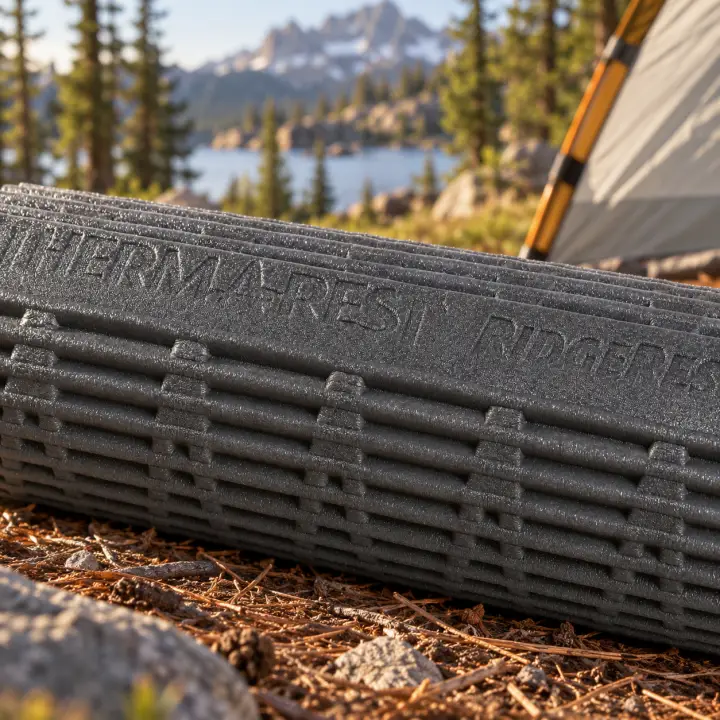
The RidgeRest Classic’s greatest advantage is its uncomplicated construction.
Because it’s made from closed-cell foam, it doesn’t depend on maintaining air pressure to provide cushioning or insulation.
There’s no valve to malfunction, no inflation system to manage, and no air chamber that can suddenly collapse after a puncture.
This makes it particularly useful for rough campsites, family outings, and trips where keeping equipment simple is a priority.
An inflatable pad generally requires more care around sharp objects, pet claws, and abrasive ground. The RidgeRest is much less vulnerable to those everyday campsite hazards.
That doesn’t make it indestructible.
The foam can still tear, become permanently compressed, or suffer damage from sharp objects and excessive heat. However, a small nick or surface puncture usually won’t compromise the entire sleeping pad.
Check out the Therm-a-Rest RidgeRest Classic on Amazon.
A Sleeping Pad That Does More Than Sleeping
The RidgeRest’s durability makes it useful around camp even when you’re not spending the night on it.
It can serve as:
- A campsite seat: Add insulation and a little cushioning when sitting on rocks, logs, or damp ground.
- A kneeling pad: Protect your knees while organizing gear, setting up equipment, or working around camp.
- A backup sleeping surface: Keep an extra pad available for guests or unexpected equipment problems.
- A gear mat: Provide a cleaner surface for organizing equipment outside the tent.
- An insulation layer: Add warmth beneath another mattress during colder trips.
These secondary uses can justify keeping a RidgeRest in your camping kit even if you’ve upgraded to a more comfortable primary mattress.
It’s also easy to maintain. Shake off dirt, wipe the foam with mild soap and water when needed, and allow it to dry before storage.
Keep it away from campfire embers, hot cookware, and other high-temperature surfaces, which can permanently damage the foam.
For campers who prefer equipment that requires very little maintenance, this simplicity is one of the RidgeRest’s strongest selling points.
The Trade-Off: Lightweight but Bulky
The RidgeRest Classic is light, but there’s no getting around its packed size.
The Regular weighs just 14 ounces, yet rolls into a cylinder approximately 20 inches long and 8 inches in diameter.
Unlike an inflatable pad, it doesn’t compress into a small storage bag.
This is one of the most important differences between the RidgeRest and modern air mattresses.
For Car Camping
The RidgeRest’s bulk is usually manageable when you have adequate vehicle storage.
You can slide it alongside other camping equipment or keep it accessible as a backup sleeping pad.
However, compact vehicles and heavily loaded trunks are another matter.
If you’re already fitting a cooler, tent, sleeping bags, camp kitchen, and multiple storage containers into a small vehicle, a large rolled foam pad can become awkward.
Its low weight doesn’t eliminate the space it occupies.
For Backpacking
Backpackers generally carry a RidgeRest attached to the outside of their pack.
That’s a practical solution, but it makes the overall load bulkier and may create problems when moving through dense vegetation or narrow passages.
The pad also needs to be secured properly so it doesn’t shift or catch on obstacles.
An inflatable mattress is usually much easier to pack inside a backpack.
The packability verdict: The RidgeRest Classic is easy to carry by weight, but not by volume. It’s best suited to campers who can accommodate a bulky foam roll without sacrificing valuable storage space.
RidgeRest Classic vs. Z Lite Sol vs. Inflatable Sleeping Pads
The RidgeRest Classic becomes easier to evaluate when compared with two alternatives: another closed-cell foam pad and a more comfortable inflatable mattress.
| Feature | RidgeRest Classic | Z Lite Sol | Inflatable Sleeping Pad |
|---|---|---|---|
| Construction | Closed-cell foam | Closed-cell foam | Sealed air chambers |
| R-value | 2.0 | 2.0 | Varies by model |
| Thickness | 0.63 in. | 0.75 in. | Often substantially thicker |
| Packed design | Rolled | Accordion-fold | Compressible |
| Cushioning | Firm | Firm | Generally better |
| Deflation risk | None | None | Possible |
| Main advantage | Simple, affordable insulation | Convenient folding design | Comfort and compact storage |
RidgeRest Classic vs. Therm-a-Rest Z Lite Sol

The Therm-a-Rest Z Lite Sol is the RidgeRest’s closest competitor.
Both use closed-cell foam, provide an R-value of 2.0, and eliminate the puncture-related deflation risk associated with inflatable mattresses.
The main difference is how they’re packed.
The RidgeRest rolls into a cylinder, while the Z Lite Sol folds accordion-style into a more rectangular shape.
That folding design can be easier to secure to a backpack, stack with other equipment, or fold into a compact seat during rest breaks.
The Z Lite Sol also features a reflective ThermaCapture coating designed to reduce radiant heat loss.
However, both pads have the same overall published R-value, so the reflective coating shouldn’t be treated as a significant difference in insulation performance.
The Z Lite Sol is slightly thicker, but neither pad offers the deep cushioning needed by many side sleepers.
Choose the RidgeRest Classic if affordability and simplicity matter most, particularly for car camping or use beneath an inflatable mattress.
Choose the Z Lite Sol if you prefer an accordion-fold design that’s convenient for backpacking and frequent use as a camp seat.
For campers who don’t mind carrying a foam roll, the RidgeRest remains a sensible lower-cost choice.
Check the Therm-a-Rest Z Lite Sol at REI
RidgeRest Classic vs. an Inflatable Sleeping Pad
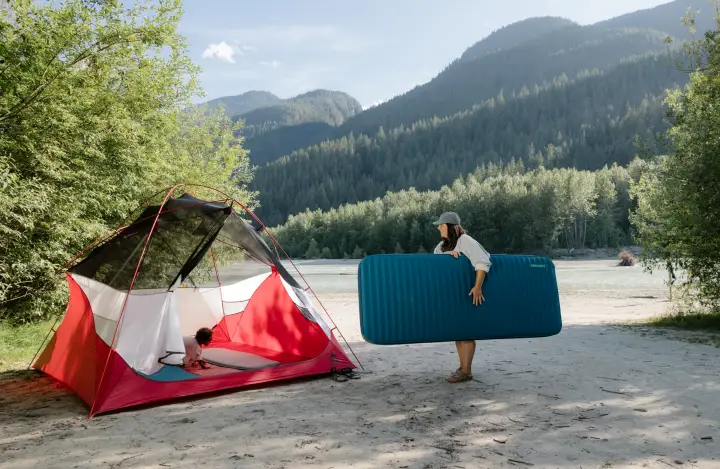
For most car campers, this is the more meaningful comparison.
A thicker inflatable or self-inflating mattress generally provides substantially better cushioning, especially for side sleepers.
Models designed for comfortable car camping, such as the Therm-a-Rest MondoKing 3D, offer a much thicker sleeping surface and higher insulation than the RidgeRest Classic.
The trade-off is greater cost, more weight, and additional setup and maintenance.
Even self-inflating mattresses contain air chambers and valves, so they still need protection from damage.
The RidgeRest avoids those complications entirely.
If you’re buying your only sleeping pad and comfort is your highest priority, a thicker mattress makes more sense.
If you already own a comfortable pad and want additional insulation or dependable backup protection, the RidgeRest may be the more useful purchase.
Who Should Buy the Therm-a-Rest RidgeRest Classic?
The RidgeRest Classic is particularly appealing to campers who know exactly what they need from a foam sleeping pad.
Buy It If You Want a Simple, Affordable Sleeping Pad
For beginners, occasional campers, and families building a basic gear kit, the RidgeRest offers a straightforward sleeping solution.
There’s no inflation process, no pump to pack, and little maintenance.
It’s especially practical for children and campers who don’t mind sleeping on a firmer surface.
The important caveat is comfort. A lower purchase price isn’t a bargain if the pad leaves you uncomfortable throughout the night.
Buy It If You Want More Insulation Under Your Existing Mattress
This is arguably the RidgeRest’s strongest role in a modern car camping sleep system.
If your current inflatable mattress is comfortable but lacks sufficient insulation for colder trips, a RidgeRest underneath can add warmth while reducing direct contact with rough ground.
It also provides an emergency fallback if the inflatable loses air.
Just make sure the foam pad’s dimensions are appropriate for your mattress.
Buy It If You Need Reliable Backup Gear
The RidgeRest makes sense as an extra sleeping pad for family camping, vehicle-based trips, and situations where keeping a simple spare is valuable.
Even when it isn’t needed for sleeping, it can serve as a seat, kneeling mat, or ground insulation layer.
Skip It If Comfort Comes First
The RidgeRest Classic is probably not the right primary mattress if you:
- Sleep mainly on your side.
- Need substantial cushioning around your hips or shoulders.
- Prefer a soft, bed-like sleeping surface.
- Have limited storage space and need compact gear.
- Frequently camp in cold conditions and want one pad to provide all your insulation.
For these campers, investing in a thicker inflatable or self-inflating mattress is likely to deliver a better night’s sleep.
Final Verdict: Is the Therm-a-Rest RidgeRest Classic Worth It?
The Therm-a-Rest RidgeRest Classic is still worth considering, but its value depends on how you plan to use it.
As a standalone sleeping pad, it’s best for warm-weather camping, budget-conscious campers, and people who don’t mind a firm surface. Its modest insulation and limited cushioning make it less suitable for cold conditions or comfort-focused car camping.
As a second layer underneath another mattress, however, the RidgeRest becomes considerably more versatile.
It adds insulation, protects your inflatable pad from rough ground, and provides a dependable backup sleeping surface—all without inflation or complicated maintenance.
That’s the strongest reason to choose it.
If you’re building an affordable, low-maintenance camping kit or looking to improve an existing sleep system, the RidgeRest Classic remains a practical option.
If your biggest priority is sleeping comfortably through the night, start with a thicker mattress instead.
Check out the Therm-a-Rest RidgeRest Classic on Amazon.
Affiliate Disclosure: GearForTheOutdoors.com participates in affiliate programs, including REI, Amazon, REI Outlet, Garage Grown Gear, evo, and other trusted partners. When you purchase through our links, we may earn a small commission at no extra cost to you. That helps support our content and keeps our recommendations useful, practical, and free.
Disclaimer: This post is for informational purposes only. Always verify current product details, fit, compatibility, availability, safety information, and manufacturer instructions before purchase or use. Outdoor conditions and gear performance can vary depending on setup, weather, terrain, vehicle, and experience level.