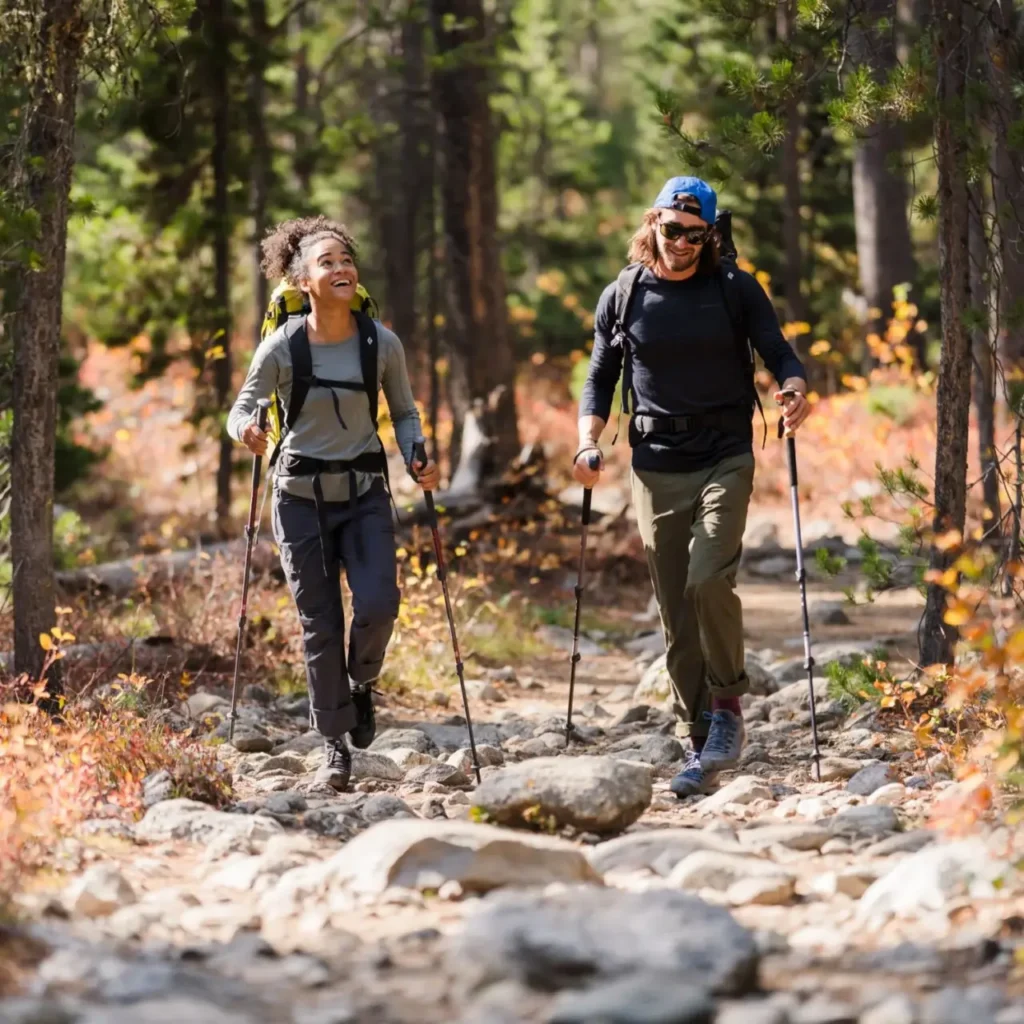
Trekking poles are easy to overlook when you’re just getting into hiking.
Boots feel essential. A daypack makes sense. Water, snacks, layers, and a headlamp are easy to understand. But poles? At first, they can look like something only long-distance backpackers or serious mountain hikers use.
Then the trail gets steep. Or muddy. Or rocky. Or the downhill lasts much longer than expected.
That’s when trekking poles start to make a lot more sense. 🥾
A good pair of trekking poles can help you feel steadier on uneven ground, take some pressure off your knees on descents, give your arms something useful to do on climbs, and help you settle into a smoother hiking rhythm. They won’t magically make a hard trail easy, but they can make the whole experience feel more controlled.
For beginners, the goal is not to buy the lightest, most technical, most expensive pair available. The goal is to find poles that are simple to adjust, comfortable to hold, durable enough for real trail use, and reasonably priced.
This guide breaks down the best trekking poles for beginners in a practical way — what actually matters, what can be skipped, and which pairs make the most sense for new hikers.
Quick Picks: Best Trekking Poles for Beginners
| Product Name | Price Tier | Best For | Why It Works for Beginners |
|---|---|---|---|
| REI Co-op Trailmade Trekking Poles | $ | Best Overall Value | Simple, durable, easy to adjust, and priced well for a first pair |
| Black Diamond Trail Back Trekking Poles | $ | Best Basic Workhorse | Tough aluminum poles with reliable external locks |
| Black Diamond Trail Trekking Poles | $$ | Best Comfort Upgrade | Better grip feel and a more refined trail experience |
| Leki Makalu Cork Lite Trekking Poles | $$$ | Best Premium Beginner Pick | Excellent ergonomics, cork comfort, and long-term durability |
Why Beginner Hikers Should Consider Trekking Poles
Trekking poles are not about looking more advanced on the trail. They are about hiking with more balance and less wasted energy.
On uneven terrain, poles give you two extra points of contact with the ground. That can help when stepping over roots, crossing shallow streams, moving across loose gravel, or descending a trail covered in dry leaves.
On climbs, poles can help your arms contribute a little more. On descents, they can help reduce some of the pounding that goes through your knees and ankles. On longer hikes, they can help you settle into a steady rhythm instead of constantly stopping and restarting.
They are especially useful for beginners because new hikers are still learning how to move efficiently over different types of terrain. A smooth dirt path, a rocky overlook trail, and a muddy forest loop all ask different things from your body. Trekking poles add stability while you build that trail confidence. 🌲
They also help when carrying a pack. Even a small daypack with water, snacks, layers, and camera gear can start to feel heavier after a few miles. Poles help distribute some effort through the upper body, which can make the hike feel more balanced.
Are they required? No.
Are they useful enough that many hikers keep using them once they try them? Absolutely.
How to Choose Trekking Poles: A Beginner’s Guide
The best first pair of trekking poles should feel simple, not fussy.
You should be able to adjust them quickly, trust them on descents, grip them comfortably, and pack them away without fighting with complicated mechanisms. For most beginners, the right choice is a pair of adjustable aluminum trekking poles with external lever locks and comfortable foam or cork grips.
That setup covers the needs of most day hikers, beginner backpackers, national park travelers, and weekend campers.
Material: Aluminum vs. Carbon Fiber
The first big choice is shaft material. Most trekking poles are made from either aluminum or carbon fiber.
Aluminum is the better starting point for most beginners. It is strong, dependable, and usually more affordable than carbon fiber. It also handles trail abuse well. If an aluminum pole gets knocked against a rock or planted awkwardly between roots, it is more likely to bend than snap.
That matters when you are still learning how to use poles. Beginners may plant poles too far forward, lean on them too heavily, or wedge them between rocks without meaning to. Aluminum is more forgiving in those situations.
Carbon fiber is lighter. That can be nice on long hikes because lighter poles create less swing fatigue over thousands of steps. Carbon also tends to feel stiff and efficient. But it costs more and can be less forgiving under sharp side pressure. If carbon fails, it is more likely to crack or splinter rather than bend.
For a first pair, durability and value usually matter more than shaving a few ounces.
Beginner’s Verdict: Choose aluminum. It is durable, practical, and the best value for most new hikers.
Locking Mechanism: Lever Lock vs. Twist Lock
Adjustable trekking poles use locks to hold each section in place. This is one feature beginners should take seriously.
Lever locks use an external clamp. Open the lever, slide the pole to the right length, close the lever, and keep hiking. They are easy to use, easy to see, and easy to adjust on the trail.
This matters because trekking poles are not always set once and forgotten. You may want them shorter for a climb, longer for a descent, and unevenly adjusted when crossing a slope. Lever locks make those changes quick and intuitive.
Twist locks use an internal system. You twist the pole section to loosen it, adjust the length, then twist it again to tighten. They can look cleaner, but they are often more frustrating for beginners. They can be harder to tighten correctly, especially with cold hands, wet weather, or dirt inside the mechanism.
A slipping pole is annoying at best and unsafe at worst. External lever locks are easier to trust because you can see whether they are open or closed.
Beginner’s Verdict: Choose external lever locks. They are simpler, faster, and more reliable for new hikers.
Grip Material: Cork, Foam, and Rubber
The grip is where your hand spends the entire hike, so comfort matters.
Foam grips are common on beginner-friendly trekking poles. They are soft, lightweight, and comfortable right away. Foam also absorbs some moisture, which helps on warm hikes when hands get sweaty.
Cork grips feel firmer and more natural. Over time, cork can slightly mold to the shape of your hand. It also handles sweat well and often feels better on longer hikes. Cork is usually found on mid-range or higher-end trekking poles.
Rubber grips are durable and can work well in cold conditions because they insulate the hand. But in warm weather, rubber can feel sweaty and may rub more over long distances.
For most beginners, foam is the best value. It is comfortable, affordable, and easy to like right away. Cork is a worthwhile upgrade if you hike often or want a more premium feel.
Beginner’s Verdict: Foam is great for a first pair. Cork is the better upgrade for regular hikers. 🏔️
Shaft Design: Telescoping vs. Folding
Trekking poles usually collapse in one of two ways.
Telescoping poles slide into themselves in sections. Most beginner-friendly poles use a three-section telescoping design. These poles are adjustable, sturdy, and easy to understand.
They are also versatile. You can fine-tune the length for different terrain, collapse them for storage, and strap them to a daypack when you don’t need them.
Folding poles, sometimes called Z-poles, fold into short sections connected by an internal cord. They pack down very small and are popular with trail runners, ultralight backpackers, and hikers who want compact gear.
Folding poles can be excellent, but they are often more expensive and may offer less adjustment. For a beginner, they are usually not necessary unless packability is the top priority.
Beginner’s Verdict: Choose three-section telescoping poles. They are adjustable, durable, and the easiest style to learn with.
Other Features Worth Understanding
Baskets are the small plastic discs near the bottom of trekking poles. They help stop the poles from sinking too deeply into mud, soft dirt, sand, or snow. Most poles include small trekking baskets. Some can be swapped for larger snow baskets.
Tips are usually made from carbide or another hard metal. These bite into dirt, gravel, rock, and packed trail better than rubber.
Rubber tip covers are useful for paved paths, travel, and storage. They reduce noise on pavement and help protect sharp metal tips when the poles are packed in a car or bag.
Wrist straps help reduce hand fatigue when used correctly. Instead of squeezing the grip tightly all day, you can push down into the strap and let your wrist and forearm share the work.
The Best Trekking Poles for Beginners
The best beginner trekking poles do not need to be complicated. They should feel stable, adjust easily, hold their length, and feel comfortable over several miles.
The picks below are built around real beginner needs: simple setup, reliable locks, durable shafts, comfortable grips, and good long-term value.
REI Co-op Trailmade Trekking Poles
- Shaft Material: Aluminum
- Grip Material: EVA Foam
- Locking Mechanism: External Lever Lock
- Best For: Most beginner hikers who want value, simplicity, and reliable trail support
The REI Co-op Trailmade Trekking Poles are the easiest recommendation for most beginners because they get the basics right without making the decision feel complicated.
They are the kind of poles that make sense for a first real hiking setup: sturdy aluminum shafts, comfortable foam grips, simple external lever locks, and a price that does not feel like a huge leap for someone still building their gear closet.
On the trail, that simplicity matters. Beginners do not need a pole that requires careful handling or constant adjustment. They need something that can be quickly sized at the trailhead, shortened for a climb, lengthened for a descent, and trusted on uneven ground.
The foam grips are comfortable right away. They feel soft enough for bare hands and practical enough for warm-weather hikes. The extended lower grip area is also helpful on short uphill sections because you can choke down on the pole without stopping to adjust the length.
These poles are a strong fit for local day hikes, national park trails, beginner backpacking trips, and camping weekends where a short hike might turn into a rocky or muddy one. They are not the lightest poles available, and they do not have premium cork grips, but that is not the point.
The point is that they work well, feel approachable, and give beginners the support they need without overcharging for features they may not use yet. 🌲
Pros:
- Excellent value for a first pair
- Durable aluminum construction
- Easy external lever-lock adjustment
- Comfortable EVA foam grips
- Extended grip area helps on short climbs
- Simple enough for first-time trekking pole users
Cons:
- Heavier than premium carbon poles
- Foam grips may not feel as refined as cork
- Not as compact as folding trekking poles
Bottom Line: The REI Co-op Trailmade Trekking Poles are the best overall pick for most beginners. They are practical, affordable, easy to adjust, and built around the features new hikers actually need.
Black Diamond Trail Back Trekking Poles
- Shaft Material: Aluminum
- Grip Material: Rubber/Foam-Style Grip, depending on current version
- Locking Mechanism: FlickLock External Lever Lock
- Best For: Beginners who want a tough, simple workhorse pole
The Black Diamond Trail Back Trekking Poles are a good match for hikers who want something rugged and straightforward.
These poles are not trying to feel fancy. They are built for dependable support on regular trails, which is exactly what many beginners need. If your hikes include rocky sections, loose dirt, uneven forest paths, or long descents, a tougher pole can feel reassuring.
The three-section aluminum design gives them a sturdy feel under pressure. They may be a little heavier than more refined models, but that weight comes with durability. For new hikers who are still learning where and how to plant poles, that durability is useful.
The FlickLock adjustment system is one of the strongest reasons to consider these poles. It is simple, visible, and trail-tested. Open the lock, set the length, close the lock, and keep moving. There is no need to guess whether an internal twist mechanism is tight enough.
The grips are more basic than the cork or softer foam options in this guide, so they may not be the most comfortable choice for long, hot hikes. But for hikers who want a reliable pair that can handle a little abuse, the Trail Back poles make a lot of sense.
These are a smart choice for beginners who want a durable pair from a trusted outdoor brand and would rather prioritize strength over premium comfort.
Pros:
- Tough aluminum construction
- Reliable FlickLock external adjustment
- Good for rocky, rooty, and uneven trails
- Simple three-section telescoping design
- Strong value from a respected outdoor brand
Cons:
- Heavier than some beginner-friendly options
- Grip comfort is more basic
- Less refined than higher-end poles
Bottom Line: The Black Diamond Trail Back Trekking Poles are a dependable workhorse pick for beginners who want simple, durable support without paying for premium extras.
Black Diamond Trail Trekking Poles
- Shaft Material: 7075 Aluminum
- Grip Material: EVA Foam
- Locking Mechanism: External Lever Lock
- Best For: Beginners who want better comfort and a more refined feel
The Black Diamond Trail Trekking Poles are a smart step up for beginners who expect to hike regularly.
They still keep things practical: aluminum construction, external lever locks, and an adjustable telescoping design. But compared with more basic entry-level poles, they feel a little more comfortable and polished in hand.
That matters once hikes get longer. A grip that feels fine for one mile can start to feel less comfortable after six. Softer EVA foam grips and more comfortable straps can make a real difference when your hands stay on the poles for hours.
The 7075 aluminum shafts are strong enough for regular trail use, and the external locks make adjustments easy. These poles work well for day hikes, longer weekend trails, beginner backpacking, and hikers who want one pair that can grow with them.
They cost more than the most basic poles, so they may not be necessary for someone who hikes only a few times a year. But for someone building a more dependable hiking setup, the upgrade is easy to justify.
The Black Diamond Trail poles are especially good for beginners who already know hiking is going to become a consistent habit. 🥾
Pros:
- Comfortable EVA foam grips
- Strong 7075 aluminum shafts
- Reliable external lever-lock adjustment
- Better comfort than basic entry-level poles
- Good balance of durability, comfort, and price
Cons:
- Costs more than basic beginner poles
- Not as compact as folding poles
- Foam grips may not appeal to hikers who prefer cork
Bottom Line: The Black Diamond Trail Trekking Poles are the best comfort upgrade for beginners who want a more refined pair without moving into high-end pricing.
Leki Makalu Cork Lite Trekking Poles
- Shaft Material: Aluminum
- Grip Material: Cork/Rubber Composite
- Locking Mechanism: Speed Lock Plus External Lever Lock
- Best For: Beginners who want premium comfort and long-term quality
The Leki Makalu Cork Lite Trekking Poles are the premium pick in this guide.
They are not the cheapest choice, and they are more pole than a very casual hiker needs. But for beginners who already know they want to hike often, they offer a more comfortable, refined trail feel from the start.
The biggest difference is the grip. The cork/rubber handle feels supportive and natural in the hand. It has a more shaped, ergonomic feel than basic foam or rubber grips, which can reduce fatigue on longer hikes.
That comfort becomes more noticeable over time. On a short trail, almost any grip can feel fine. On a long descent or an all-day hike, a better grip can make the poles feel smoother and less tiring to use.
The Speed Lock Plus system keeps adjustments simple and secure. Even though these poles sit in a more premium category, they are still beginner-friendly because the adjustment system is easy to understand.
The aluminum shaft keeps the build durable while still feeling relatively light. This makes the Makalu Cork Lite a strong option for hikers who want quality and comfort but do not want to jump to carbon fiber.
These poles are best for beginners who are ready to invest once and use the same pair for years.
Pros:
- Excellent ergonomic cork/rubber grip
- Comfortable for longer hikes
- Durable aluminum construction
- Secure Speed Lock Plus adjustment
- Strong long-term choice for regular hikers
Cons:
- Most expensive option in this guide
- More than occasional hikers may need
- Grip shape may not suit every hand
Bottom Line: The Leki Makalu Cork Lite Trekking Poles are the best premium beginner pick for hikers who want excellent comfort, strong construction, and a pair that can grow with them.
How to Use Trekking Poles Correctly
Buying the right poles is only part of the equation. A little technique makes them much more useful.
Trekking poles should help you move more smoothly, not make hiking feel awkward. The key is setting the right height, adjusting for terrain, and learning how to use the straps properly.
1. Finding the Right Height
On flat ground, adjust each pole so the tip touches the ground and your elbow forms roughly a 90-degree angle.
That is your baseline.
Your shoulders should feel relaxed. Your elbows should sit comfortably near your sides. Your wrists should feel neutral, not bent upward or stretched down.
If the poles feel like they are pushing your shoulders up, they are too long. If you feel hunched over, they are too short.
Most adjustable trekking poles have measurement markings on the shaft. Once you find your preferred flat-ground setting, remember that number. It makes future hikes faster and easier to set up.
2. Adjusting for Terrain
Trekking poles work better when their length matches the trail.
Uphill: Shorten the poles by about 5–10 cm. This makes it easier to plant them slightly ahead and use your arms to help with the climb.
Downhill: Lengthen the poles by about 5–10 cm. This lets you plant them farther in front of your body, adding stability and reducing some impact on your knees.
Traversing: When walking across a slope, make the downhill pole longer and the uphill pole shorter. This helps keep your body more upright and balanced.
You do not need to adjust your poles for every tiny rise or dip in the trail. But for longer climbs and descents, changing the length can make hiking feel noticeably smoother. 🌄
3. Using the Wrist Straps Correctly
Wrist straps are one of the most useful parts of trekking poles, but many beginners use them the wrong way.
The common mistake is sliding your hand down through the strap from above and grabbing the grip. That does not support your hand very well.
The better method is to bring your hand up through the bottom of the strap, then wrap your hand around the grip. The strap should sit between your wrist and the base of your thumb.
This lets you push down into the strap instead of squeezing the grip tightly all day. Over several miles, that can reduce hand fatigue.
There is one important exception. On tricky terrain where a pole could get stuck — like roots, talus, stream crossings, or steep scrambles — it can be safer to remove your hands from the straps. If the pole catches, your hand is not trapped.
4. Matching Pole Rhythm to Your Stride
On normal trail, the easiest rhythm is opposite hand, opposite foot.
Right foot forward, left pole forward. Left foot forward, right pole forward.
It may feel awkward for the first few minutes. Then it usually starts to click.
On steep climbs, some hikers plant both poles ahead and push upward. On steep descents, poles can be planted slightly ahead before stepping down.
The goal is not perfect technique. The goal is a natural rhythm that adds stability without slowing you down.
5. Knowing When to Put Poles Away
Trekking poles are helpful, but they are not always the right tool.
Put them away on ladders, scrambles, narrow ledges, crowded viewpoints, or any section where you need your hands free. They should also be used carefully on boardwalks, fragile terrain, or sensitive trail surfaces.
Good pole use includes knowing when to carry them and when to stow them.
Final Verdict
The best trekking poles for beginners are not the most expensive or technical poles available. They are the poles that make hiking feel steadier, more comfortable, and easier to control.
For most new hikers, the best starting point is a durable aluminum pair with external lever locks and comfortable foam or cork grips. That combination gives you the stability and adjustability you need without unnecessary complexity.
The REI Co-op Trailmade Trekking Poles are the best overall choice for most beginners because they are simple, reliable, affordable, and easy to use.
The Black Diamond Trail Back Trekking Poles are the best rugged workhorse for hikers who want durability first. The Black Diamond Trail Trekking Poles are the better comfort upgrade for beginners who plan to hike often. The Leki Makalu Cork Lite Trekking Poles are the premium choice for hikers who want excellent grip comfort and long-term quality.
A good pair of trekking poles will not make every trail easy. But they can make uneven ground feel more manageable, descents feel more controlled, and longer hikes feel smoother.
For a beginner, that extra confidence can make a big difference. 🥾
Frequently Asked Questions (FAQ)
Are trekking poles worth it for day hiking?
Yes, trekking poles can be very useful for day hiking, especially on trails with hills, loose gravel, mud, roots, rocks, or long downhill sections.
Even on a moderate hike, poles can help with balance and reduce some of the strain that builds up in your legs over time. They are especially helpful when the trail is uneven or when your knees tend to feel sore on descents.
For short, flat walks, they may not be necessary. But for most real hiking trails, they can make the experience feel steadier and more comfortable.
Do beginners really need trekking poles?
Beginners do not strictly need trekking poles, but many beginners benefit from them.
New hikers are still building balance, trail confidence, downhill technique, and stamina. Trekking poles add stability while those skills develop.
They are especially useful for hikers who feel nervous on descents, have knee sensitivity, carry a heavier daypack, or hike on uneven terrain.
Do I need one or two trekking poles?
Two trekking poles are usually better for hiking.
A pair gives balanced support on both sides of the body and helps create a smooth walking rhythm. Two poles also provide better stability on descents, stream crossings, muddy sections, and loose terrain.
A single hiking staff can still help, but it does not offer the same balance or efficiency as a pair.
Can I take trekking poles on an airplane?
Trekking poles are generally not allowed in carry-on luggage by TSA because they can be considered potential weapons.
They should be packed in checked luggage. Collapse them fully, cover the tips if possible, and pack them securely so they do not damage other gear.
For international travel, check your airline and destination rules before flying.
How much should a beginner spend on trekking poles?
Most beginners can get a good pair of trekking poles in the $60–$130 range.
Very cheap poles can work for occasional use, but they may have less reliable locks, less comfortable grips, or weaker shafts. Since slipping locks can be frustrating and potentially unsafe, it is usually worth choosing a pair from a trusted outdoor brand.
More expensive poles may offer cork grips, lighter materials, better straps, and more refined adjustment systems. Those upgrades are nice, but they are not required for a first pair.
What is the difference between men’s and women’s trekking poles?
Women-specific trekking poles are usually shorter and may have smaller grip diameters. They may also come in different colors or slightly different sizing ranges.
The label matters less than the fit. A good trekking pole should adjust to the right height, feel comfortable in your hand, and match the type of hiking you do.
Many unisex poles work well for a wide range of hikers.
Are cork grips better than foam grips?
Cork grips are often better for frequent hikers because they manage sweat well, feel natural, and can become more comfortable over time.
Foam grips are still excellent for beginners. They are soft, lightweight, comfortable right away, and usually more affordable.
For a first pair, foam is a great value. For longer hikes or sweaty hands, cork can be worth the upgrade.
Are carbon trekking poles better for beginners?
Usually, no.
Carbon poles are lighter, but they are also more expensive and less forgiving under certain types of impact. Beginners usually benefit more from durability than from saving a few ounces.
Aluminum poles are the better first choice for most new hikers because they are strong, practical, and more affordable.
Should trekking poles be used with rubber tips?
Rubber tips are useful on pavement, sidewalks, boardwalks, and during travel or storage.
On natural trails, carbide tips usually provide better grip. Dirt, gravel, mud, and rock often need the bite of the metal tip.
A good habit is to keep rubber tip covers in your pack and use them when the surface calls for it.
Can trekking poles help with knee pain?
Trekking poles may help reduce some impact on descents by shifting part of the load into your arms and upper body.
Many hikers find that poles make downhill hiking feel easier on their knees, especially on long descents. However, trekking poles are not medical treatment. Persistent knee pain should be discussed with a qualified healthcare professional.
For general hiking comfort, poles work best alongside supportive footwear, smart pacing, reasonable pack weight, and careful downhill technique.
Affiliate Disclosure: GearForTheOutdoors.com participates in affiliate programs, including REI, Amazon, REI Outlet, Garage Grown Gear, evo, and other trusted partners. When you purchase through our links, we may earn a small commission at no extra cost to you. That helps support our content and keeps our recommendations useful, practical, and free.
Disclaimer: This post is for informational purposes only. Always verify current product details, fit, availability, safety information, and manufacturer warranties before purchase or use. Outdoor conditions and gear performance can vary depending on setup, weather, terrain, and experience level.