A good campsite meal does not need to be complicated. Sometimes, the best part of the evening is simply hearing burgers sizzle while the light fades behind the trees. On a cool morning, a warm breakfast can be as simple as pancakes, bacon, and coffee prepared on a picnic table before the trail gets busy.
The right cooking setup makes those moments easier. The wrong one can leave you crowding food onto a tiny surface, fighting uneven heat, or scraping grease from a stove when everyone else is ready to relax. 🍳
The best camping grills and griddles are not interchangeable. A family cooking breakfast for five needs a different setup than a couple preparing burgers beside a campervan. An overland traveler may value a hitch-mounted grill that keeps trunk space open. A camper who enjoys slower evenings around a real fire may prefer a wood-burning system over propane convenience.
This guide focuses on current products that solve those different problems clearly. The goal is not to find the most elaborate outdoor kitchen. It is to help you choose a practical cooking setup that fits the way you actually camp.
The Best Camping Grills and Griddles at a Glance
| Product | Best For | Cooking Style | Fuel Type | Best Fit |
|---|---|---|---|---|
| Coleman Cascade 3-in-1 Camping Stove | Best Overall for Most Campers | Stove, grill, and griddle | Propane | Car camping and family trips |
| HitchFire Forge 15 Grill | Best for Overlanding and Vehicle-Based Camping | Traditional grilling with optional flat-top accessory | Propane | SUVs, trucks, and campervans |
| Weber Q 1200 Gas Grill | Best Classic Portable Propane Grill | Traditional grilling | Propane | Couples, small groups, and RV trips |
| Blackstone Adventure Ready 22-Inch Griddle Bundle | Best for Big Breakfasts and Group Meals | Flat-top griddle | Propane | Families and group campsites |
| Snow Peak Grill Burner | Best Compact Premium Griddle | Cast-iron griddle | Isobutane | Couples and organized camp kitchens |
| Snow Peak Takibi Fire & Grill | Best Packable Wood-Fire Grill | Open-fire grilling | Wood or charcoal with optional accessory | Slow campsite evenings |
| Barebones Cowboy Fire Pit Grill | Best Open-Fire Cooking Station | Adjustable open-fire grilling | Wood or charcoal | Basecamps and backyard-style campsite meals |
Quick Verdict: Which Camping Grill or Griddle Should You Buy?
For most car campers, the Coleman Cascade 3-in-1 Camping Stove is the easiest recommendation. It keeps the familiar two-burner layout but adds removable cast-iron grill and griddle plates. That means one compact stove can handle coffee water, pancakes, burgers, vegetables, and a pot of chili without requiring a separate appliance.
For larger breakfasts and flat-top meals, the Blackstone Adventure Ready 22-Inch Griddle Bundle is the more capable choice. Its wide cooking surface makes it easier to prepare pancakes, eggs, bacon, smash burgers, and chopped vegetables without cooking in several small batches.
For trucks, SUVs, and overland builds, the HitchFire Forge 15 Grill solves a different problem. It mounts to a standard hitch receiver, swings away from the vehicle, and keeps the main cooking surface outside the trunk or cargo area. 🚙
Campers who enjoy cooking slowly over real coals should look at the Snow Peak Takibi Fire & Grill or the Barebones Cowboy Fire Pit Grill. These are not the fastest options, but they create a campsite gathering place as well as a cooking surface.
Coleman Cascade 3-in-1 Camping Stove
Best For: The Most Practical All-Around Camp Kitchen Setup
A standard two-burner propane stove is still one of the most useful pieces of gear for car camping. It is easy to pack, quick to light, and flexible enough for almost any campsite meal. The Coleman Cascade 3-in-1 Camping Stove improves on that familiar setup by including removable cast-iron grill and griddle plates.
That versatility matters when a camping trip includes more than one kind of meal. You can use a pot and skillet for pasta at night, switch to the griddle for pancakes the next morning, and cook burgers on the grill plate before heading home. There is no need to pack a dedicated flat-top griddle and a separate stove. 🥞
The two burners produce 12,000 BTUs each, for 24,000 BTUs of total heat output. The stove also includes two wind guards, removable cast-iron pan supports, a rotary ignition system, and a carrying case for the grill and griddle accessories. The cooktop is designed to be easier to wipe down after meals.
| Specification | Detail |
|---|---|
| Total Heat Output | 24,000 BTUs |
| Burners | 2 adjustable burners |
| Included Cooking Surfaces | Cast-iron grill plate and cast-iron griddle plate |
| Fuel Type | Propane |
| Ignition | Rotary ignition |
| Wind Protection | 2 wind guards |
| Best Use | Car camping, family trips, and weekend basecamps |
Why It Works Well at a Campsite
The Cascade 3-in-1 is useful because it reduces the number of decisions you need to make before a trip. You can pack one cooking system without planning every meal around a single cooking surface.
The cast-iron plates are especially helpful for campers who want a more satisfying breakfast or dinner without building a large camp kitchen. The griddle makes eggs and pancakes easier. The grill plate gives burgers, chicken, and vegetables a more familiar outdoor-cooking texture.
It is still a substantial stove, and the cast-iron accessories add weight. This is not the right choice for minimalist packing or small vehicles with very limited storage. For most car campers, however, the extra weight is a reasonable trade-off for the versatility.
Pros
- Includes both grill and griddle accessories
- Two burners allow different cooking tasks at the same time
- Practical temperature control for everyday campsite meals
- Windscreens help protect the flame on breezy mornings
- Cast-iron accessories store in an included carrying case
- Easier to pack than separate stove, grill, and griddle systems
Cons
- Heavier than a basic two-burner camp stove
- Cast iron needs regular cleaning and light seasoning
- Large pans may heat less evenly around the outer edges
Who Should Buy It?
Choose the Coleman Cascade 3-in-1 if you want one reliable system for a mix of campsite meals. It is especially well suited to couples, families, and beginner car campers who want flexibility without building an elaborate outdoor kitchen.
Who Should Skip It?
Skip it if you already own a good two-burner stove and only need a larger dedicated griddle. A separate flat-top surface may give you more room for group breakfasts.
Find the Coleman Cascade 3-in-1 Camping Stove at REI
HitchFire Forge 15 Grill
Best For: Overlanding, Campervans, and Tailgate-Style Campsite Cooking
The HitchFire Forge 15 Grill is designed for campers who travel with a truck, SUV, or van and want a cooking setup that stays out of the main cargo area. Instead of placing another heavy appliance inside the vehicle, the grill attaches to a standard 2-inch hitch receiver and swings away when it is time to cook.
That design is particularly useful when the rear of the vehicle is already packed with coolers, storage bins, sleeping gear, or a drawer system. The grill can swing away from the tailgate, allowing access to the back of the vehicle while dinner is cooking. When needed, it can also detach and work as a tabletop grill with integrated legs. 🔥
The Forge 15 has two 7,500-BTU burners, for 15,000 BTUs of total heat output. Its 355-square-inch cast-iron cooking surface provides enough room for up to 14 burgers. Fold-out side tables create space for tools and seasonings, while the integrated lid helps with temperature control. The grill runs on a 16-ounce propane cylinder or a larger 20-pound tank with an adapter.
| Specification | Detail |
|---|---|
| Total Heat Output | 15,000 BTUs |
| Burners | 2 burners |
| Cooking Area | 355 sq. in. |
| Fuel Type | 16 oz. propane cylinder or 20 lb. propane tank with adapter |
| Mounting System | Standard 2-inch hitch receiver |
| Best Use | Overlanding, campervans, SUVs, trucks, and tailgating |
Why It Works Well at a Campsite
The Forge 15 is not simply a portable barbecue. Its main advantage is organization. A hitch-mounted grill keeps greasy cooking gear outside the vehicle and gives the camp kitchen a dedicated place to operate.
That can make a noticeable difference on road trips with frequent camp setup and breakdown. There is less equipment to unload from the trunk, fewer items competing for picnic-table space, and less risk of packing a messy grill beside sleeping bags or clothing.
HitchFire also offers a cast-iron flat-top accessory with a 14-by-20.5-inch cooking surface. That accessory makes the setup more useful for eggs, pancakes, vegetables, and smash burgers.
Pros
- Keeps the main grill outside the cargo area
- Swing-away system allows rear vehicle access
- Large cooking surface for families and small groups
- Can detach and work as a tabletop grill
- Optional griddle accessory adds breakfast versatility
- Helpful for repeated setup during road trips
Cons
- Requires a compatible hitch receiver
- More expensive than a simple tabletop grill
- Not necessary for campers who stay at one campsite for several nights
- Adds equipment to the rear of the vehicle
Who Should Buy It?
Choose the HitchFire Forge 15 if your trips revolve around a truck, SUV, or campervan and cargo organization matters. It is especially useful for overlanding routes, road trips, and campsites where meals need to come together quickly.
Who Should Skip It?
Skip it if you do not have a hitch receiver or prefer a small grill that can move easily between a campsite, backyard, and picnic area.
Find the HitchFire Forge 15 Grill
Weber Q 1200 Gas Grill
Best For: A Familiar Portable Grilling Experience
Sometimes, the goal is simple: cook burgers, chicken, steaks, or vegetables without turning dinner into a campsite project. The Weber Q 1200 Gas Grill is a practical choice for campers who want the feel of a traditional backyard grill in a smaller, portable package.
Its porcelain-enameled cast-iron grate retains heat well and provides a more familiar grilling surface than a lightweight wire grate. The lid helps manage temperature, and the two folding side tables give you a convenient place for tongs, seasonings, and a plate of food waiting to go onto the grill.
The Q 1200 has one 8,500-BTU burner and 189 square inches of cooking space. Weber lists the weight at approximately 31 pounds. It runs on a disposable liquid-propane cylinder, sold separately.
| Specification | Detail |
|---|---|
| Heat Output | 8,500 BTUs |
| Burners | 1 burner |
| Cooking Area | 189 sq. in. |
| Weight | Approx. 31 lbs. |
| Fuel Type | Liquid propane disposable cylinder |
| Cooking Grate | Porcelain-enameled cast iron |
| Best Use | Couples, small groups, RV trips, and weekend car camping |
Why It Works Well at a Campsite
The Q 1200 is a good fit for campers who do not need to prepare several different dishes at once. Place it on a stable table, open the lid, light the burner, and start cooking. The process feels familiar, which is useful after a long drive or a full day outside.
It is especially appealing for meals built around grilled food: burgers, sausages, chicken thighs, vegetables, or a simple steak dinner. The lid also helps when cooking thicker cuts that need more controlled heat.
The limitation is equally clear. This is primarily a grill. It is not the best choice if your camping mornings revolve around pancakes, eggs, and bacon, or if you regularly need a second burner for a pot of coffee water.
Pros
- Familiar and straightforward grilling experience
- Porcelain-enameled cast-iron grate retains heat well
- Folding side tables create useful prep space
- Lid helps control heat
- Good size for couples and small groups
- Durable build for regular car camping
Cons
- Heavier than many compact camping grills
- Only one burner
- Less versatile for breakfast foods and pots
- Takes up more vehicle space than a fold-flat stove
Who Should Buy It?
Choose the Weber Q 1200 if campsite meals usually mean grilled food and you value consistency more than maximum versatility.
Who Should Skip It?
Skip it if you need to prepare breakfast for a large family or want a single setup that can grill, griddle, and boil water at the same time.
Find the Weber Q 1200 Gas Grill on Amazon
Blackstone Adventure Ready 22-Inch Griddle Bundle
Best For: Big Breakfasts, Smash Burgers, and Group Campsites
A flat-top griddle changes the rhythm of campsite cooking. Instead of balancing a skillet over a small burner, you get one wide surface where pancakes, bacon, eggs, chopped vegetables, and toasted buns can cook at the same time.
The Blackstone Adventure Ready 22-Inch Griddle Bundle is built for that style of meal. Its 361-square-inch cooking surface is large enough to prepare breakfast for a family without sending everyone through the food line in several small waves. It also works well for smash burgers, quesadillas, fried rice, cheesesteaks, and fish tacos. 🌮
The current 22-inch Adventure Ready bundle uses an Omnivore griddle plate and provides 21,000 BTUs of heat output. Two independently controlled heat zones make it easier to keep one side hotter for searing while using the other side for gentler cooking. The bundle includes a hard cover and reinforced carry bag, which make the griddle easier to protect during travel.
| Specification | Detail |
|---|---|
| Total Heat Output | 21,000 BTUs |
| Heat Zones | 2 independently controlled zones |
| Cooking Area | 361 sq. in. |
| Cooking Surface | Omnivore flat-top griddle plate |
| Included Accessories | Hard cover and reinforced carry bag |
| Best Use | Families, group campsites, RV trips, and longer car-camping weekends |
Why It Works Well at a Campsite
The large surface area is the main advantage. Breakfast is often where a small stove starts to feel frustrating. One skillet can handle only a few pancakes or eggs at a time, while the rest of the group waits with cold coffee. A 22-inch griddle makes it easier to cook a full meal together.
The two heat zones also make the surface more practical than a large frying pan. Bacon can cook on one side while pancakes brown more gently on the other. For dinner, burgers can sear over higher heat while buns warm around the edge.
The trade-off is storage. This is not a small piece of gear. It needs a sturdy table or stand, and the cooking plate requires cleaning and light maintenance after each use.
Pros
- Wide cooking surface for large breakfasts
- Two heat zones improve flexibility
- Excellent for eggs, pancakes, bacon, burgers, and chopped vegetables
- Rear grease management simplifies cleanup
- Hard cover and carrying bag help protect the cooking surface
- Useful for family camping and RV trips
Cons
- Takes up significant trunk space
- Requires a stable table or dedicated stand
- Flat-top cooking surface needs regular cleaning and seasoning
- Less useful for boiling water unless paired with a separate stove
Who Should Buy It?
Choose the Blackstone 22-Inch Griddle if group breakfasts are a major part of your camping routine or if you prefer flat-top meals over traditional grilling.
Who Should Skip It?
Skip it if storage space is limited or if most campsite meals are built around pots, soups, pasta, and coffee water.
Find the Blackstone Adventure Ready 22-Inch Griddle Bundle on Amazon
Snow Peak Grill Burner
Best For: A Compact Premium Griddle Setup
The Snow Peak Grill Burner is a compact cast-iron griddle designed for campers who value a clean, organized cooking area. It is smaller than a Blackstone and more specialized than a traditional camp stove, but it fits neatly into a thoughtful basecamp kitchen.
The cast-iron griddle is coated with heat-resistant silicone paint to reduce sticking and simplify cleanup. Snow Peak lists a burn time of approximately 1 hour and 30 minutes at maximum flame with an 8-ounce fuel canister. The unit can also integrate with the Snow Peak Iron Grill Table system, sold separately.
| Specification | Detail |
|---|---|
| Cooking Surface | Cast-iron griddle |
| Fuel Type | 8 oz. fuel canister |
| Maximum Burn Time | Approx. 1 hr. 30 min. at maximum flame |
| System Compatibility | Snow Peak Iron Grill Table |
| Best Use | Couples, smaller families, and organized basecamp kitchens |
Why It Works Well at a Campsite
The Grill Burner is a good middle ground for campers who want better breakfast cooking without packing a full-size griddle. It is large enough for a practical meal but compact enough to fit into a carefully planned camp kitchen.
This setup makes the most sense when camp cooking is part of the experience rather than a rushed task between activities. A calm breakfast of eggs, bacon, and coffee feels right at home on a quiet campsite with a picnic table and a slow morning ahead. ☕
The main limitation is specialization. This is not the best choice if you only want one appliance for every meal. It works better as part of a modular setup.
Pros
- Compact alternative to a large tabletop griddle
- Cast-iron surface retains heat well
- Useful for breakfast foods and simple flat-top meals
- Integrates with the Snow Peak Iron Grill Table system
- Refined option for organized camp kitchens
Cons
- More specialized than a traditional two-burner stove
- Higher price than basic campsite cooking options
- Separate stove may still be needed for pots and coffee water
- Best value appears when used within the Snow Peak system
Who Should Buy It?
Choose the Snow Peak Grill Burner if you want a smaller premium griddle and enjoy building a clean, modular campsite kitchen.
Who Should Skip It?
Skip it if your first priority is maximum cooking surface for a large group or if you need one simple stove for every meal.
Find the Snow Peak Grill Burner at REI
Snow Peak Takibi Fire & Grill
Best For: A Packable Wood-Fire Grill and Campsite Gathering Place
The Snow Peak Takibi Fire & Grill is for campers who enjoy the process of outdoor cooking as much as the meal itself. It is not designed to replace a quick propane stove on a busy morning. It is designed for slower evenings when a small fire becomes the center of the campsite.
Made from durable stainless steel, the Takibi folds down for transport and works as both a fire pit and a grilling system. Snow Peak describes it as packable, portable, and modular. It can burn wood, and campers who want to cook with charcoal can add the optional Fireplace Coal Bed L accessory.
| Specification | Detail |
|---|---|
| Fuel Type | Wood or charcoal with optional coal-bed accessory |
| Material | Stainless steel |
| Weight | Approx. 32 lbs. |
| Open Dimensions | Approx. 17.9 x 17.7 x 12 in. |
| Design | Packable and modular |
| Best Use | Basecamp evenings, slower meals, and campfire-style cooking |
Why It Works Well at a Campsite
A propane grill is easier when dinner needs to happen quickly. The Takibi earns its place for a different reason: it adds a gathering point to the campsite.
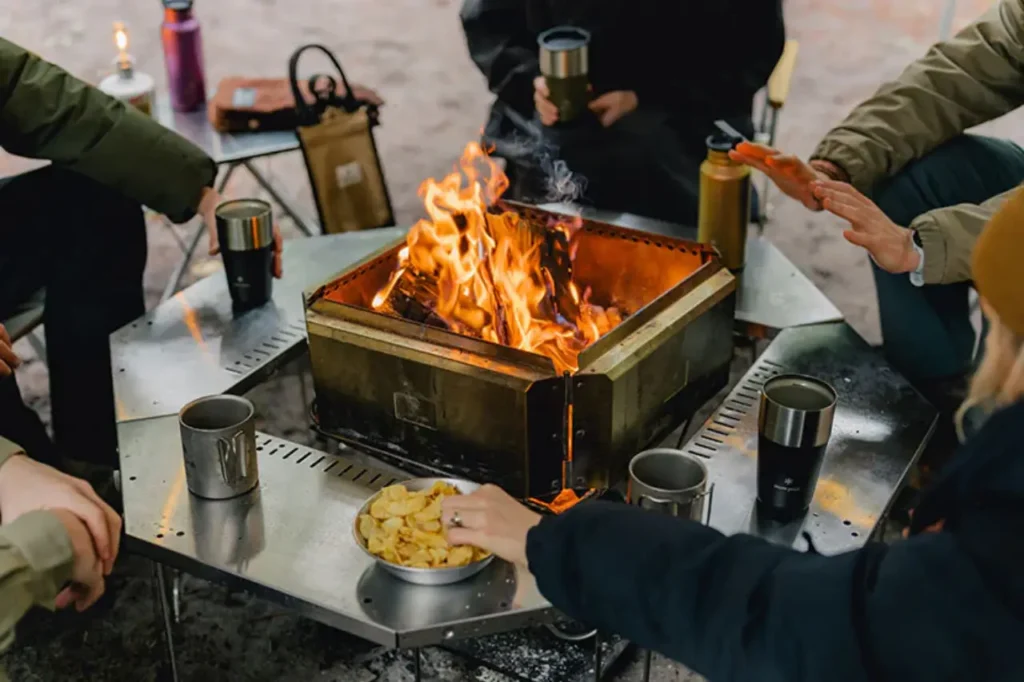
After dinner, the same setup can continue to provide warmth and a quiet place to sit while the sky gets darker. That dual purpose makes it appealing for relaxed car-camping weekends when the evening around the fire is part of the trip. 🌲
The Takibi is also easier to pack than many full-size fire pits because the fireplace folds flat. The stainless-steel construction feels appropriate for long-term use, but the system is still heavier and slower to operate than a propane stove.
Pros
- Functions as both a grill and fire pit
- Stainless-steel construction
- Fold-flat design improves transport
- Modular system with compatible Snow Peak accessories
- Good fit for slower campsite evenings
- Creates a natural gathering place after dinner
Cons
- Slower and messier than propane cooking
- Requires firewood or charcoal
- Open fires may not be permitted during fire restrictions
- Heavier than a compact gas stove
- Needs time to cool before packing
Who Should Buy It?
Choose the Snow Peak Takibi Fire & Grill if campsite evenings around a real fire are an important part of your trips and you want a durable, packable cooking system.
Who Should Skip It?
Skip it if you mainly camp in areas with frequent fire restrictions or need dinner ready quickly after a long day on the road.
Find the Snow Peak Takibi Fire & Grill
Barebones Cowboy Fire Pit Grill
Best For: Open-Fire Cooking at a Comfortable Basecamp
The Barebones Cowboy Fire Pit Grill brings a more traditional open-fire cooking style to car camping. It is not a minimalist grill and it is not intended for fast overnight stops. It works best when the campsite is a place to settle in, prepare a real meal, and spend time around the fire.
The 23-inch version is more manageable than the larger 30-inch model while still offering a controlled cooking setup. It includes a pole and grill grate, allowing the cooking surface to sit at an adjustable distance from the heat. The fire pit can also be used without the grill attachment when the meal is finished.
| Specification | Detail |
|---|---|
| Fuel Type | Wood or charcoal |
| Material | Solid steel |
| Included Components | Fire pit, pole, and grill grate |
| Overall Weight | Approx. 30 lbs. |
| Width | Approx. 25 in. without grate; 35 in. with grate |
| Height | Approx. 14.25 in.; 33 in. with pole |
| Best Use | Basecamps, longer weekends, and open-fire meals |
Why It Works Well at a Campsite
The Cowboy Fire Pit Grill makes the most sense for campers who want to cook more than burgers. The adjustable grate gives you better control over the distance between food and heat, which is useful for vegetables, fish, skewers, cast-iron cookware, and meals that need a slower pace.
The fire pit also has enough presence to become the center of camp. It feels appropriate for evenings when chairs are arranged nearby, dinner takes a little longer, and there is no rush to pack everything away before sunrise. 🏕️
The trade-off is obvious: this is a substantial steel cooking station. It requires more room in the vehicle, more cleanup after use, and careful attention to local fire rules.
Pros
- Works as both a fire pit and open-fire grill
- Adjustable grate improves heat control
- Smaller and more packable than the 30-inch version
- Suitable for cast-iron cooking and slower meals
- Creates a comfortable basecamp focal point
- Durable steel construction
Cons
- Requires more vehicle space than a propane stove
- Needs time to cool before packing
- Produces ash and requires more cleanup
- Not suitable during many fire restrictions
- Less practical for quick overnight stops
Who Should Buy It?
Choose the Barebones Cowboy Fire Pit Grill if cooking around a real fire is part of the reason you enjoy camping and your vehicle has room for a heavier basecamp setup.
Who Should Skip It?
Skip it if you prioritize fast setup, minimal cleanup, or frequent dispersed camping in dry areas with open-fire restrictions.
Find the Barebones Cowboy Fire Pit Grill
How to Choose the Best Camping Grill or Griddle
The right choice depends less on the product category and more on the meals you want to prepare. Before buying anything, picture a typical day at camp.
Will breakfast include eggs and pancakes for a family? Will dinner usually be burgers and vegetables after a hike? Does the setup need to move between campsites every day? Will the grill travel inside a compact crossover or outside a truck on a hitch receiver?
A clear answer to those questions will narrow the list quickly.
Grill vs. Griddle: What Is the Difference?
A grill uses an open grate. Fat can drip away from the food, and the surface creates the familiar sear lines associated with burgers, steaks, chicken, and grilled vegetables.
A griddle uses a flat cooking surface. Eggs, pancakes, bacon, chopped onions, quesadillas, fried rice, and smash burgers are easier to cook because small pieces cannot fall through the grate.
A traditional two-burner camp stove sits between those two options. It is the most flexible choice for pots and pans, and some models add removable grill or griddle accessories.
| Cooking Setup | Best For | Main Limitation |
|---|---|---|
| Traditional Grill | Burgers, steaks, chicken, sausages, and vegetables | Less useful for eggs, pancakes, and pots |
| Flat-Top Griddle | Breakfast, smash burgers, chopped vegetables, and large group meals | Requires cleaning and seasoning |
| Two-Burner Camp Stove | Pots, pans, coffee water, pasta, soups, and flexible meal planning | Smaller cooking surface |
| Open-Fire Grill | Slower meals, fire-pit gatherings, and cast-iron cooking | More cleanup and possible fire restrictions |
| Hitch-Mounted Grill | Vehicle-based travel and overland setups | Requires a hitch receiver |
Match the Cooking Surface to Your Group Size
A small cooking surface can become frustrating when several people are hungry at the same time.
For one or two campers, a compact stove, Weber Q 1200, or Snow Peak Grill Burner may provide enough room. For a family or group, the Blackstone 22-Inch Griddle or HitchFire Forge 15 offers a wider surface that reduces the need to cook in shifts.
For longer basecamp stays, the Barebones Cowboy Fire Pit Grill creates enough space for slower meals without forcing everyone to stand around a tiny grate.
Consider Packed Size Before Buying
The cooking surface is only part of the decision. The product still needs to fit inside or outside the vehicle with coolers, tents, chairs, sleeping gear, and food bins.
A Blackstone griddle can make breakfast much easier, but it takes up more trunk space than a fold-flat stove. A Barebones fire pit creates a beautiful basecamp cooking area, but it is less practical for a small sedan. The HitchFire Forge 15 solves storage differently by carrying the grill outside the cargo area.
Measure the available space before ordering. That simple step can prevent a bulky appliance from becoming the piece of gear that gets left in the garage.
Decide Whether Propane or Fire-Based Cooking Fits Your Trips
Propane is usually the easiest choice for practical campsite meals. It lights quickly, gives you better temperature control, and creates less cleanup.
Wood and charcoal create a different experience. Food can pick up a more traditional fire-cooked flavor, and the grill often becomes a gathering place after dinner. The trade-off is time, ash, smoke, and local restrictions.
The National Park Service recommends checking local regulations and current fire conditions before starting a campfire. Individual parks may limit or prohibit wood fires, charcoal grills, and other equipment that creates ash during dry periods. Pressurized gas stoves are often permitted when wood and charcoal fires are restricted, but rules vary by location. Check current National Park Service campfire guidance before your trip.
Pay Attention to Heat Control, Not Only BTUs
BTUs measure heat output, but the largest number is not automatically the best choice.
High heat is useful for boiling water quickly and searing meat. Lower, controllable heat matters for pancakes, eggs, sauces, rice, and anything that can burn while you are distracted by camp setup.
A good camping stove or grill should make it easy to adjust the flame without constant attention. For family camping, usable control is often more valuable than maximum power.
Plan for Cleanup Before the Trip
Grease management is easy to overlook when comparing products online. It becomes much more important after dinner, when the light is fading and the campsite needs to stay clean.
For flat-top griddles, scrape food and grease toward the collection tray while the surface is still warm. After the surface cools, wipe it down and apply a light coating of oil if the manufacturer recommends it.
For traditional grills, remove residue from the grate and empty grease trays before packing the grill away. Open-fire setups require additional attention because ash and coals must be fully extinguished and cold before disposal.
Leave No Trace guidance emphasizes packing out kitchen waste, including grease and leftovers, rather than burying it or trying to burn it in the fire. Review Leave No Trace guidance for disposing of campsite waste properly.
Which Camping Grill or Griddle Fits Your Camping Style?
| Camping Style | Best Match | Why It Fits |
|---|---|---|
| Beginner car camping | Coleman Cascade 3-in-1 | One practical system handles pots, grilling, and breakfast foods |
| Family camping weekends | Blackstone Adventure Ready 22-Inch Griddle | Large cooking surface helps feed several people without long waits |
| Overlanding and vehicle-based travel | HitchFire Forge 15 | Hitch-mounted design saves cargo space and speeds up setup |
| RV camping and easy grilled dinners | Weber Q 1200 | Familiar grill layout and straightforward cooking |
| Compact premium camp kitchen | Snow Peak Grill Burner | Smaller griddle fits organized modular setups |
| Slow evenings around the fire | Snow Peak Takibi Fire & Grill | Combines cooking surface and fire-pit atmosphere |
| Comfortable long-weekend basecamp | Barebones Cowboy Fire Pit Grill | Adjustable open-fire cooking setup creates a campsite centerpiece |
Final Verdict
The best camping grill or griddle is the one that makes your actual campsite meals easier.
For most campers, the Coleman Cascade 3-in-1 Camping Stove offers the strongest balance of versatility, packability, and everyday usefulness. It can boil water, cook in pots and pans, grill burgers, and handle a pancake breakfast without requiring several separate appliances.
For families and larger groups, the Blackstone Adventure Ready 22-Inch Griddle Bundle is the better choice when breakfast and flat-top meals are a major part of the trip. The larger surface can make a relaxed campsite morning feel much easier.
For overland routes and vehicle-based camping, the HitchFire Forge 15 Grill stands out because it solves the storage problem differently. It keeps a capable grill outside the cargo area and ready to use when the vehicle reaches camp.
And for campers who value the atmosphere of a real fire, the Snow Peak Takibi Fire & Grill and Barebones Cowboy Fire Pit Grill offer something propane cannot fully replace: a place to cook dinner, pull up a chair, and stay outside a little longer. 🔥
Frequently Asked Questions
Is a grill or griddle better for camping?
A grill is better for burgers, steaks, chicken, sausages, and vegetables when you want a more traditional barbecue-style meal. A griddle is better for eggs, pancakes, bacon, chopped vegetables, quesadillas, fried rice, and smash burgers.
For many car campers, a stove with removable grill and griddle accessories offers the best balance. It gives you more meal options without requiring several large appliances.
What size camping griddle is best for a family?
A 22-inch tabletop griddle is a practical size for most families. It provides enough room to prepare several servings of breakfast food at the same time while remaining manageable for car camping.
A smaller griddle may be easier to pack, but it can force you to cook in multiple batches. A larger griddle offers more surface area but may take up too much trunk space unless you have a truck, RV, or large SUV.
How many BTUs do you need for a camping grill?
A portable grill with roughly 8,000 to 15,000 BTUs can work well for everyday campsite grilling. A two-burner camp stove with around 10,000 to 12,000 BTUs per burner is usually practical for most car-camping meals.
BTUs are only part of the story. Flame control, wind protection, cooking-surface size, and heat distribution also affect how pleasant the stove or grill feels in real use.
Can you use a Blackstone griddle while camping?
Yes. A tabletop Blackstone griddle can work very well for car camping, RV trips, and longer basecamp stays. Place it on a stable, heat-resistant table or compatible stand and follow the manufacturer’s setup instructions.
The main considerations are packed size, weight, grease management, and access to propane. It is a better fit for vehicle-based camping than for any trip where gear needs to be carried far from the parking area.
Can you cook breakfast on a regular camping grill?
Some breakfast foods work well on a grill, but eggs, pancakes, and chopped ingredients are much easier to cook on a flat griddle surface. A cast-iron griddle plate can be placed over a compatible stove or grill if the manufacturer allows it.
A stove such as the Coleman Cascade 3-in-1 includes a dedicated griddle plate, making it easier to prepare breakfast without packing a separate appliance.
Are wood-burning grills allowed at every campsite?
No. Rules vary by campground, park, season, and current fire conditions. Wood and charcoal fires may be restricted or prohibited during dry periods, even in locations where propane stoves remain permitted.
Check the rules for the specific campground shortly before departure. Never assume that a fire pit, charcoal grill, or open-fire cooking setup will be allowed.
How do you clean a camping griddle without a sink?
Scrape food residue and grease toward the collection tray while the surface is still warm. Wipe the surface carefully with paper towels or a reusable cleaning cloth. A small amount of water can help loosen residue on some griddles, but always follow the manufacturer’s instructions.
Pack grease, food scraps, and dirty paper towels out with the rest of the trash. Do not dump grease onto the ground or burn leftovers in the campfire.
Is a hitch-mounted grill worth it?
A hitch-mounted grill can be worthwhile for overlanding, road trips, tailgating, and campervan travel. It saves interior cargo space and reduces the need to unload a heavy grill whenever you reach a campsite.
It is less useful for campers without a hitch receiver or for occasional trips where a simple tabletop stove is easier and more affordable.
Can you use a camping grill during a fire ban?
The answer depends on the specific restriction. Some fire bans prohibit wood and charcoal cooking but still allow gas or propane appliances with a shutoff valve. Other rules may be stricter.
Always verify the current regulations for the campground, park, or public land area before using any grill, stove, or open flame.
Affiliate Disclosure: GearForTheOutdoors.com participates in affiliate programs, including REI, Amazon, REI Outlet, Garage Grown Gear, evo, and other trusted partners. When a purchase is made through certain links on this page, the site may earn a small commission at no extra cost to the reader. That support helps keep the content useful, practical, and free.
Disclaimer: This post is for informational purposes only. Always verify current product details, fit, availability, safety information, and manufacturer warranties before purchase or use. Outdoor conditions and gear performance can vary depending on setup, weather, terrain, and experience level.