
Camp meals do not need to be elaborate to feel satisfying. A warm bowl of chili after a cold hike, pancakes on a quiet campground morning, or a simple sandwich beside the trail can be one of the best parts of the day.
The experience becomes considerably less enjoyable when a spoon cannot reach the bottom of a meal pouch, a plastic fork bends under a piece of meat, or the only available knife is a dirty pocketknife buried somewhere in the car.
The best camp utensils solve these small but persistent problems without taking over your kitchen box. They are comfortable to use, easy to clean, durable enough for repeated trips, and appropriately sized for the way you camp.
Backpackers may need only one long-handled spoon. Car campers preparing fresh meals will benefit from a proper knife, spatula, serving spoon, and cutting board. Families and groups may prefer a complete kitchen kit that keeps everything organized between trips. 🍳
This guide covers six practical options for backpacking, car camping, road trips, group meals, and camp food preparation. Each recommendation fills a different role, so you can choose the tools that match the meals you actually cook rather than packing equipment that never leaves the camp box.
Our Top Camp Utensil & Kitchen Tool Picks
| Product | Best For | Key Feature | Price |
|---|---|---|---|
| humangear GoBites Bio Trio | Best Overall Utensil Set | Full-size fork, spoon, and knife | $$ |
| Gerber ComplEAT Utensil Set | Best Cooking Multi-Tool | Converts into functional camp tongs | $$$ |
| Sea to Summit Frontier Long Spoon | Best for Backpacking Meals | Ultralight handle reaches deep pouches | $ |
| GSI Outdoors Destination Kitchen Set 24 | Best for Car Camping and Groups | Complete, organized camp kitchen kit | $$$$ |
| UCO ECO Utility Spork | Best Budget Pick | Simple, durable 3-in-1 design | $ |
| GSI Outdoors Santoku Knife Set | Best Camp Kitchen Knife Set | Three useful knives in a protective case | $$$$ |
Quick Verdict
The humangear GoBites Bio Trio is the most practical choice for campers who want the comfort of separate utensils without carrying household silverware. It works well for campground meals, road trips, lunches, and casual backpacking.
Campers who cook directly over a stove should consider the Gerber ComplEAT Utensil Set. Its spoon, fork, spatula, and compact multi-tool nest together, while the utensils can be connected to create tongs.
For backpackers eating from freeze-dried meal pouches, the Sea to Summit Frontier Long Spoon is the simplest and lightest option here. Its eight-inch handle helps keep food off your hands while reaching the bottom corners of deep packages.
The GSI Outdoors Destination Kitchen Set 24 makes the most sense for families and groups that regularly prepare full campsite meals. The UCO ECO Utility Spork is the inexpensive choice for basic eating, while the GSI Outdoors Santoku Knife Set is for car campers who want proper food-prep knives rather than a minimal camping blade.
How to Choose the Best Camp Utensils for Your Needs
The right utensils depend less on how impressive the product looks and more on where it will be used.
A thru-hiker carrying food for several days has little reason to pack a cutting board, serving spoon, and whisk. A family cooking burgers, vegetables, and breakfast for four will quickly become frustrated with one ultralight spork.
Start with the meals you normally prepare, then choose the smallest set of tools that handles those meals comfortably.
Material Matters: Titanium vs. Steel vs. Plastic
Material affects weight, durability, cooking compatibility, and how comfortable a utensil feels in your hand.
- Titanium: Extremely light, strong, corrosion-resistant, and well suited to backpacking. Titanium utensils tend to cost more and can feel thin compared with household cutlery.
- Hard-anodized aluminum: Almost as weight-conscious as titanium and generally more affordable. It is a strong choice for spoons, sporks, and compact cooking tools, but anodized aluminum should usually be washed by hand.
- Stainless steel: Durable, easy to clean, and familiar to use. The added weight is rarely an issue for car camping but may be unnecessary for backpacking.
- Glass-reinforced nylon or polypropylene: Lightweight, inexpensive, and safe for nonstick cookware. Quality versions can be surprisingly strong, although they should not be left resting against a hot pan.
- Wood or bamboo: Comfortable against cookware and useful for serving or stirring. These materials need to dry completely before storage to prevent odors, staining, or warping.
Plastic is not automatically the cheapest or weakest option. Well-designed nylon utensils can be more comfortable than thin metal tools and will not scratch nonstick camp cookware.
Metal remains the better choice around higher heat, especially when stirring food in stainless steel or cast-iron cookware. 🔥
Your Camping Style: Backpacking vs. Car Camping
For backpackers and thru-hikers:
- Prioritize low weight and a simple shape.
- Choose a long handle when eating from freeze-dried meal pouches.
- Avoid tools with hinges, loose parts, or functions you will not use.
- Confirm that the utensil fits inside your cook pot or food bag.
- Carry a separate knife only when your food plan requires one.
A long-handled spoon is often more useful than a complicated spork. It handles oatmeal, soup, rice, pasta, and pouch meals without the shallow bowl or uncomfortable fork tines found on some combination utensils.
For car campers, van travelers, and overlanders:
- Prioritize comfortable handles and full-size tools.
- Add a dedicated food-prep knife with a protective sheath.
- Choose utensils that work with your cookware.
- Keep everything in a case, roll, or dedicated kitchen bin.
- Consider serving tools when cooking for more than two people.
Weight matters far less when gear travels in a vehicle. A sturdy spatula that can flip a burger cleanly is more useful than saving two ounces and struggling through dinner.
All-in-One Tool or Dedicated Set?
An all-in-one utensil saves space, but every combined tool involves some compromise.
A spork may have a shallow spoon bowl and short fork tines. A serrated edge molded into a fork may cut a pancake but struggle with meat. Double-ended designs also leave one eating surface exposed while the other is in use.
Dedicated utensils provide a more natural eating experience. A separate spoon, fork, and knife are easier to hold, easier to pass around, and better suited to varied meals.
Choose an all-in-one tool when weight and packed size are the main concerns. Choose separate utensils when comfort and function matter more.
Personal Utensils vs. Cooking Tools
Eating utensils and cooking tools solve different problems.
A personal set usually includes a spoon, fork, and small knife. A cooking kit may include a spatula, serving spoon, tongs, cutting board, food-prep knife, can opener, and condiment containers.
Before buying a large kit, check which tools are already included in your cookware set. There is little value in carrying three serving spoons while forgetting the can opener.
The Best Camp Utensils & Tools in Detail
humangear GoBites Bio Trio: Best Overall Utensil Set
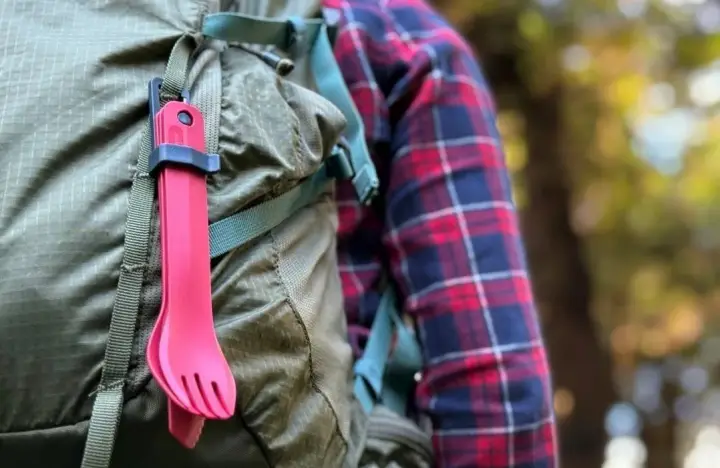
The humangear GoBites Bio Trio provides a separate fork, spoon, and serrated knife in a compact personal set. Unlike miniature travel utensils, each piece is long enough to feel comfortable during a full meal.
The utensils clip together for storage, which helps keep the set organized inside a daypack, camp kitchen bin, or lunch bag. The nylon-based construction also works well with nonstick bowls and cookware because it will not scrape the coating.
This is the most versatile option for campers who eat a mix of meals. The spoon works for cereal and soup, the fork handles pasta and vegetables, and the knife is useful for softer foods such as pancakes, cheese, and cooked meat.
It is also a sensible choice for road trips, work lunches, picnics, and travel. That broader usefulness makes the set easier to justify than highly specialized camp utensils that spend most of the year in storage. 🥣
- Best For: Car camping, road trips, day hikes, travel, and everyday lunches
- Material: Durable, food-safe nylon-based material
- Why It Works: Separate utensils provide a more natural eating experience than a traditional spork
- Things to Consider: Keep the utensils away from direct flames and avoid leaving them in a hot pan
The current GoBites Bio Trio sold through REI includes a fork, spoon, and knife designed to stay together with an included clip.
Who should buy it: Campers who want one compact personal set that still feels close to regular cutlery.
Who should skip it: Backpackers who need only a single ultralight spoon or cooks who need spatulas and serving tools.
Gerber ComplEAT Utensil Set: Best Cooking Multi-Tool
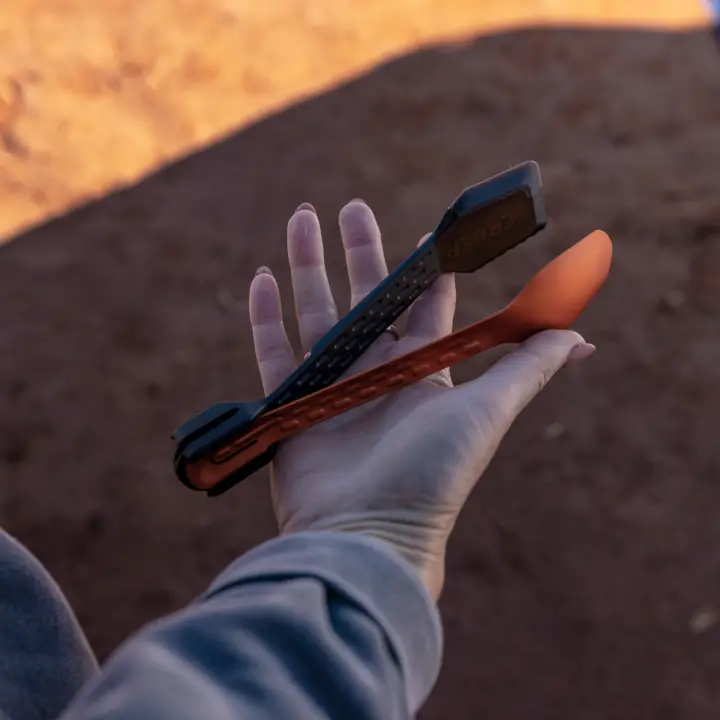
The Gerber ComplEAT is designed for campers who prepare actual meals but do not want several loose cooking tools bouncing around inside a kitchen bin.
The set includes a fork, deep spoon, dual-sided spatula, and compact multi-tool. The multi-tool incorporates a can opener, bottle opener, vegetable peeler, and package opener.
Its most useful feature appears when the fork or spoon is attached to the spatula. The two pieces become a functional pair of tongs for turning sausages, serving pasta, lifting vegetables, or moving food around a pan.
The spatula also has two different edges. One side provides more structure for turning food, while the softer scraping edge helps remove food from a pan before cleanup.
Everything nests into a narrow package, making the ComplEAT particularly useful in smaller camp kitchens where tools need to serve more than one purpose.
- Best For: Solo campers, couples, van kitchens, and compact car-camping setups
- Material: Anodized aluminum and heat-resistant nylon
- Weight: Approximately 2.3 oz.
- Why It Works: Combines eating, cooking, serving, and basic food-prep functions
- Things to Consider: It is not dishwasher-safe, and the multi-piece design requires slightly more cleaning than a single utensil
Gerber currently lists the ComplEAT with a fork, spoon, dual-sided spatula, four-function multi-tool, and tong configuration.
Who should buy it: Campers who cook one-pot meals, grilled food, pasta, eggs, or vegetables and need more than a basic eating utensil.
Who should skip it: Anyone who prefers simple, dedicated tools or rarely cooks beyond boiling water.
Sea to Summit Frontier Long Spoon: Best for Backpacking Meals
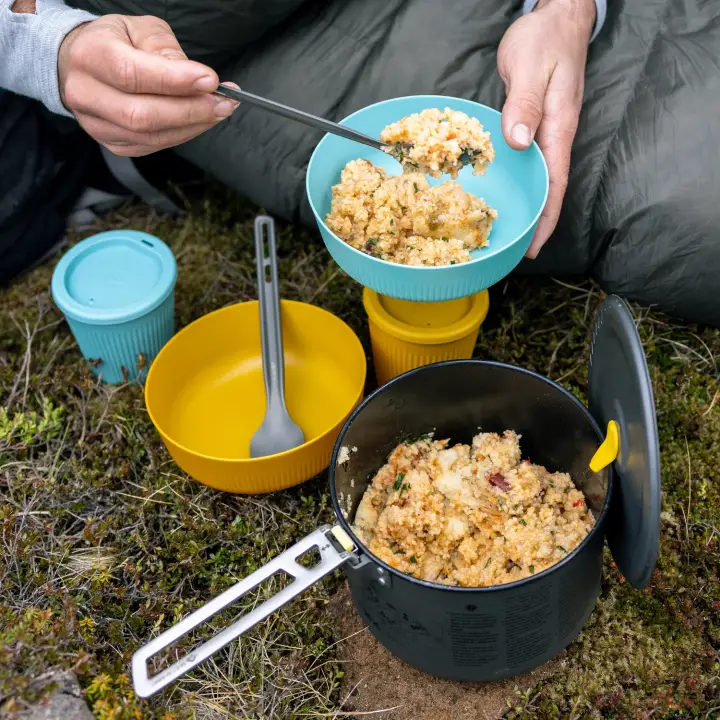
The Sea to Summit Frontier Long Spoon has one straightforward job: helping backpackers eat comfortably from deep pots and meal pouches.
A standard spoon forces your fingers and knuckles into the opening of a freeze-dried food bag. By the time the meal is nearly finished, sauce is often smeared along the handle and onto your hand.
The Frontier’s eight-inch handle reaches the bottom of most meal pouches while keeping your hand above the opening. It is also long enough to stir food in compact backpacking pots without placing your fingers directly over the heat.
Its hard-anodized aluminum construction keeps the weight to approximately 0.4 oz., so the added handle length comes with almost no meaningful weight penalty. The food-contact surface is semi-polished for a smoother feel than rough, unfinished aluminum. 🥾
- Best For: Backpacking, thru-hiking, bikepacking, and freeze-dried meals
- Material: Hard-anodized aircraft-grade aluminum
- Weight: Approximately 0.4 oz.
- Length: Approximately 8 in.
- Why It Works: Reaches into deep meal bags while remaining extremely light
- Things to Consider: It is a dedicated spoon rather than a full cutlery set, and it should be washed by hand
Sea to Summit currently lists the Frontier Long Spoon as an in-stock, hard-anodized aluminum utensil weighing about 0.4 oz.
Who should buy it: Backpackers whose meals consist mainly of oatmeal, rice, soup, pasta, or dehydrated food.
Who should skip it: Car campers who want a regular fork and knife or campers who frequently prepare food requiring cutting.
GSI Outdoors Destination Kitchen Set 24: Best for Car Camping & Groups
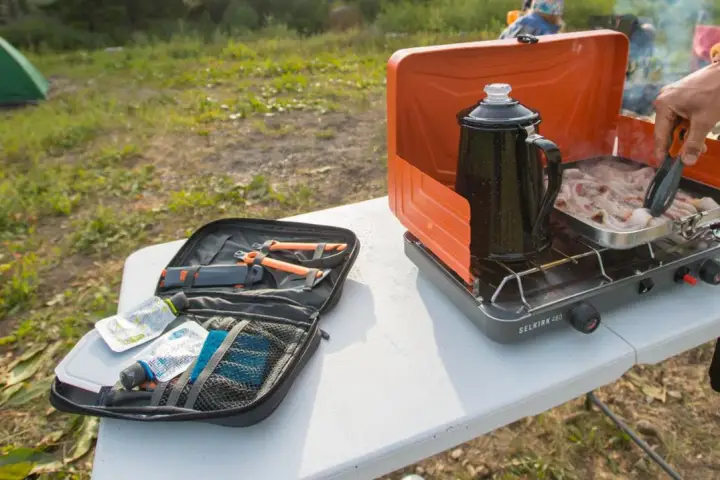
The GSI Outdoors Destination Kitchen Set 24 is closer to a portable kitchen drawer than a personal utensil set.
It includes four cutlery sets, a folding spatula, folding serving spoon, whisk, utility knife, cutting board, spice containers, condiment bottles, scrubber, and camp towel. The pieces fit inside a zippered case with designated storage areas.
That organization is the main reason to choose it. Instead of rebuilding a camp kitchen before every trip, the case can remain stocked inside a larger kitchen bin. At the campground, everything opens in one place rather than disappearing beneath cookware and food bags.
The kit is especially useful for families because it combines eating utensils and shared cooking tools. It also reduces the chance of arriving at camp with three forks but no spatula or cutting board.
At approximately 1 lb. 12 oz., this is firmly a vehicle-supported option. It is far too heavy and elaborate for backpacking, but the weight is reasonable for a group kitchen kit transported in a car, trailer, or RV.
- Best For: Families, groups, basecamps, overlanding, RV travel, and frequent car camping
- Material: Mixed synthetic materials and stainless steel
- Weight: Approximately 1 lb. 12.2 oz.
- Why It Works: Keeps most essential cooking and eating tools together in one organized case
- Things to Consider: Some campers will already own several of the included tools, and the set may be excessive for simple meals
The current Destination Kitchen Set 24 includes four cutlery sets, folding tools, a cutting board, utility knife, spice storage, and other kitchen accessories.
Who should buy it: Car campers who regularly cook for several people and want one ready-to-pack kitchen system.
Who should skip it: Solo campers, backpackers, and anyone whose camp cooking is limited to heating water.
UCO ECO Utility Spork: Best Budget Pick
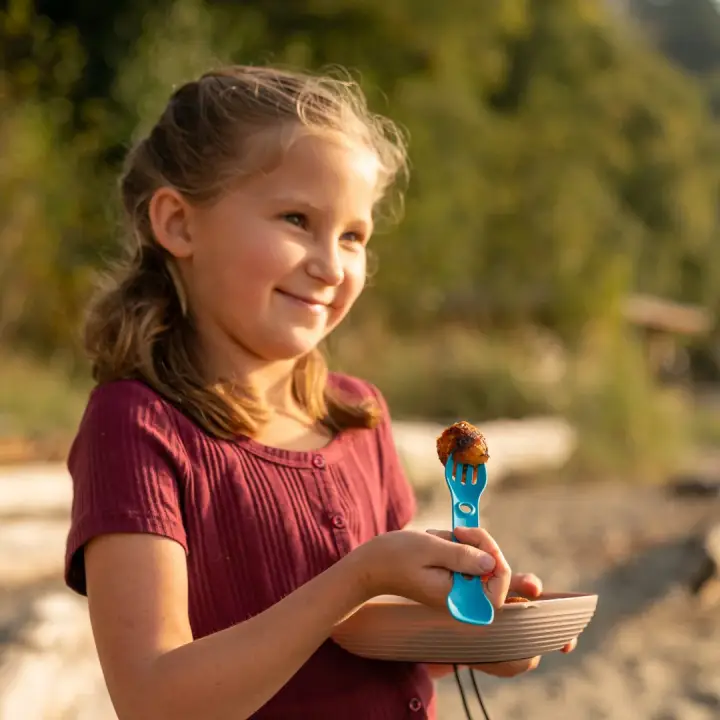
The UCO ECO Utility Spork is an inexpensive option for campers who need one durable utensil and do not require a full cutlery set.
A spoon sits at one end, while the opposite end provides a fork with a serrated cutting edge. Keeping the spoon and fork at opposite ends gives each side a more usable shape than many compact sporks, although it also means one end remains exposed while the other is being used.
The recycled polypropylene construction is lightweight, food-safe, and dishwasher-safe. It is also safe to use with coated camp bowls and nonstick cookware.
At roughly half an ounce, the UCO adds little weight to a daypack or camp box. It also makes a useful backup utensil for a vehicle emergency kit, office drawer, picnic basket, or children’s camp setup.
- Best For: Budget camping kits, kids, backups, lunches, and casual outings
- Material: Recycled polypropylene
- Weight: Approximately 0.5 oz.
- Why It Works: Delivers a functional fork, spoon, and cutting edge at a very low cost
- Things to Consider: The double-ended format can be messy, and the serrated edge is suitable only for softer foods
UCO and REI currently list individual ECO Utility Sporks, while some older two-pack versions have moved into clearance or been discontinued. Choosing the single current model is safer than relying on limited outlet inventory.
Who should buy it: Campers who want an affordable, lightweight utensil that can live permanently in a pack or camp bin.
Who should skip it: Anyone who dislikes double-ended utensils or wants the comfort of separate full-size cutlery.
GSI Outdoors Santoku Knife Set: Best Camp Kitchen Knife Set
Cutting tomatoes with a pocketknife sounds workable until the blade folds toward your knuckles, the handle becomes coated in onion juice, or the knife carries residue from previous non-food tasks.
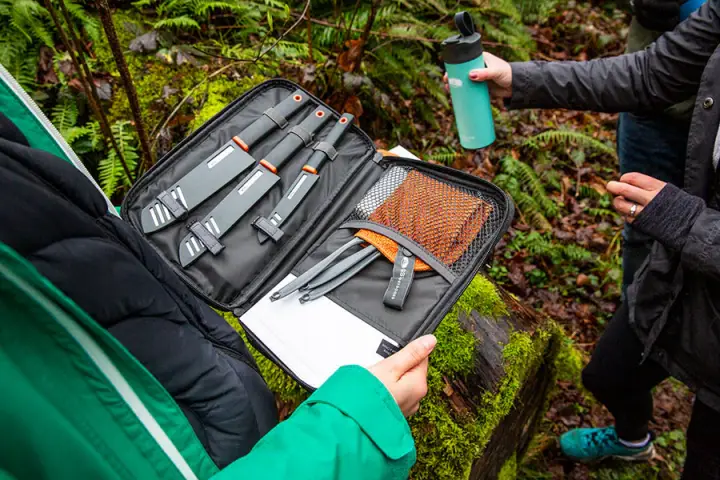
The GSI Outdoors Santoku Knife Set gives car campers three dedicated kitchen knives: a four-inch paring knife, a six-inch Santoku chef’s knife, and a six-inch serrated knife. The set also includes a cutting board, cleaning cloth, and zippered storage case.
The paring knife handles small vegetables, fruit, cheese, and detail work. The larger Santoku knife is better for chopping onions, slicing meat, and preparing larger ingredients. The serrated knife handles bread, rolls, and foods with firmer exteriors and softer centers.
A complete knife set is not necessary for every campsite. It becomes worthwhile when meals involve fresh produce, sandwiches, steaks, tacos, stir-fries, or other food that must be chopped and assembled at camp. 🥕
- Best For: Car campers who prepare fresh ingredients and multi-part meals
- Material: Stainless steel blades with a bamboo cutting board and protective case
- Why It Works: Provides the right blade for several common camp-prep tasks
- Things to Consider: It is heavier and more expensive than a single sheathed knife
GSI currently lists the Santoku Knife Set as a complete camp-prep kit, and REI continues to include it within its GSI camp kitchen selection.
Who should buy it: Camp cooks who prepare meals from fresh ingredients and want safer, more efficient knives.
Who should skip it: Campers who mainly heat packaged food or need only a small knife for cheese and fruit.
Care, Cleaning, and Organization Tips
A utensil that is easy to clean at home can become frustrating when water is limited and food has dried onto every hinge and groove.
Simple tools are generally easiest to maintain. Multi-tools and folding utensils may save space, but each joint or connection point creates another place for oil and food residue to collect.
Cleaning in the Field
Scrape food residue into your trash before washing. This keeps food particles out of the wash water and makes cleanup faster.
Use hot water and only the amount of soap needed. Biodegradable soap is still soap and should not be used directly in a lake, river, stream, or spring.
Follow local regulations and Leave No Trace guidance when disposing of wastewater. In many backcountry environments, washing and wastewater disposal should take place at least 200 feet from natural water sources.
Strain food particles from dirty water when necessary, pack the particles out with your trash, and disperse the remaining water broadly where permitted.
Dry Everything Before Storage
Moisture trapped inside a closed utensil case can create odors and mildew.
Allow utensils, cloths, cutting boards, and storage cases to dry completely before closing the kit. Mesh pouches are useful for personal utensils because they allow airflow while keeping the pieces together.
Bamboo and wooden components need particular attention. Wipe them clean, let them dry fully, and avoid sealing them inside a damp case.
Match Utensils to Your Cookware
Metal tools can scratch some nonstick coatings. Use nylon, silicone, polypropylene, bamboo, or another manufacturer-approved material with coated cookware.
Avoid leaving nylon tools resting against the side of a hot pan. Heat-resistant does not mean fireproof, and direct contact with a burner or flame can damage the utensil.
Hard-anodized aluminum utensils should generally be hand-washed because strong dishwasher detergents can damage the anodized finish.
Build a Grab-and-Go Kitchen Kit
Keeping camp utensils separate from household kitchen tools makes packing easier.
A small personal kit may contain:
- Fork, spoon, and knife
- Mug
- Bowl or plate
- Small cleaning cloth
- Mesh storage pouch
A car-camping cooking kit may contain:
- Spatula
- Serving spoon
- Tongs
- Food-prep knife
- Cutting board
- Can and bottle opener
- Whisk
- Measuring spoon
- Scrubber and camp towel
Store the kit inside a clearly labeled camp kitchen bin. After each trip, replace consumable items, wash the tools, and return everything to the same container. The next campground departure becomes much simpler. 🏕️
Final Verdict
The best camp utensils are not necessarily the lightest, most complicated, or most expensive. They are the tools that suit the food you prepare and make mealtime easier without creating unnecessary packing or cleanup.
For most campers, the humangear GoBites Bio Trio provides the strongest combination of comfort, portability, and everyday usefulness. Its separate fork, spoon, and knife work better across varied meals than a typical spork.
The Gerber ComplEAT Utensil Set is the better choice for solo campers and couples who cook at camp. Its ability to function as eating utensils, a spatula, basic prep tool, and tongs makes it unusually capable for its size.
Backpackers can keep things simple with the Sea to Summit Frontier Long Spoon, while families and groups will get more value from the organized GSI Outdoors Destination Kitchen Set 24.
The UCO ECO Utility Spork remains the practical budget choice, and the GSI Outdoors Santoku Knife Set is the worthwhile upgrade for campers who regularly chop and prepare fresh ingredients.
Choose based on the meals that appear on your real camping menu. A well-matched utensil setup means less time searching through bins, less frustration beside the stove, and more time enjoying dinner while the air cools and the campground settles into the evening. 🌲
Frequently Asked Questions
What are the best camp utensils for most people?
A separate fork, spoon, and knife usually provide the best overall eating experience. The humangear GoBites Bio Trio is a practical example because the pieces remain compact without forcing every meal through a single spork.
Is titanium better than stainless steel for camping utensils?
Titanium is better when low weight is the priority. It is strong, corrosion-resistant, and particularly useful for backpacking.
Stainless steel is usually more affordable and feels more like household cutlery, but it is heavier. That weight difference matters much less during car camping.
Are aluminum camp utensils safe?
Food-grade hard-anodized aluminum utensils are widely used for camping. The anodized surface increases durability and creates a smoother food-contact finish.
Follow the manufacturer’s care instructions. Many anodized utensils should not be cleaned in a dishwasher because harsh detergents can damage the finish.
Are nylon camp utensils safe for hot food?
Quality camping utensils made from heat-resistant nylon can be used for eating hot food and stirring within their stated temperature limits.
Do not leave a nylon utensil resting inside a hot pan or expose it directly to a flame. Use silicone, nylon, or another manufacturer-approved material when protecting a nonstick coating is important.
Are sporks actually useful?
Sporks are useful when packed size and low weight matter more than having ideal utensils for every food.
They work well for rice, pasta, oatmeal, and many backpacking meals. A separate spoon and fork will still feel more comfortable when weight is not a concern.
Why are long-handled spoons popular for backpacking?
The extra length helps reach the bottom of deep freeze-dried food pouches without pushing your hand into the opening. A long handle is also useful for stirring food in narrow backpacking pots.
Do you need a dedicated camp kitchen knife?
A dedicated knife is worthwhile when preparing vegetables, meat, cheese, bread, or fruit at camp.
A food-prep knife with a sheath or protective case is safer and easier to keep clean than a pocketknife used for rope, packaging, repairs, and other campsite tasks.
What camp utensils are safe for nonstick cookware?
Nylon, silicone, polypropylene, wood, and bamboo tools are generally safer for nonstick surfaces than bare metal utensils.
Always follow the cookware manufacturer’s recommendations because coatings and care requirements vary.
How should camp utensils be stored?
Clean and dry every piece before storage. Personal utensils can be kept in a mesh pouch or ventilated case. Cooking tools can remain in a dedicated camp kitchen bin or organized zippered kit.
Never seal damp utensils, cloths, or wooden cutting boards inside a case for long-term storage.
How many utensil sets does a family need?
Pack one eating set for each person, plus at least one spare utensil. Shared cooking tools should include a spatula, serving spoon, tongs, food-prep knife, and cutting board when the planned meals require them.
Affiliate Disclosure: GearForTheOutdoors.com participates in affiliate programs, including REI, Amazon, REI Outlet, Garage Grown Gear, evo, and other trusted partners. When you purchase through our links, we may earn a small commission at no extra cost to you. That helps support our content and keeps our recommendations useful, practical, and free.
Disclaimer: This post is for informational purposes only. Always verify current product details, fit, availability, safety information, and manufacturer warranties before purchase or use. Outdoor conditions and gear performance can vary depending on setup, weather, terrain, and experience level.