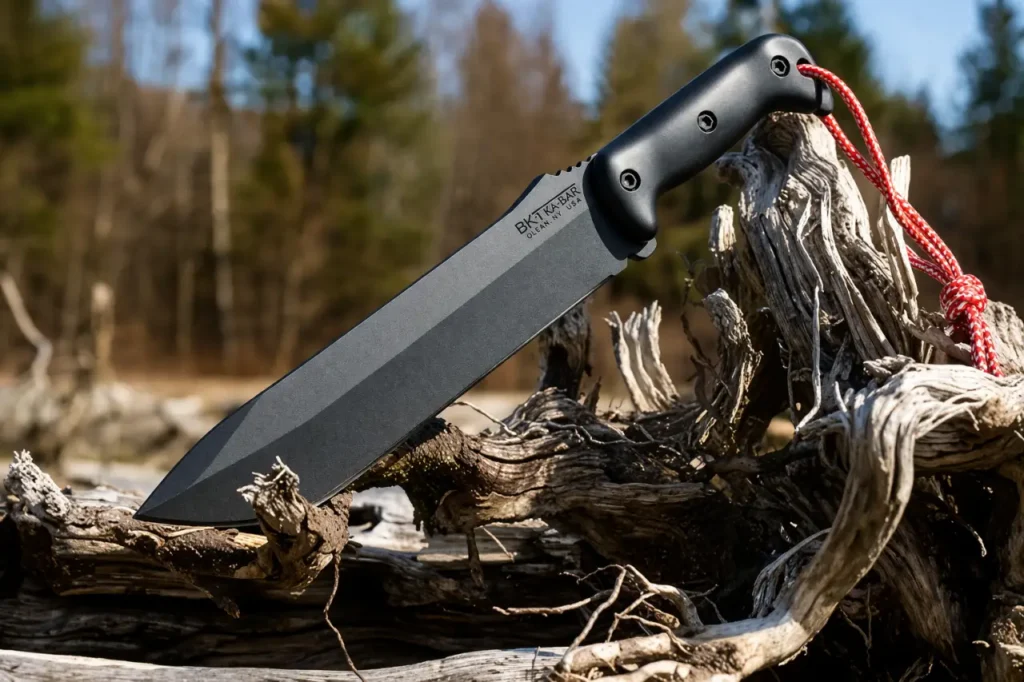
There’s always a familiar gear debate around camp: is it better to carry a hatchet, a folding saw, or one large fixed blade that can handle the bulk of the dirty work? For campers, bushcrafters, and anyone who likes sturdy tools with real presence, that question often leads straight to the KA-BAR Becker BK9.
This is not a subtle knife. The BK9 is long, heavy, and purpose-built for camp chores that can overwhelm smaller blades. It’s the kind of tool people reach for when there’s wood to split, branches to clear, stakes to shape, and a campsite to manage without babying the gear in hand. 😊
Designed by Ethan Becker and made by KA-BAR, the BK9 Combat Bowie has built a strong reputation for doing exactly what a big outdoor knife should do: hit hard, stay tough, and feel dependable when the work gets messy.
But a knife like this also raises an obvious question. Is the BK9 a genuinely practical tool for real outdoor use, or is it more knife than most people actually need?
This in-depth KA-BAR Becker BK9 review breaks down where it shines, where it asks for compromise, and who will get the most value from carrying a blade this large into camp.
Quick Verdict: A Big Camp Knife That Earns Its Reputation
The KA-BAR Becker BK9 Combat Bowie is one of the strongest big-knife options for campers, bushcrafters, and vehicle-based adventurers who want serious chopping power without stepping all the way into hatchet-only territory.
Its 9-inch 1095 Cro-Van blade delivers real authority on wood processing, the handle remains one of the most comfortable in this category, and the overall design feels built for hard outdoor use rather than shelf appeal. For car camping, basecamp chores, shelter work, and fire prep, the BK9 still makes a compelling case. 🔥
The tradeoff is simple: this is not a lightweight trail knife. It’s bulky, it carries real weight, and the carbon steel needs basic care. But for the right user, those are reasonable compromises for the kind of toughness and performance the BK9 brings to camp.
If the goal is a large, dependable camp knife that can chop, baton, and handle real outdoor abuse, the BK9 remains one of the better values in the category.
KA-BAR Becker BK9: Key Specifications
Before getting into trail use and camp performance, the spec sheet tells an important part of the story. Everything about the BK9 points toward one thing: strength-first utility.
| Specification | Detail | Why It Matters |
|---|---|---|
| Blade Length | 9 inches | Provides the reach and momentum needed for effective chopping and batoning. |
| Overall Length | 14.75 inches | A substantial tool that offers a two-handed grip option for extra power. |
| Steel Type | 1095 Cro-Van Carbon Steel | Extremely tough, holds a good edge, and is easy to sharpen in the field. |
| Blade Thickness | 0.188 inches (3/16″) | Thick enough for extreme durability and prying tasks without being overly heavy. |
| Weight | 1.05 lbs (16.8 oz) | This heft is the secret to its chopping power, but a major factor for carry. |
| Handle Material | Ultramid® (Glass-filled nylon) | Durable, weather-resistant, and ergonomically shaped for a comfortable, secure grip. |
| Grind | Full Flat Grind | Offers a good balance between strength and slicing ability for a thick blade. |
| Sheath | Heavy-duty Polyester, MOLLE compatible | Functional and versatile, with a pocket for carrying a fire starter or sharpener. |
| Country of Origin | Made in the USA | A mark of quality and craftsmanship from KA-BAR’s Olean, NY factory. |
On paper, those numbers make one thing clear: the BK9 is not trying to be minimalist, ultralight, or overly refined. It’s built to be a practical field tool for users who care more about capability than compact carry.
Deep Dive: A Closer Look at the BK9’s Features
Specs help, but they don’t fully explain why the BK9 has stayed relevant for so long. The bigger reason is how those features come together in real camp use. This knife feels purpose-built in a way that many oversized fixed blades do not.
The Blade: Big, Tough, and Ready for Dirty Work
The defining feature of the BK9 is its 9-inch Bowie-style blade. That length gives it real chopping reach, while the profile keeps it useful for more than just brute force swings. It feels like a knife designed for camp tasks first, with enough shape and control to stay versatile around wood and general outdoor chores. 😊
The steel is 1095 Cro-Van, which remains a favorite in hard-use outdoor knives for good reason. It’s tough, dependable, and relatively easy to touch up when the edge starts to lose bite. That matters for a knife designed to hit knots, split wood, and deal with rougher materials than a smaller camp blade usually sees.
Because it’s a high-carbon steel rather than stainless, the BK9 asks for basic maintenance. It needs to be dried after wet use and lightly oiled once the coating wears at the edge or along high-contact points. For many campers and bushcrafters, that’s a fair trade for the toughness and ease of sharpening this steel offers.
The full flat grind helps the BK9 feel more useful than a thick, brute-only chopper. It still has the spine thickness and mass needed for batoning and hard camp use, but it slices better than some oversized survival knives that feel clumsy once the chopping stops. That difference shows up when making feather sticks, trimming branches, or handling general cutting chores around camp.
The black blade coating is practical, not decorative. It adds some protection against corrosion and keeps the knife looking appropriately low-key, though scratches and wear will show up with real use. On a knife like this, that worn-in look usually feels earned rather than annoying.
The Handle: One of the BK9’s Biggest Strengths
Big knives can become uncomfortable fast if the handle design misses the mark. That’s one reason the BK9 stands out. The Becker handle shape has a long-standing reputation for comfort, and this knife makes that reputation easy to understand. 👍
The Ultramid handle scales feel sturdy, weather-resistant, and ready for years of hard use. More importantly, the shape fills the hand well without feeling blocky. The palm swell, contouring, and rear flare do a lot to keep the knife planted during chopping strokes, even when hands are damp, cold, or gloved.
This matters more than it may seem on paper. A big knife that shifts around under load becomes tiring, awkward, and less safe. The BK9’s handle helps reduce that problem. It offers a secure grip without forcing the user into an overly aggressive or uncomfortable position, which helps during repetitive work like splitting kindling or clearing branches. 🌲
The exposed pommel is another practical touch. It gives the knife a solid, durable end for light impact tasks like tapping stakes or knocking something loose around camp. It’s not a replacement for a hammer, but it adds useful field functionality.
The Sheath: Usable, Functional, and Easy to Outgrow
The included polyester sheath is serviceable and field-ready. It protects the blade well enough, includes MOLLE compatibility, and adds a storage pocket that can hold a small sharpener, fire starter, or other compact item.
That said, the sheath is usually the least exciting part of the BK9 package. It does the job, but it doesn’t feel as refined or confidence-inspiring as the knife itself. The bulk is noticeable, and some users eventually want faster deployment, firmer retention, or a cleaner carry system. 😊
For getting started, it’s completely workable. For long-term ownership, it’s also easy to understand why many BK9 users upgrade to Kydex or leather.
Real-World Use Cases: Where the BK9 Actually Makes Sense
A knife this large does not need to be good at everything. It just needs to be very good at the kind of tasks people realistically want from a big fixed blade in camp. That’s where the BK9 earns its place.
Camp Firewood Processing
This is the BK9’s comfort zone. The weight and blade length give it enough authority to chop small limbs, break down firewood, and handle the kindling work that often turns into a hassle with smaller knives.
For campers who want one blade that can take over much of the wood-processing job, the BK9 feels surprisingly capable. It does not replace a full-size axe for serious chopping, but it closes the gap more than many large knives do. Around a normal campsite, that can be a meaningful advantage. 🔥
Batoning Through Tough Wood
The BK9 is especially strong at batoning. Its length helps when splitting thicker pieces of wood, and the stout construction inspires confidence when the grain gets stubborn.
This is one of the main reasons people stay loyal to the BK9. It feels made for this kind of work. The combination of blade length, steel toughness, and handle ergonomics turns firewood prep into a much more realistic job for a knife-only setup. In damp conditions, where getting to dry wood inside a log can make the difference between a frustrating evening and a working fire, that matters a lot.
Bushcraft and Shelter Tasks
For shaping stakes, trimming branches, knocking down brush, and handling rough shelter-building chores, the BK9 fits naturally. It has enough blade length for broad cutting tasks, but still enough control for more deliberate work.
It is not a fine carving knife, and it should not be treated like one. But for practical field use where the priority is efficient camp setup rather than detailed woodcraft, it makes plenty of sense. 😊
General Basecamp Utility
The BK9 also works well as a vehicle-based or basecamp knife. It fits the kind of outdoor setup where gear is less about ounce-counting and more about usefulness. Car campers, overlanders, and backcountry hunters who want a large cutting tool ready in the truck, camp bin, or gear drawer will likely find the BK9 much easier to justify than a backpacker would.
That’s an important distinction. This is not a knife most people will want strapped to a pack on an all-day hike. It is, however, exactly the kind of knife many campers are glad to have once camp is established and real chores begin.
What the BK9 Is Not
One of the best ways to understand the BK9 is to be honest about what it does poorly.
It is not a good ultralight or backpacking choice. At over a pound, it asks for a level of carry commitment that most hikers simply do not need. There are smaller fixed blades that cover trail needs far more efficiently. 🎒
It is not ideal for fine carving or precision cutting. The blade is large, the geometry favors strength, and the overall feel leans toward camp labor rather than delicate control.
It is also not an everyday carry knife in any realistic sense. This is a field tool, not something that blends quietly into general daily use.
None of those are flaws if the BK9 is being judged for the job it was meant to do. But they matter if expectations are drifting toward “one knife for absolutely everything.”
Pros and Cons of the KA-BAR Becker BK9
No piece of outdoor gear gets everything right. The BK9 earns a lot of respect, but it also asks for clear-eyed tradeoffs.
Pros:
- Strong chopping and batoning performance: This is the core reason to buy the BK9. It handles heavy camp work far better than most fixed blades.
- Tough 1095 Cro-Van steel: The blade is built for hard use and stays easy to sharpen when the edge needs attention.
- Excellent handle ergonomics: The grip remains one of the standout features and helps the knife feel more usable over longer sessions.
- Full tang construction: Confidence matters in a big knife, and the BK9 delivers that solid, durable feel.
- Very good value for the capability: For a U.S.-made large fixed blade with this reputation, the BK9 remains a strong buy.
- Large aftermarket support: Upgraded scales, custom sheaths, and accessories make it easy to tailor over time. 😊
Cons:
- Heavy and bulky: This is the biggest drawback for many users, especially hikers and backpackers.
- Carbon steel needs maintenance: The blade needs drying and oiling to stay in good shape.
- Stock sheath is just okay: It works, but it does not feel like the strongest part of the package.
- Not ideal for precision work: The BK9 does big tasks well, but smaller, more delicate cutting is not its strength.
Comparisons: How the BK9 Fits Into the Big-Knife Conversation
The BK9 is easier to judge when compared to the tools people usually consider alongside it.
KA-BAR BK9 vs. ESEE Junglas
This is one of the most common comparisons in the category. Both knives target users who want a serious outdoor chopper with enough versatility for survival, bushcraft, and camp work.
The ESEE Junglas often feels more premium out of the box, especially with its handle materials, sheath quality, and overall finish. It also benefits from ESEE’s excellent warranty reputation. But those upgrades typically come with a noticeably higher price.
The BK9 makes a strong case by delivering a lot of the same real-world utility for less money. It may not feel quite as polished in stock form, but its core field performance remains excellent. For many campers, that makes it the more practical buy. 💪
Choose the BK9 if value matters and the goal is maximum hard-use performance without paying extra for a more premium package.
Choose the Junglas if budget is looser and a more refined out-of-the-box setup matters.
KA-BAR BK9 vs. a Small Hatchet
This comparison is less about direct competition and more about camp philosophy.
A small hatchet is still the more efficient dedicated chopper. If the primary job is chopping wood and little else, a hatchet often wins on pure effectiveness.
The BK9 becomes more appealing when the goal is versatility. It can chop, baton, clear brush, shape stakes, and still handle some general knife work around camp. That makes it a strong fit for people who would rather carry one large blade than a separate hatchet and smaller fixed blade. 🌲
In other words, the BK9 is often less about beating a hatchet at chopping and more about offering enough chopping power while still behaving like a knife when needed.
Who the KA-BAR Becker BK9 Is Best For
The BK9 makes the most sense for users who already know they want a large camp knife and have realistic expectations about what that means.
It’s a strong fit for:
- Car campers who want a dependable camp tool for firewood, setup, and general chores.
- Bushcrafters who value a tough blade that can chop, split, and handle rougher field work.
- Overlanders and vehicle-based campers who can afford the extra weight and want a robust all-around camp blade.
- Large fixed-blade fans who prefer one substantial knife over a multi-tool cutting setup. 😊
It makes far less sense for:
- Backpackers
- Day hikers
- Minimalist gear users
- Anyone mainly doing food prep or fine carving
That divide is worth taking seriously. The BK9 is easy to admire, but it is most satisfying in the hands of someone whose outdoor style actually matches what the knife was built to do.
Practical Tips: Care and Maintenance
Owning a BK9 does not require fussy maintenance, but it does reward a little consistency.
Keep It Clean and Dry
After camp use, wipe off moisture, dirt, sap, and debris. If the knife gets muddy or sticky, clean it with mild soap and water, then dry it thoroughly. Carbon steel is forgiving in many ways, but neglecting moisture is where problems start. 💧
Add a Light Coat of Oil
Once the blade is clean and dry, a thin coat of oil helps protect exposed metal, especially near the edge where the coating wears first. Food-grade mineral oil works well, and dedicated knife oils are fine too.
Touch Up the Edge Early
One of the nice things about 1095 Cro-Van is that it does not fight back too much at sharpening time. A field sharpener, stone, or guided system can bring the edge back without too much trouble. It’s usually better to touch it up early than wait until the blade feels completely tired.
Watch the Sheath After Wet Trips
The knife is only part of the system. If the sheath gets wet, let it dry fully before long-term storage. That small habit can help prevent moisture from lingering around the blade.
The Final Verdict: Still One of the Best Big Camp Knives for the Money
The KA-BAR Becker BK9 Combat Bowie continues to hold its place because it delivers where a big outdoor knife needs to deliver most. It chops well, batons with confidence, feels secure in hand, and brings the kind of toughness that makes sense in a rough-use camp tool.
It is not subtle, compact, or especially lightweight. It asks the user to accept real size, real heft, and a little carbon-steel maintenance in exchange for serious capability. For the wrong buyer, that can feel excessive. For the right buyer, it feels exactly right. 😊
That’s really the BK9 story. It’s not trying to be the knife for every trail, every pack, or every outdoor style. It’s a large, capable, no-nonsense field blade built for campers and outdoorsy users who want one tool that can take on wood processing, camp setup, and general hard use without complaint.
For car camping, bushcraft, overlanding, and basecamp utility, the BK9 remains a modern classic for good reason.
Frequently Asked Questions (FAQ)
Is the KA-BAR BK9 a good survival knife?
Yes, especially for users who want a durable large blade that can handle chopping, batoning, shelter tasks, and general outdoor utility. Its toughness and versatility make it a strong survival-style option, though its size is more practical for camp and vehicle-based carry than lightweight hiking.
Is the Becker BK9 full tang?
Yes. The BK9 uses full tang construction, which means the blade steel runs through the handle to the pommel. That adds strength and helps explain why the knife feels so confidence-inspiring during harder use.
What kind of steel is 1095 Cro-Van?
1095 Cro-Van is a high-carbon tool steel with added alloying elements that improve toughness and wear resistance compared to basic 1095. It’s popular in hard-use outdoor knives because it’s durable, easy to sharpen, and dependable under rough treatment, though it does need protection from rust.
Can the Becker BK9 really chop wood well?
Yes. For a knife, it chops very well. Its blade length, weight, and forward balance make it effective on branches, kindling, and smaller wood-processing tasks around camp. It won’t replace a full-size axe, but it performs far beyond what most fixed blades can manage.
Is the included sheath good enough?
For most users, yes. It’s functional, durable, and perfectly usable for getting started. Over time, though, some owners prefer to upgrade for better retention, faster access, or a slimmer carry setup.
Where is the KA-BAR Becker BK9 made?
The BK9 is made in Olean, New York, USA.
Affiliate Disclosure: GearForTheOutdoors.com participates in affiliate programs, including REI, Amazon, REI Outlet, Garage Grown Gear, evo, and other trusted partners. When you purchase through our links, we may earn a small commission at no extra cost to you. That helps support our content and keeps our recommendations useful, practical, and free.
Disclaimer: This post is for informational purposes only. Always verify current product details, fit, availability, safety information, and manufacturer warranties before purchase or use. Outdoor conditions and gear performance can vary depending on setup, weather, terrain, and experience level.