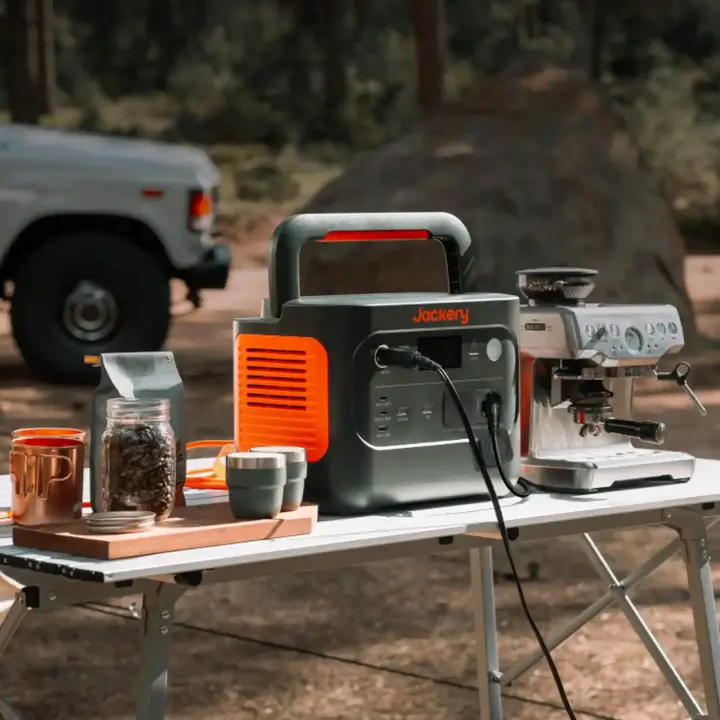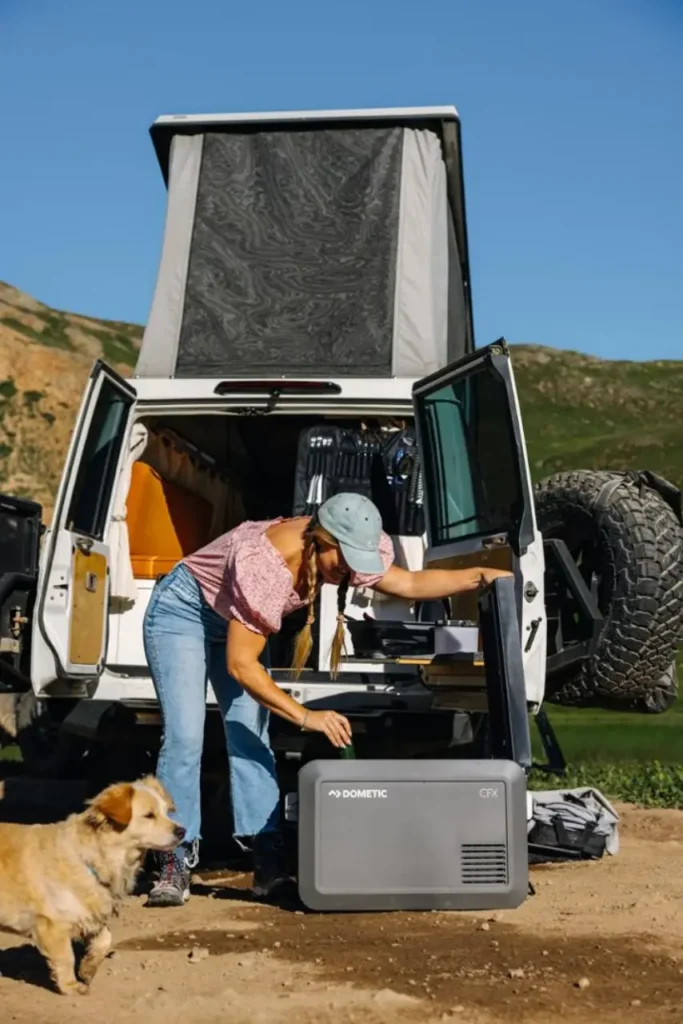

The best van life fridge is not necessarily the biggest one you can fit in your vehicle. It is the one that gives you enough cold storage without taking over your cargo space or putting unnecessary strain on your electrical system.
For most van and vehicle-based setups, the Dometic CFX5 55IM offers the best balance of usable capacity, insulation, controls, and road-ready construction. The ICECO VL45 is a better fit when value and straightforward refrigeration matter more than premium features, while the Dometic CFX5 75DZ earns its extra size if you genuinely need separate fridge and freezer compartments.
Before buying, focus on four things: capacity, exterior dimensions, power demand, and trip style. A 75-liter dual-zone fridge may look better on paper, but a compact 45-liter model can be the smarter choice if it leaves room for water, camping gear, or a larger battery.
Best Van Life Fridges at a Glance
| Powered Cooler | Best For | Capacity | Configuration | Biggest Tradeoff |
|---|---|---|---|---|
| Dometic CFX5 55IM | Best overall | 55L | Single zone + ice maker | Premium price |
| ICECO VL45 | Best value | 45L | Single zone | Fewer premium features |
| Dometic CFX5 75DZ | Best dual-zone | 75L | Dual zone | Large footprint |
| BougeRV CRS 53QT | Best budget-friendly option | 50L | Single zone | Less premium construction |
| Dometic NRX 50C | Best upright fridge | 44L | Built-in upright | Requires installation |
1. Dometic CFX5 55IM — Best Overall
Best for: Frequent van travelers, overlanders, and car campers who want a premium portable fridge with enough capacity for longer trips without moving into an oversized dual-zone model.
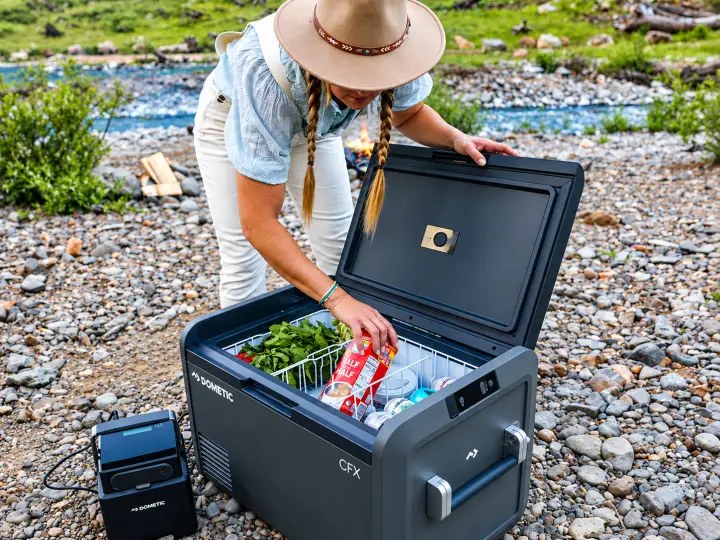
The Dometic CFX5 55IM hits a useful middle ground for van life. Its 55-liter capacity is large enough to handle a meaningful grocery load, but it is still considerably easier to integrate into a vehicle than one of the company’s larger dual-zone coolers.
The CFX5 generation uses Vacuum Insulated Panels and Dometic’s variable-speed VMSO 3.5 compressor system. It can run from 12/24V DC or AC power, includes three-stage battery protection, and can be monitored through Dometic’s Mobile Cooling app. The 55IM also adds an integrated ice maker without requiring the main compartment to operate as a freezer.
Why It Works So Well for Van Life
The biggest advantage is not the ice maker or app control. It is the combination of usable capacity and manageable size.
A fridge in this range can work well:
- behind a front seat
- beside a bed platform
- beneath a counter with enough lid clearance
- on a fridge slide
- in the cargo area of a larger SUV
The ability to monitor temperature remotely is useful when the fridge sits deep inside a drawer system, but it is a convenience rather than a reason to buy the cooler.
What matters more is whether 55 liters fits your actual food routine.
For a couple cooking regularly on the road, it provides considerably more flexibility than a small weekend cooler. For a solo traveler who shops frequently, however, it may be more refrigerator than necessary.
What to Consider
The CFX5 55IM commands a premium price, and not every traveler needs its full feature set.
It is also a chest-style fridge, so the installation needs enough room above the lid. A fridge can fit perfectly between two cabinets and still be unusable if the lid cannot open properly.
If your vehicle is compact or refrigeration needs are modest, stepping down to a 40–45L model may improve the entire layout.
2. ICECO VL45 — Best Value
Best for: Travelers who want a sturdy compressor fridge with straightforward controls and a more approachable price than premium Dometic models.

The ICECO VL45 keeps the formula relatively simple: a 45-liter single-zone compartment, metal shell, Secop compressor, AC/DC compatibility, and three-stage battery protection.
Its temperature range extends from about 0°F to 50°F, allowing the compartment to operate as either a refrigerator or a freezer. The compressor carries a five-year warranty, while the remaining components have one year of coverage.
That 45-liter size is one of the strongest reasons to consider it.
Why 45 Liters Can Be the Sweet Spot
It is easy to assume that more capacity is always better. Inside a van or SUV, every extra inch has a cost.
A smaller fridge can leave room for:
- a larger power station
- water storage
- recovery gear
- camp kitchen equipment
- drawers or storage bins
- a wider sleeping platform
For solo travelers and couples who can resupply regularly, 45 liters can provide enough refrigeration without forcing the rest of the build to work around the fridge.
The tradeoff is that the VL45 does not provide the same level of smart features as the premium Dometic models. There is no integrated ice maker, and the overall interface is simpler.
For travelers who primarily want food to stay cold, that may not be much of a sacrifice.
Check the ICECO VL45 on Amazon
3. Dometic CFX5 75DZ — Best Dual-Zone Van Life Fridge
Best for: Longer trips and larger builds where having a refrigerator and freezer running simultaneously is genuinely useful.

A dual-zone fridge sounds appealing, but it only earns the extra space if you actually use both temperature zones.
The Dometic CFX5 75DZ provides 75 liters of total capacity divided between two independently controlled compartments. One side can refrigerate while the other freezes, or the compartments can be configured around different cooling needs. It also carries over the CFX5 family’s Vacuum Insulated Panels, VMSO 3.5 compressor technology, app control, and AC/DC power compatibility.
When Dual Zone Is Worth It
A separate freezer becomes much more useful when your trip style includes:
- carrying frozen meat or prepared meals
- spending long stretches between grocery stops
- stocking a van for extended remote travel
- keeping frozen food separate from fresh produce and drinks
For a full-time van or long overland trip, that flexibility can be valuable.
For weekend travel, it may simply mean carrying a much larger appliance than necessary.
The Real Cost Is Space
The extra purchase price is only part of the tradeoff.
A 75-liter fridge occupies a significant portion of a vehicle interior. It also becomes heavy once loaded, and a larger refrigerated volume places more importance on having a properly sized electrical system.
Before choosing a fridge this large, measure the entire installation rather than just checking whether its footprint fits.
Account for:
- lid clearance
- ventilation
- wiring
- tie-down points
- slide clearance
- nearby drawers or doors
- access from inside the van
If the 75DZ forces you to compromise important storage or living space, a 45–55L single-zone fridge and more frequent grocery stops may produce a better van setup overall.
4. BougeRV CRS 53QT — Best Budget-Friendly Powered Cooler
Best for: Road trippers and newer van builds where keeping the initial refrigeration cost down is more important than premium construction.
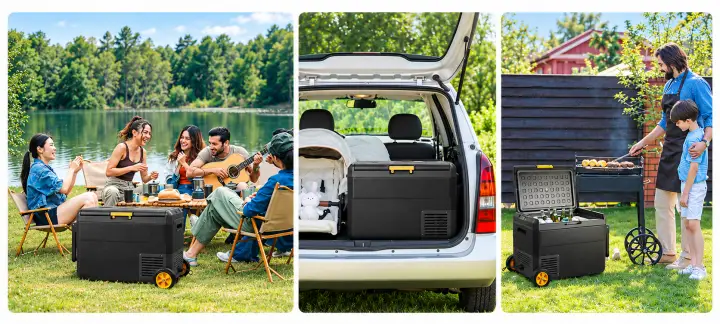
The BougeRV CRS 53QT provides about 50 liters of single-zone storage with a temperature range from approximately -4°F to 68°F.
The compact wheelless version weighs about 31.8 pounds and measures roughly 25.9 × 16.3 × 18.2 inches. It supports 12/24V DC and household AC through an adapter, offers app control, and has a rated input of 60 watts.
Those numbers make it particularly interesting for campers building an entire electrical-and-refrigeration system on a limited budget.
Why a Less Expensive Fridge Can Make Sense
A van fridge does not work in isolation.
You may also need:
- an auxiliary battery or portable power station
- DC charging
- solar
- wiring and fusing
- a mounting solution
- ventilation
- other electrical upgrades
Spending less on the refrigerator can free up money for the parts of the system that actually keep it running.
A premium fridge connected to an undersized battery is not necessarily a better setup than a reasonably priced fridge supported by a well-designed electrical system.
Where the Tradeoff Appears
The CRS does not have the same premium construction and long-established overlanding reputation as the more expensive models in this guide.
That matters more for travelers expecting continuous use, substantial vibration, and years of full-time duty than it does for occasional road trips and weekend camping.
5. Dometic NRX 50C — Best Upright Van Fridge
Best for: Permanent camper van conversions with a built-in galley.
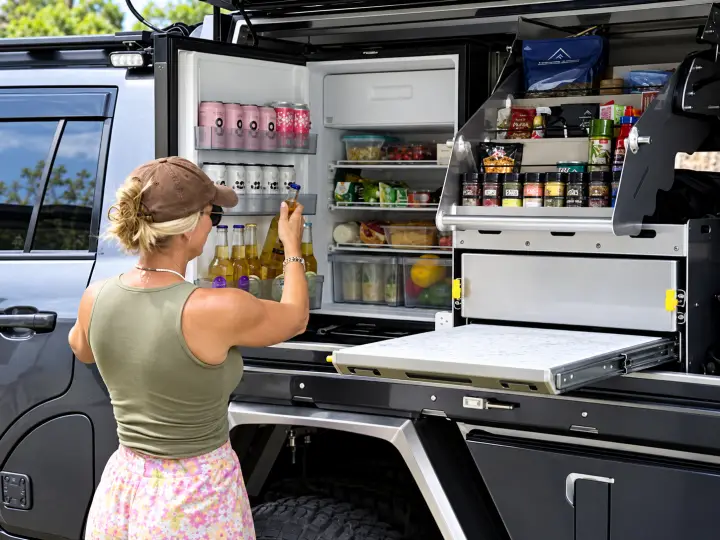
Portable chest fridges are efficient and versatile, but they are not always the most convenient option for a permanent kitchen.
The Dometic NRX 50C takes a different approach. It is a 44-liter upright compressor refrigerator designed to integrate into cabinetry, with a removable freezer compartment and Eco, Boost, and Silent operating modes.
The biggest advantage is everyday access.
Open the door and the food is directly in front of you. Shelves and door storage make groceries easier to organize, and nothing has to be cleared from the top of the refrigerator before opening it.
Why an Upright Fridge Works Better in Some Vans
An upright model is particularly appealing when:
- the van has permanent cabinetry
- the fridge sits below a countertop
- cooking happens inside regularly
- easy access matters more than portability
- the refrigerator will rarely leave the vehicle
It can make a compact galley feel much closer to a normal kitchen.
Why It Is Not for Everyone
Installation is more involved.
An upright compressor refrigerator needs a secure cabinet and adequate ventilation around the cooling system. It also loses the portability that makes chest-style fridges useful for SUVs, pickup camping, and modular van builds.
If the refrigerator needs to move between vehicles—or out to a campsite—the NRX is the wrong style of fridge.
How to Choose a Van Life Fridge
Once you have narrowed down a few reliable models, the decision should come down to four questions:
- How much food actually needs to stay cold?
- How much vehicle space can you give up?
- Can your electrical system comfortably support the fridge?
- Do you really need a freezer?
Get those answers right before worrying about apps, displays, USB ports, or other secondary features.
What Size 12V Fridge Do You Need?
Capacity figures are useful, but there is no reliable formula that says a certain number of liters equals a certain number of travel days.
Food choices matter too much.
Fresh produce, meal-prep containers, drinks, condiments, and bulky packaging can fill a refrigerator very differently than compact meals and a carefully planned grocery list.
As a starting point:
| Capacity | A Good Starting Point For |
|---|---|
| 25–35L | Solo travelers, short trips, very small vehicles |
| 40–50L | Solo van life, couples, SUVs and compact vans |
| 50–60L | Couples who cook regularly and carry more fresh food |
| 65–80L | Larger vans, long trips, dual-zone refrigeration |
| 90L+ | Families and high-capacity builds |
Do not buy a larger fridge simply to avoid reorganizing groceries.
In a vehicle, oversized appliances permanently consume valuable space even when half empty.
Measure the Fridge Space Before You Shop
Exterior dimensions can matter more than capacity.
Measure:
- width
- depth
- height
- room for ventilation
- lid or door movement
- cable access
- mounting or tie-down space
For chest-style models, check the dimensions with the lid fully open.
If the refrigerator will live on a slide, measure the slide and surrounding cabinetry too. Make sure the power cable can move safely as the slide extends and retracts.
A cardboard mockup can reveal layout problems before an expensive fridge arrives.
Single-Zone vs. Dual-Zone Fridges
This is one of the easiest decisions to overcomplicate.
Choose a Single-Zone Fridge If:
You mainly want refrigeration.
A single-zone fridge uses one temperature-controlled compartment. Depending on the model, it may be capable of freezing, but it generally cannot refrigerate some food while simultaneously keeping another section frozen.
For most campers, that is enough.
Single-zone fridges also tend to make better use of their interior volume.
Choose a Dual-Zone Fridge If:
You regularly need a real freezer.
Two independently controlled compartments let you keep frozen meals or meat in one side while using the other for normal refrigeration.
That capability is valuable—but only when it solves an actual problem.
If you almost never carry frozen food, using vehicle space and budget for a dual-zone refrigerator may provide little benefit.
Chest-Style vs. Upright Van Fridges
Your vehicle layout often answers this question for you.
Choose a Chest Fridge When:
- your build is modular
- the fridge needs to move
- you have enough vertical lid clearance
- it will live on a slide or cargo platform
- maximum layout flexibility matters
Chest fridges are particularly well suited to SUVs, pickup beds, overland rigs, and removable camper builds.
Choose an Upright Fridge When:
- you have permanent cabinetry
- the fridge lives under a counter
- easy food access is important
- shelves and door storage are useful
- portability does not matter
For a full-time van with a permanent galley, an upright can be much more pleasant to use several times a day.
How Much Power Does a 12V Fridge Use?
This is where simple buying guides often become misleading.
There is no single trustworthy daily consumption number for a fridge in every vehicle and climate.
Actual energy use changes with:
- ambient temperature
- fridge temperature
- freezer use
- how frequently the lid opens
- ventilation around the compressor
- direct sunlight
- how much warm food is added
- insulation
- refrigerator size
A fridge’s rated wattage also does not mean it pulls that amount continuously.
Compressor refrigerators cycle. They consume more power while actively cooling and much less when the compressor is off.
That is why two people using the same fridge can see significantly different daily energy consumption.
Think About the Whole Electrical System
A refrigerator is important because it is a continuous load.
A coffee maker may draw far more power, but only for a few minutes. A fridge has to keep working through the afternoon, overnight, and periods when solar production falls.
Depending on the build, the system may include:
- a LiFePO4 auxiliary battery
- DC-to-DC alternator charging
- solar panels
- shore power
- a portable power station
Do not size the battery around the refrigerator alone. Lights, fans, device charging, water pumps, inverters, cooking appliances, and other loads all compete for the same stored energy.
Do You Need a Separate Battery for a Van Fridge?
For regular use while parked, a separate power source is the safer approach.
Many powered coolers include low-voltage protection designed to shut down before battery voltage falls too far. That is useful protection, but relying on the vehicle’s starter battery as your everyday house battery is still a poor long-term strategy.
An auxiliary battery or portable power station lets the fridge operate while leaving the starting system dedicated to the vehicle.
For weekend SUV camping, a portable power station can keep the setup simple.
For a permanent van conversion, an integrated auxiliary battery with alternator and/or solar charging generally provides a cleaner long-term system.
Features That Actually Matter
Once the basic fridge type and size are right, a few secondary features can improve daily use.
Battery Protection
Multiple low-voltage cutoff levels give you more control when operating from a vehicle or auxiliary electrical system.
Removable Baskets
A basket may sound unimportant until you need to remove several days of food to clean a spill at the bottom of the fridge.
It also helps separate frequently used items from food stored underneath.
Reversible or Removable Lids
Opening direction matters in tight spaces.
A fridge positioned perfectly against a cabinet can become frustrating if the lid opens toward the wrong side of the vehicle.
Drain Plug
Useful for cleaning spills and condensation without tipping a heavy refrigerator.
App Control
Most useful when the fridge is mounted somewhere difficult to see.
If the control panel sits directly beside the kitchen, an app adds much less value.
Strong Handles and Secure Mounting Points
A fridge filled with food and drinks becomes heavy.
Solid handles and a secure installation matter far more on rough roads than another digital feature.
How to Reduce Fridge Power Use
You do not necessarily need a smaller refrigerator to reduce energy consumption.
A few setup choices help the fridge work less.
Pre-Cool Before Leaving
Run the fridge from household power and load already-cold food before starting the trip when practical.
The vehicle electrical system then maintains temperature instead of having to cool the fridge and an entire load of room-temperature groceries at once.
Keep It Out of Direct Sun
A fridge sitting beside a sun-heated window has to reject more heat than one installed in a shaded area.
Give the Compressor Room to Vent
Do not pack bedding, clothing, or storage boxes tightly against ventilation openings.
The cooling system needs somewhere to send the heat it removes from inside the refrigerator.
Keep the Fridge Organized
Organization saves more than frustration.
Knowing exactly where food is stored reduces the amount of time spent searching through an open refrigerator and makes a smaller fridge easier to use.
Van Life Fridge FAQ
Is a 12V Fridge Worth It for Van Life?
For frequent vehicle travel, it can be one of the most useful upgrades.
A compressor fridge eliminates ice runs, provides controlled temperatures, and prevents food from sitting in meltwater.
For someone who camps only a few weekends each year, however, a quality ice cooler may remain the simpler and less expensive choice.
Can a 12V Fridge Drain a Car Battery?
Yes.
Battery-protection features reduce the risk, but a refrigerator still consumes energy. An auxiliary battery or portable power station is a better solution for regular operation while the vehicle is parked.
Can You Run a 12V Fridge From Solar?
Yes, but solar normally charges the battery or power station that supplies the refrigerator.
Because solar production changes with weather, season, shade, and panel orientation, the system still needs enough stored energy to keep the fridge operating when solar output drops.
Can a Powered Cooler Be Used as a Freezer?
Many compressor models can reach freezer temperatures.
With a single-zone fridge, however, the entire main compartment is normally set to roughly the same temperature.
If you want refrigerated and frozen food at the same time, look for a true dual-zone model.
Is a Bigger Van Fridge Better?
Only if you need the additional capacity.
Every increase in fridge size affects cargo space, installation options, weight, and potentially electrical demand.
The best size is the smallest refrigerator that comfortably supports the way you actually travel and eat.
Which Van Life Fridge Should You Choose?
The Dometic CFX5 55IM is the strongest all-around choice here for travelers who have room for a 55-liter chest fridge and will use it often enough to justify the premium price.
Choose the ICECO VL45 instead if you want a simpler 45-liter fridge that preserves more vehicle space while still providing a Secop compressor and robust metal construction.
The Dometic CFX5 75DZ is the better choice when a real freezer is part of the plan—not simply an attractive extra feature.
For a tighter budget, the BougeRV CRS 53QT provides substantial capacity while leaving more money available for the battery, charging, and solar equipment that make refrigeration useful off-grid.
And if you are designing a permanent van galley rather than a modular camping setup, the Dometic NRX 50C offers the easier everyday access of a built-in upright refrigerator.
The final decision should come back to four things: how much cold storage you need, where the fridge will fit, how you will power it, and whether your travel style genuinely requires a freezer.
Solve those first, and choosing between the best van life fridges becomes much easier.
Affiliate Disclosure: GearForTheOutdoors.com participates in affiliate programs, including REI, Amazon, REI Outlet, Garage Grown Gear, evo, and other trusted partners. When you purchase through our links, we may earn a small commission at no extra cost to you. That helps support our content and keeps our recommendations useful, practical, and free.
Disclaimer: This post is for informational purposes only. Always verify current product details, fit, compatibility, availability, safety information, and manufacturer instructions before purchase or use. Outdoor conditions and gear performance can vary depending on setup, weather, terrain, vehicle, and experience level.