A good camp meal can change the whole mood of a trip.
After a long hike, a chilly paddle, a dusty drive into camp, or a full day of setting up tents and chasing shade, there is something deeply satisfying about hearing food sizzle on a camp stove. A warm skillet breakfast, pasta under the stars, a quick rice bowl, or even just hot coffee at sunrise can make a campsite feel a lot more comfortable. 🍳
But camp cooking only feels easy when the cookware actually fits the trip.
The bulky pots from home usually take up too much space. Thin bargain pans can scorch food before the middle is warm. Heavy cast iron is wonderful at a drive-up campsite but makes no sense in a backpack. Tiny ultralight pots are perfect for boiling water on trail but frustrating when cooking real food for a family.
That is where choosing the right camp cookware set matters.
The best camp cookware sets are not all built for the same kind of camper. Some are made for backpackers who need every piece to nest tightly inside a pack. Some are built for car campers who want enough pot space to feed four hungry people. Others are better for van life, overlanding, or relaxed campground meals where cooking is part of the fun.
This guide breaks down the strongest camp cookware options for different outdoor setups, from lightweight backpacking kits to family-friendly car camping systems and cast iron cookware for slow, satisfying meals around camp. 🏕️
Our Top Camp Cookware Picks
| Product | Best For | Material | Price Tier |
|---|---|---|---|
| GSI Outdoors Pinnacle Ceramic Camper | Car Camping Families & Groups | Hard-Anodized Aluminum w/ Ceramic Non-stick | $$$ |
| MSR Ceramic 2-Pot Set | Backpacking Duos & Couples | Hard-Anodized Aluminum w/ Ceramic Non-stick | $$$ |
| Sea to Summit Alpha Cookset 2.2 | Lightweight Backpacking | Hard-Anodized Aluminum | $$ |
| Stanley Wildfare Go Two Bowl Prep & Cook Set | Durable Stainless Camp Cooking for Two | Stainless Steel | $$ |
| TOAKS Titanium 1600ml Pot with Pan | Ultralight Solo Backpacking | Titanium | $$ |
| Lodge Cast Iron Combo Cooker | Gourmet Car Camping & Van Life | Cast Iron | $$ |
| GSI Outdoors Bugaboo Ceramic Base Camper | Value-Driven Car Campers | Aluminum w/ Ceramic Non-stick | $$ |
How to Choose Your Perfect Camp Cookware Set
The best camp cookware set is the one that matches how the trip actually works.
A backpacker hiking into the mountains with dehydrated meals needs a very different setup than a family making pancakes, pasta, and chili at a campground. A van traveler may care more about storage efficiency and cooking comfort. A weekend car camper might want a set that cleans up quickly and does not require a complicated kitchen bin.
Before choosing a set, think about four things: what kind of camping it will be used for, how many people need to eat, how much cooking will actually happen, and how much space is available for packing. That simple filter makes the decision much easier. 🔥
Material Matters
The material of a cookware set affects weight, durability, heat control, cleanup, and price. It also affects how enjoyable cooking feels at camp.
Hard-Anodized Aluminum:
This is one of the most useful materials for general camp cookware. It is lighter than stainless steel, heats evenly, and works well on compact camp stoves. Hard-anodized aluminum also has a tougher surface than basic aluminum, which helps with durability. Many popular camp cooksets use this material because it hits a nice balance between weight, cooking performance, and packability.
Stainless Steel:
Stainless steel is the durable workhorse of camp cookware. It can handle bumps, scrapes, metal utensils, and years of rough packing better than most lightweight materials. It is heavier than aluminum and can create hot spots if the pan is thin, but it is a great choice for car camping, basecamp cooking, and anyone who wants cookware that feels sturdy rather than delicate.
Titanium:
Titanium is made for people who care most about weight savings. It is strong, corrosion-resistant, and extremely light, which makes it a favorite for ultralight backpacking and thru-hiking. The downside is cooking performance. Titanium does not spread heat as evenly as aluminum, so it is best for boiling water, reheating simple meals, and minimalist cooking rather than simmering sauces or frying delicate food.
Cast Iron:
Cast iron is heavy, slow to heat, and not remotely backpacking-friendly. It is also one of the best materials for outdoor cooking when weight does not matter. It holds heat beautifully, works well over coals, handles searing and baking, and can last for generations with proper care. For car camping, cabin trips, and van life, cast iron can turn camp cooking into something that feels much closer to a real kitchen. 🍞
Nesting Design and Packability
A good camp cookware set should pack down cleanly.
“Nesting” means the pots, pans, lids, bowls, mugs, handles, and sometimes utensils fit inside each other as one compact unit. This matters more than it might seem. A cookset that nests well is easier to store in a camp bin, slide into a van drawer, or fit inside a backpack without rattling around.
For backpacking, nesting design can determine whether the set is practical at all. For car camping, it keeps the kitchen box organized and makes setup less annoying when dinner needs to happen before sunset.
Look for sets with locking handles, lids that stay put, stuff sacks that double as wash basins, or enough interior space to nest a stove, fuel canister, sponge, lighter, or small utensil kit.
Group Size
The right size depends on how many people are eating and how much real cooking is planned.
Solo Campers:
A single pot between 750ml and 1.1L is usually enough for boiling water, making oatmeal, cooking ramen, or preparing a dehydrated backpacking meal. Solo campers who like fresh food may prefer something closer to 1.3L or 1.6L for more room to stir.
Two People:
A two-pot set is often the sweet spot. One smaller pot can handle coffee, oatmeal, or sauce while the larger pot boils water, pasta, rice, or soup. For backpacking couples, a compact 1.2L + 2.5L or 2.7L setup can cover a surprising range of meals.
Families and Groups:
For three or more people, capacity becomes more important than weight. Look for a 3L to 5L main pot, a usable frying pan, and ideally a system that includes plates, bowls, mugs, or strainer lids. These larger sets are usually best for car camping because they take up more space and weigh more.
Non-Stick vs. Uncoated
Non-stick cookware makes camp cooking easier, especially for eggs, pancakes, rice dishes, quesadillas, and sticky sauces. It also saves water during cleanup, which is a real advantage when camping without a sink. Modern ceramic non-stick coatings from reputable outdoor brands are often designed to be easier to clean and free from older chemical concerns.
The trade-off is care. Non-stick surfaces should be used with wood, silicone, or plastic utensils. They should not be scrubbed aggressively with metal pads or packed loosely against sharp gear.
Uncoated cookware, such as stainless steel, titanium, and cast iron, is more durable in the long run. It can handle harder use, but food may stick more easily. It also usually requires better heat control and a little more oil.
For most beginners and casual campers, non-stick aluminum is easier. For long-term durability, stainless steel or cast iron is better. For backpacking weight savings, titanium has a clear place.
The Best Camp Cookware Sets of 2026
These camp cookware sets were chosen for practical outdoor use, current relevance, affiliate program fit, and the kinds of trips readers are most likely planning: car camping weekends, family campground meals, van life setups, backpacking trips, and lightweight trail cooking.
GSI Outdoors Pinnacle Ceramic Camper Cookset
Best All-in-One Set for Car Camping Families
The GSI Outdoors Pinnacle Ceramic Camper is one of the easiest cooksets to recommend for car camping families, small groups, and weekend campers who want a complete kitchen system without building everything piece by piece.
This is the kind of set that makes sense when dinner involves more than boiling water. It includes two pots, a frying pan, plates, bowls, insulated mugs, lids, a folding handle, and a stuff sack that can double as a wash basin. Everything nests together into a compact package, which is helpful when the back of the car is already packed with sleeping bags, chairs, coolers, and camp bins. 🏕️
The updated ceramic version is especially appealing because it keeps the same smart GSI nesting concept while leaning into easier cooking and cleanup. The hard-anodized aluminum heats efficiently, and the ceramic non-stick surface helps with meals that would otherwise become a cleanup headache at camp: scrambled eggs, pancakes, rice bowls, and saucy pasta.
This is not a backpacking set. It is too large and too complete for that. But for a family campsite, a van setup, or a well-organized car camping kitchen, it covers a lot of needs in one tidy system.
| Specification | Detail |
|---|---|
| Material | Hard-Anodized Aluminum w/ Ceramic Non-stick |
| Weight | Around 3 lbs. 10 oz. |
| Includes | 3L pot, 2L pot, frypan, strainer lids, plates, bowls, insulated mugs, folding pot handle, stuff sack/wash basin |
| Best For | Car camping, van life, groups of 3–4 |
Pros:
- Complete kitchen system for four campers
- Excellent nesting design for organized packing
- Ceramic non-stick surface makes cooking and cleanup easier
- Good pot sizes for real campground meals
- Helpful extras like strainer lids and color-coded dishware
Cons:
- Too bulky for backpacking
- More expensive than basic pot-and-pan sets
- Non-stick coating still needs gentle utensils and careful packing
MSR Ceramic 2-Pot Set
Best Premium Cookset for Two
The MSR Ceramic 2-Pot Set is a clean, simple, high-quality option for two people who want real cooking performance without carrying a full kitchen kit.
It includes a 2.5L pot, a 1.5L pot, a strainer lid, and MSR’s removable Talon pot handle. That may sound minimal compared to some all-in-one systems, but that simplicity is part of the appeal. There are no plates, cups, bowls, or extra utensils to sort through. It is just two useful pots that nest well and cook better than many lightweight backpacking sets.
The ceramic non-stick coating is the main reason this set stands out. It is useful for campers who want to cook fresh food instead of relying only on freeze-dried meals. Pasta, rice, oatmeal, soup, vegetables, and simple one-pot meals are all easier to manage when the pot distributes heat well and does not cling to every bite.
For backpacking couples, it is a little more cooking-focused than the most minimalist setups. For car campers, it is compact enough to tuck into a small kitchen bin. For van travelers, it works well as a space-saving two-pot system that can handle everyday camp meals. 🍲
| Specification | Detail |
|---|---|
| Material | Hard-Anodized Aluminum w/ Ceramic Non-stick |
| Weight | Around 1 lb. |
| Includes | 2.5L pot, 1.5L pot, strainer lid, pot handle |
| Best For | Backpacking duos, couples, compact car camping kitchens |
Pros:
- Excellent balance of weight, capacity, and cooking performance
- Ceramic non-stick surface is helpful for fresh meals
- Two-pot design works well for couples
- Compact and easy to pack
- More versatile than tiny solo backpacking pots
Cons:
- Does not include bowls, mugs, plates, or utensils
- Premium price for a cookware-only set
- Not ideal for larger families or group meals
Check Price at REI | Check Price on Amazon
Sea to Summit Alpha Cookset 2.2
Best Lightweight Backpacking Set
The Sea to Summit Alpha Cookset 2.2 is a strong pick for backpacking pairs who want a more complete eating-and-cooking setup without moving into heavy car camping cookware.
The set usually includes a 2.7L pot, a 1.2L pot, two bowls, and two insulated mugs. That gives two campers enough flexibility for coffee, oatmeal, pasta, soup, and simple trail meals while keeping the whole kit tidy and packable.
What makes the Alpha 2.2 especially useful is the way everything fits together. The pots nest cleanly, the bowls and mugs tuck inside, and the handle system helps keep the kit locked down during transport. In a backpack, that matters. A cookset that clanks, shifts, or spills pieces into the pack gets annoying fast.
The hard-anodized aluminum keeps weight reasonable while offering better heat performance than titanium. It is not a non-stick set, so cooking eggs or sticky sauces takes more attention. But for backpackers who want something tougher and more complete than a tiny mug-style pot, this is a practical middle ground. ⛰️
| Specification | Detail |
|---|---|
| Material | Hard-Anodized Aluminum |
| Weight | Around 1 lb. 11 oz. |
| Includes | 2.7L pot, 1.2L pot, lids, 2 bowls, 2 insulated mugs, dishcloth |
| Best For | Backpacking couples, lightweight camping, compact meal prep |
Pros:
- Great balance of packability and meal flexibility
- Includes bowls and mugs for two people
- Hard-anodized aluminum cooks better than titanium for real meals
- Smart nesting system saves pack space
- Good option for backpackers who do more than boil water
Cons:
- Uncoated surface requires more careful cooking and cleaning
- Not as ultralight as a minimalist titanium pot
- Mugs may feel small for campers who like larger hot drinks
Stanley Wildfare Go Two Bowl Prep & Cook Set
Best Durable Stainless Camp Cooking Set for Two
The Stanley Wildfare Go Two Bowl Prep & Cook Set is a practical choice for campers who want stainless steel durability in a compact kit for two.
It is not trying to be the lightest backpacking cookware set. It is better suited to car camping, road trips, van weekends, cabin stays, and simple campground cooking where durability and organization matter more than shaving ounces.
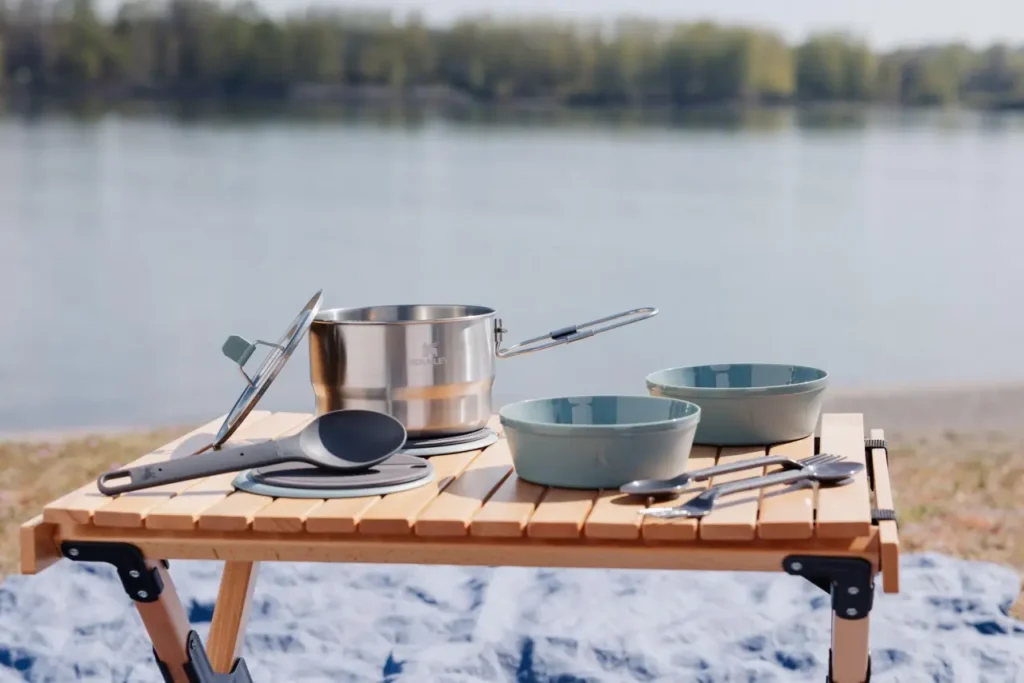
The set includes a stainless steel saucepan, a vented and straining lid, two bowls, two sporks, cutting boards, trivets, and a compact spatula setup. That makes it more than just a pot. It works like a small prep-and-cook system, especially for quick meals such as noodles, rice bowls, soup, oatmeal, mac and cheese, or reheated leftovers at camp.
Stainless steel is tougher than coated aluminum and does not require the same level of gentle handling. It can be scrubbed more confidently and packed with fewer worries. The trade-off is that it can be less forgiving with sticky foods, and it does not offer the same non-stick ease as ceramic-coated sets.
For two campers who like simple, durable gear that nests neatly and feels built for regular use, this Stanley set makes a lot of sense. ☕
| Specification | Detail |
|---|---|
| Material | 18/8 Stainless Steel, BPA-free accessories |
| Weight | Varies by retailer listing |
| Includes | 1.65-quart saucepan, vented/strainer lid, 2 bowls, 2 sporks, cutting boards, trivets, spatula pieces |
| Best For | Car camping, road trips, van life, compact cooking for two |
Pros:
- Durable stainless steel construction
- Good compact system for two people
- Includes bowls, sporks, prep boards, and cooking accessories
- Better for rough packing than delicate non-stick cookware
- Useful for road trips and small camp kitchens
Cons:
- Not ideal for larger groups
- Stainless steel can be harder to clean if food burns
- Less versatile than a full family-size cookset
Check Price at REI | Check Price on Amazon
TOAKS Titanium 1600ml Pot with Pan
Best for Ultralight Minimalists
The TOAKS Titanium 1600ml Pot with Pan is for campers who think about every ounce.
This is not a cozy family cookset. It is a lightweight, simple, trail-focused pot-and-pan combo for backpackers, thru-hikers, bikepackers, and minimalist travelers who mostly need to boil water, rehydrate meals, make coffee, or cook simple one-pot food.
The 1600ml capacity is generous for a solo backpacker and workable for two minimalists sharing basic meals. The pan doubles as a lid, which adds versatility without adding much bulk. The pot also has measurement marks, folding handles, and enough room to nest small cooking items depending on the stove and fuel setup.
The big thing to understand is that titanium is not magic. It is strong and light, but it does not spread heat as evenly as aluminum. That means it can scorch food if the stove is cranked too high or if the meal needs slow simmering. For boiling water, it is excellent. For delicate camp cooking, it takes patience.
Choose this set when weight matters more than gourmet cooking. Skip it for pancakes, eggs, and family camp meals. 🥾
| Specification | Detail |
|---|---|
| Material | Titanium |
| Weight | Around 8.2 oz. |
| Includes | 1600ml pot, 490ml pan/lid, mesh sack |
| Best For | Ultralight backpacking, thru-hiking, minimalist solo cooking |
Pros:
- Very lightweight for its capacity
- Strong, durable, and corrosion-resistant
- Pan doubles as a lid
- Large enough for solo meals or minimalist two-person use
- Great for boiling water and simple trail meals
Cons:
- Poor heat distribution compared with aluminum
- Easy to scorch food if cooking too hot
- Pan function is limited
- Not ideal for relaxed campground cooking
Check Price at REI | Check Price on Amazon
Lodge Cast Iron Combo Cooker
Best for Gourmet Car Camping
The Lodge Cast Iron Combo Cooker is the opposite of ultralight cookware — and that is exactly the point.
This is for car campers, van travelers, cabin cooks, overlanders, and campground meal lovers who see cooking as part of the trip. It is heavy, rugged, and wonderfully useful when the campsite is close to the vehicle.
The Combo Cooker works as a deep skillet, Dutch oven, and shallow skillet/lid. That opens the door to meals most lightweight camp cookware cannot handle well: cornbread, biscuits, chili, fried potatoes, seared steaks, campfire nachos, breakfast hash, and slow-simmered dinners.
Cast iron holds heat beautifully, which helps when cooking over coals or a camp stove with uneven flame control. It is also durable enough to last for decades when properly cared for. The trade-off is obvious: weight. At nearly 13 pounds, this piece belongs in a car camping bin, not a backpack.
It also requires maintenance. Cast iron should be dried thoroughly and lightly oiled after use to prevent rust. That extra care is worth it for campers who like cooking real meals outdoors. For campers who want fast cleanup and minimal fuss, a non-stick aluminum set will be easier. 🍞
| Specification | Detail |
|---|---|
| Material | Cast Iron |
| Weight | Around 12.85 lbs. |
| Includes | 3.2-quart deep skillet/Dutch oven base, 10.25-inch skillet/lid |
| Best For | Car camping, campfire cooking, van life, outdoor baking |
Pros:
- Excellent heat retention and cooking performance
- Works as a skillet, Dutch oven, fryer, and baking vessel
- Extremely durable with proper care
- Great for campfire and coal cooking
- Made for meals that feel more like real home cooking
Cons:
- Far too heavy for backpacking
- Requires drying, oiling, and basic cast iron care
- Not the easiest option for quick cleanup
GSI Outdoors Bugaboo Ceramic Base Camper
Best Budget-Friendly Car Camping Set
The GSI Outdoors Bugaboo Ceramic Base Camper is a smart pick for campers who want a reliable car camping cookware set without jumping into the higher price range of more premium systems.
It offers the core pieces most weekend campers need: two pots, a frying pan, strainer lids, a folding handle, a cutting board, and a stuff sack that helps keep everything together. Depending on the size selected, it can work for couples, small families, or groups.
The ceramic non-stick surface makes it easier to cook campground staples like eggs, stir-fries, pancakes, pasta, and rice dishes. The aluminum construction heats quickly, which is helpful on camp stoves, especially when fuel efficiency matters.
Compared with the Pinnacle Ceramic Camper, the Bugaboo Ceramic Base Camper is less complete because it does not include the full dishware setup for four. But that can actually be a benefit for campers who already have plates, bowls, and mugs they like. It keeps the system focused on cooking instead of turning it into a full kitchen-in-a-bag.
For beginner car campers, budget-conscious families, and anyone building a camp kitchen one piece at a time, this is one of the most practical options. 🔥
| Specification | Detail |
|---|---|
| Material | Aluminum w/ Ceramic Non-stick |
| Weight | Varies by size |
| Includes | 2 pots, frypan, 2 strainer lids, cutting board, folding pot handle, stuff sack/sink |
| Best For | Budget-conscious car campers, beginners, small groups |
Pros:
- Strong value for a car camping cookset
- Ceramic non-stick surface helps with cleanup
- Includes useful pot and pan sizes
- Available in multiple sizes
- Stuff sack can help with storage and washing
Cons:
- Does not include plates, mugs, or bowls
- Non-stick coating still needs careful utensils
- Aluminum can dent more easily than stainless steel
Check Price at REI | Check Price on Amazon
Care and Maintenance for Your Camp Cookware
Good camp cookware lasts longer when it is cleaned and packed with a little care.
That does not mean camp dishes need to become a complicated chore. It just means using the right cleaning method for the material, avoiding scratches when possible, and making sure everything is dry before it goes back into storage.
- Use the right sponge: A soft sponge or non-abrasive scrubber is best for non-stick cookware. Avoid steel wool or aggressive scrub pads on ceramic-coated pots and pans.
- Protect non-stick surfaces: Use wood, silicone, or plastic utensils. During transport, place a dishcloth, paper towel, or small towel between nested pots and pans to reduce rubbing.
- Clean away from water sources: Wash dishes at least 200 feet away from lakes, rivers, and streams. Use minimal biodegradable soap and strain food scraps so they can be packed out.
- Loosen stuck food with warm water: Add a little water to the dirty pot and warm it on the stove. This helps soften stuck food before scrubbing.
- Dry everything fully: Moisture trapped inside nested cookware can cause odors, mildew, or corrosion over time.
- Care for cast iron separately: Rinse with hot water, scrub with a stiff brush if needed, dry completely over low heat, and wipe on a thin layer of cooking oil before storing.
- Avoid overheating empty non-stick pans: Empty coated cookware can get too hot quickly on camp stoves. Add food or oil before prolonged heating.
A small camp dish kit can make cleanup much easier: a scraper, sponge, tiny bottle of soap, quick-dry towel, and a mesh bag for drying utensils. Simple, organized, and easy to keep in the kitchen bin. 🧽
Final Verdict
The best camp cookware sets depend on the kind of outdoor meals that need to happen.
For family car camping, the GSI Outdoors Pinnacle Ceramic Camper is the most complete and convenient option. It packs cookware and dishware into one organized system, making it especially useful for groups of three or four.
For couples who want better cooking performance in a compact setup, the MSR Ceramic 2-Pot Set is one of the strongest all-around choices. It is simple, well-made, and practical for both backpacking and car camping.
For lightweight backpacking pairs, the Sea to Summit Alpha Cookset 2.2 offers a helpful balance of packability, cooking space, bowls, and mugs. For ultralight solo trips, the TOAKS Titanium 1600ml Pot with Pan is the better minimalist choice.
For car campers who care about durability, the Stanley Wildfare Go Two Bowl Prep & Cook Set is a sturdy stainless option for two. For campers who want the best cooking experience at a drive-up campsite, the Lodge Cast Iron Combo Cooker is hard to beat.
And for beginners or budget-conscious campers, the GSI Outdoors Bugaboo Ceramic Base Camper keeps things practical, useful, and easier to clean without overcomplicating the camp kitchen.
The right cookware should make outdoor meals feel simpler, not harder. Choose the set that fits the trip, the group size, and the kind of food that will actually be cooked. A warm meal at camp does not need to be fancy — it just needs to feel satisfying after a day outside. 🌲
Frequently Asked Questions
What’s the difference between backpacking and car camping cookware?
Backpacking cookware is built around weight and packability. The pieces are usually smaller, lighter, and designed to nest tightly inside a backpack. Most backpacking cookware focuses on boiling water, heating simple meals, and saving space.
Car camping cookware can be larger, heavier, and more comfortable to cook with because the gear only needs to travel from the car to the campsite. That opens the door to bigger pots, better frying pans, cast iron, full dish sets, and more comfortable cooking tools.
A backpacking cookset should disappear into a pack. A car camping cookset should make cooking at camp easier and more enjoyable.
Is non-stick cookware safe for camping?
Yes, modern non-stick camp cookware from reputable outdoor brands is generally safe when used as directed. Many current ceramic non-stick coatings are designed without older chemicals like PFOA and are made for easier cleanup at camp.
The key is proper use. Do not overheat an empty non-stick pan, avoid metal utensils, and do not scrub the coating with abrasive pads. Non-stick cookware is especially useful for eggs, pancakes, rice dishes, and meals that would otherwise stick badly to thin camp pots.
For campers who are rough on gear or prefer cookware that can be scrubbed aggressively, stainless steel, titanium, or cast iron may be a better fit.
Can I just use my cookware from home for camping?
Home cookware can work for some car camping trips, but it is usually not ideal.
Kitchen pots and pans often have long handles, bulky shapes, glass lids, or heavier construction that does not pack well. They can take up too much room in a camp bin and may be awkward on small camp stoves.
Dedicated camp cookware is usually designed to nest, pack tightly, heat efficiently on portable stoves, and handle outdoor use better. For one casual drive-up camping trip, home cookware can get the job done. For repeated camping, a proper cookset is easier to pack, use, and clean.
How do I clean cookware without a sink and running water?
Start by scraping food scraps into the trash so they can be packed out. Then add a small amount of water to the pot or pan and warm it slightly on the stove to loosen stuck food.
Use a sponge, scraper, and a small amount of biodegradable soap when needed. Wash dishes at least 200 feet away from lakes, rivers, and streams. Strain dirty dishwater so food particles do not get scattered around camp, then dispose of the water responsibly according to local guidelines.
Let everything dry fully before packing. Wet cookware stored inside a stuff sack can smell bad fast.
What size camp cookware set is best for two people?
For two people, a two-pot setup is usually the most versatile. A smaller pot around 1.2L to 1.5L works well for coffee, oatmeal, sauce, or side dishes. A larger pot around 2.5L to 2.7L is better for pasta, rice, soup, or boiling enough water for two meals.
Backpacking couples may prefer a compact hard-anodized aluminum set with bowls and mugs included. Car camping couples can choose something slightly heavier with better cooking comfort, such as ceramic non-stick aluminum or stainless steel.
Is titanium cookware worth it?
Titanium cookware is worth it when low weight matters more than cooking performance.
For backpackers, thru-hikers, and minimalist campers who mostly boil water, titanium is excellent. It is strong, light, and easy to pack. But it does not spread heat evenly, which means food can scorch quickly when simmering or frying.
For real cooking, aluminum or stainless steel is usually more forgiving. For ultralight trail meals, titanium makes a lot of sense.
Is cast iron good for camping?
Cast iron is excellent for car camping, van life, cabin trips, and campfire cooking. It holds heat well, cooks evenly, and works beautifully for meals like chili, cornbread, fried potatoes, breakfast hash, and seared meats.
The downside is weight and care. Cast iron must be dried thoroughly and lightly oiled to prevent rust. It also takes up more space and is not practical for backpacking.
For campers who enjoy cooking outdoors and have room in the vehicle, cast iron can be one of the most rewarding pieces of camp kitchen gear.
What cookware material is best for beginners?
Hard-anodized aluminum with a ceramic non-stick surface is usually the easiest choice for beginners. It is lighter than stainless steel, cooks more evenly than titanium, and cleans up more easily than uncoated cookware.
For beginners who mostly car camp and want something extra durable, stainless steel is also a good option. For beginners who are backpacking, a compact aluminum cookset is usually more forgiving than titanium.
The best beginner cookware is simple, easy to clean, and matched to the trip style.
Should a camp cookware set include plates, bowls, and mugs?
It depends on the setup.
All-in-one systems with plates, bowls, and mugs are great for families, groups, and campers who want one organized kit. They reduce the chance of forgetting something and make packing easier.
Cookware-only sets are better for campers who already have favorite bowls, mugs, utensils, or camp kitchen systems. They are also easier to customize.
For beginners, an all-in-one set can be helpful. For experienced campers, a cookware-only set may be more flexible.
Affiliate Disclosure: GearForTheOutdoors.com participates in affiliate programs, including REI, Amazon, REI Outlet, Garage Grown Gear, evo, and other trusted partners. When you purchase through our links, we may earn a small commission at no extra cost to you. That helps support our content and keeps our recommendations useful, practical, and free.
Disclaimer: This post is for informational purposes only. Always verify current product details, fit, availability, safety information, and manufacturer warranties before purchase or use. Outdoor conditions and gear performance can vary depending on setup, weather, terrain, and experience level.