Buying a first camping sleeping bag should feel exciting, not confusing.
But once the search begins, the options pile up quickly: 20-degree bags, 30-degree bags, mummy bags, rectangular bags, synthetic bags, down bags, double bags, ultralight bags, budget bags, and premium bags that all promise a better night outside. Then come the specs — comfort ratings, lower limits, fill power, packed size, shell fabric, shoulder girth, footboxes — and suddenly a simple weekend camping trip starts to feel like a technical gear exam. 🏕️
The good news: choosing one of the best camping sleeping bags for beginners does not need to be complicated.
For most first-time campers, weekend campers, and casual car campers, the right sleeping bag should do four things well:
It should feel comfortable.
It should keep you warm enough for the conditions.
It should be easy to use and care for.
It should make sense for the kind of camping you actually plan to do.
That last part matters most.
A beginner does not need the lightest alpine sleeping bag on the wall for a first campground trip. A family car camper does not need to obsess over every ounce. A future backpacker, on the other hand, probably should think about weight and packed size before buying a bulky rectangular bag.
The goal is not to buy the “most advanced” sleeping bag. The goal is to buy the one that helps you sleep well outside — because a cold, restless night can make camping feel harder than it needs to be.
This guide breaks down what actually matters, which specs are worth paying attention to, and which beginner-friendly sleeping bags make the most sense for real weekend trips, car camping setups, and first steps toward backpacking.
Top Picks for Beginner Campers at a Glance
| Sleeping Bag | Price Tier | Insulation | Shape | Best For |
|---|---|---|---|---|
| REI Co-op Siesta Hooded 20 | $$ | Synthetic | Rectangular | Overall Comfort & Car Camping |
| Kelty Cosmic 20 | $$$ | Down | Mummy | Beginner Backpacking Crossover |
| NEMO Tempo 20 Endless Promise Synthetic | $$$ | Synthetic | Spoon / Relaxed Mummy | Roomier Mummy-Bag Comfort |
| Marmot Trestles Elite Eco 20 | $$$ | Synthetic | Mummy | Best Warmth-to-Weight Synthetic |
| Kelty Tru.Comfort Doublewide | $$$ | Synthetic | Double Rectangular | Couples & Spacious Car Camping |
How to Choose a Camping Sleeping Bag: A Beginner’s Guide
A sleeping bag is only one part of a good night outside. It works together with a sleeping pad, tent setup, sleep clothing, campsite conditions, and the weather.
That is why the best camping sleeping bag for one beginner may not be the best choice for another.
A camper sleeping beside the car in a roomy tent has different needs than someone carrying gear into a backcountry campsite. A warm sleeper in Texas has different needs than a cold sleeper camping in Colorado shoulder season. A couple sharing a tent has different priorities than a solo hiker testing out a first overnight trail.
Before choosing a bag, think through these questions:
What nighttime temperatures are realistic for your trips?
Will the bag mostly be used for car camping or backpacking?
Do you sleep warm or cold?
Do you need room to move around?
Will the bag be used in damp or humid conditions?
How much storage space do you have at home and in the car?
Once those answers are clear, the buying decision gets much easier. 🌲
1. Understanding Temperature Ratings
Temperature ratings are often the first thing beginners notice — and the first thing that causes confusion.
A sleeping bag labeled “20°F” does not always mean every camper will feel warm, cozy, and relaxed at 20°F. In many cases, that number is closer to the lower end of the bag’s usable range, not a guarantee of comfort.
Many sleeping bags use standardized EN or ISO temperature testing. When available, pay attention to these ratings:
- Comfort Rating: The temperature where a colder sleeper is more likely to feel comfortable in a relaxed sleeping position.
- Limit Rating / Lower Limit: The temperature where a warmer sleeper may be able to sleep curled up without getting dangerously cold.
- Extreme Rating: A survival-focused number, not a target for normal camping comfort.
For beginner campers, the comfort rating is the number that matters most.
If nighttime temperatures are expected to dip to around 40°F, a bag with a comfort rating around 30°F to 35°F can be a good fit. If the trip is in the mountains, desert, or shoulder season, a warmer bag gives more breathing room when the temperature drops faster than expected.
A practical rule: choose a sleeping bag rated about 10–15°F colder than the lowest nighttime temperature expected.
That extra buffer helps when the forecast is off, the campsite sits in a colder valley, or damp air makes the night feel colder than the number on the weather app.
For most 3-season camping in the U.S. — spring, summer, and fall — a sleeping bag in the 20°F to 35°F range is the most useful starting point.
A 20°F bag gives more warmth for cool spring and fall nights. A 30°F or 35°F bag may feel better for warmer summer camping, especially in humid climates. Cold sleepers should usually lean warmer.
2. Insulation: Down vs. Synthetic
The insulation inside a sleeping bag traps warm air around the body. That trapped air is what helps keep you warm through the night.
Most camping sleeping bags use either down or synthetic insulation.
Both can work well, but they behave differently.
| Feature | Down Insulation | Synthetic Insulation |
|---|---|---|
| Warmth-to-Weight | Excellent. Very warm for its weight. | Good. Usually heavier for the same warmth. |
| Compressibility | Excellent. Packs down small. | Fair to good. Usually bulkier. |
| Wet Performance | Loses loft when wet, though treated down helps. | Performs better when damp. |
| Durability | Can last for many years with proper care. | Durable, but insulation can lose loft over time. |
| Cost | Usually more expensive. | Usually more affordable. |
| Care | Needs more careful washing and storage. | Easier for beginners to maintain. |
For many beginner car campers, synthetic insulation is the easiest place to start.
It is usually more affordable, easier to care for, and more forgiving when things get damp. That matters when camping with kids, dogs, morning condensation, wet grass, muddy gear, spilled drinks, or a tent wall that collects moisture overnight.
Down is the better choice when weight and packed size matter. It compresses smaller, feels lighter in a backpack, and can last a long time when properly cared for. A beginner who wants one sleeping bag for both car camping and future backpacking may appreciate a down mummy bag.
Here is the simple version:
Choose synthetic if comfort, price, easy care, and damp-weather forgiveness matter most.
Choose down if weight, packed size, and backpacking potential matter more.
3. Sleeping Bag Shapes
The shape of a sleeping bag affects both warmth and comfort.
Some campers like a snug, cocoon-like feel. Others need space to bend a knee, roll onto one side, or stretch out after a long day outside. The best beginner sleeping bag should match the way the person actually sleeps — not just what looks most technical online. 😴
- Rectangular:
Rectangular sleeping bags feel the most like regular bedding. They are roomy, easy to move around in, and often unzip fully into a blanket. The tradeoff is warmth efficiency. Extra interior space means the body has more air to heat.- Best for: Car campers, restless sleepers, warm-weather camping, and anyone who values comfort over packability.
- Mummy:
Mummy bags are narrower, more tapered, and usually include a hood. They reduce empty space, which helps them stay warmer for their weight. The downside is that some beginners find them restrictive.- Best for: Colder conditions, backpacking, and campers who want better thermal efficiency.
- Semi-Rectangular / Spoon / Relaxed Mummy:
These designs sit between rectangular and mummy bags. They provide more room around the shoulders, knees, or feet while still being warmer and more packable than a full rectangular bag.- Best for: Campers who want warmth and packability without feeling boxed in.
- Double Sleeping Bags:
Double bags are made for two people or one camper who wants maximum space. They are heavy and bulky, but they can make a tent feel much more like a real bed.- Best for: Couples, family camping, van setups, and comfort-focused car camping.
The Best Camping Sleeping Bags for Beginners in 2026
The sleeping bags below were selected because they solve real beginner problems: staying warm, sleeping comfortably, avoiding overly technical gear, and choosing something that fits the way most people actually camp.
Some are best for car camping. Some are better for backpacking crossover use. One is built for couples and roomy tent setups.
The right choice depends less on the label and more on how the bag will be used.
REI Co-op Siesta Hooded 20 Sleeping Bag
- Temp Rating: 20°F
- Insulation: Synthetic
- Weight: Varies by size
- Shape: Rectangular
- Best For: Comfortable car camping and relaxed weekend trips
The REI Co-op Siesta Hooded 20 is the kind of sleeping bag that makes sense for a lot of first-time campers because it prioritizes comfort over technical minimalism.
It feels familiar. The rectangular shape gives the body room to move, which is a big deal for anyone who dislikes the tight feel of mummy bags. Side sleepers, restless sleepers, and campers who like to bend a knee will usually feel more at home in this kind of shape.
The hood is what makes it more useful than many basic rectangular sleeping bags. A lot of heat can escape around the head and shoulders on cool nights, especially when the air gets damp inside the tent. The hood helps hold warmth without forcing the entire bag into a narrow, restrictive cut.
This is a car camping bag first. It is not designed to disappear into a backpack or win any ultralight awards. But for a drive-up campsite, a weekend tent setup, or a simple family camping trip, that bulk matters far less than getting a good night of sleep.
The synthetic insulation also fits the beginner use case well. It is practical around condensation, easier to care for than down, and more forgiving when camp life gets messy.
The Siesta is a great choice for campers who want to pull into a campground, set up a tent, roll out a sleeping pad, and sleep comfortably without overthinking the gear. 🔥
Pros:
- Roomy rectangular shape feels comfortable and familiar
- Hood adds warmth on cooler nights
- Synthetic insulation is beginner-friendly and easy to care for
- Strong value for casual camping and car camping
- Good fit for people who dislike tight mummy bags
Cons:
- Too bulky for most backpacking trips
- Less thermally efficient than a mummy bag
- Not ideal for campers who need a compact packed size
Who It’s Best For:
Beginner campers who want a comfortable, roomy, no-fuss sleeping bag for car camping, campground weekends, and relaxed tent camping.
Who Should Skip It:
Campers planning to backpack, hike long distances with gear, or prioritize small packed size should choose a lighter mummy or relaxed mummy bag instead.
Kelty Cosmic 20
- Temp Rating: 20°F
- Insulation: Down
- Weight: Lighter than most synthetic car-camping bags
- Shape: Mummy
- Best For: Beginners who may want to try backpacking later
The Kelty Cosmic 20 is a strong pick for beginners who want a sleeping bag that can grow with them.
It works for car camping, but it also makes sense for someone who might eventually try backpacking. Compared with bulky rectangular bags, it packs smaller, weighs less, and fits better into a backpack. That versatility is the main reason it has become such a popular first “real” sleeping bag.
The mummy shape helps hold warmth by reducing empty space inside the bag. That matters on chilly nights when a wide rectangular bag can feel harder to warm up. The hood also helps keep heat from escaping around the head and neck.
The down insulation is the biggest advantage. Down gives better warmth for its weight than most synthetic fill, which makes the Cosmic feel more efficient and more packable. For a beginner who wants to move beyond campground-only camping, that can be a smart long-term investment.
The tradeoff is space. A mummy bag will never feel as open as a rectangular car-camping bag. Campers who toss, turn, sprawl, or feel claustrophobic in narrow sleep systems may need time to adjust.
Down also requires more care. It should be kept dry, stored loose, and washed properly. That is not difficult, but it does require better habits than tossing a synthetic bag into a garage bin for months.
For the beginner who wants one bag for campground weekends now and trail overnights later, the Kelty Cosmic 20 is one of the most practical crossover choices. 🌄
Pros:
- Much lighter and more packable than most car-camping bags
- Down insulation offers strong warmth-to-weight performance
- Good crossover option for car camping and beginner backpacking
- 20°F rating gives useful 3-season coverage
- Better long-term versatility than a bulky rectangular bag
Cons:
- Mummy shape can feel restrictive for restless sleepers
- Down requires more careful storage and cleaning
- Not as roomy or bed-like as a rectangular bag
Who It’s Best For:
Beginners who mostly car camp now but may want to try backpacking, short overnight hikes, or more gear-conscious trips later.
Who Should Skip It:
Campers who know they only want roomy car-camping comfort may be happier with a rectangular or double sleeping bag.
Check Price at REI | Check Price on Amazon
NEMO Tempo 20 Endless Promise Synthetic Sleeping Bag
- Temp Rating: 20°F
- Insulation: Synthetic
- Weight: Moderate
- Shape: Spoon / Relaxed Mummy
- Best For: Campers who want warmth without a tight mummy fit
The NEMO Tempo 20 Endless Promise Synthetic is a smart middle ground for beginners who want better warmth efficiency than a rectangular bag but do not want the tight feel of a classic mummy bag.
The key is the shape.
NEMO’s spoon-style design gives more room around the elbows and knees, which makes the bag feel more natural for side sleepers and campers who move around at night. Instead of lying stiff and straight, the sleeper has space to shift positions without fighting the bag.
That matters more than many beginners expect. A sleeping bag can have great specs and still feel frustrating if the shape does not match the way a person sleeps.
The Tempo is still warmer and more efficient than a full rectangular bag, thanks to its hooded, tapered design. But it feels friendlier than a narrow mummy, especially for campers who want comfort and warmth in the same setup.
The synthetic insulation keeps the bag practical for damp campgrounds, cool shoulder-season trips, and beginners who do not want to baby their gear. It is also a good choice for camping in areas where condensation, humidity, or wet weather are part of the experience.
This is not the smallest or lightest option in the guide. Dedicated backpackers may eventually want something lighter. But for a beginner who wants a comfortable, warm, and forgiving sleeping bag, the NEMO Tempo is one of the most reader-friendly choices here. 🏕️
Pros:
- Roomier than a traditional mummy bag
- Good balance of warmth, comfort, and beginner-friendly care
- Synthetic insulation handles damp conditions better than down
- Better thermal efficiency than a full rectangular bag
- Nice fit for side sleepers who still want a hooded bag
Cons:
- Bulkier than down backpacking bags
- Not as spacious as a full rectangular car-camping bag
- May be more bag than needed for warm summer-only camping
Who It’s Best For:
Beginner campers who want a warm, comfortable, synthetic sleeping bag that feels less restrictive than a standard mummy bag.
Who Should Skip It:
Campers who want maximum room should look at the REI Siesta or Kelty Tru.Comfort Doublewide. Campers focused heavily on backpacking should compare it with lighter down options.
Check Price at REI | Check Price on Amazon
Marmot Trestles Elite Eco 20
- Temp Rating: 20°F
- Insulation: Synthetic
- Weight: Moderate for a synthetic mummy bag
- Shape: Mummy
- Best For: Synthetic warmth with better packability
The Marmot Trestles Elite Eco 20 is a good choice for campers who like the reliability of synthetic insulation but want something more efficient than a big rectangular car-camping bag.
It sits in a useful middle zone. It is warmer and more weather-forgiving than many basic beginner bags, more packable than bulky campground models, and less delicate than a down bag. That makes it appealing for campers who expect mixed conditions or want one bag that can handle more than easy summer nights.
The mummy shape helps the bag hold warmth by keeping extra space to a minimum. That is helpful when temperatures drop, especially in spring or fall. The hood and tapered cut make it more efficient than a rectangular bag, while the synthetic insulation keeps it practical around dampness and condensation.
This bag is a good fit for campers who want a little more performance without jumping into expensive ultralight gear. It can work for car camping, walk-in campsites, short backpacking trips, and cooler-weather weekends where a basic summer sleeping bag would not be enough.
The main question is whether the mummy fit feels comfortable. Some beginners love the tucked-in warmth. Others prefer more room. Anyone who knows they need space to move may be happier with the NEMO Tempo or REI Siesta.
For a beginner who sleeps fairly still and wants dependable warmth in a synthetic bag, the Trestles Elite Eco 20 is a strong, practical option. 🌲
Pros:
- Strong warmth-to-weight performance for synthetic insulation
- More packable than many beginner car-camping bags
- Synthetic fill is practical for damp conditions
- Good crossover use for camping and short backpacking trips
- Eco-conscious materials add appeal for sustainability-minded campers
Cons:
- Mummy fit may feel tight for some beginners
- Heavier and bulkier than many down options
- Less comfortable for sprawling than rectangular bags
Who It’s Best For:
Campers who want the reliability of synthetic insulation in a warmer, more performance-focused mummy-style bag.
Who Should Skip It:
Campers who mostly stay at drive-up campsites and value roomy comfort above everything else may prefer a rectangular bag.
Check Price at REI | Check Price on Amazon
Kelty Tru.Comfort Doublewide
- Temp Rating: 20°F
- Insulation: Synthetic
- Weight: Heavy
- Shape: Double Rectangular
- Best For: Couples, families, and roomy car-camping sleep setups
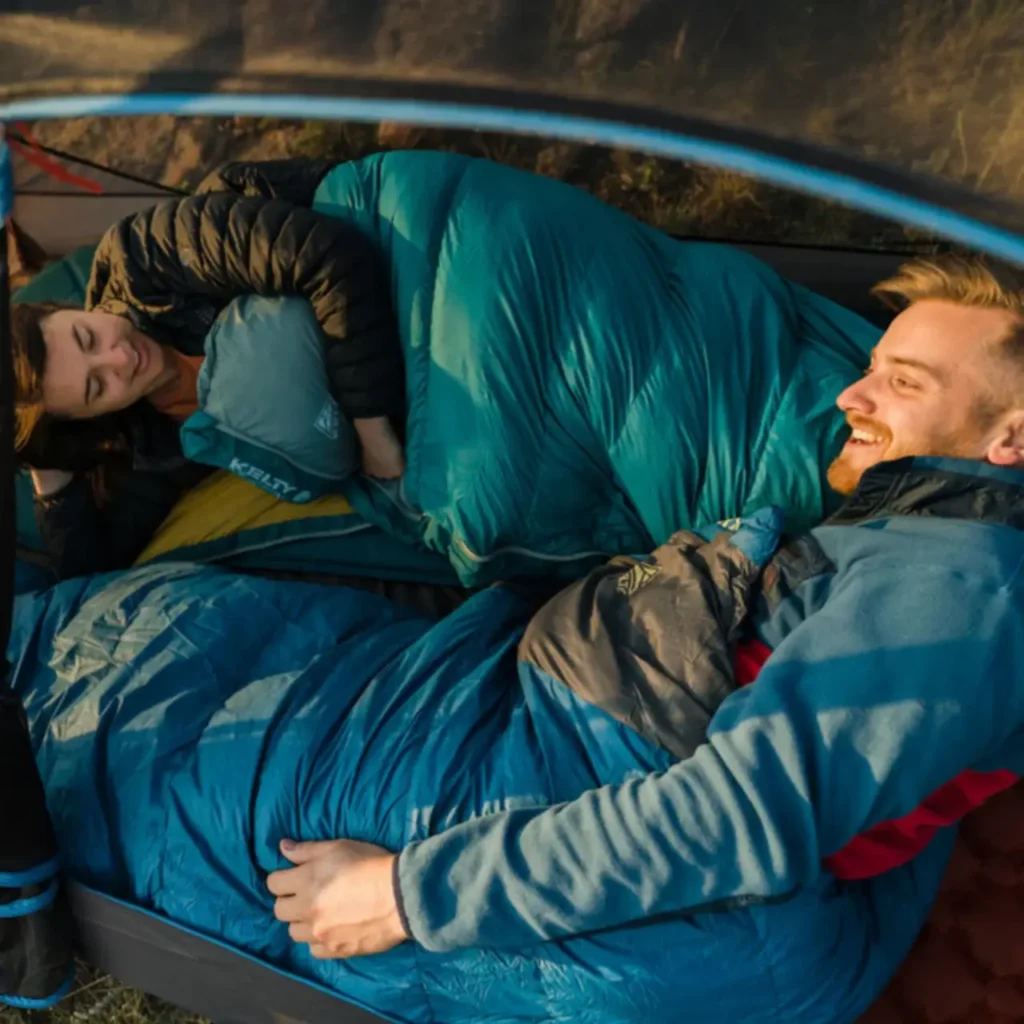
The Kelty Tru.Comfort Doublewide is built for campers who want the tent to feel more like a real bedroom.
It is big. It is heavy. It is not trying to be minimalist. But for couples, family campers, van campers, and comfort-first car campers, that can be exactly the point.
A double sleeping bag creates a shared sleep space instead of forcing two separate bags side by side. That can feel more natural for couples and more comfortable for relaxed campground trips. The extra room also helps campers who dislike the confined feel of single mummy bags.
The Tru.Comfort design is especially useful because each sleeper has more control. Foot vents help with temperature regulation, and built-in blanket-style layers make it easier to adjust warmth during the night. That matters when one person sleeps hot and the other sleeps cold — a common camping reality.
The oversized hood area also works well with pillows from home. Paired with a thick double sleeping pad or camping mattress, this bag can make a tent sleep setup feel much more comfortable than a standard beginner kit.
The downside is obvious: this is not a bag for backpacking, minimalist packing, or tiny storage spaces. It belongs in a car camping setup, van setup, or basecamp-style gear loadout.
For couples who want camping to feel easier and more inviting, the Kelty Tru.Comfort Doublewide is one of the most comfortable options on this list. 😴
Pros:
- Very spacious and comfortable for two people
- Built-in blankets help each sleeper manage warmth
- Foot vents add practical temperature control
- Oversized hood works well with pillows from home
- Excellent for car camping comfort
Cons:
- Very heavy and bulky
- Not suitable for backpacking
- Too large for campers with limited vehicle storage
- Overkill for solo minimalist camping
Who It’s Best For:
Couples, family campers, van campers, and comfort-focused car campers who want a shared sleep system.
Who Should Skip It:
Solo campers, backpackers, and anyone with limited storage space should choose a single sleeping bag instead.
Check Price at REI | Check Price on Amazon
Essential Tips for Using and Caring for Your New Sleeping Bag
A good sleeping bag can last for years, but only if it is used and stored correctly.
Most beginner problems come from a few simple mistakes: sleeping directly on the ground without enough insulation, storing the bag compressed, packing it away damp, or choosing sleep clothing that traps moisture.
These habits make a big difference.
- Always use a sleeping pad.
A sleeping bag does not provide much warmth underneath the body once the insulation is compressed. A sleeping pad creates the warm barrier between the sleeper and the cold ground. For comfort and warmth, the pad is just as important as the bag. - Choose the right sleeping pad for the season.
For warm summer camping, a basic pad may be enough. For spring, fall, mountain trips, or colder nights, look for an insulated pad with a higher R-value. A warm sleeping bag can still feel cold if the pad underneath is too thin. - Store the bag loose.
Do not store a sleeping bag long-term in its tight stuff sack. Compression can damage the loft over time. Use the large storage sack that came with the bag, hang it in a closet, or store it loosely in a breathable bin. - Air it out after every trip.
Even if the bag feels dry, body moisture and tent condensation can linger. Unzip the bag fully and let it air out before storing it. - Use a sleeping bag liner when practical.
A liner helps keep sweat, sunscreen, dirt, and body oils out of the sleeping bag. It is easier to wash a liner than the whole bag. - Sleep in dry base layers.
Clean socks, dry base layers, and a warm beanie can make a sleeping bag feel much warmer. Avoid sleeping in damp hiking clothes. - Vent before overheating.
If the bag feels too warm, unzip it slightly before sweating. Moisture inside the bag can make the early morning feel colder. - Follow the care label.
Down and synthetic bags need different washing and drying methods. Always follow the manufacturer’s instructions before washing.
A sleeping bag works best as part of a complete sleep system. Pair it with a good pad, dry clothing, smart tent ventilation, and a flat campsite, and even a simple beginner bag can feel surprisingly cozy. 🔥
The Final Verdict
The best camping sleeping bag for beginners depends on the kind of camping planned most often.
For most beginner car campers, the REI Co-op Siesta Hooded 20 is the easiest overall recommendation. It is roomy, comfortable, warm enough for many 3-season trips, and much less restrictive than a mummy bag.
For beginners who may want to backpack later, the Kelty Cosmic 20 is the better long-term choice. It packs smaller, weighs less, and gives new campers a bridge between campground camping and trail-based overnights.
For campers who want warmth without the tight feel of a classic mummy bag, the NEMO Tempo 20 Endless Promise Synthetic is a comfortable middle ground. It gives more room to move while still offering better warmth efficiency than a rectangular bag.
The Marmot Trestles Elite Eco 20 is best for campers who want synthetic reliability in a more performance-focused shape, while the Kelty Tru.Comfort Doublewide is the comfort pick for couples and spacious car-camping setups.
A good sleeping bag should make camping feel easier. It should help the night feel warmer, calmer, and more comfortable — so the next morning starts with fresh air, warm coffee, and enough energy to enjoy the day outside. 🌄
Frequently Asked Questions (FAQ)
What temperature rating sleeping bag do beginners really need?
For most 3-season camping in the U.S., beginners should look at sleeping bags rated between 20°F and 35°F. A 20°F bag gives more margin for cool spring and fall nights, while a 30°F or 35°F bag may feel better for warmer summer trips.
A good rule is to choose a bag rated 10–15°F colder than the lowest temperature expected. If the forecast says the low will be around 40°F, a 30°F bag usually gives a more comfortable buffer. If the trip is in the mountains, desert, or shoulder season, a warmer bag is often the safer choice.
Is a 20-degree sleeping bag too warm for summer camping?
It can be, especially on humid summer nights or low-elevation trips. But many 20°F sleeping bags can be unzipped and used more like a quilt when temperatures are mild.
For beginners who want one bag for spring, summer, and fall, a 20°F bag is often more versatile than a summer-only bag. It is easier to vent a warm bag than to make a thin bag warmer on a cold night.
Is down or synthetic better for a first sleeping bag?
Synthetic is usually better for beginner car campers because it is affordable, easier to care for, and performs better when damp. It is a practical choice for campground camping, family trips, and weekend use.
Down is better for beginners who care about weight and packed size. It compresses smaller and carries better in a backpack, which makes it a smart choice for someone who may try backpacking later.
Can a car camping sleeping bag be used for backpacking?
Technically, yes. Practically, it is usually not enjoyable. Car camping sleeping bags are often heavy and bulky, which makes them difficult to pack and carry on the trail.
If backpacking is part of the plan, choose a lighter mummy or relaxed mummy bag from the beginning. The Kelty Cosmic 20 or Marmot Trestles Elite Eco 20 makes more sense than a large rectangular car-camping bag.
What is the most comfortable sleeping bag shape for beginners?
Rectangular bags are usually the most comfortable for beginners because they provide more room to move. They feel more like bedding from home and are less restrictive than mummy bags.
Mummy bags are warmer and more efficient, but they can feel tight. Relaxed mummy or spoon-shaped bags are a good compromise for campers who want warmth without feeling too confined.
Do sleeping bags keep you warm underneath?
Not very well on their own. When body weight compresses the insulation underneath, the bag loses much of its ability to trap warm air in that area.
That is why a sleeping pad is essential. A warm sleeping bag paired with a thin, uninsulated pad can still feel cold from below.
Do beginners need a sleeping bag liner?
A liner is not required, but it is useful. It helps keep the inside of the sleeping bag cleaner, adds a little warmth, and can feel more comfortable against the skin.
For frequent camping, a liner is a smart upgrade because it reduces how often the sleeping bag itself needs to be washed.
Can two sleeping bags zip together?
Some sleeping bags can zip together, but not all. Zipper side, size, brand, and design all matter.
Campers who specifically want a shared sleep setup are usually better off buying a double sleeping bag. A double bag is heavier and bulkier, but it is much more comfortable for couples than trying to connect two incompatible single bags.
How should a sleeping bag be stored at home?
A sleeping bag should be stored loose, dry, and uncompressed. Long-term storage in a tight stuff sack can damage the insulation and reduce warmth over time.
Use the large storage sack that came with the bag, hang it in a closet, or store it loosely in a breathable bin. Make sure it is fully dry before storing.
What is the best beginner sleeping bag for car camping?
For most beginner car campers, the REI Co-op Siesta Hooded 20 is one of the best overall choices because it is roomy, warm, simple, and comfortable.
Campers who want more long-term versatility for backpacking should consider the Kelty Cosmic 20 or Marmot Trestles Elite Eco 20 instead.
Affiliate Disclosure: GearForTheOutdoors.com participates in affiliate programs, including REI, Amazon, REI Outlet, Garage Grown Gear, evo, and other trusted partners. When you purchase through links on this site, GearForTheOutdoors.com may earn a small commission at no extra cost to you. That helps support the content and keeps recommendations useful, practical, and free.
Disclaimer: This post is for informational purposes only. Always verify current product details, fit, availability, safety information, and manufacturer warranties before purchase or use. Outdoor conditions and gear performance can vary depending on setup, weather, terrain, and experience level.