A camping pillow may look like a small luxury until the first morning after sleeping with a jacket stuffed under your head. Uneven support, sliding layers, and a stiff neck can turn an otherwise comfortable sleep system into a restless night.
A purpose-built pillow solves that problem without necessarily taking up much pack space. Today’s best camping pillows range from sub-2-ounce inflatables built for backpacking to plush foam models that feel much closer to the pillow on a bed at home.
The trick is choosing the right kind of comfort for the way you camp. A car camper has little reason to sacrifice softness just to save a few ounces. A backpacker carrying everything for 10 miles has the opposite problem. Side sleepers often need more height, while back sleepers may be happier with a thinner, softer setup.
🏕️ The six pillows below cover those different needs, with current models selected for backpacking, car camping, side sleeping, ultralight trips, premium comfort, and budget-conscious camping. Several older products from the original lineup have also been updated to their current versions, including the Therm-a-Rest Compressible Pillow Cinch and the latest Sea to Summit Aeros designs.
Top Camping Pillow Picks
| Pillow | Category | Weight | Best For |
|---|---|---|---|
| Sea to Summit Aeros Premium | Best Overall | 3.5 oz. (Regular) | Backpacking + all-around camping |
| NEMO Fillo | Most Comfortable | 9.2 oz. | Side sleepers + comfort-focused campers |
| Therm-a-Rest Compressible Pillow Cinch | Best Foam Pillow | 8 oz. (Small) | Car camping + home-like comfort |
| Sea to Summit Aeros Ultralight | Best Ultralight | 1.9 oz. (Regular) | Thru-hiking + lightweight backpacking |
| Sea to Summit Aeros Down | Best Premium Backpacking Pillow | 2.5 oz. (Regular) | Softness without much weight |
| TREKOLOGY Aluft 2.0 | Best Budget Buy | About 3.4 oz. | Beginners + budget-conscious campers |
The Sea to Summit Aeros Premium is the strongest all-around choice for most campers because it lands in the useful middle ground: light enough for backpacking, compact enough for small packs, yet considerably more comfortable than a bare-bones inflatable.
If comfort matters more than weight, the NEMO Fillo is the better fit. For car camping, the Therm-a-Rest Compressible Pillow Cinch provides an even softer, more familiar feel without an air chamber underneath.
Backpackers trying to trim every possible ounce should look closely at the Sea to Summit Aeros Ultralight, while the Aeros Down adds a softer down layer for surprisingly little extra weight. The TREKOLOGY Aluft 2.0 remains a practical low-cost alternative and is still sold by the manufacturer for the U.S. market.
How to Choose the Best Camping Pillow
Camping pillows seem simple until several nights are spent actually sleeping on them. Height, surface fabric, shape, firmness, and how well the pillow stays on the sleeping pad can matter just as much as weight.
Start with one question: How far does the pillow need to be carried?
If the answer is from the car trunk to the tent, there is little reason to tolerate an uncomfortable ultralight pillow. If the pillow needs to travel 15 miles into the backcountry, a bulky foam model suddenly becomes much harder to justify.
🎒 Your sleeping position matters too. Side sleepers generally need more loft to fill the space between the shoulder and head. Back sleepers can often use a lower pillow, while stomach sleepers typically benefit from something relatively thin or only partially inflated.
Types of Camping Pillows
There are three main types of camping pillows, and each has a different feel once the tent gets quiet and it is finally time to sleep.
Inflatable pillows are the clear choice when weight and packed size matter most. They compress into tiny stuff sacks and can weigh less than two ounces. Firmness is also adjustable: let out a little air and the surface becomes less rigid.
The trade-off is feel. A fully inflated pillow can feel springy, especially if the face fabric is thin. Inflatable models can also move around on slick sleeping pads unless the design includes a contoured underside, grip surface, strap, or pad-attachment system.
Compressible pillows use foam or synthetic fill instead of relying on an air bladder. They are quieter, softer, and generally feel more like something from a bedroom.
Their weakness is easy to spot in a packed car or backpack: bulk. Even compressed, foam takes up substantially more space than an inflatable pillow.
Hybrid pillows combine an air chamber with foam, synthetic insulation, or down on top. For many campers, this is the sweet spot. The air chamber provides adjustable height, while the soft upper layer reduces the hard, balloon-like feel that turns some people away from inflatables.
Key Features to Consider
Weight & Packability
For backpacking, pillow weight should make sense relative to the rest of the sleep system.
A 1.9-ounce inflatable such as the current Sea to Summit Aeros Ultralight barely affects pack weight. A 9-ounce hybrid like the NEMO Fillo asks for a bigger commitment, but that extra weight buys a much softer sleeping surface.
For car camping, weight should move much farther down the priority list. Comfort, pillow size, and how the pillow feels against the face are usually more important.
🌲 Packed volume can matter even when weight does not. A family loading sleeping bags, pads, chairs, cooking gear, and food into a vehicle may still appreciate a pillow that does not occupy half a duffel bag.
Comfort & Support
A pillow should keep the head and neck in a reasonably neutral position rather than simply creating something soft to lie on.
For side sleepers, height is especially important. A pillow that compresses completely under the head can leave the neck angled downward toward the sleeping pad. Adjustable inflatables and hybrids make it easier to experiment with loft.
Back sleepers may prefer slightly less air. Inflating a camping pillow to maximum pressure often makes it feel harder and more unstable than necessary.
One of the easiest improvements is simply letting some air out.
A slightly underinflated pillow usually allows the head to settle into the center instead of balancing on top of a tight air chamber.
Surface Fabric
Camping pillows spend hours against the face, so the fabric deserves more attention than it usually gets.
Soft stretch-knit polyester, jersey, brushed fabrics, and down-backed surfaces tend to feel more comfortable than slick technical nylon.
Thin ultralight fabrics save weight but usually feel more technical. That does not automatically make them uncomfortable, but campers who dislike the sensation of sleeping directly against a sleeping-pad-style fabric may be happier with a foam-topped hybrid.
😴 A T-shirt or lightweight pillowcase can also soften the surface, especially on longer trips when sweat, sunscreen, and trail dust begin accumulating on gear.
Shape and Pillow Stability
One of the most frustrating camping-pillow problems has nothing to do with softness: the pillow keeps escaping.
A slippery pillow on a slippery sleeping pad can gradually migrate toward the tent wall every time the sleeper moves.
Contoured surfaces help cradle the head, while curved lower edges can sit more naturally around the shoulders. Some pillows also use attachment systems or nonslip surfaces.
Sea to Summit’s current Aeros pillows, for example, include PillowLock patches designed to help secure compatible pillows to camping mats.
Durability & Valve Design
Inflatable pillows depend on two things that foam pillows do not: an airtight bladder and a dependable valve.
A good valve should make inflation quick, allow small pressure adjustments, and release air quickly when packing up.
Material durability matters too, especially for ultralight models. A pillow normally lives in the relatively protected environment of a tent, but keeping sharp objects, pine needles, dog claws, and exposed zippers away from thin inflatable fabric is still smart.
The Best Camping Pillows Reviewed
1. Sea to Summit Aeros Premium Pillow
Best Overall
| Spec | Detail |
|---|---|
| Weight | 3.5 oz. Regular / 5.3 oz. Large |
| Dimensions | Regular: 13.4 x 9.4 x 4.3 in. / Large: 16.9 x 11.8 x 4.7 in. |
| Fill Type | Hybrid-style inflatable with foam top layer |
| Surface | Recycled stretch-knit fabric |
| Best Use | Backpacking + camping |
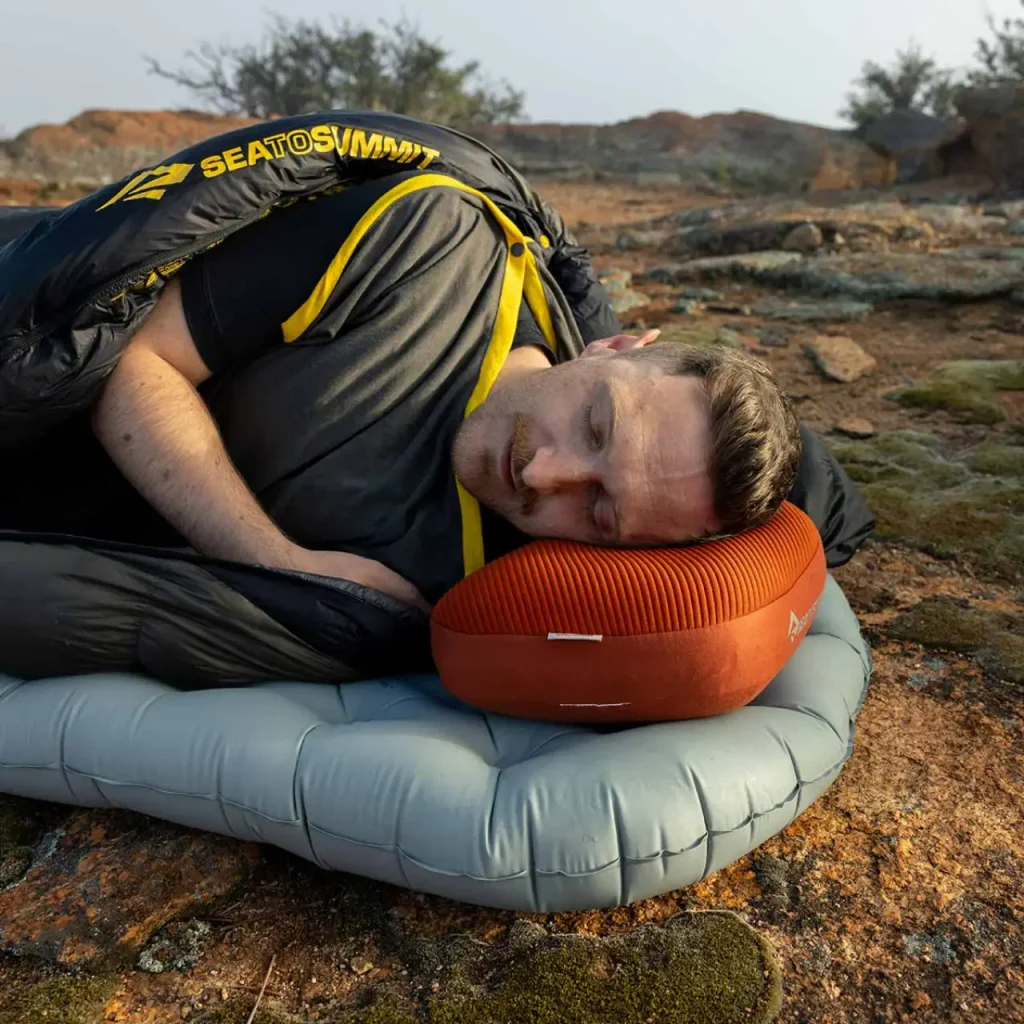
The latest Sea to Summit Aeros Premium is the camping pillow that makes the most sense for the broadest range of people.
At 3.5 ounces in the Regular size, it is still light enough to disappear into a backpack without creating the kind of comfort compromise found in many stripped-down ultralight pillows. The current version uses a memory-foam top layer over the adjustable air chamber, along with a soft 3D-knit surface.
That combination matters after several nights outdoors. Instead of placing the head directly on a taut inflatable surface, the foam layer adds a little cushioning and makes the pillow feel less obviously inflatable.
The concave top helps keep the head centered, while the scalloped edge gives the shoulders somewhere to settle instead of pushing the pillow farther up the sleeping pad.
🏕️ Firmness is adjustable through the XPRESS valve, and Sea to Summit includes PillowLock patches that can be attached to most camping mats. That helps solve one of the most common nighttime annoyances: waking up because the pillow has slid toward the corner of the tent.
The Aeros Premium is not the lightest pillow in this guide and not the softest. That is exactly why it works so well as an all-around option—it sits between those extremes.
What We Like:
- Excellent balance of weight and comfort
- Foam top softens the inflatable feel
- Adjustable firmness
- Supportive concave shape
- PillowLock system helps prevent sliding
- Small enough for backpacking
What We Don’t Like:
- More expensive than basic inflatable pillows
- Comfort-focused backpackers may still prefer the thicker NEMO Fillo
Best For: Backpackers and campers who want one pillow that can work equally well for trail trips, campground weekends, and travel.
2. NEMO Fillo Pillow

Most Comfortable
| Spec | Detail |
|---|---|
| Weight | 9.2 oz. |
| Dimensions | 17 x 11 x 4 in. |
| Fill Type | Hybrid: air cell + foam |
| Fabric | Polyester jersey |
| Best Use | Camping + comfort-focused backpacking |
The NEMO Fillo is the better choice when the question is not “How little can this pillow weigh?” but “How comfortably can someone actually sleep on it?”
A 3-inch I-beam baffled air cell provides structure, but thick foam sits above it, creating a softer and more forgiving surface than most inflatable camping pillows. NEMO also uses a removable, machine-washable recycled fabric cover and a microadjustable valve for controlling firmness.
That combination is especially appealing for side sleepers. The four-inch overall height provides enough loft to work with broader shoulders, while the foam reduces the hard edge that can develop when a pure inflatable needs extra pressure to stay tall.
At 9.2 ounces, however, the Fillo is much heavier than an Aeros Ultralight or Aeros Premium. That makes the decision straightforward.
🥾 For a thru-hiker trying to cut pack weight, it is hard to justify. For a camper who repeatedly sleeps poorly on thin inflatable pillows, those extra ounces may be some of the most worthwhile weight in the pack.
It also makes sense for road trips and car camping, where a few extra ounces are essentially irrelevant.
What We Like:
- Thick foam creates a noticeably softer surface
- Excellent support for side sleepers
- Adjustable firmness
- Removable, washable cover
- Integrated stuff sack
- Comfortable enough for travel as well as camping
What We Don’t Like:
- Considerably heavier than ultralight pillows
- Bulkier than simple inflatable models
Best For: Side sleepers, car campers, and backpackers who place sleep comfort ahead of shaving every possible ounce.
3. Therm-a-Rest Compressible Pillow Cinch
Best Foam Pillow
| Spec | Detail |
|---|---|
| Weight | 8 oz. Small / 11.5 oz. Medium / 1 lb. Large |
| Dimensions | Small: 15 x 11 x 5 in. / Medium: 18 x 13 x 6 in. / Large: 22 x 15 x 7 in. |
| Fill Type | Upcycled urethane foam |
| Fabric | Polyester shell |
| Best Use | Car camping + travel |
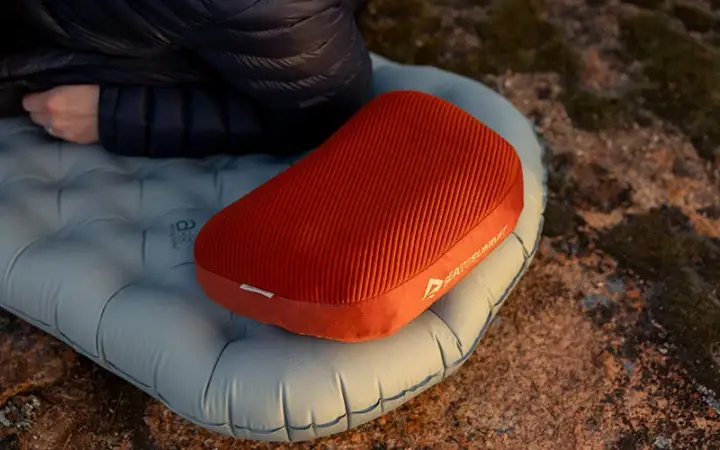
Anyone who dislikes inflatable pillows should start here.
The current Therm-a-Rest Compressible Pillow Cinch keeps the straightforward appeal of the long-running Compressible Pillow but adds a cinch cord that lets the sleeper adjust the shape and firmness.
Inside is upcycled foam left over from Therm-a-Rest sleeping-pad production, covered by a soft polyester shell. A light insulation layer across the top helps smooth the sleeping surface instead of leaving individual foam pieces pushing against the fabric.
There is no valve to open and no air pressure to fine-tune. Unpack it, allow the foam to expand, adjust the cinch, and settle in.
☕ That simplicity feels particularly good during relaxed campground mornings and multi-night base camps, where the goal is comfortable sleep rather than minimum pack weight.
The penalty is bulk. Even the Small is noticeably larger when packed than an inflatable. Backpackers trying to fit everything into a compact pack will probably find better options elsewhere.
For car camping, however, that drawback matters much less.
What We Like:
- Soft, quiet foam feel
- No inflation required
- Adjustable cinch changes firmness and shape
- Machine-washable
- Multiple sizes
- Foam is upcycled from sleeping-pad production
What We Don’t Like:
- Too bulky for most weight-conscious backpacking
- Heavier than inflatable pillows
Best For: Car campers, van travelers, road trippers, and anyone who strongly prefers a traditional pillow feel.
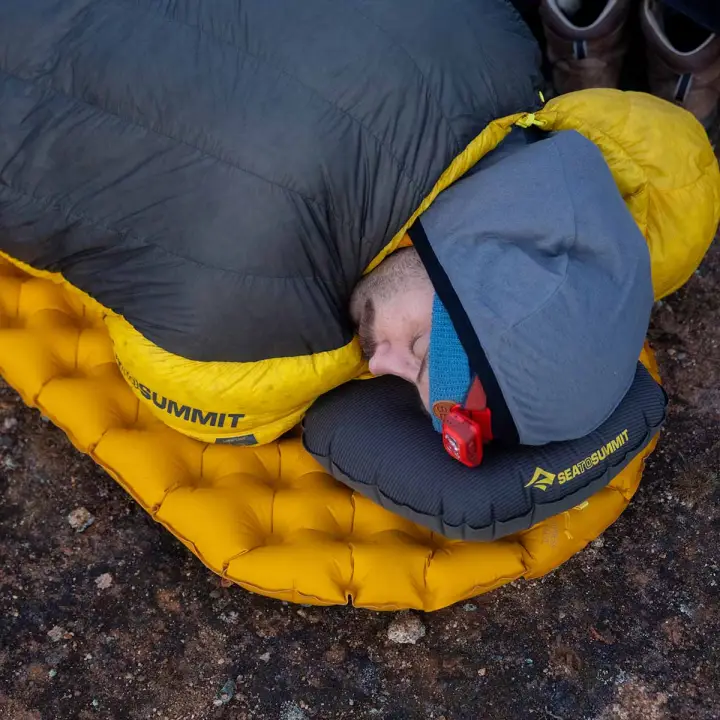
4. Sea to Summit Aeros Ultralight Pillow
Best Ultralight
| Spec | Detail |
|---|---|
| Weight | 1.9 oz. Regular / 2.8 oz. Large |
| Dimensions | Regular: 13.4 x 10.2 x 4.3 in. / Large: 17.7 x 12.2 x 4.7 in. |
| Fill Type | Inflatable |
| Best Use | Ultralight backpacking |
At just 1.9 ounces in Regular, the current Sea to Summit Aeros Ultralight makes a convincing case against using a stuff sack full of spare clothes as a pillow.
This is the model for trips where every piece of gear earns its space.
The pillow inflates through Sea to Summit’s mini XPRESS valve and offers up to 4.3 inches of adjustable thickness in the Regular size. A concave upper surface helps cradle the head, while the scalloped lower edge gives the shoulders space to settle naturally.
There is no foam topper here. That saves weight but also means the sleeper is much more aware that the pillow is inflatable.
The best way to use it is rarely at maximum pressure. Letting a little air escape allows the head to settle deeper into the center, reducing bounce and giving the pillow a more forgiving feel.
⛰️ For long-distance backpacking, that is a reasonable trade: real head support for less than two ounces.
For campground weekends where the pillow only travels from the trunk to the tent, there is little reason to make the same compromise.
What We Like:
- Exceptionally light
- Tiny packed size
- Adjustable firmness
- Supportive contoured shape
- PillowLock compatibility
- Current model uses recycled materials
What We Don’t Like:
- Less plush than hybrid or foam pillows
- Can feel firm if overinflated
- Comfort is intentionally sacrificed to save weight
Best For: Thru-hikers, ultralight backpackers, fast-and-light trips, and anyone trying to keep sleep-system weight as low as possible.
5. Sea to Summit Aeros Down Pillow

Best Premium Backpacking Pillow
| Spec | Detail |
|---|---|
| Weight | 2.5 oz. Regular / 3.2 oz. Large |
| Dimensions | Regular: 13.4 x 9.4 x 4.7 in. / Large: 16.5 x 11 x 4.7 in. |
| Fill Type | Air chamber + 650-fill-power duck down |
| Fabric | Soft-touch recycled nylon |
| Best Use | Lightweight backpacking with extra comfort |
The Sea to Summit Aeros Down is for backpackers who look at ultralight gear and think, “Almost—but make it softer.”
Instead of placing the face directly against a thin inflatable shell, the Aeros Down adds a layer of 650-fill-power duck down above the air chamber. The Regular still weighs only 2.5 ounces.
That is an impressive comfort-to-weight ratio.
The air chamber controls the pillow’s height and support, while the down layer adds softness and reduces the stark inflatable feel. The result sits much closer to the Aeros Ultralight in weight than to the NEMO Fillo, yet provides a noticeably softer sleeping surface.
🌙 The down does not transform it into a full-size bedroom pillow. It is still a compact backpacking pillow with an inflatable core.
But for someone who dislikes sleeping directly on technical fabric, those few extra fractions of an ounce can make the sleep system feel considerably more refined.
It is also available in Regular, Large, and XL sizes, giving campers more flexibility than most lightweight backpacking pillows.
What We Like:
- Excellent comfort for the weight
- Soft down top layer
- Adjustable firmness
- Lightweight enough for backpacking
- PillowLock-compatible design
- Multiple sizes
What We Don’t Like:
- Premium price
- Still feels like an inflatable underneath the down
- NEMO Fillo is more comfortable when weight does not matter
Best For: Backpackers willing to spend more for a softer pillow without adding much pack weight.
6. TREKOLOGY Aluft 2.0 Inflatable Pillow

Best Budget Buy
| Spec | Detail |
|---|---|
| Weight | About 3.4 oz. |
| Dimensions | About 16 x 12 x 4 in. |
| Packed Size | About 5 x 2 in. |
| Fill Type | Inflatable |
| Best Use | Budget camping + backpacking |
Camping pillows do not have to cost $50 or more.
The TREKOLOGY Aluft 2.0 remains a useful entry-level option for campers who want to stop sleeping on bundled-up clothing without spending premium-brand money. The manufacturer currently lists the U.S. Aluft 2.0 at $19.99 and in stock.
It is a simple inflatable pillow with an ergonomic shape, adjustable air pressure, nonslip dots, and a strap designed to help keep the pillow connected to a sleeping pad.
Those features matter more than fancy materials when the main goal is simply keeping the head supported through the night.
At roughly 16 x 12 x 4 inches inflated, it also provides enough size and loft to be useful for a range of sleeping positions while still packing down to around 5 x 2 inches.
💤 The main compromise is surface feel. There is no thick foam or down layer between the sleeper and the air chamber, so it cannot match the NEMO Fillo or Aeros Down for softness.
That is acceptable at this price. For occasional campers, Scouts, beginners, or anyone assembling a camping setup on a limited budget, the Aluft 2.0 handles the core job well.
What We Like:
- Low price
- Lightweight
- Small packed size
- Adjustable firmness
- Nonslip surface and pad strap
- Still currently available
What We Don’t Like:
- Less refined surface than premium models
- Not as soft as foam or down-topped alternatives
- Basic construction compared with higher-end options
Best For: Beginners, occasional campers, families buying multiple pillows, and anyone prioritizing price over premium materials.
Final Verdict
A good camping pillow does not need to feel luxurious. It needs to solve the problem that matters most for the way the reader actually sleeps outdoors.
For backpackers who want a strong balance of comfort, packability, and low weight, the Sea to Summit Aeros Premium is the most versatile choice. The latest version adds a softer foam layer while staying light enough for trail use.
For campers who regularly wake up because inflatable pillows feel too hard or unstable, the NEMO Fillo is worth carrying. The added foam and larger sleeping surface make it one of the better options for side sleepers and comfort-first campers.
For car camping, the decision gets easier: the Therm-a-Rest Compressible Pillow Cinch provides the soft, quiet feel of foam without any need to inflate a pillow at the end of the day.
🥾 Backpackers chasing minimum weight should go straight to the Sea to Summit Aeros Ultralight. Campers who want nearly the same packability with a softer surface should look at the Aeros Down instead.
And for someone buying a first camping pillow without wanting to spend much, the TREKOLOGY Aluft 2.0 remains a practical budget choice.
The important part is matching the pillow to the trip. A two-ounce inflatable is brilliant on a long backpacking route and unnecessary at a drive-up campground. A plush foam pillow can be wonderful in the tent and frustrating when it takes up valuable room in a backpack.
Better sleep usually comes from choosing the right compromise—not simply choosing the lightest or most expensive pillow.
FAQ About Camping Pillows
Is a camping pillow really worth it?
For most regular campers, yes. A dedicated pillow provides more consistent height and head support than a rolled jacket or clothing-filled stuff sack.
The difference becomes more noticeable over several nights, especially for side sleepers or anyone prone to waking with neck stiffness.
Modern inflatable pillows can weigh less than two ounces, so backpackers no longer need to make a large weight sacrifice just to have a real pillow.
Which camping pillow is best for side sleepers?
Side sleepers generally benefit from more loft because the pillow needs to fill the space created by the shoulder.
The NEMO Fillo is particularly well suited to this because its foam-covered air chamber provides about four inches of height while remaining adjustable.
The Sea to Summit Aeros Premium can also work well, especially when pack weight matters more.
Should a camping pillow be fully inflated?
Usually not.
A pillow inflated until it becomes completely rigid can feel springy and push the head upward instead of supporting it comfortably.
Try inflating the pillow fully and then releasing a small amount of air once lying on the sleeping pad. The goal is enough height to support the neck while still allowing the head to settle naturally into the pillow.
🏕️ Small adjustments can make a surprisingly large difference.
How do you stop a camping pillow from sliding off a sleeping pad?
Start with any built-in attachment system.
Current Sea to Summit Aeros pillows include PillowLock patches designed to help keep the pillow connected to a camping mat.
Other models use nonslip fabrics or straps.
Without those features, placing the pillow inside the hood of a mummy sleeping bag can help. A T-shirt pulled over the pillow can also increase friction between the pillow and pad.
Is foam or inflatable better for camping?
Neither is universally better.
Choose foam or compressible fill when softness, quietness, and a home-like feel matter most.
Choose inflatable when low weight and packed size matter most.
Choose a hybrid when both matter. Models such as the Sea to Summit Aeros Premium and NEMO Fillo use an inflatable core with softer material above it, providing more comfort without requiring a full-size foam pillow.
Can a stuff sack filled with clothes replace a camping pillow?
Yes, especially on occasional trips.
A stuff sack filled with a fleece, puffy jacket, or spare clothing can provide basic head support without adding another piece of gear.
The downside is consistency. Clothing shifts, compresses unevenly, and can create pressure points during the night. A dedicated pillow provides a predictable shape and height every time.
It also leaves warm clothing available for its intended purpose if temperatures drop overnight.
Which camping pillow is best for backpacking?
For most backpackers, the Sea to Summit Aeros Premium offers the strongest balance of comfort and low weight.
For ultralight trips where every ounce matters, the Sea to Summit Aeros Ultralight drops the Regular size to 1.9 ounces.
For backpackers willing to carry more weight for better comfort, the NEMO Fillo provides a much softer sleeping surface.
Which camping pillow is best for car camping?
The Therm-a-Rest Compressible Pillow Cinch makes the most sense when packed size is not a major limitation.
Its foam construction feels softer and quieter than a pure inflatable, and it is available in multiple sizes, including a Large measuring 22 x 15 x 7 inches.
For campers wanting something even more compact while retaining excellent comfort, the NEMO Fillo is another strong choice.
How do you wash a camping pillow?
Follow the manufacturer’s care instructions first because inflatable, foam, down, and hybrid designs need different treatment.
Removable fabric covers are generally the easiest to clean. The NEMO Fillo has a removable machine-washable cover, while the Therm-a-Rest Compressible Pillow Cinch itself is machine-washable.
Inflatable pillows should be completely dry before being packed away for long-term storage.
Keeping the pillow clean is also easier if sunscreen, bug spray, and skin oils are not allowed to build up on the surface. A clean T-shirt makes an easy improvised pillowcase on longer trips.
Affiliate Disclosure: GearForTheOutdoors.com participates in affiliate programs, including REI, Amazon, REI Outlet, Garage Grown Gear, evo, and other trusted partners. When you purchase through our links, we may earn a small commission at no extra cost to you. That helps support our content and keeps our recommendations useful, practical, and free.
Disclaimer: This post is for informational purposes only. Always verify current product details, fit, availability, safety information, and manufacturer warranties before purchase or use. Outdoor conditions and gear performance can vary depending on setup, weather, terrain, and experience level.