
A pillow can seem like a minor piece of camping gear—right up until a stiff neck turns the first morning of a trip into a slow start.
Stuffing a fleece or puffy jacket into a sack works in a pinch, but the result tends to shift, flatten, and develop uncomfortable lumps as the night goes on. At the other extreme, many ultralight inflatable pillows pack beautifully but can feel firm, slippery, or a little too much like sleeping on a balloon.
The NEMO Fillo sits between those two approaches. Instead of relying on air alone, it combines a baffled inflatable core with a layer of soft foam and a fabric cover. The result is a compact camp pillow that feels noticeably more familiar under the head while still packing small enough for camping, travel, and backpacking.
That balance is the main reason the Fillo remains interesting. At 9.2 ounces, it is not an ultralight pillow. But for campers and backpackers who sleep better with more cushioning and a softer surface, the extra weight may be easier to justify than another night spent reshaping a jacket beneath the sleeping bag hood.
This NEMO Fillo review looks at how the pillow actually fits into a sleep system, what kind of sleeper is most likely to appreciate it, where its limitations show up, and how the current Fillo lineup compares with other popular camping pillows. 🏕️
Quick Verdict: The NEMO Fillo at a Glance
The standard NEMO Fillo is best thought of as the comfort-focused middle ground between a bulky foam pillow and a minimalist inflatable.
Its 17 x 11 x 4-inch shape gives the head enough room to settle in without taking over the top of a sleeping pad. Inside, a 3-inch I-beam baffled air cell provides the structure, while a thick foam layer softens the surface and reduces the rigid feel common to simpler inflatable pillows. The firmness can be adjusted by letting small amounts of air out through the microadjust valve.
| Feature | NEMO Fillo |
|---|---|
| Pillow Type | Hybrid air + foam |
| Weight | 9.2 oz / 261 g |
| Dimensions | 17 x 11 x 4 in. |
| Air Cell | 3 in. I-beam baffled air cell |
| Cover | Soft removable, machine-washable recycled fabric |
| Stuff Sack | Integrated |
| Firmness | Microadjustable |
| Best For | Car camping, travel, comfort-focused backpacking |
Best fit: campers who dislike the hard, springy feel of basic air pillows and would rather carry a little more weight for a softer place to land at night.
Think twice if: every ounce in the backpack matters, or a side sleeper needs considerably more than four inches of loft to keep the neck aligned.
Check Price & Availability at REI
Check Price & Availability on Amazon
A Deep Dive Into the NEMO Fillo’s Design
The Fillo does not stand out because of one dramatic feature. Its strength is that several small details work together to make sleeping in a tent feel less improvised.
The Hybrid Engine: Air Bladder Meets Foam
The biggest difference between the Fillo and a basic inflatable pillow becomes obvious as soon as the head hits the surface.
A traditional air pillow depends almost entirely on pressure for support. Add too much air and the pillow can feel hard and rounded. Let too much out and the head may sink toward the sleeping pad.
The Fillo adds foam above the inflatable structure. That layer takes some of the edge off the air chamber, creating a softer transition beneath the head and ears.
The baffled air cell underneath still does the heavy lifting. Inflate it more for firmer support, or bleed out a little air to create more give around the head and neck. NEMO uses a 3-inch I-beam baffled air cell specifically to help the pillow hold its shape without developing the exaggerated rounded feel of a simple air bladder.
That adjustability matters more than it may seem. A pillow that feels comfortable while lying on the back can suddenly feel too tall or too firm after rolling onto the side. Being able to soften it without rebuilding the entire camp bed makes it much easier to find a usable middle ground. 😴
The foam also helps isolate the sleeper from some of the plasticky sensation associated with ultralight inflatable pillows. It does not turn the Fillo into a full-size bedroom pillow, but the surface feels more forgiving and substantial.
The Cover: Soft, Practical, and Washable
Camping pillows spend the night against skin, hair, sunscreen, sweat, bug spray residue, and whatever dust managed to enter the tent before the door was zipped.
A removable cover is therefore more useful than it might sound on a spec sheet.
The current Fillo uses a soft recycled fabric cover that can be removed and machine washed. That makes cleanup straightforward after dusty road trips, humid summer camps, or several consecutive nights outside.
The fabric also creates a more comfortable next-to-skin surface than sleeping directly against coated nylon or TPU.
On cool evenings, that small layer of softness can make a surprising difference. Instead of resting a cheek against a cold, slick inflatable surface, the pillow feels closer to something that belongs in a normal bedding setup.
The Valve: Where Comfort Gets Fine-Tuned
Pillow firmness is highly personal, and the Fillo works better when it is not automatically inflated as hard as possible.
The current valve allows small pressure adjustments rather than forcing the sleeper to choose between fully inflated and noticeably soft. NEMO describes it as microadjustable, with quick inflation and deflation.
For many sleepers, the most comfortable setup is to inflate the pillow, lie down in the actual sleeping position, and then release air gradually.
That last step is important.
A pillow that feels perfect while sitting upright in a tent can feel too firm once the shoulders settle into a sleeping pad. Adjust it while lying down instead, especially when using a thick inflatable mattress that allows the shoulder to sink farther into the pad.
Side sleepers may prefer more pressure and height. Back sleepers can often release more air and let the head settle naturally into the center.
The Stuff Sack: Built In, So It Is Harder to Lose
Tiny accessory sacks have an impressive ability to disappear into gear bins.
The Fillo avoids that problem by integrating its storage pouch into the pillow itself. Once deflated, the pillow folds and rolls into the attached sack instead of requiring a separate storage bag.
It takes a little more compression than simply deflating a bare air pillow because of the foam layer, but the tradeoff is a much softer sleeping surface once camp is set up.
For car camping, the packed size is almost irrelevant. For backpacking, the important question is whether the extra volume and roughly nine-ounce weight make sense compared with lighter alternatives.
That answer depends heavily on how much sleep quality affects the following day on trail. 🌲
The Fillo Family: Which NEMO Pillow Is Right for You?

The Fillo lineup has changed, and choosing between the current versions is more useful than comparing the standard model with older Fillo configurations.
NEMO currently lists five Fillo models: the Fillo, Fillo Wide, Fillo Elite, Fillo Elite Wide, and Fillo King.
| Model | Weight | Inflated Size | Best Use | Main Difference |
|---|---|---|---|---|
| NEMO Fillo | 9.2 oz | 17 x 11 x 4 in. | Camping, travel, comfort-focused backpacking | Best balance of foam comfort and packability |
| NEMO Fillo Wide | 12 oz | 20 x 11 x 4 in. | Camping, side sleepers, mixed use | Wider surface and underside shockcord |
| NEMO Fillo Elite | 3 oz | 15 x 11 x 3 in. | Backpacking | Major weight savings |
| NEMO Fillo Elite Wide | 4 oz | 21 x 11 x 3 in. | Backpacking with more room | Wider ultralight design |
| NEMO Fillo King | 13.6 oz | 17 x 14 x 6 in. | Car camping, van life, side sleepers | Tallest and most bedroom-like option |
Current specifications are based on NEMO and REI listings.
NEMO Fillo: The Best All-Around Choice
For most campers considering the Fillo family, the standard version is the easiest place to start.
It keeps the thick foam layer that gives the pillow much of its appeal, but remains compact enough for travel and occasional backpacking. At 9.2 ounces, it will never appeal to strict ultralight hikers, yet it is still dramatically easier to pack than a household pillow.
The four-inch height also works for a broad range of sleeping positions.
Back sleepers may want to release some air so the neck does not get pushed forward. Side sleepers can leave more pressure inside, although anyone with broad shoulders may still want more loft.
For one pillow that moves between a campground, road trip, airplane, and weekend backpack, this is the most versatile option.
NEMO Fillo Elite: When Pack Weight Matters More
The Fillo Elite changes the equation substantially.
At only 3 ounces, it cuts more than six ounces from the standard Fillo. Its dimensions shrink to 15 x 11 x 3 inches, and the cushioned layer is lighter and less plush than the thick foam used in the standard model.
That makes it much easier to justify on backpacking trips where every small item is competing for space and weight.
The tradeoff shows up most clearly for side sleepers. Three inches of height may not create enough distance between the sleeping pad and head for broader shoulders, even when the pillow is fully inflated.
For back sleepers or hikers who mainly want something far more consistent than bundled clothing without carrying a nine-ounce pillow, the Elite makes much more sense.
NEMO Fillo Wide: More Room to Move
The Fillo Wide keeps the plush foam-and-air approach of the standard pillow but stretches the sleeping surface to 20 inches wide.
That extra room is useful for sleepers who tend to roll from side to side and occasionally wake up with half their face hanging beyond the edge of a smaller camp pillow.
It weighs 12 ounces, so this version leans more toward comfort than weight efficiency. The underside also has shockcord lacing that can hold an extra layer—such as folded clothing—to increase support beneath the pillow.
That feature can be particularly useful for side sleepers who like the Fillo feel but need a little more height.
For long backpacking trips, twelve ounces will be difficult to justify for many hikers. For mixed car camping and short-distance backpacking, however, the wider surface can make camp feel considerably more relaxed.
NEMO Fillo Elite Wide: The Interesting Backpacking Middle Ground
The Fillo Elite Wide may be the most interesting option for backpackers who dislike tiny pillows.
It weighs only 4 ounces but expands the width to 21 inches, compared with 15 inches on the regular Elite. Height remains three inches.
That means it does not solve every side-sleeper loft issue, but it does solve another common problem: rolling off a narrow pillow during the night.
The current model uses a baffled air cell with recycled Zerofiber insulation for cushioning and packs into an integrated stuff sack.
For hikers trying to keep base weight low without sleeping on something that feels tiny, this is arguably the most practical compromise in the family.
NEMO Fillo King: For Car Camping and Side Sleepers
The former idea of a generic “Fillo Luxury” is better represented in the current lineup by the Fillo King.
This is a significantly different pillow from the Elite models.
It measures 17 x 14 inches and rises to 6 inches tall, making it the loftiest Fillo currently listed. Weight climbs to 13.6 ounces, which makes its intended use fairly clear: car camping, van life, road trips, and camps where comfort matters more than counting ounces.
The six-inch height is especially relevant for side sleepers and people with broader shoulders. Instead of stacking clothing underneath a shorter pillow, the Fillo King provides substantially more vertical support from the start.
It also uses repurposed foam from NEMO sleeping pad production over a baffled air core, with a removable machine-washable jersey cover.
For backpacking, it is excessive for most people.
For a tent set up beside the car with a thick sleeping pad, comfortable sleeping bag, and no concern about pack weight, it makes much more sense. 🏕️
Real-World Performance: Where Does the Fillo Shine?
Specs help narrow a gear list. Comfort becomes easier to understand once the pillow is placed into an actual camp setup.
For Car Camping & Van Life
This is where the standard Fillo, Fillo Wide, and Fillo King make the strongest case.
Weight matters very little when the pillow is moving from a gear bin to a tent twenty feet away. What matters instead is whether the sleep system feels comfortable after a long day hiking, driving, paddling, or setting up camp.
On a thick self-inflating mattress or camp bed, the standard Fillo adds enough cushioning to feel substantially more polished than a lightweight air pillow.
The Fillo King goes further. Its six-inch height is better suited to campers accustomed to a taller bedroom pillow, especially when sleeping on the side.
The washable covers are another advantage here. Car-camping gear tends to get tossed onto picnic tables, tent floors, seats, and dusty storage bins. Being able to remove and wash the sleeping surface keeps the pillow easier to live with over multiple seasons.
For Backpacking
Backpacking exposes the biggest weakness of the standard Fillo: 9.2 ounces is a meaningful amount of weight for one pillow.
For a weekend trip where the pack is already reasonably light, that may be completely acceptable. Sleep is part of recovery, and carrying a few additional ounces can be worthwhile when it helps a hiker feel better the next morning.
On longer routes, the calculation changes.
A 3-ounce Fillo Elite or 4-ounce Fillo Elite Wide saves enough weight to noticeably change the value proposition.
The standard Fillo makes the most sense for comfort-first backpackers.
The Elite models make more sense when mileage and pack weight take priority.
🥾 A useful rule: if a nine-ounce pillow already sounds heavy before the backpack is packed, choose an Elite version. If bad sleep routinely affects the following day, the standard Fillo deserves stronger consideration.
For Travel
Camping is not the only place where this design works.
The Fillo packs much smaller than a normal bedroom pillow and can be adjusted for use against an airplane window, on a train, in a rental car, or behind the lower back during a long drive. NEMO specifically positions the standard Fillo for travel and lumbar support as well as camping.
The flat rectangular shape also makes it more versatile than a traditional U-shaped neck pillow once the destination is reached.
It can become a normal pillow at a hotel, hostel, cabin, or campsite instead of being useful only while sitting upright.
NEMO Fillo Review: The Pros and Cons
No camp pillow works equally well for every sleeper. The Fillo is strongest when comfort and adjustability matter more than absolute minimum weight.
What We Like
- The foam actually changes the feel. The surface is softer and less balloon-like than a basic inflatable pillow.
- Firmness is easy to adjust. The microadjust valve makes it possible to fine-tune the air pressure instead of accepting a single level of support.
- The cover is removable and washable. That matters after sweaty summer nights, dusty campgrounds, and longer trips.
- The integrated stuff sack is genuinely useful. There is no separate tiny pouch to keep track of.
- The standard size is versatile. Seventeen inches of width gives enough room for normal movement without turning the pillow into a bulky car-camping-only item.
- There are now meaningful choices inside the Fillo family. Backpackers can move toward the Elite models, while side sleepers and comfort-focused campers can move toward the Wide or King versions.
What Could Be Improved
- The standard Fillo is heavy for backpacking. At 9.2 ounces, it weighs roughly three times as much as the Fillo Elite.
- Four inches of height will not suit every side sleeper. Broad shoulders can leave the head lower than ideal, particularly on a firm or thin sleeping pad.
- It takes more effort to pack than a bare inflatable. Foam has to be compressed as the pillow is rolled into its integrated pouch.
- It costs more than a basic air pillow or DIY clothing setup. Most of that extra cost goes toward the hybrid construction, softer surface, washable cover, and adjustability.
- The foam requires more care around moisture. Unlike a simple air bladder, a foam layer is something worth keeping dry inside the tent or pack.
How the Fillo Compares to the Competition
The Fillo is not the only pillow trying to combine comfort with reasonable packability, and some of its closest competitors have changed significantly.
NEMO Fillo vs. Sea to Summit Aeros Premium Pillow
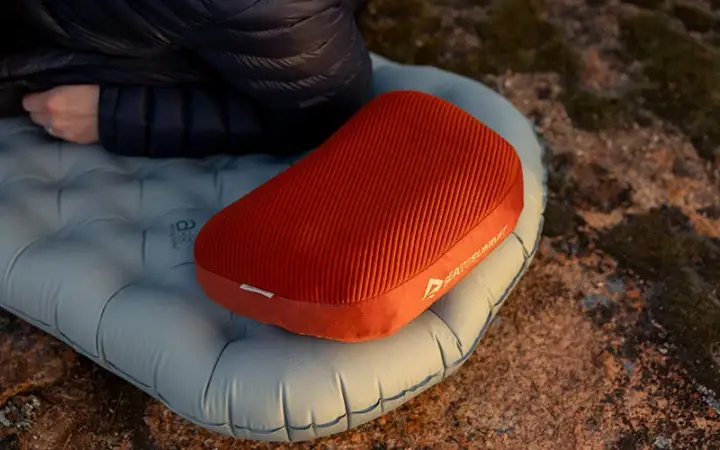
The current Sea to Summit Aeros Premium is no longer simply an air pillow with fabric stretched over it.
The latest version also uses a memory foam top layer, an adjustable air chamber, recycled stretch-knit fabric, and Sea to Summit’s PillowLock attachment system. The regular size weighs 3.5 ounces, making it much lighter than the standard Fillo.
That creates a much closer comparison than older versions did.
Choose the Fillo if:
- A thicker, softer foam feel matters more than saving several ounces.
- The familiar Fillo shape and integrated stuff sack appeal more.
- The pillow will be used frequently for car camping and travel as well as backpacking.
Choose the Aeros Premium if:
- Weight matters but a minimalist air-only pillow still sounds unappealing.
- A sleeping pad compatible with Sea to Summit’s PillowLock system is already part of the setup.
- A lighter hybrid-style pillow fits the trip better.
The Aeros Premium is particularly compelling for backpackers because its regular size is much closer to Fillo Elite territory in weight while still providing a padded top surface.
NEMO Fillo vs. Therm-a-Rest Compressible Pillow Cinch

The current comparison on the Therm-a-Rest side is the Compressible Pillow Cinch.
Unlike the Fillo, it is not inflatable. It uses upcycled urethane foam inside a soft polyester shell and relies on a cinch cord to adjust firmness and support.
The smallest version measures 15 x 11 x 5 inches and weighs 8 ounces. Larger sizes become significantly heavier and bulkier.
Choose the Fillo if:
- Packed space matters.
- Adjustable air pressure is useful.
- The same pillow needs to work for backpacking, camping, and travel.
- A more structured support platform is preferred.
Choose the Therm-a-Rest if:
- The feel of a traditional all-foam pillow matters more than compact packing.
- Most trips involve car camping.
- There is enough room in the vehicle for a bulkier pillow.
- Inflation simply is not appealing.
The Therm-a-Rest feels more like a conventional pillow because there is no air bladder underneath. The Fillo is the stronger option when storage space matters.
NEMO Fillo vs. a DIY Stuff Sack Pillow
The cheapest and lightest competitor may already be inside the backpack.
A stuff sack filled with a puffy jacket, fleece, spare base layer, or other soft clothing adds essentially no dedicated pillow weight.
That sounds ideal until the clothes move.
A sleeve bunches into one corner. A zipper ends up against the cheek. The jacket compresses as the night goes on. The support that felt fine at 10 p.m. may look very different at 3 a.m.
Choose the Fillo if:
- Consistent support matters.
- A sore neck has been a recurring problem on trips.
- Clothing is already being worn at night and cannot reliably serve as pillow stuffing.
- Better sleep is worth carrying dedicated gear.
Choose the stuff sack if:
- Eliminating every optional ounce is the priority.
- The improvised setup already works.
- The trip is short enough that occasional mediocre sleep is an acceptable tradeoff.
A dedicated camp pillow is not automatically necessary.
But it becomes much easier to justify once the DIY alternative repeatedly interferes with sleep. 🌙
Final Verdict: Is the NEMO Fillo Worth It?
For the right camper, yes—but the reason has less to do with luxury and more to do with consistency.
The standard NEMO Fillo creates a predictable sleeping surface night after night. It does not depend on whether a fleece happens to be packed, whether a puffy jacket is being worn, or whether clothing stays evenly distributed inside a stuff sack.
Its air-and-foam construction also addresses one of the biggest weaknesses of traditional inflatable camp pillows: the sensation of resting the head directly on a pressurized bladder.
The tradeoff is straightforward.
At 9.2 ounces, the standard Fillo is heavier than many backpacking pillows.
For a car camper, that barely matters.
For a backpacker hiking long mileage, it matters a lot.
The standard NEMO Fillo makes the most sense if:
- Camping comfort matters more than minimizing every ounce.
- Basic inflatable pillows feel too hard or springy.
- One pillow needs to cover car camping, travel, and occasional backpacking.
- A washable fabric sleeping surface is important.
- Adjustable firmness is useful.
Consider another Fillo model if:
- Backpacking weight is the priority — look at the Fillo Elite.
- Backpacking weight matters but more width is desirable — look at the Fillo Elite Wide.
- Extra room and adjustable added height sound useful — consider the Fillo Wide.
- Car camping comfort and side-sleeper loft matter most — the Fillo King is the better fit.
Skip the Fillo family entirely if:
- A clothing-filled stuff sack already provides comfortable sleep.
- Spending extra money on a dedicated pillow will not meaningfully improve the sleep system.
- The goal is the absolute lowest possible backpack weight.
For everyone else, the standard Fillo occupies a very useful middle ground: noticeably more comfortable than a minimalist inflatable, dramatically more packable than a normal pillow, and versatile enough to move from a campground to a backpack to a carry-on.
That is what makes it such an appealing upgrade—not because a camping pillow needs to feel luxurious, but because waking up rested makes the next day outside a lot more enjoyable. 🌲
Frequently Asked Questions (FAQ)
How do you wash the NEMO Fillo pillow?
The outer cover is removable and machine washable. The current NEMO and REI product information specifically identifies the fabric cover as washable. The internal air-and-foam assembly should be treated separately rather than simply putting the entire pillow into the washing machine.
After cleaning, allow everything to dry thoroughly before storing the pillow.
Is the NEMO Fillo noisy to sleep on?
It generally feels quieter and less plasticky than a bare inflatable because the head rests against fabric and foam rather than directly against the air bladder.
That does not mean it will be completely silent. Movement against sleeping bags, pads, and tent fabrics can still create noise. The main advantage is that the hybrid construction places cushioning between the sleeper and the inflatable core.
How firm should the NEMO Fillo be?
Start with the pillow inflated, lie down in the normal sleeping position, and then release small amounts of air until the head settles comfortably.
A fully pressurized pillow is not automatically better.
Back sleepers often prefer a little more give, while side sleepers may need more air to preserve height.
Is the NEMO Fillo good for side sleepers?
It can be, but shoulder width matters.
The standard Fillo is four inches tall. That may be enough for some side sleepers but not enough for people with broad shoulders or those using a relatively firm sleeping pad.
The Fillo Wide provides an underside shockcord system that can hold additional clothing beneath the pillow for added height, while the Fillo King increases the pillow height to six inches and is specifically positioned for broader shoulders.
What is the difference between the NEMO Fillo and Fillo Elite?
The biggest difference is weight and cushioning.
The standard Fillo weighs 9.2 ounces, measures 17 x 11 x 4 inches, and uses a thick foam layer over its baffled air cell.
The Fillo Elite weighs just 3 ounces, measures 15 x 11 x 3 inches, and uses a much lighter insulated cushioning layer to reduce bulk and weight.
The standard Fillo prioritizes comfort.
The Elite prioritizes backpacking efficiency.
What is the best NEMO Fillo for backpacking?
For hikers focused on weight, the 3-ounce Fillo Elite is the obvious starting point.
The 4-ounce Fillo Elite Wide adds six inches of width for only about one additional ounce, making it particularly appealing to sleepers who tend to move around during the night.
The standard Fillo is better suited to backpackers willing to carry additional weight for thicker foam and a plusher feel.
What is the best NEMO Fillo for car camping?
The standard Fillo works well for most campers, but the Fillo King is the comfort-focused option.
Its 17 x 14 x 6-inch dimensions provide substantially more height and sleeping surface than the standard model, making it particularly relevant for side sleepers and campers with broader shoulders.
Is a dedicated camping pillow really necessary?
No.
A folded fleece, puffy jacket, or clothing-filled stuff sack can work perfectly well.
A dedicated pillow becomes useful when that improvised solution stops providing reliable sleep. For campers who regularly wake up adjusting clothing beneath their head or dealing with neck discomfort, a pillow is one of the smaller pieces of gear that can noticeably change the overall sleep setup.
Sometimes comfort outdoors comes from a warmer sleeping bag or thicker pad.
Sometimes it is simply having a pillow that stays the same shape until morning.
Affiliate Disclosure: GearForTheOutdoors.com participates in affiliate programs, including REI, Amazon, REI Outlet, Garage Grown Gear, evo, and other trusted partners. When you purchase through our links, we may earn a small commission at no extra cost to you. That helps support our content and keeps our recommendations useful, practical, and free.
Disclaimer: This post is for informational purposes only. Always verify current product details, fit, availability, safety information, and manufacturer warranties before purchase or use. Outdoor conditions and gear performance can vary depending on setup, weather, terrain, and experience level.