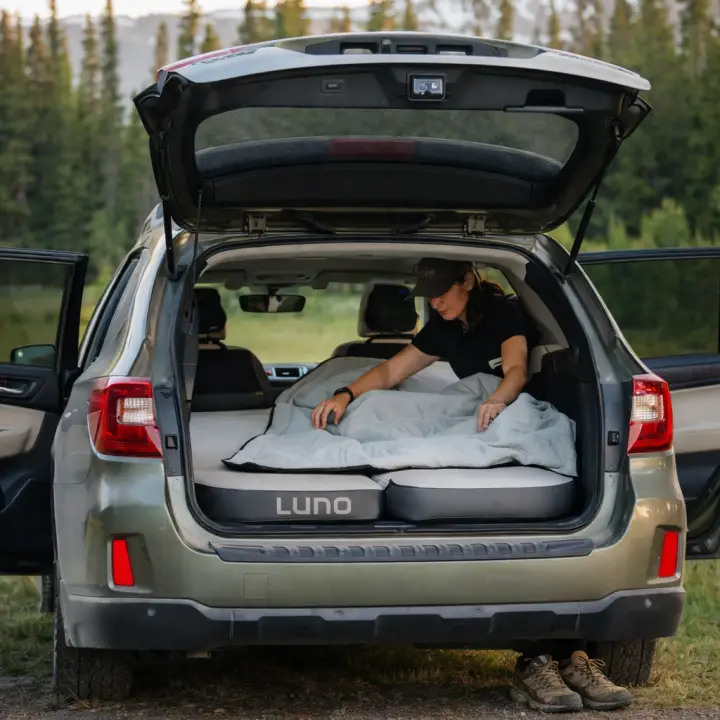

A camping cot can completely change how a night in a tent feels.
Instead of lowering yourself onto the ground at the end of the day, you get a flat, elevated sleeping surface that feels closer to a real bed. That can mean less pressure on your hips and shoulders, an easier time getting up in the morning, and fewer battles with rocks, roots, and uneven ground.
For car camping, especially, a cot is one of the easiest ways to make a tent more comfortable. Add a sleeping pad and a good sleeping bag, and even a basic campground setup can feel surprisingly cozy. 🏕️
The challenge is choosing the right one.
Some camping cots are wide enough to stretch out comfortably but take up a lot of tent and vehicle space. Others pack small and light but sit close to the ground. Some are ideal for taller sleepers, while others make more sense for families trying to fit multiple beds inside one tent.
The best camping cot is the one that fits your body, your tent, your vehicle, and the way you actually camp.
Our Top Picks for the Best Camping Cots
| Product | Best For | Weight Capacity | Weight | Price Tier |
|---|---|---|---|---|
| REI Co-op Campwell Folding Cot | Overall | 300 lbs. | 17 lbs. 13 oz. | $$ |
| TETON Sports Outfitter XXL Cot | Maximum Space & Support | 600 lbs. | Approx. 26 lbs. | $$ |
| Helinox Cot One Convertible | Lightweight Portability | 320 lbs. | 4 lbs. 13.6 oz. | $$$$ |
| Coleman Converta Cot | Budget-Friendly | 225 lbs. | 16 lbs. 4.8 oz. | $ |
| Disc-O-Bed Large Bunk | Families & Groups | 500 lbs. per cot | 59 lbs. total | $$$$ |
In-Depth Reviews of the Best Camping Cots
REI Co-op Campwell Folding Cot

Best Overall
Specs:
- Weight: 17 lbs. 13 oz.
- Weight Capacity: 300 lbs.
- Dimensions (L x W x H): 76 x 25 x 18 in.
- Packed Size: 8 x 37 in.
- Frame Material: Steel
The REI Co-op Campwell Folding Cot is a strong fit for the kind of camper who wants to make sleeping in a tent noticeably more comfortable without turning the entire trip into a gear-hauling exercise.
At 18 inches high, it feels much more like getting in and out of a normal bed than lowering yourself onto a sleeping pad on the floor. That difference is especially noticeable first thing in the morning, when knees and hips are stiff, or at night when you are trying to change clothes and get settled without crawling around the tent.
The extra height also creates genuinely useful space underneath.
Shoes, a duffel bag, extra layers, or a small gear bin can slide under the cot instead of taking up the narrow walkway beside your sleeping setup. In a tent where every square foot matters, that helps the whole space feel less cluttered.
The 25-inch width keeps the cot relatively easy to fit inside a standard car-camping tent, but it is worth thinking honestly about how you sleep. If you stay mostly on your back, that width will likely feel fine. If you roll around a lot or sleep with one knee bent out to the side, a wider cot may feel less restrictive.
At nearly 18 pounds, this is not something most campers will want to carry far from the vehicle. But for campground trips where the parking spot is close to the tent, that weight is easy enough to live with.
Who It’s Best For: Car campers who want a comfortable, elevated sleep setup that is easy to live with for weekend and multi-night campground trips.
Who Should Skip It: Campers who need a lot of shoulder room, want to travel ultralight, or regularly camp far from the vehicle.
Pros:
- Comfortable 18-inch height
- Easy to sit on while getting dressed or putting on shoes
- Useful storage space underneath
- Sturdy 300-pound capacity
- Practical size for many car-camping tents
- Good balance of comfort and portability
Cons:
- Too heavy for backpacking
- 25-inch width may feel narrow for active sleepers
- Still takes up meaningful cargo space
TETON Sports Outfitter XXL Cot
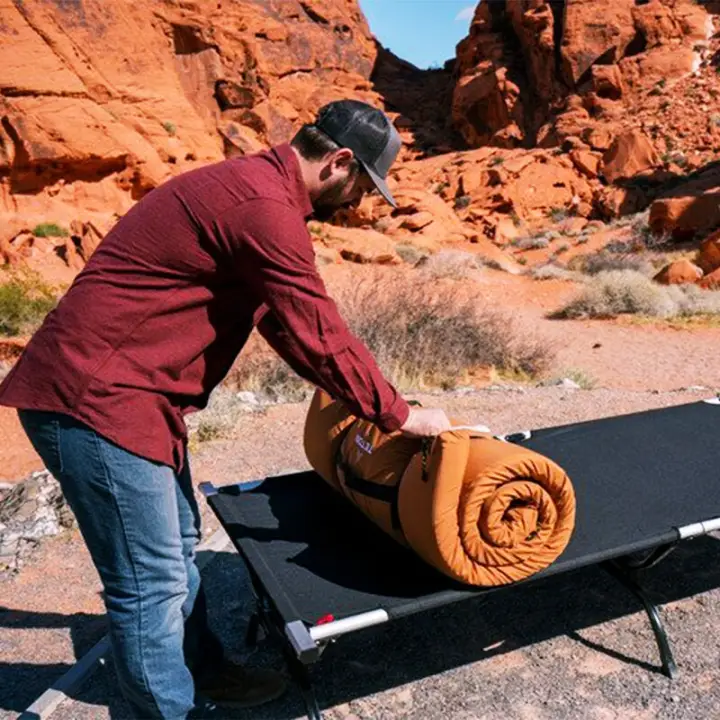
Best for Maximum Space & Support
Specs:
- Weight: Approx. 26 lbs.
- Weight Capacity: 600 lbs.
- Sleeping Surface: 85 x 40 in.
- Packed Size: Approx. 42 x 12 x 7 in.
- Frame Material: Steel
If a narrow cot makes you feel like you are sleeping on a bench, the TETON Sports Outfitter XXL takes a very different approach.
Its 40-inch width gives you much more freedom to move.
That matters most for side sleepers, larger campers, and anyone who tends to roll from one position to another during the night. Instead of constantly being aware of the frame along your shoulders, elbows, or knees, there is enough room to settle into a more natural sleeping position.
The extra length is equally useful for taller campers.
At 85 inches long, it provides significantly more room than many standard camping cots. If your feet usually end up at the edge of a sleeping pad or cot, the difference is immediately noticeable.
The 600-pound weight capacity also makes it a reassuring option for larger sleepers or anyone who simply wants a very solid-feeling bed.
The trade-off is space.
This is a big cot even before it is set up. It works best when there is plenty of room in the vehicle and inside the tent. A pickup, large SUV, van, or gear trailer makes it much easier to live with. Inside a smaller tent, it can dominate the floor plan.
That is not necessarily a problem if comfort is the priority.
For a three- or four-night basecamp where you are not moving every morning, the extra size can feel completely worthwhile. 🚙
Who It’s Best For: Tall campers, larger sleepers, side sleepers, and anyone who wants maximum sleeping room at a campground.
Who Should Skip It: Campers with a small car, compact tent, limited cargo space, or walk-in campsite.
Pros:
- Very spacious 85 x 40-inch sleeping area
- Excellent for side sleepers
- More comfortable for tall campers
- 600-pound weight capacity
- Stable, sturdy feel
Cons:
- Heavy
- Bulky when packed
- Takes up a lot of tent space
- Requires substantial vehicle storage
Helinox Cot One Convertible

Best for Lightweight Portability
Specs:
- Weight: 4 lbs. 13.6 oz.
- Weight Capacity: 320 lbs.
- Dimensions (L x W x H): 74.8 x 26.8 x 6.7 in.
- Packed Size: 21.3 x 6.3 x 6.3 in.
- Frame Material: Aluminum
The Helinox Cot One Convertible is for campers who like the idea of sleeping off the ground but do not want a traditional steel cot taking over the trunk.
At under 5 pounds, it feels almost like a different category of gear.
That lower weight makes a meaningful difference if you are camping from a small car, traveling by motorcycle, packing a kayak, or simply trying to keep bulky gear under control.
The packed size is also one of its biggest advantages.
Instead of a long, heavy frame that needs its own dedicated corner of the cargo area, the Helinox packs down small enough to tuck alongside other gear. When space is tight, that can be more valuable than having the tallest or widest cot at camp.
The sleeping surface sits low to the ground, though.
At around 6.7 inches high, you will not get the same easy sit-down-and-stand-up experience offered by a taller car-camping cot. Getting out of bed still involves pushing yourself up from fairly close to the floor.
The optional leg extensions make the setup more versatile if you want extra height, but they add cost and additional gear to pack.
Assembly also takes a little more attention than opening a basic folding cot. You need to put the frame together and tension the sleeping surface, so this is not the fastest possible setup after arriving at camp in the dark.
The reward is portability.
For campers who value low weight and compact storage more than simplicity, the Helinox stands out. 🧭
Who It’s Best For: Campers with limited vehicle space, motorcycle campers, paddlers, overlanders, and anyone trying to reduce the size and weight of their sleep setup.
Who Should Skip It: Campers who want a tall bed, maximum sleeping width, or the cheapest possible option.
Pros:
- Extremely light for a full-size cot
- Packs down very small
- 320-pound capacity
- Easier to fit into small vehicles
- Optional leg extensions add flexibility
Cons:
- Expensive
- Low to the ground without extensions
- Requires more assembly than a folding cot
- Not as wide as comfort-focused models
Coleman Converta Cot
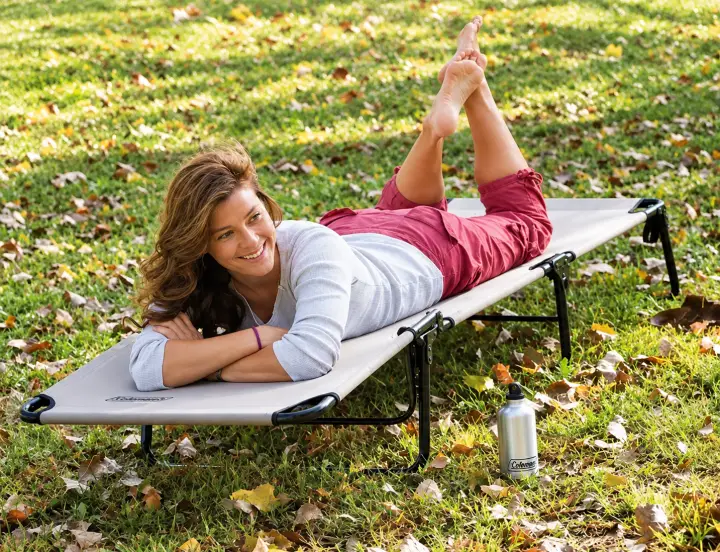
Best Budget-Friendly
Specs:
- Weight: 16 lbs. 4.8 oz.
- Weight Capacity: 225 lbs.
- Dimensions (L x W x H): 76.3 x 25.2 x 12.8 in.
- Packed Size: 26.5 x 14.75 x 12.25 in.
- Frame Material: Steel
The Coleman Converta Cot makes sense for campers who want to get off the tent floor without spending premium-cot money.
Its biggest advantage is simplicity.
It folds open quickly, does not require a complicated frame assembly, and gives you a raised sleeping surface that feels much more comfortable than lying directly on the ground.
It also works as more than just a bed.
The adjustable back and foot positions let you use it as a lounger during the day. That can be handy on a relaxed campground trip when the same piece of gear becomes a place to read, rest, or stretch out in the shade before turning back into a bed at night. ☕
The main thing to watch is size and weight capacity.
At just over 25 inches wide, it is not particularly spacious. Campers who like to spread out may feel confined, especially when sleeping on their side.
The 225-pound weight limit is also lower than the other cots in this guide, so it is important to check whether it is a comfortable fit for your body rather than choosing it based on price alone.
For the right sleeper, though, it offers a lot of utility for the money.
Who It’s Best For: Occasional campers, families buying multiple sleep setups, backyard camping, and anyone looking for a straightforward budget cot.
Who Should Skip It: Larger sleepers, tall campers who need extra length, and anyone who wants a wide bed-like sleeping surface.
Pros:
- Affordable
- Fast and simple setup
- Adjustable reclining positions
- Can double as daytime camp furniture
- Easier entry and exit than sleeping on the ground
Cons:
- Lower 225-pound weight capacity
- Narrow sleeping surface
- Fairly heavy for its size
- Not ideal for larger sleepers
Disc-O-Bed Large Bunk

Best for Families & Groups
Specs:
- Weight: 59 lbs. total
- Weight Capacity: 500 lbs. per cot
- Dimensions (L x W x H): 82 x 36 x 32.5 in. when bunked
- Packed Size: 34 x 17 x 11 in.
- Frame Material: Powder-coated steel
- Sleeping Capacity: 2 people
Camping with several people often turns tent organization into a bigger challenge than sleep comfort itself.
Put two or three cots side by side, add sleeping bags and duffels, and suddenly there is no room left to stand, change clothes, or walk to the door.
The Disc-O-Bed Large Bunk helps by using vertical space instead of spreading beds across the floor.
Stacked as bunk beds, two people can sleep in roughly the floor space normally used by one large cot. That leaves more room for gear and gives the tent a much less crowded feel.
For families, that can be a major advantage.
Kids can sleep vertically instead of taking up an entire side of the tent, while the remaining space can be used for storage, changing clothes, or keeping a clear path to the door. 🏕️
The bunks can also be separated and used as two individual cots, which gives you more flexibility if the tent layout changes from one trip to another.
Each cot supports up to 500 pounds, so the system works for adults as well as children.
The obvious downside is weight.
At 59 pounds total, this is essentially campsite furniture. It makes sense when you are driving directly to camp and staying there for several nights. It makes much less sense if you move camp frequently or need to carry gear any real distance.
Who It’s Best For: Families, scout groups, large tents, and multi-night basecamp setups where saving floor space matters.
Who Should Skip It: Campers who want a quick, lightweight, or minimalist setup.
Pros:
- Sleeps two people using vertical space
- Can be used as two separate cots
- 500-pound capacity per cot
- Excellent for organizing large family tents
- Very sturdy construction
Cons:
- Extremely heavy
- More time-consuming to set up
- Requires a tall, roomy tent
- Expensive compared with simple single cots
How to Choose the Best Camping Cot: A Buyer’s Guide
A camping cot can look great online and still be uncomfortable once it is inside your tent.
The best way to choose one is to picture the full campsite setup rather than looking at the cot alone.
Where will it fit inside the tent?
Can you sit up without hitting the wall?
Can another person still walk past it?
Will it fit in the vehicle alongside the cooler, chairs, stove, and everything else?
Those questions matter more than almost any individual specification.
Comfort & Support System
Comfort starts with how much room you have to sleep naturally.
If you stay mostly on your back, a narrower cot may feel perfectly comfortable. If you sleep on your side, bend your knees, or roll around frequently, width becomes much more important.
The side rails are usually where you notice a poor fit first.
If your shoulder, elbow, or knee is constantly touching the frame, the cot will feel smaller than the dimensions suggest.
A sleeping pad can make the setup much more comfortable by adding cushioning around pressure points.
It also helps smooth out the firm feel of a tightly tensioned cot surface.
Size & Weight Capacity
Do not assume all adult camping cots are roughly the same size.
They are not.
Length: If you are tall, look carefully at the full sleeping length. A few extra inches can make the difference between sleeping naturally and constantly feeling the end rail near your feet.
Width: Around 25 inches keeps a cot compact. Around 30 inches feels noticeably roomier. A 40-inch cot gives you much more freedom but takes up substantially more tent space.
Height: A taller cot makes sitting down, standing up, and putting on shoes easier. It also creates storage space underneath.
Weight Capacity: Always check the manufacturer’s rating before buying. Make sure there is enough margin for comfortable, normal use.
Measure Your Tent Before Buying
This is one of the most important steps.
Tent capacity labels do not tell you how well a cot will actually fit.
A 4-person tent may technically have room for four sleeping pads but still feel cramped with two tall cots because cot frames are rigid and the walls slope inward.
Measure:
- Floor length
- Floor width
- Cot width
- Cot length
- Cot height
- Door location
- Space between beds
- Wall angle
- Storage space
The wall angle is easy to overlook.
A tall cot placed close to a sloping tent wall can move your head and shoulders much closer to the fabric. That may leave you sleeping with the wall touching your sleeping bag or face.
A simple way to test the layout is to mark the cot dimensions on the floor at home using painter’s tape.
That gives you a much better idea of how much usable space will actually remain. 📏
Packed Size & Portability
A cot may be easy to sleep on but difficult to travel with.
Look at the packed dimensions, not just the weight.
A long, narrow cot bag may slide easily beside a tent and camp table, while a lighter cot that folds into a large flat rectangle can be much harder to fit into a loaded trunk.
Think about your normal vehicle setup.
If you already travel with a large cooler, camp kitchen, family tent, chairs, sleeping bags, and duffels, adding two bulky cots can change how everything fits.
For campground camping, 15 to 25 pounds is usually manageable.
For walk-in sites, motorcycle camping, kayaking, or small-car travel, compact packed size becomes much more important.
Setup & Takedown
Setup matters most when you move often.
For a weekend spent at one campsite, a few extra minutes of assembly is not a big deal.
For a road trip where camp gets packed every morning, those minutes add up quickly.
Simple folding cots are the easiest to live with.
Compact aluminum cots take more assembly because the frame needs to be connected and tensioned.
Bunk systems take even longer.
Think about when you usually arrive at camp.
If it is often after sunset, a simple setup can feel much more valuable than it does in a product description. 🔦
Durability & Materials
Cots get dragged through dirt, packed against hard gear, stored in garages, and exposed to damp mornings.
Steel frames tend to be heavy but sturdy.
Aluminum frames save a lot of weight and are easier to travel with, but lightweight construction usually costs more.
The sleeping fabric also matters.
Look for durable polyester or nylon with solid stitching and enough tension that the surface does not sag excessively once you lie down.
For frequent campers, a cot that feels slightly overbuilt is often better than one that feels flimsy the first time you sit on the edge.
Pro Tip: Don’t Forget Insulation
Sleeping off the ground does not automatically mean sleeping warm.
A cot creates an open air space underneath your body.
When temperatures drop, that moving air can pull heat away from you surprisingly quickly.
Your sleeping bag also loses much of its insulating loft where your body compresses it against the cot.
That is why an insulated sleeping pad is still important.
Place the pad directly on top of the cot and choose an R-value appropriate for the temperatures you expect.
In warm summer weather, a lightly insulated pad may be enough.
On colder nights, the difference between a warm and uninsulated pad can be the difference between sleeping comfortably and waking up cold at 2 a.m. ❄️
Final Verdict
For most car campers, the REI Co-op Campwell Folding Cot is the easiest one to recommend because it gets the everyday details right.
It sits high enough to make getting in and out comfortable, leaves room underneath for gear, and does not take up as much tent space as the oversized options.
If sleeping space matters more than cargo space, the TETON Sports Outfitter XXL is the better fit. Taller campers and side sleepers will appreciate the extra width and length immediately.
For small vehicles, motorcycles, paddling trips, or anyone trying to keep gear compact, the Helinox Cot One Convertible is the standout choice.
Families who need to make the most of a large tent should look at the Disc-O-Bed Large Bunk, while the Coleman Converta Cot makes sense for occasional campers who want a simpler and more affordable way to sleep off the ground.
The best cot should make camp feel easier.
You should be able to climb into bed without thinking about the frame, roll over without hitting a rail, wake up without feeling beaten up by the ground, and start the morning ready for coffee, breakfast, and another day outside. 🌲
Frequently Asked Questions (FAQ)
Do I need a sleeping pad with a camping cot?
Usually, yes.
A sleeping pad adds cushioning, but more importantly, it provides insulation underneath your body.
Because air moves beneath a cot, sleeping without insulation can feel surprisingly cold even when the ground itself does not feel especially cold.
Are camping cots comfortable for side sleepers?
They can be.
Width is especially important for side sleepers because bent knees and elbows take up more room.
A cot around 30 inches wide or more usually feels less restrictive than a narrow 25-inch model.
A thicker sleeping pad can also reduce pressure on your hips and shoulders.
How much weight can a camping cot hold?
Weight capacity varies significantly by model.
Standard camping cots often support somewhere around 225 to 350 pounds, while heavy-duty models can support 500 pounds or more.
Always check the manufacturer’s current rating before using the cot.
Are camping cots better than air mattresses?
It depends on what bothers you most when camping.
A cot gives you firmer support, keeps you elevated, creates storage space underneath, and does not deflate overnight.
An air mattress often gives you a wider, softer sleeping surface and may cost less.
Both can feel cold without proper insulation, so a sleeping pad or insulated sleep system may still be necessary.
How high should a camping cot be?
For most car campers, a cot around 15 to 20 inches high is comfortable because it is easier to sit down and stand up.
Lower cots are better when packed size, weight, or tent wall clearance matters more.
Can a camping cot damage a tent floor?
It can if the feet create concentrated pressure points.
Make sure the tent floor is free of rocks and debris before placing the cot inside.
If the cot feet are narrow or hard-edged, small protective pads can help spread the load.
What size tent works best with camping cots?
The cot dimensions matter more than the tent’s advertised sleeping capacity.
Measure the cot footprint and compare it with the actual interior dimensions of the tent.
Also account for sloping walls, the tent door, walking space, and gear storage.
Two large cots can make even a roomy tent feel much smaller than expected.
Affiliate Disclosure: GearForTheOutdoors.com participates in affiliate programs, including REI, Amazon, REI Outlet, Garage Grown Gear, evo, and other trusted partners. When you purchase through these links, the site may earn a small commission at no extra cost to you. That helps support the content and keeps gear recommendations useful, practical, and free.
Disclaimer: This post is for informational purposes only. Always verify current product details, fit, availability, safety information, and manufacturer warranties before purchase or use. Outdoor conditions and gear performance can vary depending on setup, weather, terrain, and experience level.