
Tired of hearing pots, pans, and utensils clanking around every time you hit a bump on the way to camp?
The easiest way to stop camping cookware and utensils from rattling in your car is to prevent hard surfaces from touching and keep your kitchen gear from shifting during travel.
You don’t need expensive storage drawers or a custom-built overlanding setup. For most car campers, a few microfiber towels, nesting cookware, a utensil roll, and a well-organized storage bin can make a noticeable difference.
The trick is knowing where the noise is coming from.
A loose pot lid needs a different solution than a storage box sliding across your SUV’s cargo floor. Fixing the right problem first saves time, money, and unnecessary gear purchases.
Here’s how to build a quieter, more organized camp kitchen that stays secure from your driveway to the campsite.
Quick Fix: What’s Making Your Camp Kitchen Rattle?
Before buying another organizer, identify what’s actually moving.
| If you hear… | Try this first |
|---|---|
| Pots and pans clanking together | Add microfiber towels between nested cookware |
| Metal utensils rattling | Pack them in a utensil roll or padded pouch |
| Pot lids bouncing around | Wrap lids separately or secure them inside the cookware stack |
| Cookware hitting a storage bin | Add dividers, foam padding, or snug compartments |
| An entire kitchen box sliding | Secure the container using appropriate cargo restraints |
| Multiple items knocking together | Fill empty spaces with soft gear and separate heavy items |
Start with padding and containment. They’re inexpensive, easy to adjust, and often enough to solve the problem without replacing your existing cookware.
If rattling continues, look at how your kitchen equipment is organized inside its storage box—and how that box is secured inside your vehicle.
1. Nest Your Camping Cookware to Reduce Movement
Best for: Keeping pots and pans compact, organized, and easier to secure.
Nesting cookware is one of the simplest ways to reduce both noise and storage space.
Instead of packing several individual pots, arrange compatible cookware into a single compact stack. Smaller pots fit inside larger ones, while folding handles and well-positioned lids help reduce loose pieces.
The advantage isn’t just saving room.
A compact cookware stack is much easier to stabilize inside a storage bin than several separate pots and pans.
How to Nest Pots and Pans Without Rattling
- Start with the largest pot or pan.
- Place a thin microfiber towel or soft liner inside.
- Add the next smaller pot.
- Continue separating hard surfaces as you stack.
- Wrap loose lids or position them so they cannot bounce.
- Secure folding handles and place the finished stack inside a snug compartment or storage bag.
Don’t force cookware together if the padding makes the stack too tight. Thin separators are usually better than bulky towels.
Also, be careful when storing accessories inside pots.
A compact stove or small kitchen tool may fit perfectly, but it can still scratch the interior or bounce against the cookware unless it’s protected.
Keep fuel canisters in accordance with their manufacturer’s storage instructions, away from heat and potential damage.
A Practical Nesting Cookware Option: GSI Outdoors Glacier Stainless Base Camper Medium
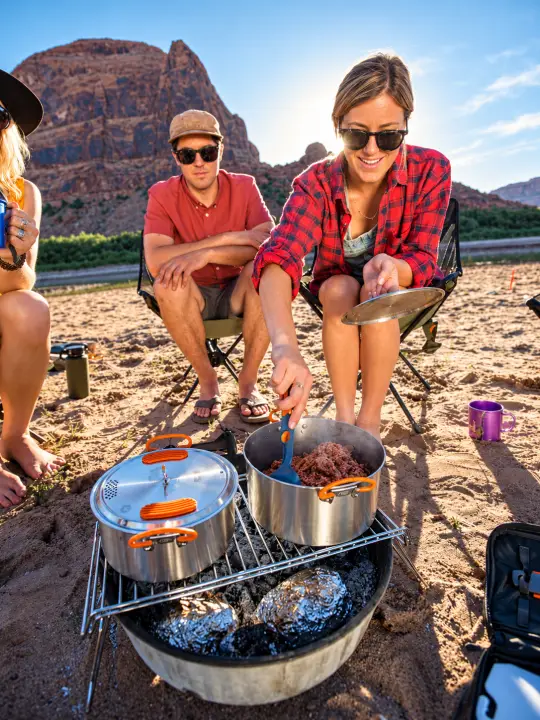
The GSI Outdoors Glacier Stainless Base Camper Medium is worth considering if your current cookware consists of several bulky, mismatched pieces.
The stainless steel set includes a 2-liter pot, a 3-liter pot, a frying pan, and two strainer lids. The components nest together and fit inside an included mesh storage sack.
That makes it particularly useful for car campers who want a compact cooking setup without giving up separate pots for preparing different parts of a meal.
The tradeoff is that stainless steel cookware can still make noise when its components contact one another. The mesh sack contains the set, but thin padding between the pots and lids can help prevent rattling.
If your existing pots already nest securely, there’s little reason to replace them just to make your kitchen quieter.
Check the GSI Outdoors Glacier Stainless Base Camper Medium
2. Add Padding Between Pots, Pans, and Lids
Best for: Eliminating metal-on-metal noise without buying new cookware.
Even well-designed nesting cookware can rattle when two metal surfaces touch.
A thin protective layer is often all you need.
Fortunately, some of the best padding materials are things you’re probably already bringing on your camping trip.
| Padding material | Best use | Main consideration |
|---|---|---|
| Microfiber towels | Separating nested pots and pans | Lightweight, reusable, and useful for cleanup |
| Dish towels | Wrapping cookware and loose lids | Can add bulk inside smaller pots |
| Silicone trivets | Separating pans and larger cookware | Grippy but thicker than fabric |
| Foam sheets | Cushioning cookware against storage-bin walls | Need to stay away from hot equipment |
| Soft pot protectors | Protecting nonstick cooking surfaces | Work best when sized for the cookware |
For most car campers, microfiber towels are the easiest starting point.
They’re thin enough to fit between many nesting pots, soft enough to protect cooking surfaces, and useful for drying dishes at camp.
Silicone trivets are another practical option, especially for larger frying pans. Their grippy surface helps reduce sliding, and they can double as hot-pot protection at the campsite.
Don’t Forget the Lids
Loose lids are among the easiest sources of rattling to overlook.
A pot might fit securely inside another pot, but a metal lid sitting on top can bounce with every bump.
Try wrapping the lid in a thin towel before placing it inside the cookware stack. If the design allows, secure the entire stack with a reusable strap.
Make sure any handle or knob isn’t pressing against a surface that could become damaged during transport.
For nonstick cookware, use clean, soft separators. Trapped sand, grit, or metal utensils can scratch the coating.
And when you get home, remove damp padding and let everything dry before putting the cookware away.
3. Keep Loose Camping Utensils in a Roll or Pouch
Best for: Forks, spoons, spatulas, tongs, knives, and other smaller cooking tools.
A handful of metal utensils sliding around inside a plastic bin can create an incredible amount of noise.
Even when your pots and pans are perfectly packed, loose flatware or cooking tools can keep your camp kitchen rattling.
The simplest fix is to give those items their own storage space.
Use a Utensil Roll for Better Separation
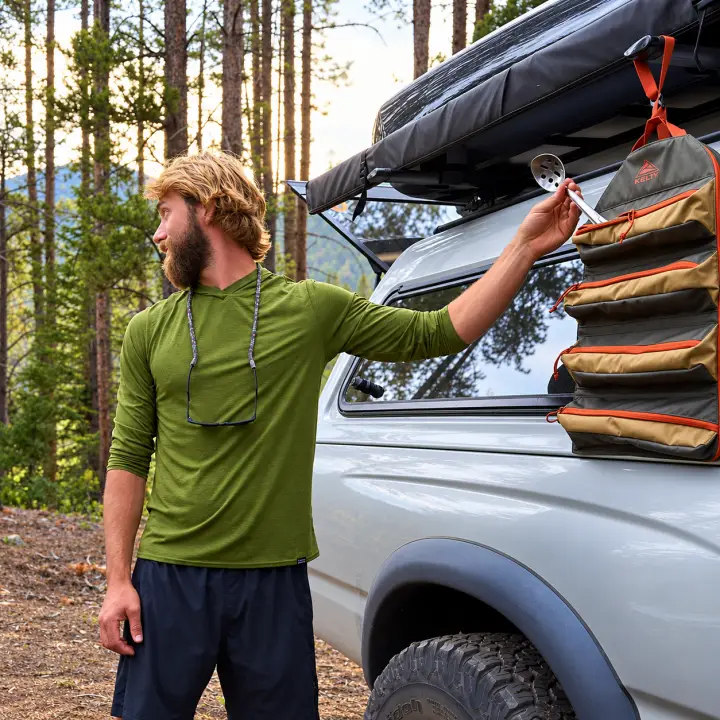
A fabric utensil roll or organizer keeps cooking tools together instead of allowing them to scatter around the main kitchen box.
Organizers with individual sleeves are especially useful because they limit contact between metal items.
Zippered pockets work well for smaller accessories, although utensils inside the same pocket may still need individual wrapping.
The Kelty Chef Roll is a practical example for car camping.
It has four zippered pockets for cooking tools, utensils, spices, and other small kitchen accessories.
It can hang near your cooking area or lie flat on a tailgate or camp table, keeping the same organization system useful during transport and at camp.
Its biggest advantage is convenience: cooking tools have a designated place instead of ending up loose at the bottom of your kitchen bin.
However, it isn’t a rigid protective case. If several metal utensils are packed loosely into one pocket, they can still knock together.
For a quieter setup, group utensils with soft dividers or wrap particularly noisy pieces before closing the roll.
The Free Alternative: Wrap Utensils in a Dish Towel
A dedicated organizer isn’t necessary for a small camp kitchen.
Lay your utensils across a clean dish towel, leaving some fabric between metal pieces. Roll everything into a compact bundle and secure it with reusable gear ties.
Place the bundle inside your main kitchen box.
This simple method works particularly well for campers carrying only a spatula, tongs, a cooking spoon, and a few pieces of flatware.
Sharp knives need additional protection. Always use a properly fitted blade guard or sheath rather than relying on fabric alone.
4. Use a Camp Kitchen Box With Dividers
Best for: Preventing larger cookware, dishes, and cooking supplies from shifting against one another.
A sturdy kitchen storage box helps keep your cooking equipment together, but simply throwing everything into one large container won’t eliminate rattling.
In fact, a half-empty plastic tote can make the problem worse.
Every turn or bump gives pots, pans, and kitchen accessories room to slide into each other or strike the hard walls of the container.
The solution is to create smaller, well-fitted compartments.
Hard-Sided Bins for Structured Storage
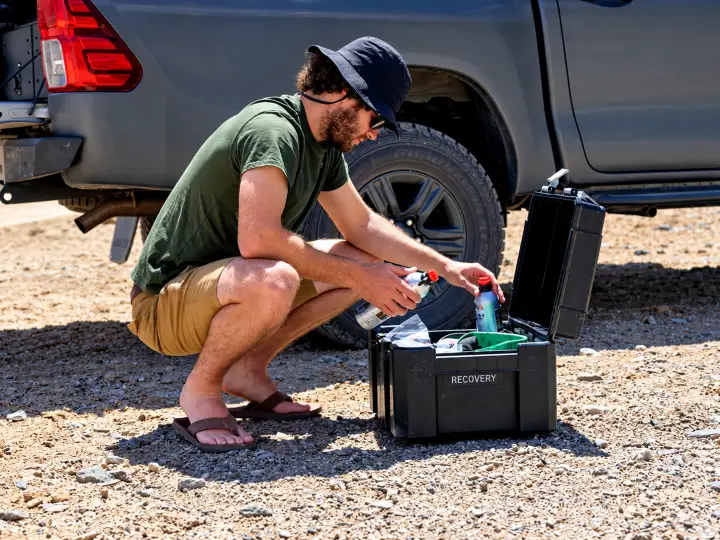
Hard-sided storage boxes are useful when you need to carry cookware alongside other camping equipment.
They protect their contents from surrounding cargo and make it easier to arrange dividers, pouches, and smaller containers.
One option is the Front Runner Wolf Pack Pro.
Its impact-resistant plastic construction, secure latching lid, and stackable shape make it useful for organized SUV, truck, and overlanding storage.
The relatively straight sides also make arranging internal organizers easier than in some irregularly shaped totes.
However, the Wolf Pack Pro is primarily a storage box—not a complete kitchen organizer.
Without additional padding or compartments, cookware can still move around inside.
It’s a sensible choice for campers building a modular storage system, but a sturdy, inexpensive plastic tote can work just as well for occasional car camping.
One compatibility detail matters if you’re expanding an existing Front Runner setup: the Wolf Pack Pro is not designed to stack with the older Wolf Pack.
Check the Front Runner Wolf Pack Pro
Add Simple DIY Dividers
You don’t need custom-made drawers to create effective kitchen compartments.
Useful divider materials include:
- Corrugated plastic: Lightweight, easy to clean, and moisture-resistant.
- Sturdy cardboard: An inexpensive option for testing a layout before making permanent dividers.
- Thin plywood: Useful for more structured, long-term compartments.
- Foam blocks: Good for cushioning cookware against hard walls.
- Small fabric pouches: Ideal for irregularly shaped utensils and accessories.
Arrange the dividers around the equipment you actually carry.
For example, one compartment could hold a nesting cookware stack, another could contain a utensil pouch, and a third could store dishes or cooking accessories.
The compartments should be snug enough to limit movement without making gear difficult to remove.
For a more detailed comparison of storage styles, see our guide to the best camp kitchen boxes and organizers for car camping.
5. Fill Empty Spaces and Pack Heavy Cookware Low
Even a good storage box can make noise when its contents have room to move.
The goal isn’t to pack everything as tightly as possible. It’s to keep each item securely positioned without putting unnecessary pressure on fragile equipment.
Use Soft Gear to Fill Small Gaps
Instead of buying specialized padding for every corner of your kitchen box, use lightweight items you’re already carrying.
Clean dish towels, microfiber cloths, pot holders, and soft utensil pouches can fill gaps around larger cookware.
For example, a rolled towel placed between a pot and the wall of a storage bin can prevent the pot from knocking against the plastic.
But avoid stuffing the box so tightly that its lid has to be forced closed.
Keep Heavy Items at the Bottom
Cast iron pans, Dutch ovens, and other heavy cooking equipment should sit low in the storage system.
Lighter utensils, dishes, and soft accessories can occupy the remaining space.
Keep delicate cookware away from heavy objects that could shift into it during sudden braking.
If a single kitchen box becomes difficult to lift or secure, consider splitting the equipment between two smaller containers.
One can hold cookware and cooking tools, while the other carries plates, cleanup supplies, and lighter kitchen accessories.
For many car campers, two manageable boxes are more practical than one oversized container.
6. Secure Your Camp Kitchen Box Inside the Vehicle
Best for: Preventing movement in SUVs, vans, trucks, and vehicles traveling over uneven roads.
You can carefully organize every piece of cookware and still hear rattling if the entire kitchen box slides around the cargo area.
That’s why securing the container itself is just as important as organizing what’s inside it.
Choose a stable location low in the vehicle, then use appropriate restraints to prevent movement.
Depending on your vehicle’s cargo setup, options include:
- Cargo straps connected to suitable vehicle anchor points
- A properly secured storage drawer or cargo platform
- A fitted cargo management system
- Non-slip cargo mats to reduce minor sliding and vibration
Non-slip mats can be helpful, but they do not replace proper restraints during sudden braking or a collision.
Always follow your vehicle’s cargo-loading and tie-down guidance.
Check the Box’s Handles and Latches
Sometimes the sound isn’t coming from the cookware at all.
Loose handles, latches, or lids can vibrate against a plastic storage container.
Before driving, check that the lid is properly closed and the handles are secured.
Also look at nearby equipment. Two hard-sided storage boxes positioned directly against each other may knock together on uneven roads.
Adding a protective barrier can reduce contact noise, but each container still needs to be safely secured.
7. Consider a Hanging Camp Kitchen Organizer
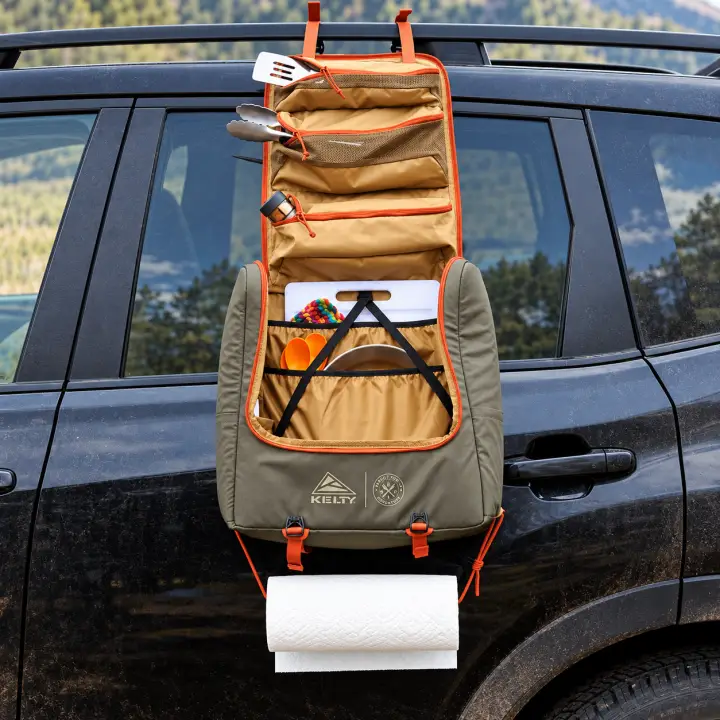
Best for: Frequent car campers who want better access to cooking tools and accessories at camp.
A hanging organizer can solve two problems at once.
It keeps smaller kitchen accessories contained during transport and makes them easier to find once you’re parked.
The Kelty Camp Galley Deluxe is designed around that approach.
It has a structured body, three zippered pockets for smaller kitchen items, sleeves for plates and cutting boards, and additional storage for longer cooking tools.
It can hang from a suitable support near the cooking area or lie flat on a table or tailgate.
For campers who regularly carry spices, serving utensils, cutting boards, and other accessories, it offers more organization than a simple utensil pouch.
However, the Camp Galley Deluxe isn’t intended to replace a main storage box for bulky cookware.
It’s better suited to smaller kitchen essentials, while pots and pans remain in a separate container.
And like any fabric organizer, it won’t automatically silence multiple metal items packed loosely into the same compartment.
Check the Kelty Camp Galley Deluxe
Which Camp Kitchen Organizer Makes More Sense?
| Product | Main advantage | Best for |
|---|---|---|
| GSI Outdoors Glacier Stainless Base Camper Medium | Cookware nests into a compact stack | Campers replacing bulky, mismatched pots |
| Kelty Chef Roll | Keeps utensils and small accessories together | Smaller kitchens with loose cooking tools |
| Front Runner Wolf Pack Pro | Structured, stackable equipment storage | SUV and overlanding setups |
| Kelty Camp Galley Deluxe | Larger hanging organizer with multiple compartments | Campers carrying more kitchen accessories |
You don’t need all four.
If you already own nesting pots, start with inexpensive padding. If utensils are your biggest problem, a roll or pouch makes more sense than a new storage box.
And if your entire kitchen setup is disorganized, improving the main storage container may deliver the biggest practical benefit.
A Simple No-Rattle Camp Kitchen Setup for Weekend Trips
For a couple heading out on a weekend car camping trip, a quiet kitchen can be surprisingly simple.
Start with one medium-sized storage box.
Inside, arrange the equipment into three groups:
Cookware: Nest pots and pans together with microfiber towels between hard surfaces. Wrap lids so they cannot bounce around.
Utensils: Keep spatulas, tongs, serving spoons, and flatware in a compact roll or protective pouch.
Other kitchen supplies: Place dishes and smaller accessories in separate compartments, using soft padding wherever hard surfaces could touch.
Keep heavy equipment low and use the remaining soft items to fill small gaps.
Then close the box and secure it properly inside the vehicle.
This arrangement provides the basic advantages of a dedicated camp kitchen system without requiring expensive drawers, custom cabinetry, or multiple specialty cases.
It’s also easy to adjust as your cooking setup changes.
Common Mistakes That Keep Camping Cookware Rattling
If your kitchen still makes noise after organizing it, check for these easily overlooked issues.
Leaving lids loose: Even well-nested pots can rattle when their lids bounce against the cookware.
Putting too many metal utensils in one pouch: A fabric bag contains the utensils, but it doesn’t necessarily keep them separated.
Using an oversized storage box: Extra space allows cookware to slide farther before striking the container walls.
Installing hard dividers without padding: Dividers restrict movement, but cookware can still knock against rigid surfaces.
Ignoring external handles and latches: Sometimes the storage container itself is making the noise.
Forgetting to secure the box inside the vehicle: Internal organization cannot compensate for an entire container moving around the cargo floor.
Most of these problems can be corrected in a few minutes without purchasing additional gear.
Your No-Rattle Camp Kitchen Packing Checklist
Before your next trip, run through this quick checklist:
- Nest compatible pots and pans together.
- Place microfiber towels or soft liners between hard cookware surfaces.
- Wrap or secure loose pot lids.
- Keep metal utensils in a roll, pouch, or towel bundle.
- Protect kitchen knives with proper blade guards or sheaths.
- Use dividers to keep cookware and smaller accessories separated.
- Fill small gaps with soft, lightweight gear.
- Pack heavy cookware low in the storage container.
- Secure the kitchen box inside your vehicle.
- Check loose handles, latches, and nearby containers.
Once everything is packed, check for movement within the container before loading it into your vehicle.
If you hear metal striking another hard surface, identify the loose item and adjust the padding or storage arrangement.
A small adjustment at home can prevent an irritating rattle throughout the drive.
Final Verdict: Start With Simple Fixes Before Buying More Gear
For most car campers, the best way to stop camping cookware and utensils from rattling is to combine nesting, soft padding, and a securely packed storage box.
Start with microfiber towels between pots and pans. Keep utensils together in a roll or pouch, add dividers where equipment can shift, and secure the entire container inside your vehicle.
If your current setup still feels disorganized, choose an upgrade based on the actual problem.
A nesting cookware set helps reduce bulk. A utensil roll controls smaller tools. A structured storage box provides better separation and protection.
The best camp kitchen setup isn’t the one with the most organizers. It’s the one that keeps your cookware protected, your vehicle cargo secure, and everything easy to find when it’s time to cook.
Affiliate Disclosure: GearForTheOutdoors.com participates in affiliate programs, including REI, Amazon, REI Outlet, Garage Grown Gear, evo, and other trusted partners. When you purchase through our links, we may earn a small commission at no extra cost to you. That helps support our content and keeps our recommendations useful, practical, and free.
Disclaimer: This post is for informational purposes only. Always verify current product details, fit, compatibility, availability, safety information, and manufacturer instructions before purchase or use. Outdoor conditions and gear performance can vary depending on setup, weather, terrain, vehicle, and experience level.