The best camp kitchen organizer depends on what is making camp cooking frustrating in the first place.
For most car campers, a medium hard box or structured soft bin combined with one smaller utensil organizer is more practical than a giant kitchen trunk. It keeps cookware and prep gear together without creating a box that becomes difficult to lift.
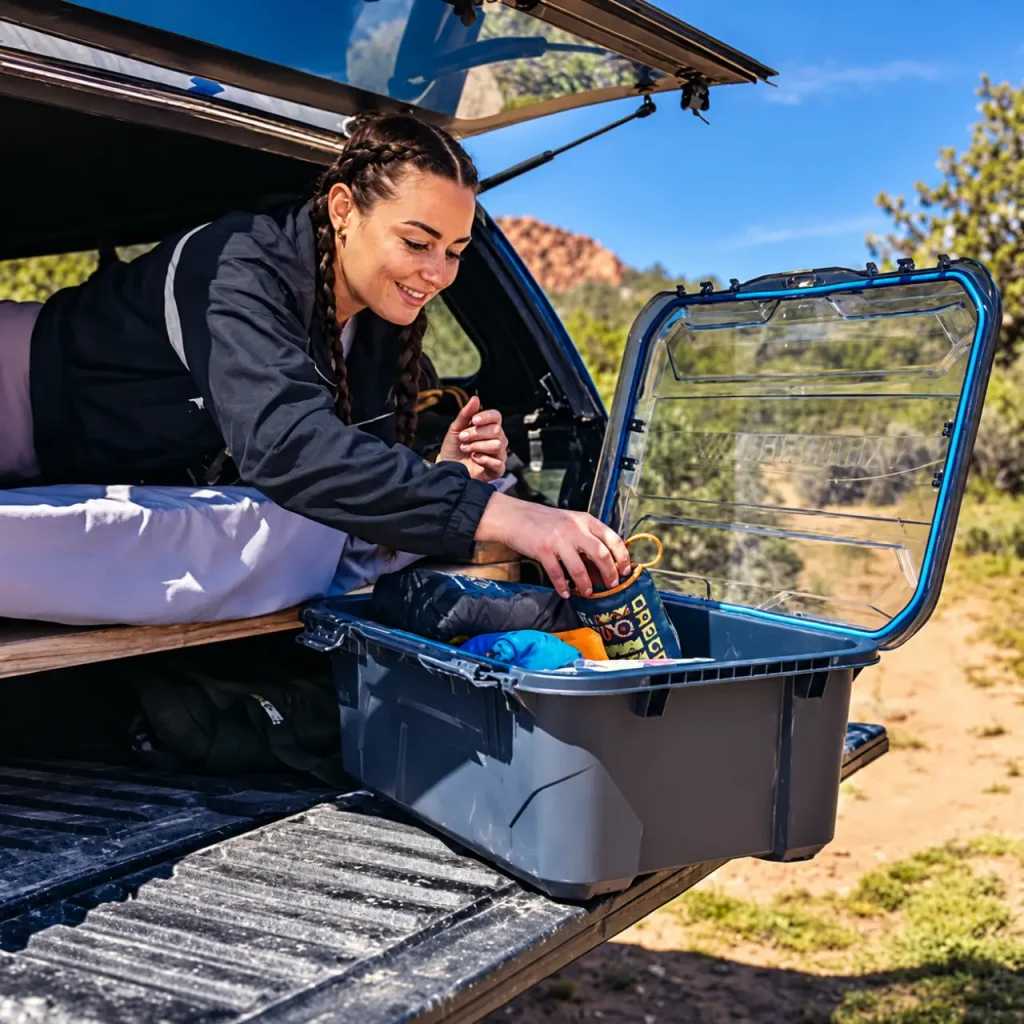
A weather-sealed hard case makes more sense when gear rides in an open truck bed or regularly deals with dust and rain. Soft organizers are easier to fit into crowded SUVs. Roll-up and hanging organizers solve a different problem: keeping small utensils, spices, and cleanup gear from disappearing underneath cookware.
The goal isn’t simply to find the biggest box. It is to build a kitchen that fits the vehicle, keeps frequently used gear accessible, and can stay mostly packed between trips.
Our Top Picks at a Glance
| Product | Type | Best For | Main Advantage | Main Tradeoff |
|---|---|---|---|---|
| Gregory Alpaca Gear Box 45 | Hard box | Best overall | Great balance of capacity, protection, and weight | Needs smaller organizers inside |
| YETI LoadOut GoBox 30 | Sealed hard case | Wet, dusty, or exposed travel | Excellent weather protection and built-in organization | Heavy and expensive for its size |
| REI Co-op Trailgate Gear Bin 60 | Structured soft bin | Flexible car camping setups | Roomy, light, and collapsible | Open top offers little weather protection |
| Kelty Camp Galley Deluxe | Hanging organizer | Small tools, plates, spices, and utensils | Turns into accessible campsite storage | Doesn’t hold bulky cookware |
| Sea to Summit Camp Kitchen Tool Kit | Roll-up organizer | Compact utensil organization | Keeps cooking and cleanup tools together | Complements rather than replaces a kitchen box |
| Front Runner Wolf Pack Pro | Modular hard box | Overlanding and multi-box systems | Stackable, space-efficient modular design | Most useful when building a larger system |
| Plano Sportsman’s Trunk | Large hard trunk | Budget-minded campers carrying bulky gear | Lots of usable space for the money | Very easy to overload |
| OXO Outdoor Camp Kitchen Prep Set | Compact prep case | Knives, spices, oils, and prep tools | Self-contained food-prep module | Too small for general kitchen storage |
1. Gregory Alpaca Gear Box 45 — Best Overall Camp Kitchen Box

The Gregory Alpaca Gear Box 45 hits a useful middle ground for car camping: large enough to hold a substantial kitchen kit, but not so oversized that it automatically becomes a two-person job to move.
Its 45-liter capacity works particularly well for cookware, plates and bowls, coffee equipment, cleanup supplies, and a smaller utensil organizer. The broad, relatively shallow shape also makes more sense for kitchen equipment than a very deep tote where small items disappear beneath pots and pans.
The clear lid is especially useful when several storage containers live in the same vehicle. Coffee gear, plates, or cleanup supplies can be spotted without opening every box.
The lid can open from either side or be removed completely, and the boxes are designed to stack. Gregory rates the box to IP65 for dust and water-jet protection. It measures 26.8 x 17.5 x 10.6 inches, weighs about 6.1 pounds, holds 45 liters, and has a 50-pound maximum carry weight.
What works well
- Manageable 45-liter capacity
- Clear lid makes contents easy to identify
- Stackable shape
- Good protection from dust and weather
- Wide interior works well for cookware and dishes
- Significantly lighter than some premium sealed cases
What to consider
The interior is largely open.
That is great for pots and bulky kitchen equipment, but spatulas, spices, knives, lighters, coffee filters, and cleanup tools still need smaller containers or pouches.
Its relatively low height also means tall bottles and larger upright equipment should be measured before buying.
Best for
Weekend car campers who want one primary kitchen box for cookware, dishes, coffee gear, and everyday cooking supplies.
Check the Gregory Alpaca Gear Box 45 at REI
2. YETI LoadOut GoBox 30 — Best Premium Hard Case
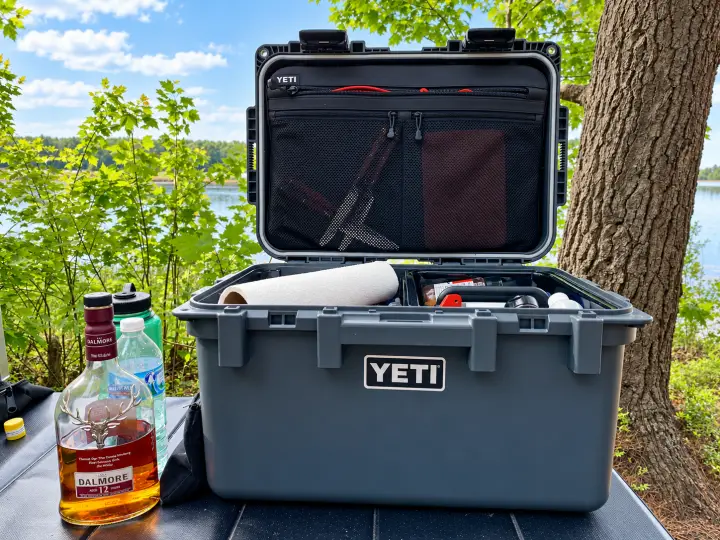
The YETI LoadOut GoBox 30 makes the most sense when protection matters more than maximum storage volume.
That distinction is important.
If a kitchen box spends almost every trip inside a closed SUV, paying for a highly sealed case may not add much practical value. But if gear travels in an open pickup bed, boat, dusty cargo area, or exposed overland setup, better sealing can become genuinely useful.
The GoBox 30 meets both IP65 and IP67 standards. YETI also includes a removable caddy and divider, giving small equipment a more defined place than it would have in a completely open box. Its current exterior dimensions are roughly 20.4 x 14.7 x 11.2 inches, and the case weighs about 12.1 pounds with its included accessories.
That weight is the biggest tradeoff.
At around 12 pounds before loading cookware, the GoBox can become heavy quickly. Its 30-liter size also demands a more edited kitchen than the Gregory or REI Trailgate.
This is therefore better viewed as a protected kitchen core than as a giant everything-in-one-box solution.
Small cookware, coffee gear, utensils, spices, knives, fire-starting equipment, and other important kitchen items are a better fit than trying to force a large two-burner stove and a complete family setup inside.
What works well
- Excellent dust and water protection
- Internal divider and removable caddy
- Stackable design
- Useful size for an organized kitchen core
- Good fit for exposed vehicle-based travel
What to consider
- Heavy before gear is added
- Considerably more expensive than basic storage boxes
- Less total storage space than many alternatives
- Overkill for many fair-weather campground trips
Best for
Campers, overlanders, and road trippers whose kitchen storage regularly encounters rain, dust, rough transport, or exposed cargo areas.
Check the YETI LoadOut GoBox 30 at REI
3. REI Co-op Trailgate Gear Bin 60 — Best Soft Camp Kitchen Organizer
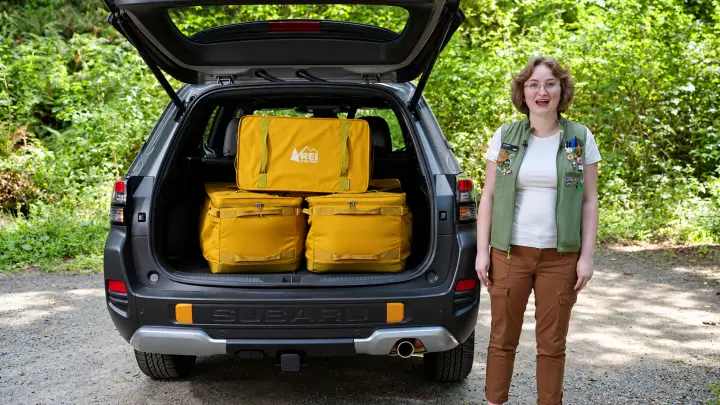
Not every camp kitchen needs a sealed plastic case.
The REI Co-op Trailgate Gear Bin 60 is a better fit when packing flexibility, low weight, and easy access matter more than weather protection.
Its structured fabric panels keep the bin upright while loading and unloading, while the entire organizer can collapse flat and fold when not in use. The 60-liter version provides 59.3 liters of capacity, measures 24 x 13.5 x 14 inches, and weighs 2 pounds, 13 ounces.
That combination works particularly well in crossovers and SUVs.
Rigid boxes demand the same rectangular footprint no matter how much is inside. A soft bin is more forgiving when the cargo area also needs to accommodate a cooler, duffels, sleeping bags, chairs, tents, and other awkwardly shaped gear.
The wide opening is another advantage at camp. Cookware and dishes can be reached without digging through a narrow opening.
The tradeoff is protection.
The Trailgate is better treated as an interior vehicle organizer than as a weatherproof outdoor box. Its open top leaves kitchen gear exposed if the bin is placed in rain, dust, or an uncovered truck bed.
It also benefits from smaller pouches or bins inside. Otherwise, the generous 60-liter compartment can become another large container full of loose gear.
What works well
- Excellent capacity-to-weight ratio
- Wide opening makes cookware easy to access
- Structured sides help it hold its shape
- Collapses for storage at home
- Easier to fit around other cargo than a rigid case
- Good choice for larger but lightweight kitchen setups
What to consider
- Open top
- Limited weather protection
- Cannot protect fragile items like a hard case
- Needs internal organizers for small equipment
- Not ideal when other heavy boxes must be stacked on top
Best for
Car campers who keep the kitchen inside their vehicle and want a lightweight, roomy organizer that does not permanently consume garage or closet space.
Check the REI Co-op Trailgate Gear Bin at REI
4. Kelty Camp Galley Deluxe — Best Hanging Camp Kitchen Organizer
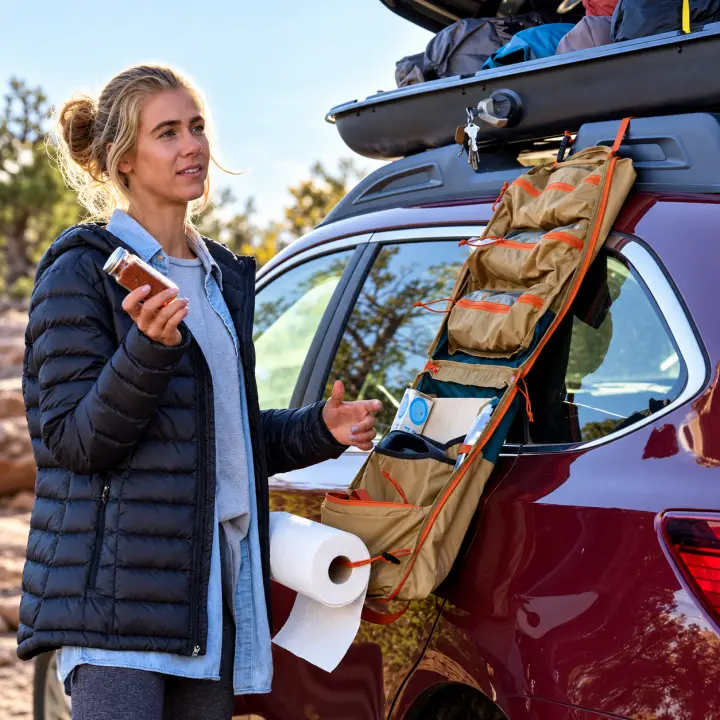
A large kitchen box solves the problem of transporting gear.
It doesn’t necessarily solve the problem of using that gear at camp.
The Kelty Camp Galley Deluxe takes the opposite approach. Instead of functioning as another big cargo box, it organizes the small kitchen equipment that campers reach for repeatedly.
The structured organizer can hang from a vehicle roof rack or another suitable support and can also be laid on a tailgate or table. Three zippered pockets provide storage for spices, tools, and utensils, while lower sleeves can hold items such as plates and cutting boards. Kelty lists a 27-liter volume and a weight of about 1.5 pounds.
That makes it particularly useful for campsite organization.
Instead of pulling a spatula, knife, seasoning bottle, and cutting board from four different corners of a large box, the frequently used tools can stay together and visible near the cooking area.
It is also a good companion to a larger hard box.
The hard box carries pots and bulky equipment during transit. The Camp Galley handles the smaller items that need fast access once camp is set up.
What works well
- Organizes small kitchen items by function
- Can hang near the cooking area
- Dedicated spaces for utensils, spices, plates, and cutting boards
- Lightweight compared with hard storage boxes
- Useful independently or inside a larger storage system
What to consider
- Not weather-sealed
- Does not replace storage for pots, pans, or larger equipment
- Requires somewhere practical to hang or place it
- Less useful for very minimalist kitchens
Best for
Campers whose main problem is not carrying cookware, but keeping utensils, plates, seasonings, and prep tools organized and immediately accessible.
Check the Kelty Camp Galley Deluxe
5. Sea to Summit Camp Kitchen Tool Kit — Best Roll-Up Utensil Organizer

Spatulas, spoons, scrubbers, dish towels, oil bottles, and other small items are usually what turn a seemingly organized kitchen box into a mess.
The Sea to Summit Camp Kitchen Tool Kit gives those pieces their own compact module.
The 10-piece kit packs into a hangable nylon roll measuring about 9 x 5 x 2 inches and weighing 10.9 ounces. It includes a folding spatula, folding serving spoon, scrubber, Wilderness Wash, refillable bottles, washcloth, and dish towel.
Its biggest advantage isn’t the amount of equipment it holds.
It is the fact that the entire cooking-and-cleanup module can move from storage box to campsite in one piece and hang near the cooking area.
That makes a roll organizer one of the easiest upgrades to a basic plastic tote.
A large box can remain relatively simple: cookware and dishes below, utensil roll on top. When it is time to cook, grab the roll instead of searching through loose equipment.
What works well
- Compact
- Lightweight
- Keeps frequently used tools together
- Can hang near the cooking area
- Includes both cooking and cleanup basics
- Easy to move between different kitchen systems
What to consider
- Not a replacement for a main storage box
- Campers with favorite existing utensils may not need the included tools
- Soft construction provides little crush protection
- Works best as one part of a larger system
Best for
Campers who already have a storage box but need a better way to control the small cooking and cleanup equipment inside it.
Check the Sea to Summit Camp Kitchen Tool Kit at REI
6. Front Runner Wolf Pack Pro — Best Modular Camp Kitchen System
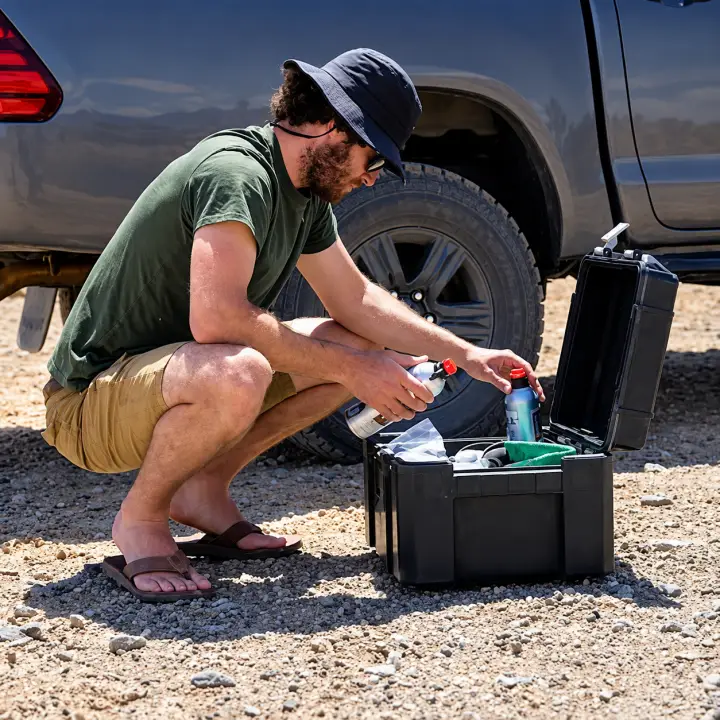
One giant kitchen trunk sounds convenient until it is packed with cookware, food, dishes, fuel, and cleanup supplies.
Then it needs to be lifted.
The Front Runner Wolf Pack Pro supports a different strategy: several smaller matching boxes, each with a specific job.
For example:
- Box 1: cookware and cooking tools
- Box 2: pantry supplies and coffee
- Box 3: dishes and cleanup equipment
The Wolf Pack Pro has relatively straight sides and a nesting design that allows matching boxes to stack securely. It is built from impact-resistant plastic and can also be integrated with Front Runner vehicle-storage and roof-rack accessories.
That makes it particularly compelling for overlanding, vans, trucks, and camping setups where cargo organization extends beyond the kitchen.
The modular approach has another advantage: you don’t need the whole kitchen for every task.
Breakfast supplies can live in one box. Cookware can stay in another. Cleanup equipment doesn’t have to be moved just to make coffee.
The downside is that a modular system requires more planning—and usually more money—than buying one general-purpose tote.
The basic Wolf Pack Pro is also an open compartment internally. Pouches, liners, or smaller containers are still useful for utensils and small bottles.
What works well
- Designed to stack with matching boxes
- Straight-sided shape uses cargo space efficiently
- Easier to divide gear by function
- More manageable than one oversized trunk
- Works particularly well in vehicle-based camping systems
- Accessories allow the system to expand over time
What to consider
- One box may not hold an entire kitchen
- Internal organization generally requires accessories or smaller containers
- Building a multi-box system costs more
- Most useful when you actually want modular storage
Best for
Overlanders, van campers, truck campers, and organized car campers who prefer several purpose-specific boxes instead of one oversized container.
Check the Front Runner Wolf Pack Pro at Amazon
7. Plano Sportsman’s Trunk — Best Budget Camp Kitchen Box
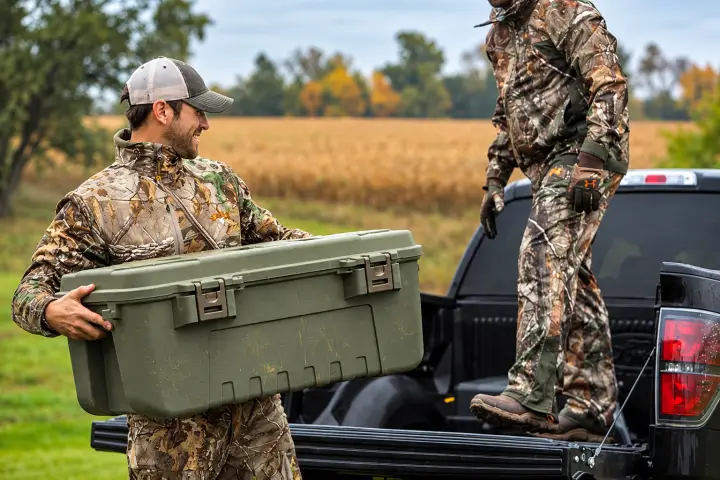
Premium outdoor storage boxes are not necessary for every camping setup.
Sometimes the priority is simply getting plenty of usable cargo space without spending heavily.
The Plano Sportsman’s Trunk is a straightforward hard-sided solution with a removable latching lid, stacking grooves, tie-down points, and a lockable design. The current Medium version measures approximately 30 x 14.25 x 12.75 inches externally, with an interior around 26 x 11.25 x 11.25 inches.
That long shape is helpful for a camp kitchen because bulky equipment doesn’t always fit efficiently inside square boxes.
Cutting boards, pans, griddles, dishes, wash basins, and other awkward kitchen gear can take advantage of the rectangular footprint.
But inexpensive large trunks have one predictable problem:
The available space encourages overpacking.
Fill a large box with cast iron, canned food, cookware, fuel, and glass bottles and it can become difficult to move even though there is still room available.
The better strategy is to use the trunk for bulky equipment while keeping dense pantry items, water, and other heavy supplies elsewhere.
Small organizers inside are almost essential. Without them, utensils, spices, lighters, and cleanup gear quickly work their way underneath larger equipment.
What works well
- Lots of usable storage for the price
- Long shape accommodates bulky kitchen equipment
- Stackable
- Tie-down points simplify vehicle transport
- Lockable
- Good foundation for a DIY organization system
What to consider
- Easy to make excessively heavy
- No built-in organization
- Basic protection compared with premium sealed cases
- Occupies substantial cargo space
- Small gear needs separate pouches or containers
Best for
Families and car campers who need a lot of kitchen storage and would rather spend money on camping gear than on a premium cargo case.
Check the Plano Sportsman’s Trunk at Amazon
8. OXO Outdoor Camp Kitchen Prep Set — Best Compact Prep Organizer

The OXO Outdoor Camp Kitchen Prep Set solves a narrower problem than the other organizers in this guide—and that is exactly why it is useful.
It creates one dedicated place for the equipment used during food prep.
The kit includes a watertight gear case, flexible cutting board, 5.5-inch Santoku knife with locking sheath, two 3-ounce squeeze bottles, and two spice shakers. The case also leaves some space for small additional tools. OXO lists the complete set at 11.45 x 13.4 x 3.25 inches and 3.32 pounds.
Think of it as a module inside the larger kitchen.
Instead of having a knife wrapped in a towel, spices in one bag, cooking oil somewhere else, and a cutting board wedged beside the stove, the basic prep kit comes out together.
It is particularly helpful for campers who already have storage figured out but still lose small food-prep equipment inside a larger bin.
What works well
- Keeps essential prep tools together
- Knife has its own protective sheath
- Dedicated containers for seasonings and liquids
- Compact enough to fit inside a larger kitchen box
- Easy to move directly to the prep area
What to consider
- Too small to be a primary camp kitchen organizer
- Included equipment may duplicate items you already own
- Best value when you want the complete prep system rather than just another case
Best for
Campers who want food-prep equipment organized as one self-contained module inside a larger car-camping kitchen.
Check the OXO Outdoor Camp Kitchen Prep Set
Hard Box vs. Soft Organizer vs. Roll Bag vs. Modular System
The products above are easier to compare when you stop thinking about brands and start thinking about what each format actually does well.
| Choose This | When It Makes the Most Sense |
|---|---|
| Hard box | You want cookware protected, need stackability, or expect dust and weather exposure |
| Soft organizer | Low weight, flexible packing, and easy access matter more than weather protection |
| Hanging organizer | You want frequently used items visible and accessible while cooking |
| Roll bag | Loose utensils and cleanup tools are your biggest organization problem |
| Modular boxes | You want different parts of the kitchen separated into stackable units |
| Large trunk | Capacity and value matter more than refined organization |
| Compact prep case | Knives, seasonings, oils, and small food-prep tools need their own module |
For many car campers, the best answer is not choosing only one.
A very effective system might use a Gregory Alpaca Gear Box 45 or REI Trailgate Gear Bin as the main container, then add a Sea to Summit utensil roll or OXO prep case inside.
That creates organization at two levels:
Large gear has a home. Small gear has a home inside that home.
One Big Camp Kitchen Box or Several Smaller Organizers?
One giant box feels simple because the entire kitchen travels together.
In practice, bigger is not always better.
A large kitchen trunk tends to create three problems:
- It becomes heavy.
- Small items migrate toward the bottom.
- Getting one piece of gear can require moving several others.
A modular setup avoids some of those problems.
Instead of one enormous box, the kitchen can be divided into:
Cooking
- Pots
- Pans
- Stove accessories
- Spatula
- Spoon
- Tongs
- Pot holder
Food Prep
- Knife
- Cutting board
- Oil
- Spices
- Can opener
- Prep utensils
Eating
- Plates
- Bowls
- Mugs
- Flatware
Coffee
- Brewer
- Filters
- Coffee
- Grinder
- Mugs
Cleanup
- Soap
- Sponge
- Dish towel
- Wash basin
- Trash bags
You do not necessarily need five separate boxes.
The point is to create recognizable modules so you can remove what is needed without digging through the entire kitchen.
For two people on simple weekend trips, one medium main box plus a utensil or prep organizer may be enough.
For families or longer trips, two medium boxes can be easier to handle than one huge trunk.
How Much Camp Kitchen Storage Do You Actually Need?
Liters and quarts are useful, but they don’t tell the whole story.
The shape of your largest gear matters more than the published capacity.
Before buying a kitchen box, lay out the equipment you plan to store inside it.
Pay particular attention to:
- two-burner camp stove
- largest skillet
- cutting board
- coffee press
- kettle
- nesting pot set
- wash basin
- tall oil bottles
- plates
- bulky food-prep equipment
Measure those items.
A box can have plenty of overall volume and still be too short for the coffee press or too narrow for the stove.
Also measure the intended cargo space in the vehicle.
Know whether the organizer needs to fit:
- behind a rear seat
- underneath a sleeping platform
- beside a cooler
- underneath a cargo shelf
- inside a truck-bed drawer system
- under the campsite table
The best camp kitchen box isn’t the one that holds the most.
It is the one that fits the kitchen and still fits the vehicle.
Hard-Sided Camp Kitchen Boxes: When They Make Sense
Hard boxes are the better choice when gear needs physical protection.
They keep cookware from being crushed underneath other cargo and generally stack better than soft bags or collapsible bins.
They also make sense when the kitchen may be exposed to:
- rain
- road dust
- sand
- mud
- open truck beds
- roof racks
- rough loading and unloading
But hard cases come with two costs: weight and fixed volume.
A rigid 45-liter box occupies roughly the same cargo space whether it contains 45 liters of gear or five.
That matters in smaller vehicles.
Do not automatically pay for the highest waterproof rating either. If the box always rides inside an SUV and sits underneath shelter at camp, extreme sealing may provide little practical advantage.
Soft Camp Kitchen Organizers: When They’re Better
Soft-sided organizers give up some protection in exchange for flexibility.
That can be the better tradeoff in a tightly packed car.
They are generally easier to squeeze beside bedding and other soft equipment, and collapsible models consume far less storage space at home between trips.
A soft organizer is especially attractive when:
- gear stays inside the vehicle
- most camping happens at developed campgrounds
- weight matters
- home storage is limited
- cargo configurations change from trip to trip
The downside is stacking.
A hard box can often become part of the vehicle’s cargo structure. A soft bin generally needs to live on top or beside heavier gear rather than underneath it.
Why Roll Bags and Hanging Organizers Work So Well
A common mistake is expecting the main kitchen box to organize everything.
A 45- or 60-liter compartment is good for cookware.
It is terrible at controlling twenty small objects.
That is where roll bags and hanging organizers become useful.
Items such as:
- spatulas
- knives
- tongs
- lighter
- coffee scoop
- bottle opener
- can opener
- spices
- dishcloth
- scrubber
should ideally live in a smaller organizer.
That organizer can remain near the cooking area while the large storage box stays underneath a table or beside the vehicle.
This is usually much more convenient than opening the main box every time something small is needed.
What Should Go Inside a Camp Kitchen Box?
The easiest way to build a camp kitchen is to start with items used on nearly every trip.
Cookware
- Pot
- Skillet
- Lids
- Kettle if regularly used
Cooking tools
- Spatula
- Spoon
- Tongs
- Pot holder
- Lighter
Prep gear
- Knife
- Cutting board
- Can opener
- Bottle opener
Eating gear
- Plates or bowls
- Mugs
- Forks
- Spoons
- Knives
Coffee setup
If coffee is part of every camping morning, treat the coffee system as permanent kitchen equipment rather than repacking it every trip.
Cleanup supplies
- Soap
- Sponge
- Dishcloth
- Towel
- Trash bags
- Wash basin if needed
Small pantry essentials
- Salt
- Pepper
- Frequently used spices
- Cooking oil
- Foil
- Food-storage bags
Trip-specific food does not necessarily belong in the permanent kitchen box.
Keeping food separate makes it easier to leave most of the camp kitchen packed between trips.
Keep Food Storage Separate From Permanent Kitchen Gear
Your cookware stays fairly consistent.
Your food changes every trip.
That is a good reason to separate the two.
A practical car camping setup can look like:
Kitchen box: cookware, dishes, utensils, coffee equipment, spices, cleanup supplies
Pantry box: bread, dry ingredients, snacks, canned food
Cooler: perishable food and drinks
Separating these categories means the kitchen can remain almost permanently packed.
Before the next trip, you are adding food instead of rebuilding the kitchen from scratch.
Don’t Put Everything Heavy in One Box
Camp kitchen boxes become deceptively heavy.
Cast iron, canned food, water, glass bottles, fuel, and cookware add weight quickly.
Even if everything physically fits, that does not mean everything should travel together.
The Gregory Alpaca Gear Box 45, for example, has a published maximum carry weight of 50 pounds.
That is not a packing target.
A kitchen box that can technically carry a heavy load may still be awkward to lift into a vehicle or carry across an uneven campsite.
Test the loaded organizer at home.
If moving it feels cumbersome, split the kitchen into two modules.
Put the Most-Used Gear Where You Can Reach It
Good camp kitchen organization is partly about frequency of use.
Things used at every meal should never live underneath equipment that only comes out occasionally.
Keep these items near the top:
- lighter
- cooking utensils
- knife
- cutting board
- coffee gear
- trash bags
- dishcloth
- soap
- favorite seasonings
Bulkier or infrequently used equipment can live deeper in the box.
Transparent lids, labeled pouches, and repeatable packing positions all help.
The goal is to reach for an item without having to remember where it was packed this time.
Be Careful With Liquids
Cooking oil and dish soap can create a spectacular mess inside an otherwise organized kitchen.
Whenever possible:
- use reliable leak-resistant containers
- keep bottles upright
- avoid oversized household packaging
- place liquids inside a secondary washable container
- don’t store liquids loose between fabric items
One leaking bottle should not require cleaning the entire camp kitchen.
Camp Kitchen Boxes Are Not Automatically Bear-Resistant
A heavy lid, weather seal, or sturdy latch does not automatically make a kitchen box suitable for food storage in bear country.
YETI, for example, specifically notes that the LoadOut GoBox itself is not bear-proof.
Food, trash, cooking oil, toiletries, dirty dishes, and other scented items need to be stored according to the requirements of the campground or public land you are visiting.
Depending on the location, that may mean using:
- a provided food-storage locker
- an approved bear-resistant container
- another locally required storage method
Treat the camp kitchen organizer as an organization system—not as a substitute for required wildlife-safe food storage.
A Simple Camp Kitchen Setup for Most Car Campers
There is no need to build an elaborate overland kitchen just to keep camping gear organized.
A simple and highly functional setup can consist of:
One medium main box
For cookware, dishes, coffee equipment, and bulky kitchen supplies.
One utensil organizer
For spatulas, knives, cooking tools, and frequently used small equipment.
One prep module
For seasonings, oils, cutting board, and food-prep tools.
One cleanup pouch
For soap, scrubber, towels, and trash bags.
Separate food storage
For trip-specific pantry supplies and perishables.
This setup scales easily.
For a short weekend, leave unnecessary modules at home.
For a longer family trip, add a second main box rather than replacing the entire system with one enormous trunk.
Frequently Asked Questions
What is the best type of camp kitchen box for car camping?
For most car campers, a medium hard box or structured soft bin offers the best balance.
Choose a hard box when stacking, weather protection, and gear protection matter. Choose a soft organizer when weight, packing flexibility, and compact storage at home are more important.
Adding a smaller utensil organizer inside either system usually improves the setup considerably.
Is one big camp kitchen box better than several smaller boxes?
Not necessarily.
One large box is convenient because everything stays together, but it can become heavy and difficult to organize.
Several smaller modules make it easier to separate cookware, pantry supplies, dishes, and cleanup gear.
For many car campers, two manageable boxes are more useful than one oversized trunk.
Do camp kitchen organizers need to be waterproof?
Not for every trip.
A kitchen stored inside a closed vehicle typically needs much less weather protection than one riding in an open pickup bed or on an exposed rack.
Pay for waterproof or highly weather-resistant construction when it solves a real exposure problem rather than simply because the specification sounds impressive.
What’s the difference between a camp kitchen box and a chuck box?
A basic camp kitchen box is primarily storage.
A traditional chuck box usually adds internal compartments, shelves, or even a fold-down work surface to create something closer to a portable kitchen cabinet.
Chuck boxes can be extremely functional, but they also tend to be heavier and harder to fit into smaller vehicles.
For many weekend car campers, a well-organized plastic box is simpler.
How do you keep utensils organized inside a large camping box?
Give them their own smaller container.
Roll-up organizers, hanging bags, zippered pouches, and compact prep cases prevent small tools from disappearing underneath cookware.
Keeping a utensil module near the top of the main box also means it can be pulled out first when cooking begins.
Should food go inside the camp kitchen box?
Some dry pantry items can, but permanently mixing food with cookware usually makes the kitchen harder to keep ready between trips.
Separating permanent cooking gear from trip-specific food makes packing and restocking much easier.
Follow local wildlife-storage requirements wherever you camp.
Final Verdict
For most car campers, the Gregory Alpaca Gear Box 45 offers the strongest starting point. It provides enough room for a useful kitchen without becoming unnecessarily oversized, and its relatively light hard-shell design, clear lid, stackability, and weather protection make it easy to build around.
Check the Gregory Alpaca Gear Box 45 at REI
Choose the YETI LoadOut GoBox 30 instead when water, dust, and exposed transport are serious concerns. Choose the REI Trailgate Gear Bin 60 when lighter weight and flexible vehicle packing matter more than weather protection.
But the biggest improvement often comes from combining systems.
A main box for cookware plus a Kelty hanging organizer, Sea to Summit roll, or OXO prep case gives large and small equipment separate homes—and prevents the camp kitchen from slowly turning back into one giant tote full of loose gear.
The best setup is the one that lets you open the vehicle, pull out the kitchen, and know where the spatula, knife, coffee gear, and cleanup supplies are before the stove is even lit.
Affiliate Disclosure: GearForTheOutdoors.com participates in affiliate programs, including REI, Amazon, REI Outlet, Garage Grown Gear, evo, and other trusted partners. When you purchase through our links, we may earn a small commission at no extra cost to you. That helps support our content and keeps our recommendations useful, practical, and free.
Disclaimer: This post is for informational purposes only. Always verify current product details, fit, compatibility, availability, safety information, and manufacturer instructions before purchase or use. Outdoor conditions and gear performance can vary depending on setup, weather, terrain, vehicle, and experience level.