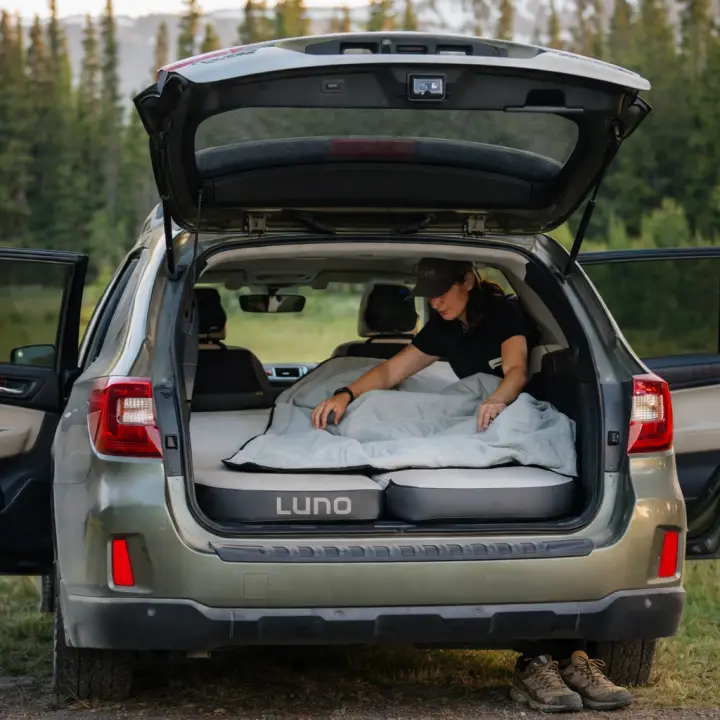
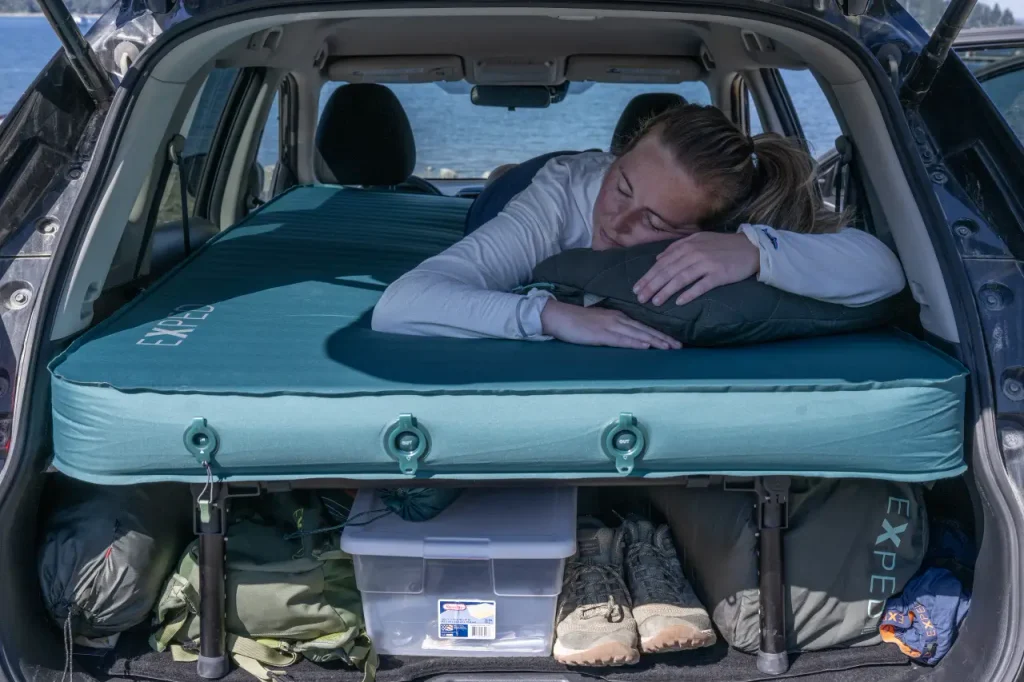
A good car camping trip can unravel pretty quickly after a bad night of sleep.
Maybe the mattress was too thin and every pressure point found the hard cargo floor underneath. Maybe the air bed slowly softened overnight. Or maybe the temperature dropped and all that cold air beneath the sleeping bag turned an otherwise comfortable setup into a chilly one.
Car camping gives you one big advantage over backpacking: you can prioritize comfort.
There is usually no need to chase the lightest or smallest sleeping pad. Instead, you can bring thicker foam, wider mattresses, supportive air-and-foam designs, and sleep systems that feel much closer to a real bed.
The challenge is finding a mattress that is not only comfortable, but also works with your vehicle, sleeping style, camping conditions, and available cargo space.
This guide breaks down some of the best car camping beds for different kinds of campers, along with the practical details that matter before you buy. 🏕️
Our Top Car Camping Bed Picks at a Glance
| Product | Type | Best For | Price Tier |
|---|---|---|---|
| EXPED MegaMat Duo | Self-Inflating | Best overall comfort for couples | $$$ |
| NEMO Roamer Double | Self-Inflating | Plush comfort with easier packing | $$$ |
| HEST Dually | Foam Mattress | Maximum durability and instant setup | $$$$ |
| REI Co-op Westward Dreamer Double | Self-Inflating | Best balance of comfort and value | $$ |
| Therm-a-Rest MondoKing 3D | Self-Inflating | Spacious solo car camping | $$$ |
For most couples, the EXPED MegaMat Duo is the place to start. It combines thick cushioning, excellent insulation, and a stable sleeping surface that feels much more like a mattress than a typical camping pad.
The NEMO Roamer Double is another excellent option if you want similar comfort in a design that is relatively easy to pack and adjust.
Campers who never want to worry about punctures or inflation should look closely at the HEST Dually, while the REI Co-op Westward Dreamer Double offers a very appealing mix of comfort, warmth, and price.
Solo campers who want to stretch out should consider the Therm-a-Rest MondoKing 3D, especially if narrow backpacking pads tend to feel restrictive.
In-Depth Reviews of the Best Car Camping Mattresses
The biggest mistake when choosing a car camping mattress is focusing only on comfort.
A plush mattress is not very useful if it is three inches too wide for the cargo area. A foam bed may feel fantastic but become frustrating if there is nowhere to store it during the day.
Think about where the mattress will actually live before choosing one.
Will it stay inside an SUV? Sit in the bed of a pickup? Go inside a large tent next to the vehicle?
Those details can make one mattress a perfect fit and another a complete nuisance.
EXPED MegaMat Duo: Best Overall for Couples
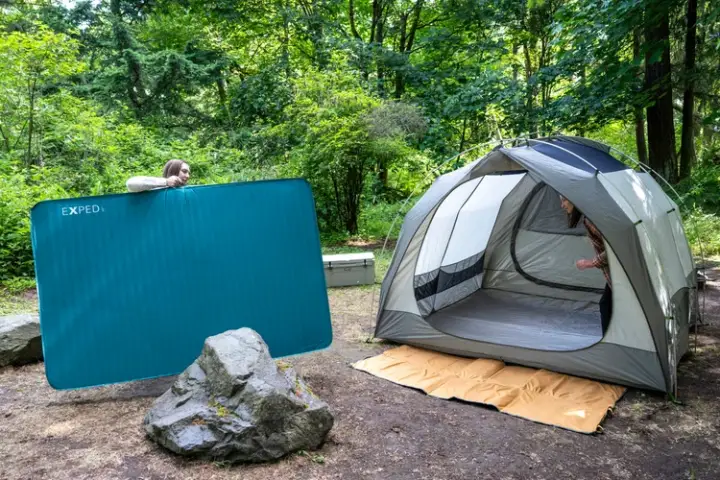
If the goal is to make camping sleep feel as close as possible to sleeping at home, the EXPED MegaMat Duo is one of the strongest options available.
Its biggest advantage is not simply thickness. It is the way the mattress supports the body.
Instead of lying on a large air chamber, you are supported by a combination of open-cell foam and adjustable air pressure. That creates a more stable surface under the shoulders, hips, and lower back.
For side sleepers in particular, that extra cushioning can make a noticeable difference after a long day of hiking.
The rectangular shape also gives you more usable sleeping space from edge to edge. There is less of the rounded, unstable feeling that comes with many traditional air mattresses.
Key Specs & Features
- Type: Self-inflating foam/air mattress
- Thickness: About 4 inches
- Sleeping Capacity: 2 people
- Insulated: Yes
- Shape: Rectangular
- Best Use: Car camping, base camping, large tents
What We Like
The MegaMat feels exceptionally stable.
When one person rolls over, the other side usually stays calmer than it would on a conventional air bed. That can be a major advantage for couples with different sleep habits.
The thick foam core also helps prevent hips and shoulders from reaching the hard surface below.
And when temperatures drop, the insulation becomes just as important as the cushioning. Cold ground and cold vehicle floors can pull heat away surprisingly quickly, so a well-insulated mattress is useful far beyond winter camping.
What We Don’t Like
The MegaMat takes up space.
Even after it is rolled and packed, this is not a mattress you tuck into a tiny corner of the trunk.
If your vehicle is already carrying a cooler, chairs, cooking equipment, water, clothes, and other bulky camping gear, the packed mattress becomes another item that needs a dedicated spot.
It is also expensive compared with basic camping pads.
Best For: Couples who camp frequently and value sleep comfort more than compact packing.
Skip It If: Cargo space is tight or the mattress needs to disappear into a small vehicle every morning.
Check Price & Availability at REI
NEMO Roamer Double: Best for Plush Comfort and Easier Packing

The NEMO Roamer Double is another mattress built around the idea that car campers do not need to sacrifice comfort to save a few ounces.
At roughly 4 inches thick, it provides plenty of cushioning for hips and shoulders while still feeling stable underneath the body.
That makes it especially comfortable for couples and side sleepers.
One of the Roamer’s strongest features is how easy it is to fine-tune the firmness. Add a little air for a firmer feel or release some for more pressure relief.
That sounds minor, but it can dramatically change how a camping mattress feels overnight.
Key Specs & Features
- Type: Self-inflating foam/air
- R-Value: Around 7
- Thickness: About 4 inches
- Dimensions, Double Wide: About 78 x 52 inches
- Sleeping Capacity: 2 people
- Best Use: Car camping and base camping
What We Like
The Roamer strikes a very good balance between softness and support.
It does not have the bouncy feel of a tall household air mattress, and the foam gives the surface enough structure that sleepers do not feel like they are floating.
The fabric surface also feels more inviting than the slick plastic finish found on inexpensive inflatable beds.
Another advantage is adjustability. Couples who like slightly different firmness levels can often find a compromise simply by changing the air pressure.
🚙 For road trips, that kind of simple setup matters. The less time spent fighting with camp furniture and bedding at the end of the day, the better.
What We Don’t Like
The Double Wide model is still large.
At roughly 52 inches across, it may be wider than the space between the wheel wells in many SUVs and crossovers.
That does not matter if the mattress will be used in a tent, but it matters a lot if the plan is to sleep directly inside the vehicle.
Best For: Couples who want a thick, comfortable mattress without moving to a bulky all-foam bed.
Skip It If: Your vehicle’s sleeping area is narrower than about 52 inches.
Check Price & Availability at Amazon
HEST Dually: Best Foam Car Camping Mattress
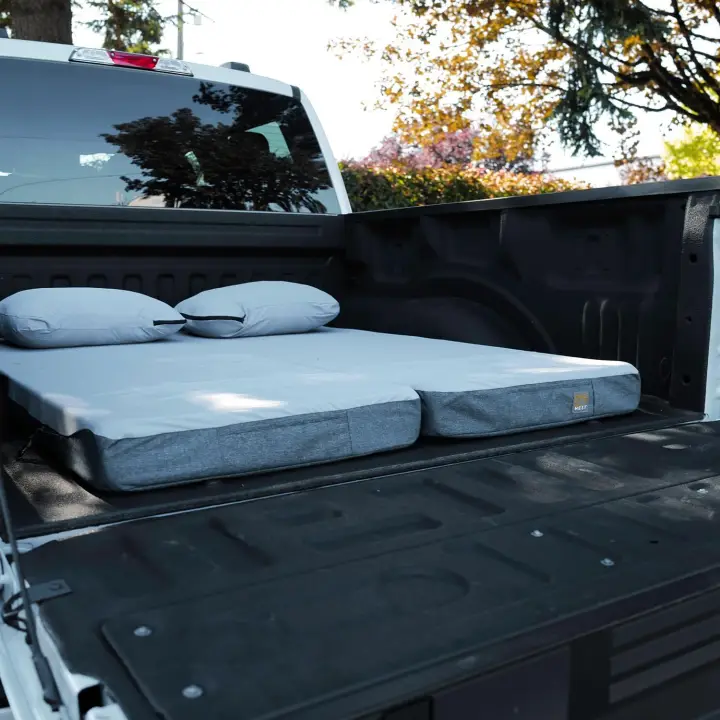
Some campers want comfort without dealing with air at all.
That is where the HEST Dually makes sense.
Instead of relying on an inflatable chamber, it uses thick foam to create a supportive sleeping surface. Unfold it, add bedding, and the bed is ready.
There are no valves to adjust, no pump to find, and no slow leak to discover halfway through the night.
That simplicity is especially appealing for campers who set up and break down often.
Key Specs & Features
- Type: Folding foam mattress
- Thickness: About 3.9 inches
- Dimensions, Long: About 78 x 50 inches
- Weight: Around 24 lbs.
- Sleeping Capacity: 2 people
- Inflation Required: No
What We Like
The biggest advantage is reliability.
A foam mattress cannot lose air during the night.
That removes one of the most frustrating problems associated with inflatable sleeping systems.
It is also easy to use around dogs, truck beds, gravel campsites, and rougher surfaces where punctures might otherwise be a concern.
The layered foam provides plenty of support, and the mattress feels solid rather than springy.
For long road trips or frequent camping, simply unfolding the bed each evening can feel wonderfully uncomplicated.
What We Don’t Like
The Dually is bulky.
Very bulky.
It folds, but it does not compress like an inflatable mattress. That means a large section of the vehicle needs to be reserved for it even when nobody is sleeping.
The weight is also significant compared with self-inflating alternatives.
Best For: Pickup campers, van campers, overlanders, dog owners, and anyone who prioritizes durability and simplicity.
Skip It If: Storage space inside the vehicle is already limited.
Check Price & Availability at REI
REI Co-op Westward Dreamer Double: Best Value for Two
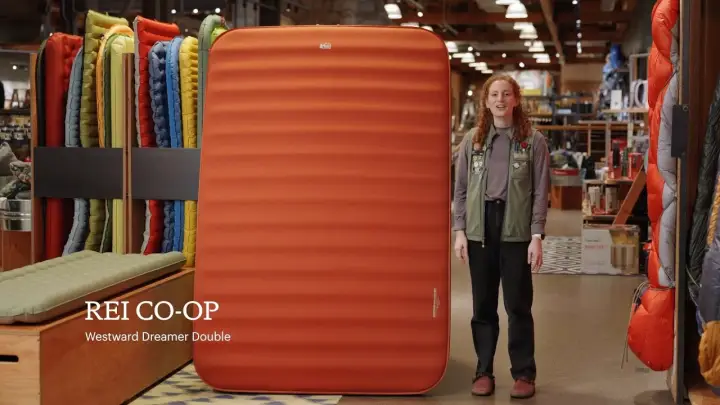
The REI Co-op Westward Dreamer Double is a strong choice for campers who want the thick, stable feel of a self-inflating mattress without moving immediately into the most expensive options.
At about 4 inches thick, it provides enough cushioning to make a firm campsite or vehicle floor much easier on the body.
It is also slightly narrower than some competing double mattresses, which can make it easier to fit into tents and larger vehicle interiors.
Key Specs & Features
- Type: Self-inflating foam/air
- R-Value: About 6.7
- Thickness: About 4 inches
- Dimensions: About 76 x 50 inches
- Sleeping Capacity: 2 people
- Best Use: Car camping and family camping
What We Like
The 50-inch width is a practical compromise.
There is enough room for two sleepers, but the mattress is not quite as demanding of interior space as wider double pads.
The insulation is another strong point.
Even during shoulder-season camping, the mattress helps separate the sleeper from a cold tent floor or vehicle cargo area.
The foam-and-air construction also creates much better support than a basic inflatable guest mattress.
⛺ For campers building their first genuinely comfortable sleep system, this is the kind of upgrade that can change how enjoyable a weekend outside feels.
What We Don’t Like
Like most thick self-inflating mattresses, it requires some effort to pack.
The foam wants to expand while you are rolling it, so compressing it tightly takes more work than simply opening the valve on a thin air pad.
It is also still too wide for some smaller SUVs.
Best For: Couples and families who want a comfortable, warm camping mattress at a more approachable price.
Skip It If: You need something compact enough to share a small cargo area with a lot of gear.
Check Price & Availability at REI
Therm-a-Rest MondoKing 3D: Best for a Luxurious Solo Setup
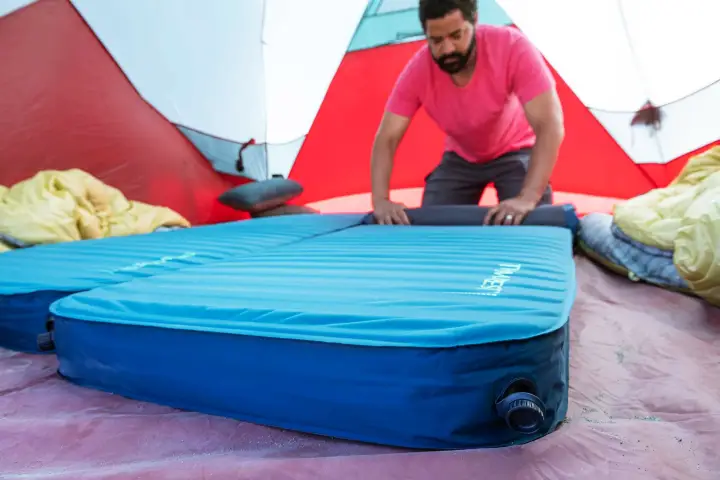
Solo car campers do not necessarily need a double mattress.
In fact, a wide single pad can be easier to fit, easier to pack, and just as comfortable.
The Therm-a-Rest MondoKing 3D is designed for campers who want more room than a typical backpacking mattress without carrying a full double bed.
Its generous rectangular shape creates plenty of space for changing sleeping positions during the night.
That can be especially important for side sleepers or anyone who feels confined on narrow backpacking pads.
Key Specs & Features
- Type: Self-inflating foam/air
- R-Value: About 7
- Thickness: About 4.25 inches
- Shape: Rectangular
- Sleeping Capacity: 1 person
- Best Use: Car camping
What We Like
The MondoKing feels substantial under the body.
The extra thickness gives hips and shoulders room to settle without bottoming out, while the vertical sidewalls maximize the usable sleeping surface.
That makes it much easier to roll from back to side without ending up halfway off the mattress.
For a solo SUV setup, a wide rectangular pad can also leave valuable cargo space beside the sleeping area.
What We Don’t Like
This is not a lightweight multipurpose backpacking pad.
It is designed for comfort, and the packed size reflects that.
Couples using two individual MondoKing pads will also spend more and may need a way to keep the mattresses from separating overnight.
Best For: Solo campers who want maximum cushioning and room to move.
Skip It If: You need one sleeping pad for both backpacking and car camping.
Check Price & Availability at Amazon
How to Choose the Best Car Camping Bed: A Buyer’s Guide
The best camping mattress is not automatically the one with the highest R-value, thickest foam, or biggest price tag.
It is the mattress that works with your actual sleep setup.
Before comparing models, figure out where you are going to sleep most often.
Inside an SUV?
In the bed of a truck?
Inside a large family tent?
In a rooftop tent?
Once that is clear, the right type of mattress becomes much easier to identify.
Types of Car Camping Beds Explained
Self-Inflating Mattresses
These are among the best all-around choices for car camping.
Open-cell foam inside an airtight shell expands when the valve is opened, pulling in air. A pump sack or small pump is usually used afterward to adjust firmness.
They tend to feel more stable and supportive than basic air mattresses and usually provide better insulation.
The downside is packed bulk.
Air Mattresses
Traditional air mattresses use air almost entirely for support.
They can be thick, comfortable, and relatively inexpensive, but they often move more when two people share them.
The bigger issue is insulation.
A large chamber of uninsulated air can become surprisingly cold overnight, even when the air temperature does not feel particularly harsh.
Foam Mattresses
Foam is simple.
There is nothing to inflate and nothing to puncture.
They are comfortable, warm, and reliable, but they take up considerably more space than inflatable mattresses.
For campers with trucks, vans, or large SUVs, that may not matter.
For compact crossovers, it can matter a lot.
Vehicle-Specific Mattresses
These mattresses are designed to fit around wheel wells, seat backs, cargo areas, or footwells.
A good vehicle-specific mattress can turn an awkward SUV interior into a much more usable sleeping platform.
The downside is flexibility. A mattress designed around one vehicle may not work nearly as well after changing cars. 🚗
Key Considerations for Your Sleep Setup
1. Comfort and Thickness
Car camping is one of the few outdoor situations where carrying a thicker mattress usually makes sense.
Pads in the 3- to 4-inch range provide noticeably more pressure relief than thin backpacking mattresses.
Side sleepers benefit the most because body weight concentrates around the hips and shoulders.
That said, thickness alone does not guarantee comfort.
A supportive 4-inch self-inflating mattress can feel far better than a 10-inch household air bed that bounces every time someone moves.
2. Insulation and R-Value
The mattress underneath you is part of the insulation system.
A sleeping bag slows heat loss above and around your body. The mattress helps slow heat loss underneath it.
As a general reference:
- R-Value 1–3: Better for warm-weather camping
- R-Value 3–5: Useful for many spring, summer, and fall trips
- R-Value 5+: Better for cold nights and shoulder-season camping
Higher is not always necessary, but an insulated mattress gives you more flexibility when temperatures drop unexpectedly.
3. Size and Fit: Measure Twice
This is arguably the most important step in buying a mattress for sleeping inside a vehicle.
Do not rely on labels such as “Double,” “Queen,” or “Wide.”
Use actual measurements.
With the seats arranged exactly as they will be at night, measure:
- Length from the closed hatch to the front seats
- Width between the wheel wells
- Maximum width above the wheel wells
- Height from the sleeping platform to the ceiling
- Any gap between folded rear seats and front seats
📏 Pay particular attention to the narrowest point.
A mattress that is 52 inches wide does not become a 48-inch mattress just because the rest of the cargo area is wider.
Also check mattress thickness against headroom. Four extra inches of comfort can make sitting upright much harder in a low-roof crossover.
4. One Double Mattress or Two Singles?
A double mattress feels more like a conventional bed.
There is no gap in the middle, bedding is easier to arrange, and couples can spread out across one continuous surface.
Two individual mattresses offer different advantages.
Each sleeper can adjust firmness separately. The pads are easier to move and pack. One can be used alone on solo trips.
Two narrower pads may also fit better around wheel wells or irregular sleeping platforms.
Neither arrangement is inherently better.
Choose based on your vehicle and sleeping habits.
5. Ease of Inflation and Deflation
Setting up a mattress at home in daylight is one thing.
Doing it in a dark campsite after several hours on the road feels very different.
Self-inflating pads usually need time to expand and then a little extra air.
Traditional air mattresses require a pump.
Foam beds simply unfold.
Think about packing, too.
A thick self-inflating mattress can be easy to set up but surprisingly stubborn when it is time to roll it tightly enough to fit back inside the storage bag.
6. Durability and Materials
Camping mattresses live a harder life than bedroom mattresses.
Dirt, gravel, dog claws, seat hardware, cargo hooks, sharp plastic edges, and rough tent floors are all common.
Clear the sleeping area before inflating anything.
A simple blanket, foam layer, non-slip mat, or other protective barrier underneath the mattress can help reduce wear.
Pro Tips for the Perfect Car Camping Sleep Setup
A good mattress solves only part of the problem.
The rest of the vehicle setup can make just as much difference.
Level the vehicle.
A slight slope can feel surprisingly dramatic when you spend eight hours sleeping on it.
Whenever possible, choose a level parking spot. Leveling blocks can help on uneven campsites when used safely.
Test everything at home first.
Do not discover at the campground that the hatch will not close.
Fold the seats, inflate the mattress, climb inside, close the doors, and check:
- Legroom
- Headroom
- Mattress fit
- Seat gaps
- Storage space
- Access to doors
A 15-minute driveway test can prevent a frustrating first night.
Protect the mattress.
Before inflating it, feel around the cargo floor for exposed bolts, sharp brackets, seat hardware, or forgotten gear.
One small metal edge can end a trip surprisingly quickly.
Use window covers.
Window covers improve privacy and reduce early-morning sunlight.
They can also make the vehicle feel more like a dedicated sleeping space instead of a parked car.
Ventilate overnight.
Condensation builds quickly when people sleep inside a closed vehicle.
Crack windows slightly on opposite sides to create airflow.
Mesh window screens are useful when mosquitoes or other insects are active. 🌲
Keep nighttime essentials within reach.
Do not bury everything underneath the mattress.
Keep a small nighttime kit nearby with:
- Headlamp
- Water
- Phone
- Keys
- Glasses
- Shoes
- Any medication or personal essentials
You do not want to reorganize the vehicle in the dark just to find a headlamp.
Decide where your gear goes before bedtime.
This is one of the most overlooked parts of sleeping inside a vehicle.
The cargo area that holds the mattress during the night probably held gear during the day.
Before the trip, decide where those items will go once the bed is set up.
Front seats, roof boxes, waterproof bins, and tent vestibules can all help.
Bring real pillows if you have the space.
Car camping does not require backpacking compromises.
If your favorite pillow fits in the vehicle, bring it.
Small improvements in bedding often matter more than adding another piece of complicated camping equipment.
Frequently Asked Questions
Can I use a regular air mattress from home for car camping?
Yes, especially for occasional warm-weather trips.
But household air mattresses have a few drawbacks outdoors.
Most provide little insulation underneath the sleeper, which can become noticeable when the ground or vehicle floor gets cold.
They also tend to be taller and bouncier than camping mattresses.
For occasional campground use in mild conditions, a regular air mattress can work fine.
For frequent camping, colder nights, or sleeping directly inside a vehicle, an insulated camping mattress is usually a more comfortable long-term option.
What R-value do I need for car camping?
For most 3-season camping, an R-value somewhere around 3 to 5 or higher is a useful starting point.
If nighttime temperatures regularly approach freezing, a higher R-value provides more insulation between your body and the cold surface underneath.
Keep in mind that the mattress is only one part of the system.
Your sleeping bag or quilt still needs to match the expected overnight temperatures.
What is the best car camping mattress for side sleepers?
Look for a mattress around 4 inches thick with good stability and adjustable firmness.
Side sleepers need enough cushioning for the hips and shoulders to sink into the mattress without touching the surface below.
The EXPED MegaMat Duo, NEMO Roamer, REI Co-op Westward Dreamer, and Therm-a-Rest MondoKing all fit this style of sleep system.
Do not automatically inflate the mattress as firmly as possible.
Releasing a small amount of air often improves pressure relief.
Is a double camping mattress better than two singles?
It depends on the setup.
A double provides a continuous sleep surface and tends to feel more like a normal bed.
Two singles are easier to move, allow individual firmness adjustment, and can fit better in awkward vehicle interiors.
Couples camping mainly in large tents may prefer a double.
Couples sleeping inside SUVs may find two narrower pads easier to work with.
How do I keep my mattress from sliding around inside the car?
A thin non-slip rug pad or yoga mat underneath the mattress usually helps.
It creates friction against smooth cargo floors and can also add a little protection from abrasion.
Can I leave my car camping mattress inflated during a road trip?
If there is enough room, keeping the mattress set up can make multi-day trips much easier.
But the sleeping setup should never interfere with safe driving.
Bedding, mattresses, and gear must stay clear of seats, seat belts, airbags, mirrors, windows, and vehicle controls while driving.
What is the best option if I am worried about punctures?
A foam mattress such as the HEST Dually removes the problem completely.
There is no air chamber to puncture or leak.
The tradeoff is storage space.
Foam mattresses are much harder to compress.
What is the best mattress for sleeping inside an SUV?
Start with measurements rather than brands.
Many double camping mattresses are around 50 to 52 inches wide, while the space between SUV wheel wells can be considerably narrower.
A wide solo mattress or two narrower pads may work better than a traditional double.
The mattress that fits your actual cargo area is usually a better choice than the more comfortable mattress that does not.
The Final Word on Car Camping Beds
A comfortable car camping bed does not need to recreate a bedroom.
It just needs to let you sleep deeply enough that the next morning starts with coffee and excitement instead of sore hips and a stiff back.
For couples who want the most mattress-like experience, the EXPED MegaMat Duo is hard to beat.
The NEMO Roamer Double provides similarly plush comfort and is another excellent choice for campers who prioritize a supportive foam-and-air design.
The REI Co-op Westward Dreamer Double offers an appealing balance of comfort, insulation, and value.
If pumps, valves, and punctures sound like unnecessary complications, the HEST Dually provides a much simpler foam-based solution.
And for solo campers, the Therm-a-Rest MondoKing 3D offers plenty of room without requiring the footprint of a full double mattress.
But before choosing any of them, grab a tape measure.
Measure the length.
Measure between the wheel wells.
Check the headroom.
Think about where the cooler and duffel bags will go once the mattress fills the cargo area.
Those practical details will have a bigger effect on your camping experience than almost any specification on a product page.
Get the fit right, bring warm bedding, add a little ventilation, and a vehicle can become a surprisingly comfortable base camp for waking up somewhere beautiful. 🌄
Affiliate Disclosure: GearForTheOutdoors.com participates in affiliate programs, including REI, Amazon, REI Outlet, Garage Grown Gear, evo, and other trusted partners. When you purchase through our links, we may earn a small commission at no extra cost to you. That helps support our content and keeps our recommendations useful, practical, and free.
Disclaimer: This post is for informational purposes only. Always verify current product details, fit, availability, safety information, and manufacturer warranties before purchase or use. Outdoor conditions and gear performance can vary depending on setup, weather, terrain, and experience level.