
A backpack can look almost perfect on a gear list and still become the one thing you think about all afternoon.
Maybe the shoulder straps start pulling after lunch. Maybe your water bottle is impossible to reach without stopping. Maybe the pack feels great at 20 pounds but awkward once food and water push the load closer to 30.
The REI Co-op Flash 55 is built around those everyday backpacking problems.
It weighs under 3 pounds, carries loads up to about 35 pounds, offers roughly 55 liters of space, and keeps many of the comfort and organization features that disappear on more minimalist ultralight packs.
That makes it especially appealing if you want to lighten your setup without turning every piece of gear into an ounce-counting exercise.
There is still a real frame. The torso is adjustable. The hipbelt is structured. Water and snacks can stay within reach. Wet layers have somewhere convenient to go. And when a shorter trip calls for less gear, several Packmod pieces can be removed or repositioned.
In practical terms, the Flash 55 feels less like a specialized ultralight pack and more like a lighter, more adaptable version of the backpacking pack many hikers already know how to use.
That is a useful place to be.
The Short Answer: Quick Verdict

The REI Co-op Flash 55 makes the most sense for backpackers carrying roughly 20–35 pounds who want to save meaningful pack weight without giving up support, accessible storage, or an adjustable fit.
It is especially well suited to weekend trips, three- to five-day routes, and hikers gradually moving toward lighter gear.
A 55-liter pack gives you enough room for a typical three-season sleep system, shelter, food, layers, cooking gear, and a few comforts without creating the temptation to fill a huge pack with unnecessary extras.
And unlike many minimalist designs, the Flash 55 does not ask you to sacrifice convenience just to cut weight.
You still get:
- An internal spring-steel frame
- An adjustable torso
- A supportive hipbelt
- A roll-top main compartment
- A removable lid
- Removable Packmod pockets
- Forward-positioned water bottle storage
- A large front stash pocket
- Hydration-reservoir compatibility
- Multiple exterior attachment points
The trade-offs are equally clear.
If your loaded pack regularly climbs past 35 pounds, a more substantial suspension will probably feel better. If back ventilation is one of your highest priorities, the Osprey Exos 58 or Gregory Focal 58 creates more separation between the pack and your back.
But if your goal is to carry a normal three-season backpacking load in a pack that feels lighter without becoming fussy, the Flash 55 lands in a very practical middle ground. 🎒
| Feature | REI Co-op Flash 55 |
|---|---|
| Best use | Backpacking |
| Capacity | 53–57 L depending on size |
| Men’s M weight | 2 lbs. 13 oz. |
| Women’s M weight | 2 lbs. 12 oz. |
| Recommended load | Up to 35 lbs. |
| Frame | Internal spring-steel frame |
| Torso adjustment | Yes |
| Main access | Top / roll-top |
| Exterior pockets | 9 + main compartment |
| Hydration compatible | Yes, up to 3 L |
| Raincover included | No |
| Listed price | $229 |
Those numbers put the Flash 55 squarely between heavier traditional backpacking packs and more stripped-down ultralight options.
Key Features Deep Dive
The Flash 55 is easiest to appreciate when you stop looking at individual features and think about how a backpack gets used during a full hiking day.
You leave the trailhead with food packed tightly, a cool morning layer still on, and plenty of water.
An hour later, that layer comes off.
By midday, snacks are disappearing, water bottles are moving in and out of pockets, and sunscreen or a rain shell may need to be reached quickly.
At camp, the pack has to open easily, swallow bulky gear again in the morning, and carry everything comfortably once the routine starts over.
A good backpack makes those transitions almost invisible.
The Flash 55 is particularly strong at that kind of practical trail organization.
The Packmod System Makes More Sense on the Trail Than on Paper
“Modular” can sound like another gear-marketing word until it solves an actual problem.
The Flash 55’s Packmod system lets you remove or reposition several exterior pieces rather than forcing you to use one fixed configuration on every trip.
That flexibility becomes useful once your trips start looking different from one another.
For a longer route, keeping the lid and extra pockets attached gives you more organization.
For a quick summer overnight, some of those pieces may simply be extra weight and clutter.
Going somewhere that requires a foam pad outside the pack? Reposition the compression straps.
Want a cleaner pack with fewer dangling pieces? Remove what you do not need.
The real benefit is not that the Flash 55 can become dramatically lighter.
It is that you are not locked into carrying every feature on every trip.
Removable Top Lid
The lid works well for small items that are easy to lose inside a 55-liter main compartment.
Headlamps, gloves, maps, snacks, electronics, and small first-aid items are all easier to find when they have a predictable place.
On trips where that extra organization is unnecessary, the lid can stay home.
The pack still has a roll-top main closure underneath, so removing the lid does not leave you with an awkward or incomplete backpack.
That roll-top also helps the Flash 55 handle changing loads.
A pack that starts the trip full of food can be rolled farther down two or three days later as the contents shrink.
Instead of having a half-empty upper compartment bouncing around, the pack can compress around what is actually inside.
That sounds minor in the garage.
On a trail, it feels tidy and intentional.
Removable Shoulder and Hipbelt Pockets
This is one of the Flash 55’s more useful ideas.
Think about how often a phone, snack, sunscreen, lip balm, or small camera gets used during a hiking day.
If all of those items live inside the main pack, every quick stop becomes:
pack off → buckle open → item out → pack closed → pack back on.
Do that repeatedly over 10 miles and it becomes annoying fast.
Keeping those essentials within reach helps the day flow better.
The Flash 55 includes Packmod storage around the shoulder straps and hipbelt, and those pieces can be removed if you prefer a simpler setup.
That makes the storage feel purposeful rather than excessive.
The 55-Liter Capacity Hits a Useful Sweet Spot
Backpack volume affects behavior more than it gets credit for.
A very large pack makes it easy to bring “just one more thing.”
Another shirt.
A bigger stove.
Extra camp shoes.
The chair that seemed unnecessary until there was room for it.
A 55-liter backpack does not prevent overpacking, but it encourages a more deliberate gear list.
At the same time, it is still large enough for many normal three-season setups.
A compact tent, sleeping bag or quilt, sleeping pad, insulating layer, rain gear, food, cookware, and personal items can all fit comfortably when the rest of the kit is reasonably modern and packable.
That makes the Flash 55 particularly useful for hikers somewhere between traditional and ultralight backpacking.
You do not need a tiny quilt or frameless pack mentality.
You just need gear that is not excessively bulky.
🌲 For many weekend and multiday backpackers, that is exactly the right balance.
Comfort and Carry: The 35-Pound Question
The most important number on the Flash 55 is not 55 liters.
It is 35 pounds.
That is the load range where the pack is intended to work.
The internal spring-steel frame gives the pack enough structure to transfer weight toward the hips, while the contoured hipbelt helps support the load around your pelvis rather than leaving your shoulders to do all the work.
That is a very different experience from carrying the same weight in a frameless ultralight pack.
Around the mid-20-pound range, a pack like the Flash 55 gives you plenty of room to carry normal backpacking gear without requiring an extreme setup.
Closer to 30–35 pounds, fit becomes more important.
The hipbelt needs to land correctly.
The torso needs to match your body.
The load should stay close to your back.
And heavy items should be packed where the frame can manage them effectively.
Above that range, the question starts changing.
Instead of asking whether the Flash 55 can physically hold the gear, it becomes more useful to ask whether a heavier suspension would carry it more comfortably.
For hikers regularly carrying winter equipment, climbing hardware, lots of water, family gear, or very long food carries, that answer may be yes.
Adjustable Torso Length Is More Important Than Saving a Few Ounces
A backpack that is half a pound lighter but fits poorly is not the better backpack.
Fit matters more.
The Flash 55 has an adjustable torso and comes in several size combinations, giving you more room to dial in the fit than many fixed-size minimalist designs.
The most useful way to judge that fit is with weight inside.
Put roughly 20–30 pounds in the pack.
Tighten the hipbelt first.
Then adjust the shoulder straps, load lifters, and sternum strap.
The shoulder straps should follow the shape of your body without carrying the entire load, while the hipbelt should sit securely around the top of your hips.
Walk around.
Climb stairs if possible.
Lean forward.
Move side to side.
A pack that feels comfortable for 30 seconds in front of a mirror has not told you much yet.
Back Ventilation: Good, but Not the Main Strength
The Flash 55 uses a ventilated back panel, but the pack still rides fairly close to the body.
That has one obvious advantage.
The load stays close to your center of gravity.
On uneven trail, rocky steps, or quick changes in direction, that can make the pack feel stable rather than hanging behind you.
The trade-off is airflow.
Suspended-mesh packs such as the Osprey Exos 58 create a larger gap between the pack body and your back.
If most of your backpacking happens in hot, humid weather, that difference can matter.
If you hike mostly in moderate temperatures or prefer a close, stable carry, it may matter much less.
Smart Storage and Trail Access

The Flash 55 has plenty of pockets, but the more important question is whether they are where you actually need them.
For the most part, they are.
The Front Pocket Is the Place for “Not Quite Dry”
A big exterior front pocket is one of the most useful features on any backpacking pack.
That becomes obvious the first time the weather changes three times before lunch.
Rain starts.
Shell goes on.
Rain stops.
Shell is damp.
The last place you want to put it is deep inside the pack beside your dry insulation.
The Flash 55’s large front pocket gives that wet layer somewhere easy to go.
The same space works well for:
- A wind shell
- Water filter
- Damp tent fly
- Gloves
- Camp sandals
- Puffy jacket during a quick break
- Other gear you may want again soon
It is not complicated.
It is just useful.
Water Bottle Access Actually Matters
It is easy to underestimate how annoying a poorly positioned bottle pocket can become.
If you cannot reach a bottle while wearing the pack, every drink becomes a stop.
The Flash 55 positions its bottle storage forward, closer to the hipbelt, so water is easier to reach without removing the pack.
For hikers who prefer bottles instead of a bladder, that is a meaningful advantage.
It keeps water visible.
It makes refilling simple.
And you can see how much is left without guessing.
Hydration Reservoir Users Are Covered Too
Prefer drinking through a hose?
An internal sleeve holds up to a 3-liter hydration reservoir, with routing over either shoulder.
That means the pack works equally well for bottle users, bladder users, or hikers who use both.
On dry routes, carrying a bladder plus a bottle can also make water management easier.
How It Compares: Flash 55 vs. the Competition
The Flash 55 sits in a crowded part of the backpacking market.
That is good news.
You do not have to choose between one lightweight pack and a bunch of heavy alternatives.
The Osprey Exos 58 and Gregory Focal 58 are both close enough in capacity and weight to make the differences meaningful.
| Model | Capacity | Weight | Listed Price | Back Panel | Best For |
|---|---|---|---|---|---|
| REI Co-op Flash 55 | 53–57 L | Men’s M: 2 lbs. 13 oz. | $229 | Ventilated padded panel | Adaptability and storage |
| Osprey Exos 58 | 58–61 L | S/M: 2 lbs. 13 oz. | $285 | AirSpeed suspended mesh | Hot-weather ventilation |
| Gregory Focal 58 | 54–62 L | M: 2 lbs. 10.4 oz. | $269.95 | Suspended mesh | Ventilation + flexible hipbelt |
The weights are close enough that there is little reason to choose based on ounces alone.
Fit and suspension style matter much more here.
REI Flash 55 vs. Osprey Exos 58

The Osprey Exos 58 makes the strongest case for hikers who hate a sweaty back.
Its AirSpeed suspended-mesh back panel creates a noticeable gap between you and the pack body.
That airflow can feel especially good on long summer climbs.
The Exos also offers slightly more capacity, with roughly 58 liters depending on size, while staying in almost the same weight class as the Flash 55.
So why choose the Flash?
Because the two packs organize gear differently.
The Flash 55 gives you more modularity and more configurable exterior storage.
The Exos puts more emphasis on ventilation.
This decision becomes much easier when framed around the trail:
Choose the Flash 55 if: you like having snacks, phone, bottles, rain gear, and other small essentials easy to organize—and you want to change that setup depending on the trip.
Choose the Exos 58 if: hot-weather airflow matters more than modular storage.
There is no meaningful advantage in chasing a few ounces here.
Pick the suspension you would rather wear for eight hours.
Check the Osprey Exos 58 for current sizes, colors, and availability →
REI Flash 55 vs. Gregory Focal 58
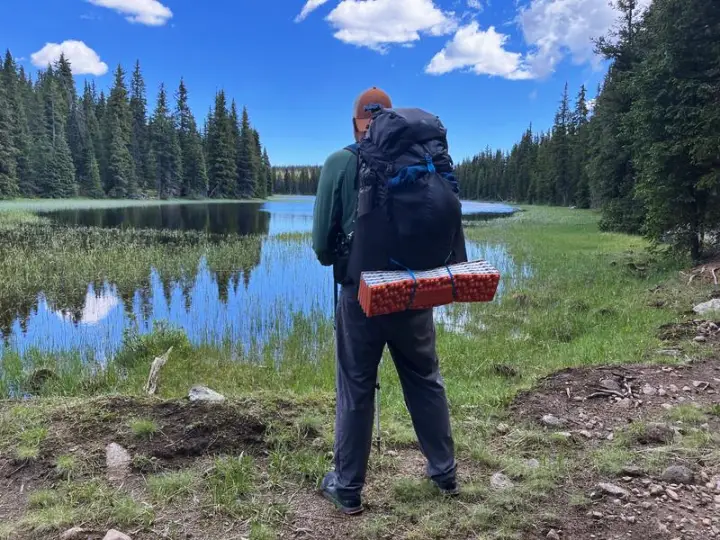
The Gregory Focal 58 approaches lightweight comfort differently.
Its FreeFloat suspension uses a suspended-mesh back panel and a hipbelt designed to move with your stride.
Again, the scale does not settle the decision.
The difference is in how you want the backpack to behave.
The Focal is appealing if you want more airflow and a suspension that feels dynamic as your body moves.
The Flash 55 is appealing if you value accessible storage and the ability to reconfigure the exterior.
Choose the Flash 55 if: adaptable organization is high on the list.
Choose the Gregory Focal 58 if: back-panel airflow and hipbelt movement matter more.
If all three packs fit your budget, trying them loaded is more useful than comparing another spreadsheet.
Check the Gregory Focal 58 for current sizes, colors, and availability →
Who Is This Backpack Best For? And Who Should Skip It?
The Flash 55 is broad enough to work for many backpackers, but that does not mean everyone should buy one.
The easiest way to decide is to compare its strengths with the way you actually hike.
You should consider the REI Flash 55 if…
- Your loaded backpack usually stays under 35 pounds.
That keeps the pack within the load range its suspension is designed to handle. - You want to move away from a heavy traditional pack.
Cutting a pound or more from the backpack itself is one of the simplest ways to reduce total pack weight. - You still want structure.
The Flash 55 keeps an internal frame, supportive hipbelt, and adjustable torso rather than forcing you into a frameless design. - You like having trail essentials within reach.
Water, snacks, phone, layers, and small accessories can all be kept outside the main compartment. - Your trips vary.
A short overnight and a multiday trip do not need exactly the same pack setup, and the removable components let you adjust accordingly. - You are still refining your backpacking kit.
The Flash 55 gives you enough flexibility to become lighter over time without immediately outgrowing the pack.
You might want to look elsewhere if…
- Your starting loads regularly exceed 35 pounds.
A heavier frame and suspension may carry those loads more comfortably. - You hike primarily in hot, humid weather.
A suspended-mesh pack may give you noticeably better airflow. - Your entire kit is already genuinely ultralight.
If loaded trips stay around 15–20 pounds, you may not need this much frame, hipbelt, or storage. - You want panel access or multiple zippered compartments.
The Flash 55 is fundamentally a top-loading pack. - You prefer fixed organization.
The Packmod approach works best for hikers who appreciate flexibility rather than a permanent pocket layout.
The Final Verdict
The Flash 55 gets the most important thing right: it makes carrying less weight easier without making backpacking itself harder.
That distinction matters.
Some lightweight packs save ounces by removing structure, pockets, adjustment, padding, or convenient access.
For the right hiker, that is a perfectly good trade.
But it is not the trade every backpacker wants.
The Flash 55 lets you keep most of the features that make a backpack easy to live with.
There is a real hipbelt.
There is an adjustable torso.
Water is accessible.
Wet gear has somewhere sensible to go.
Frequently used items do not have to disappear inside the main compartment.
And the pack has enough structure to carry a typical three-season load without requiring an ultralight gear list first.
At the same time, it does not lock you into carrying every accessory forever.
As your kit gets lighter, the pack can get simpler too.
That is probably the best reason to consider it.
For a newer backpacker, the Flash 55 leaves room to grow.
For an experienced backpacker coming from a heavier pack, it can cut meaningful weight without dramatically changing the way gear is packed.
And for someone who simply wants one versatile backpack for most three-season trips, 55 liters is a very useful place to land.
The Flash 55 is less convincing if heavy loads are normal or maximum ventilation is essential.
But for the large middle ground between traditional backpacking and hardcore ultralight gear, it makes a lot of sense.
Before buying, the most important step is not comparing another spec.
It is making sure the torso and hipbelt fit are right.
Check the REI Co-op Flash 55 for current sizes, colors, and availability →
Frequently Asked Questions (FAQ)
Is the REI Flash 55 waterproof?
No.
The Flash 55 uses water-resistant materials, but it is not waterproof and does not include a raincover.
For wet-weather backpacking, a waterproof pack liner is still one of the simplest and most reliable ways to protect your sleeping bag, dry layers, electronics, and other critical gear.
A heavy-duty trash compactor bag can work surprisingly well for this purpose.
How much weight can the REI Flash 55 comfortably carry?
The pack is designed for loads up to about 35 pounds.
For many hikers, the most comfortable use case will be somewhere below that limit.
A starting load in the mid-20s gives the suspension plenty of room to work while keeping the overall pack noticeably lighter than a traditional setup.
If 35 pounds is your normal starting point rather than an occasional maximum, it is worth trying a more substantial backpack for comparison.
Can the REI Flash 55 fit a bear canister?
Many common bear canisters can be carried in a pack this size, but the exact fit depends on the canister and the rest of your gear.
A large canister may work best vertically inside the main compartment.
Smaller models give you more freedom to arrange the load.
The best approach is simple: test the actual canister before the trip.
And always check the food-storage regulations for the specific park, wilderness area, or forest you are visiting.
Does the Flash 55 have an adjustable torso?
Yes.
That is one of the pack’s more important features.
The adjustable torso gives you more room to match the shoulder harness and hipbelt to your body.
That matters because the goal is not simply to keep the pack attached to your back.
The goal is to transfer most of the load through the hipbelt while letting the shoulder straps stabilize the pack.
What size REI Flash 55 should you buy?
Start with torso length rather than height.
Measure from the C7 vertebra at the base of your neck down to the top of the iliac crest.
Then compare that number with the appropriate pack size.
Hipbelt fit matters too.
The belt should wrap securely around the top of your hips without running out of adjustment.
Whenever possible, try the pack with realistic weight inside.
A backpack can feel completely different loaded with 25 pounds than it does empty.
Is the REI Flash 55 good for beginners?
Yes, especially for someone who expects to backpack regularly rather than buying a pack for one isolated trip.
It is light enough to avoid starting with unnecessary pack weight but structured enough that you do not need to understand frameless ultralight packing immediately.
The adjustable torso is also helpful because beginners are often still learning what a properly fitted backpack should feel like.
And as the rest of the gear list improves, some removable accessories can stay home.
That gives the Flash 55 room to grow with the hiker rather than becoming obsolete as soon as the kit gets lighter.
Is 55 liters enough for a multiday backpacking trip?
For many three-season trips, yes.
The number of nights matters less than how bulky your equipment is.
A compact quilt, small tent, inflatable pad, and lightweight clothing can leave plenty of room for several days of food.
A bulky synthetic sleeping bag, large tent, thick cold-weather layers, or bear canister will consume space much faster.
If all of your current gear barely fits into a 70-liter pack, switching directly to 55 liters may require changes elsewhere first.
Is the REI Flash 55 an ultralight backpack?
The Flash 55 sits on the lighter side of framed backpacking packs, but it makes more sense to think of it as a lightweight framed backpack with ultralight-friendly design features.
There are much lighter frameless packs available.
The Flash 55 keeps more support, adjustability, storage, and load-carrying structure.
That balance is exactly why it works for hikers who want to reduce weight without going fully minimalist.
Flash 55 or Osprey Exos 58?
Choose based on how you prefer a backpack to feel.
The Exos 58 has a suspended AirSpeed back panel and is the more obvious choice if ventilation is the priority.
The Flash 55 gives you more modular storage and a closer, more traditional carry.
Their weights are close enough that fit, airflow, and organization should matter more than the scale.
Flash 55 or Gregory Focal 58?
The Gregory Focal 58 uses a suspended-mesh back panel with a flexible hipbelt designed to move naturally with your stride.
The Flash 55 focuses more heavily on configurable pockets, removable components, and adaptable exterior storage.
If organization and flexibility matter most, the Flash 55 has the stronger appeal.
If you prioritize ventilation and suspension movement, the Focal 58 deserves a close look.
Affiliate Disclosure: GearForTheOutdoors.com participates in affiliate programs, including REI, Amazon, REI Outlet, Garage Grown Gear, evo, and other trusted partners. When you purchase through our links, we may earn a small commission at no extra cost to you. That helps support our content and keeps our recommendations useful, practical, and free.
Disclaimer: This post is for informational purposes only. Always verify current product details, fit, availability, safety information, and manufacturer warranties before purchase or use. Outdoor conditions and gear performance can vary depending on setup, weather, terrain, and experience level.