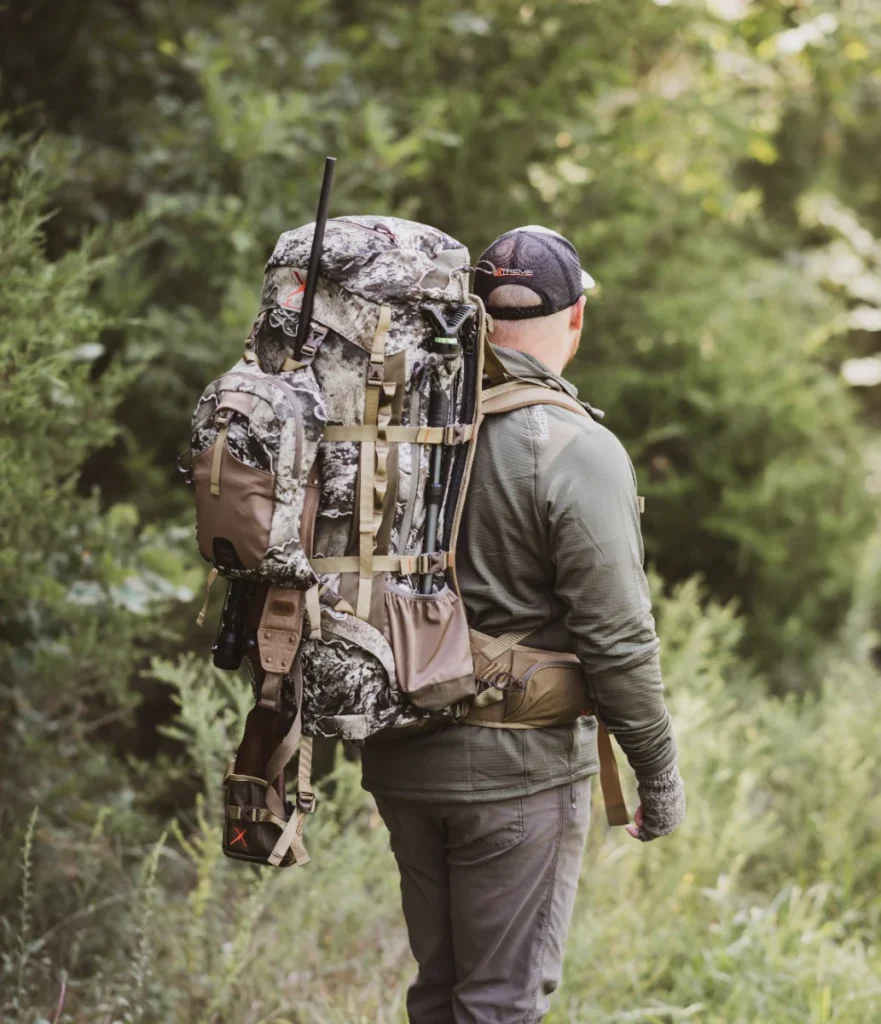
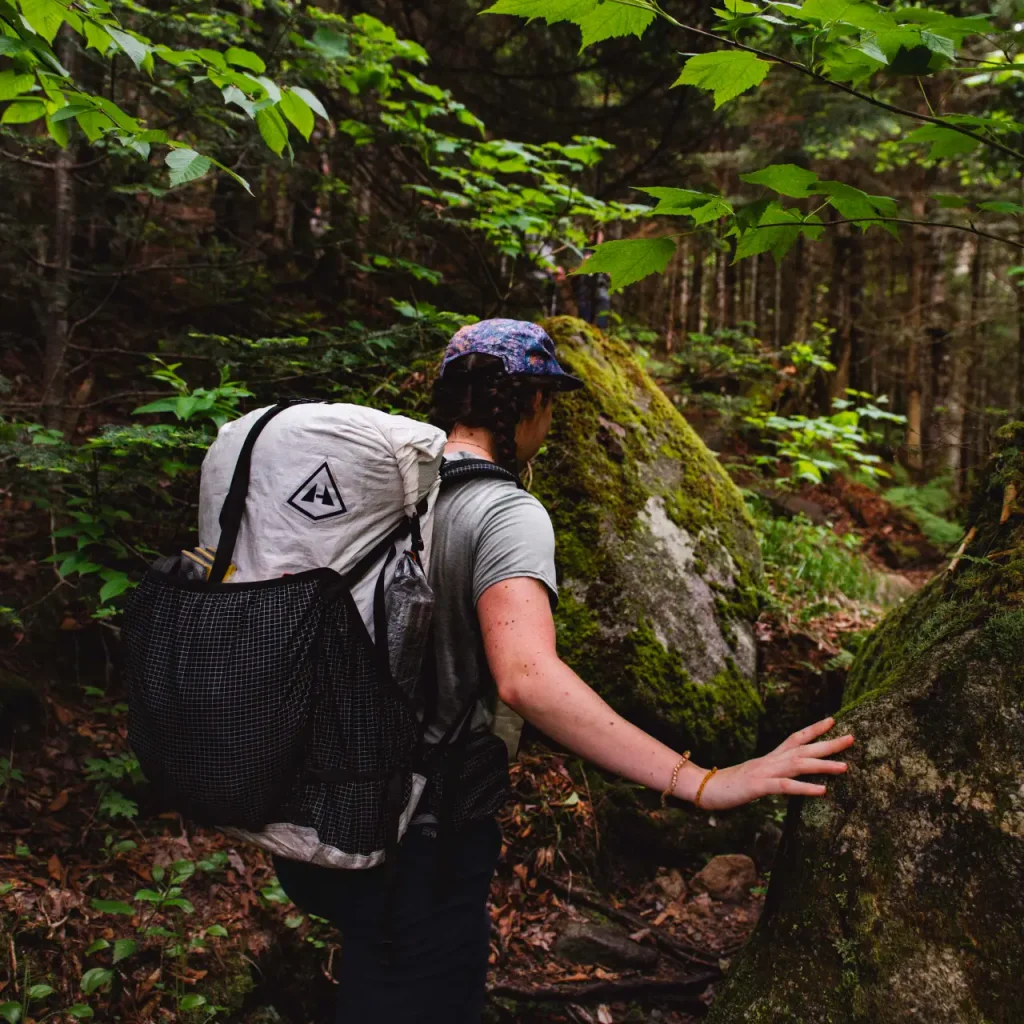
A backpack can feel perfectly comfortable for five minutes in a store and completely different after three hours of climbing with 30 pounds on your back.
That is why choosing one of the best backpacking backpacks is less about finding the pack with the longest feature list and more about matching the pack to your body, your gear, and the way you actually backpack.
A hiker carrying a compact quilt, trekking-pole shelter, and lightweight cook kit has very different needs from someone packing a synthetic sleeping bag, freestanding tent, bear canister, and four days of food. The first may be happiest with a simple two-pound pack. The second will probably appreciate a stronger frame and more supportive hipbelt long before reaching camp.
The five backpacks below cover those different styles rather than competing for the same type of hiker.
For most backpackers who prioritize comfort and airflow, the Osprey Atmos AG LT 65 is the easiest place to start. Heavy-load trips point toward the Gregory Baltoro 65 or Deva. The REI Co-op Trailmade 60 delivers strong value for a first serious backpacking setup, while the Hyperlite Mountain Gear Southwest 55 makes much more sense once the rest of the gear list is already light and compact.
And for trips where capacity changes from one outing to the next, the expandable Deuter Aircontact Core offers a lot of flexibility. 🎒
Top Backpacking Pack Picks at a Glance
| Backpack | Best For | Capacity | Approx. Weight | Price Tier |
|---|---|---|---|---|
| Osprey Atmos AG LT 65 / Aura AG | Comfort & Ventilation | 65L+ depending on model/size | Around 4 lbs. | $$$ |
| Gregory Baltoro 65 / Deva | Heavy Loads | Varies by model/size | Around 4.5–5+ lbs. | $$$$ |
| REI Co-op Trailmade 60 | Best Value / First Pack | 60L | Mid-3-lb. range | $$ |
| Hyperlite Mountain Gear Southwest 55 | Ultralight Backpacking | 55L | About 1.9–2 lbs. | $$$$ |
| Deuter Aircontact Core 60+10 / 55+10 SL | Larger & Changing Loads | 65–70L expanded | About 5 lbs. | $$$ |
There is no universal winner here.
If you tend to run hot and want the pack to feel supportive over long days, the Atmos stands out. If your trips start heavy, the Baltoro makes more sense. If you’re putting together a first backpacking setup, the Trailmade gives you room to spend more of the budget on your shelter and sleep system.
And if your base weight is already low, carrying an ultralight pack like the Southwest becomes much easier to justify.
How to Choose a Backpacking Backpack: A Buyer’s Guide
Before worrying about pockets, zippers, removable lids, or hydration sleeves, answer three questions:
- How bulky is your gear?
- How heavy is your typical loaded pack?
- What actually makes you uncomfortable while hiking?
Those answers usually narrow the field quickly.
A sweaty back may make ventilation a priority. Sore shoulders may point toward better load transfer and fit. A 20-pound setup opens the door to lighter packs, while a 35- or 40-pound load rewards stronger suspension.
1. Backpack Capacity: Start With Your Gear, Not the Number of Nights
Capacity recommendations often look deceptively simple:
- 30–50 liters: Light overnight trips and compact setups
- 50–70 liters: Most multiday backpacking
- 70+ liters: Bulky winter gear, long food carries, family equipment, or expedition-style trips
Those ranges are useful, but the actual volume of your gear matters more than whether a trip lasts three nights or four.
A down quilt can disappear into the bottom of a pack. A bulky synthetic sleeping bag may consume a huge portion of the same space. Add a bear canister, puffy jacket, fleece, and several days of food, and a pack that looked enormous online can fill surprisingly fast.
For many backpackers, 55–65 liters is a particularly useful range.
It leaves enough room for a conventional three-season setup without automatically pushing you toward an oversized pack that invites extra gear.
🏕️ Before buying: Put your tent, sleep system, clothing, kitchen gear, water treatment, and typical food bag together. Seeing how much physical space the gear occupies is far more useful than guessing from trip length alone.
2. Fit Matters More Than Almost Everything Else
A $400 backpack that does not fit properly is a bad backpack for you.
A less expensive model that matches your torso and hips can feel dramatically better after ten miles.
The goal is for the hipbelt to carry much of the pack’s weight while the shoulder straps keep the load stable against your body. When the fit is wrong, weight tends to hang from the shoulders or pull backward.
That usually gets worse as the day goes on.
Measure Your Torso, Not Your Height
Backpack sizing is based largely on torso length.
To measure it:
- Tilt your head forward slightly and locate the C7 vertebra—the noticeable bump near the base of your neck.
- Put your hands on the tops of your hip bones.
- Imagine a horizontal line running between those points across your lower back.
- Measure from C7 down to that line.
Having someone else take the measurement is much easier.
Your hipbelt should then wrap around the upper portion of your hip bones rather than sitting loosely around your waist.
Once the pack is loaded, look for a secure wrap around the hips, smooth contact through the shoulder straps, and a load that feels close to your center of gravity.
🥾 If a shoulder strap digs in, a hipbelt slides down, or the pack consistently pulls backward during a short fitting session, those problems rarely become more pleasant after six hours on trail.
3. Think About Your Real Trail Weight
One of the easiest mistakes is buying an ultralight backpack before the rest of the gear becomes ultralight.
The result can be a very light empty pack carrying a very uncomfortable heavy load.
If your typical starting weight is around 20–25 pounds, a lighter pack can work beautifully. Once food, water, winter equipment, or shared gear starts pushing the load higher, a stronger frame and more substantial hipbelt can become worth their own extra weight.
That makes the question less about:
“How much does the backpack weigh?”
and more about:
“How well will this backpack carry everything that needs to go inside it?”
A two-pound pack is not automatically better than a four-pound pack.
If the heavier pack keeps 35 pounds stable on your hips while the lighter one concentrates pressure on your shoulders, the trail may make that extra two pounds feel like a bargain.
4. Pay Attention to the Features You Use While Hiking
Some backpack features sound impressive on a product page but barely matter once you start walking.
Others affect nearly every trail day.
Hipbelt Pockets
These are worth having if you like snacks, sunscreen, lip balm, a phone, or a compact camera within reach.
Check their size with the pack on. Tiny hipbelt pockets are much less useful than they appear in photos.
Side Water Bottle Pockets
Try reaching them without removing the pack.
Easy bottle access is one of those small details that becomes surprisingly important when you’re drinking every 20 or 30 minutes on a hot climb.
Front Stretch or Shove-It Pocket
Excellent for gear that needs to remain accessible—or separate from dry gear.
Think rain jacket, damp shelter fabric, filter, camp sandals, or a layer that keeps coming on and off.
Panel Access
Traditional top-loading packs work well until the one item you need is buried near the bottom.
A front or U-shaped zipper lets you reach deeper gear without dismantling your entire campsite on the trail.
Ventilation
A suspended mesh panel helps create airflow between your shirt and the pack.
It will not eliminate sweat on a summer climb, but it can make the difference between a damp back and feeling like you’re hiking with a warm foam pad strapped against you.
Compression Straps
Useful for controlling partially filled packs and securing awkward items such as tent poles or a foam sleeping pad.
The main benefit is load stability: less shifting usually means a more natural walking motion.
The Best Backpacking Backpacks of 2026: In-Depth Reviews
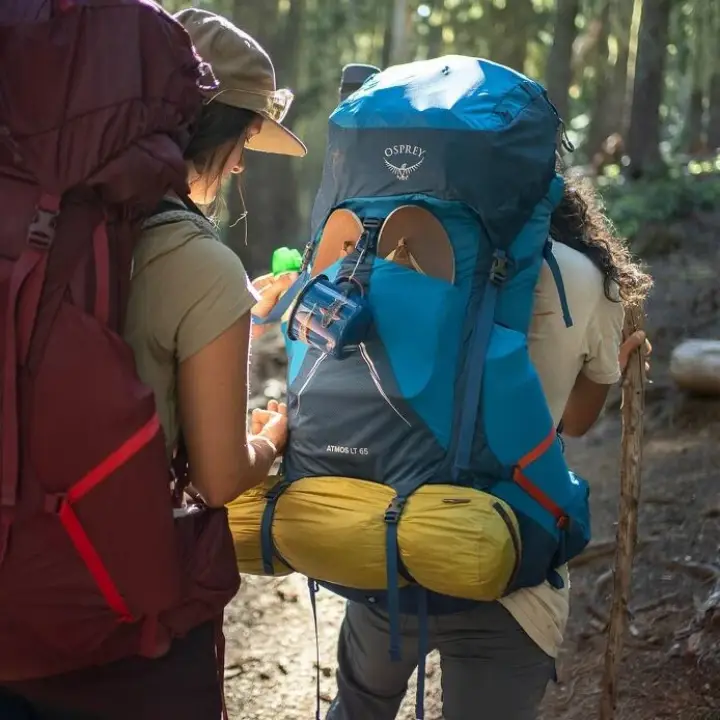
Osprey Atmos AG LT 65 & Aura AG
Best For: Comfort & Ventilation
Capacity: Atmos AG LT 65: approximately 65–68L depending on size
Weight: Around 4 lbs.
Price Tier: $$$
The Osprey Atmos AG LT 65 makes the strongest case for hikers who finish long trail days wishing their backpack felt cooler and better supported.
Its suspended AntiGravity back panel is the defining feature.
Instead of having most of the pack body resting directly against your back, the mesh suspension creates some separation while wrapping around the hips and torso.
The advantage becomes particularly noticeable when the temperature climbs.
A steep afternoon ascent will still make you sweat, but airflow behind the pack is considerably better than what you get from many traditional padded back panels.
The Atmos also carries like a traditional backpacking pack rather than an ultralight sack with shoulder straps.
Load it with a tent, sleeping bag, pad, stove, clothing, water, and several days of food, and the suspension gives that weight a structured place to go.
🌲 On rolling or uneven trail, that stability matters. The pack stays connected to your movement instead of feeling like a heavy bag swinging behind you.
Organization is practical without becoming fussy. Hipbelt storage keeps small essentials accessible, side pockets handle water, and the exterior gives wet or frequently used gear somewhere to live outside the main compartment.
There is a tradeoff.
At roughly four pounds, the Atmos itself represents a significant chunk of a lightweight backpacker’s base weight. If the rest of your equipment has already been trimmed to the minimum, carrying this much suspension may be unnecessary.
For someone starting a trip with a conventional 25–35-pound load, though, comfort may matter much more than saving another pound from the empty pack.
What stands out on the trail
- Excellent airflow behind the back
- Supportive hipbelt and suspension
- Stable feel on uneven terrain
- Useful pockets without excessive complexity
- Good capacity for typical multiday trips
What to consider first
- Significantly heavier than minimalist packs
- Suspended frame creates a curved interior profile
- Overbuilt for hikers with very low trail weights
Best fit: A backpacker carrying a conventional multiday load who would gladly add some pack weight for better support and ventilation.
Look elsewhere if: Your gear is already light, compact, and comfortably carried in a sub-3-pound pack.
If comfort and airflow matter more than shaving every ounce, this is the pack to compare first.
Check the Osprey Atmos AG LT 65 at REI →
Women looking for the same comfort-focused approach can compare the corresponding Osprey Aura AG models.
Check the Osprey Aura AG at REI →
Gregory Baltoro 65 & Deva

Best For: Heavy Loads & Maximum Support
Capacity: Varies by model and size
Weight: Roughly 4.5–5+ lbs. depending on model/size
Price Tier: $$$$
Some trips simply begin heavy.
Maybe the first reliable water source is miles away. Maybe a bear canister is packed with four or five days of food. Maybe colder temperatures mean extra insulation and a larger sleeping bag.
This is where the Gregory Baltoro earns its weight.
Rather than chasing a low number on the scale, the suspension is built around controlling a heavier load.
The hipbelt moves with your body, the shoulder harness stays supportive, and the frame helps keep the contents from sagging away from your back.
That can make a much bigger difference at mile 12 than it does while standing beside the car.
⛰️ With a heavy pack, the worst feeling is often not the weight itself. It is weight that shifts, pulls backward, or concentrates into a few uncomfortable pressure points.
The Baltoro is designed to reduce those problems.
Front access is another feature that becomes increasingly useful as trips get longer.
When the puffy jacket ends up beneath the cook kit, food bag, and half the contents of your pack, opening the front is much more convenient than emptying everything from the top.
The downside is straightforward: the Baltoro is heavy before a single piece of gear goes inside.
For a lightweight weekend setup, much of that suspension capacity is unnecessary.
But if your trips routinely push into heavier loads, removing two pounds from the backpack is not always worth sacrificing the system that makes the remaining 30-plus pounds easier to carry.
What stands out on the trail
- Excellent load control
- Supportive hipbelt
- Stable carry under heavier weights
- Convenient access to buried gear
- Plenty of usable organization
What to consider first
- Heavy empty weight
- Premium price
- Far more suspension than lightweight trips require
Best fit: Hikers who regularly carry heavier food, water, winter gear, shared equipment, or simply prefer a highly supportive pack.
Look elsewhere if: Your starting trail weight is already low enough that a simpler suspension carries it comfortably.
Regularly starting trips with a heavy pack? The Baltoro is worth comparing for the suspension alone.
Check the Gregory Baltoro 65 at REI →
The Gregory Deva offers the same heavy-load philosophy with a women-specific fit.
Check the Gregory Deva at REI →
REI Co-op Trailmade 60
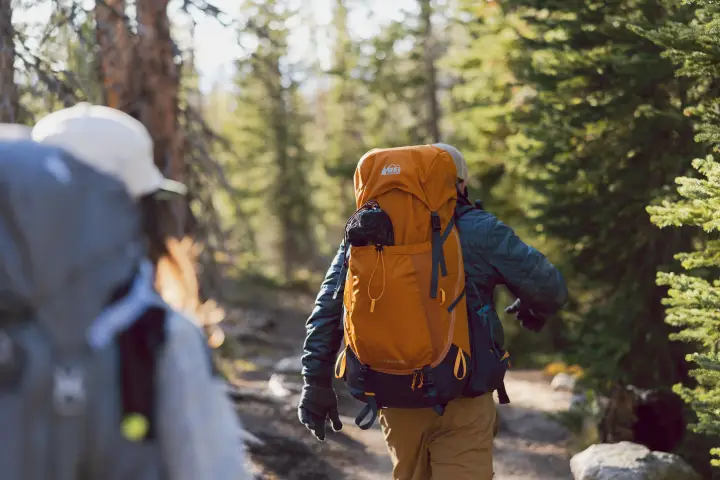
Best For: First Backpacking Pack & Value
Capacity: 60L
Weight: Mid-3-lb. range depending on configuration
Price Tier: $$
Building a first backpacking setup can get expensive fast.
Tent. Sleeping bag. Pad. Stove. Water treatment. Clothing. Headlamp. Trekking poles.
The backpack matters, but spending premium money on it can make less sense when the entire kit still needs attention.
That is where the Trailmade 60 fits particularly well.
It provides the basic ingredients most recreational backpackers actually need: 60 liters of usable capacity, adjustable fit, a supportive internal structure, accessible exterior storage, and straightforward organization.
For newer backpackers, 60 liters is also forgiving.
Your first sleeping bag may not compress into a tiny stuff sack. Your tent may take more space than an ultralight shelter. Food organization may still be a work in progress.
Having some extra room prevents every packing session from becoming a game of backcountry Tetris.
🏕️ At camp, simplicity is part of the appeal.
The pack does not require an elaborate system to understand where everything belongs. Essential gear goes into the main compartment, items needed during the day stay accessible, and the adjustable back panel gives you room to dial in the fit.
Its biggest limitation appears as loads increase.
This is not intended to compete with the Baltoro as a heavy-hauling pack. If every trip starts with 40-plus pounds, a stronger suspension is the better tool.
For typical weekend and multiday backpacking at moderate weights, however, that extra heavy-duty structure may not be necessary.
What stands out on the trail
- Excellent capacity for the price
- Adjustable fit
- Simple organization
- Useful access to the main compartment
- Enough room for less compact beginner gear
What to consider first
- Less sophisticated suspension than premium packs
- Not designed around very heavy loads
- Conventional back-panel ventilation
- Rain cover not included
Best fit: Someone buying a first serious backpacking pack or wanting a reliable multiday setup without paying premium-pack prices.
Look elsewhere if: Heavy load hauling or ultralight performance is your main priority.
For a first multiday pack, the Trailmade 60 leaves more room in the budget for the gear that goes inside it.
Check the REI Co-op Trailmade 60 at REI →
Hyperlite Mountain Gear Southwest 55
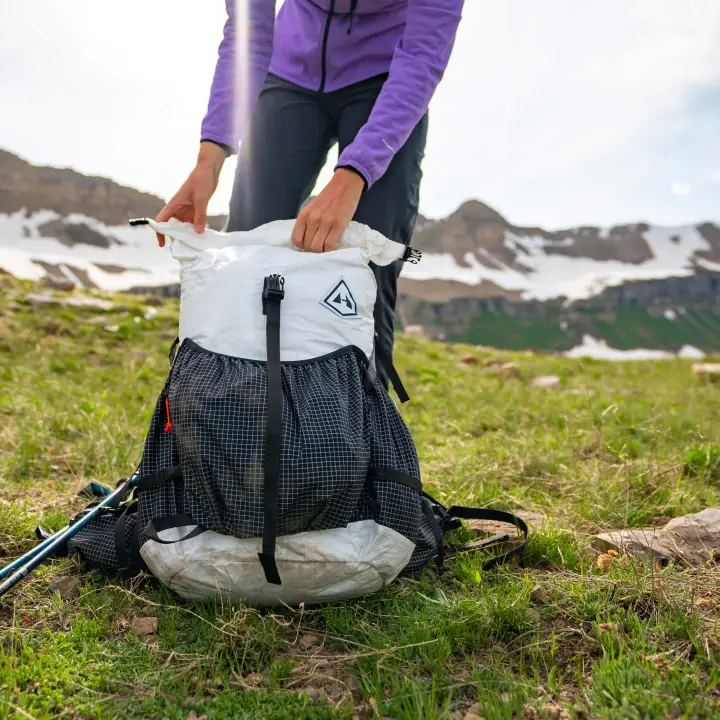
Best For: Ultralight Backpacking & Thru-Hiking
Capacity: 55L
Weight: About 1.9–2 lbs. depending on size
Price Tier: $$$$
The Southwest 55 becomes much more compelling after the rest of your gear has already gone through a diet.
A lightweight shelter, compact quilt, efficient cooking setup, and carefully chosen clothing mean the backpack no longer needs to support 35 or 40 pounds.
At that point, carrying a four- or five-pound pack starts to feel unnecessary.
The Southwest takes the opposite approach.
Its minimalist roll-top layout, simple frame, large exterior storage, and lightweight construction keep the pack around the two-pound mark.
There are fewer layers between you and your gear—and that is intentional.
No large floating lid. No complicated pocket system. No elaborate panel access.
Your sleeping gear, clothing, and food go inside. Frequently used or damp items go into the large exterior pockets. Small essentials stay accessible around the hipbelt.
🥾 Once that packing routine becomes familiar, it is wonderfully efficient.
Morning pack-up gets quicker because every item has a predictable place. During the day, there is less temptation to carry unnecessary gear just because another pocket exists.
But the Southwest rewards good packing more than something like the Atmos or Baltoro.
A bulky object pressed poorly against the back panel is easier to notice. A badly balanced load can affect comfort. And a heavy gear list exposes the limits of the simpler suspension.
That is why this is a much stronger choice for an experienced lightweight backpacker than for someone assembling a first backpacking setup.
What stands out on the trail
- Very low empty weight
- Durable construction
- Simple roll-top packing
- Large exterior pockets
- Excellent pairing with compact lightweight equipment
What to consider first
- Expensive
- Less forgiving when poorly packed
- Limited back ventilation
- Minimal organization compared with traditional packs
- Lightweight suspension makes more sense with lightweight gear
Best fit: Experienced backpackers, long-distance hikers, and anyone who has already reduced the weight and bulk of the rest of the kit.
Look elsewhere if: Your sleeping system, shelter, food carries, or other gear still produce a heavy backpack.
If your base weight is already dialed in, the Southwest 55 is where dropping pack weight starts to make real sense.
Check the Hyperlite Mountain Gear Southwest 55 at REI →
Deuter Aircontact Core 60+10 & 55+10 SL
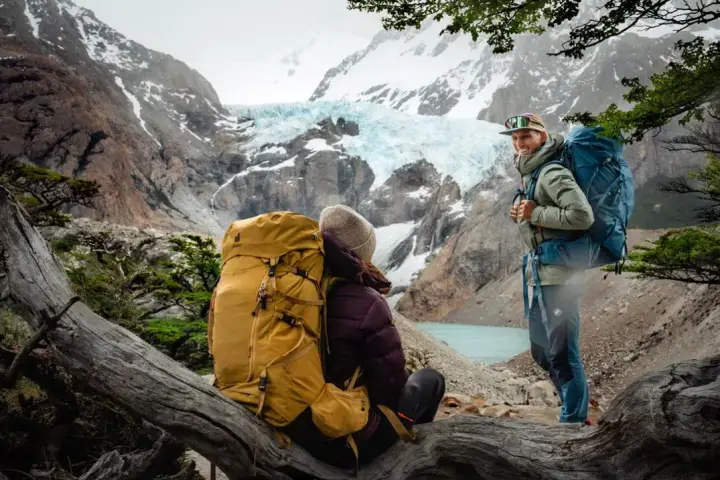
Best For: Changing Loads, Long Trips & Adjustability
Capacity: Up to 70L / 65L depending on version
Weight: Around 5 lbs.
Price Tier: $$$
Sometimes the challenge is not carrying the same load comfortably every weekend.
It is that one trip barely fills a pack while the next requires a bear canister, colder sleeping bag, extra insulation, and several more days of food.
The Deuter Aircontact Core handles that variation particularly well.
The 60+10 version provides 60 liters for the main load, then lets the collar expand when another 10 liters becomes necessary.
That extra capacity is useful because it does not need to be filled every time.
Keep the extension compressed for a normal multiday trip, then open it when colder weather or a long resupply stretch adds bulk.
The U-shaped front opening is equally practical.
🌲 Picture arriving at camp just as the sun drops behind a ridge.
The temperature falls quickly, and your insulated jacket is buried halfway down the pack.
Opening the front and grabbing it directly is a small convenience—but exactly the kind of convenience that feels worthwhile after a long day.
The Aircontact Core also puts a strong emphasis on adjustment and load control.
That makes it particularly useful for backpackers who struggle to find a comfortable fit in fixed or lightly adjustable torso systems.
Its biggest disadvantage is impossible to ignore: it is heavy.
At around five pounds, there is little reason to choose it for a compact 20-pound setup.
For larger loads and longer trips, however, the additional structure, adjustability, and organization have a clear purpose.
What stands out on the trail
- Expandable capacity
- Highly adjustable fit
- Excellent front access
- Supportive suspension
- Useful organization for longer trips
What to consider first
- Heavy empty weight
- Too much capacity for many weekend trips
- Not intended for ultralight setups
- Rain cover not included
Best fit: Backpackers whose load changes significantly between trips or who regularly carry bulky gear and want a highly adjustable pack.
Look elsewhere if: Your entire kit already fits easily into a smaller, lighter backpack.
Need a pack that can handle both normal weekends and bulkier long trips? The expandable Aircontact Core is built for that flexibility.
Check the Deuter Aircontact Core 60+10 at REI →
For a shorter torso range and women-specific fit, compare the Aircontact Core 55+10 SL.
Check the Deuter Aircontact Core 55+10 SL at REI →
Frequently Asked Questions (FAQ)
Q: What size backpack is best for a 3-day trip?
For many backpackers, 50–60 liters is a comfortable range for a typical three-day trip.
But gear bulk matters more than the number of nights.
A lightweight backpacker may easily fit three days of gear into 40–50 liters. Someone carrying a bulky sleeping bag, large tent, colder layers, and a bear canister could need considerably more.
Lay out the gear first, then choose the backpack.
Q: Is a 65-liter backpack too big for backpacking?
Not necessarily.
A 65-liter pack is extremely useful for conventional multiday gear, colder conditions, longer food carries, or backpackers who have not converted every piece of equipment to a compact ultralight version.
The danger is filling available space simply because it exists.
If your normal gear fits comfortably in 50–55 liters, carrying the larger pack may only encourage unnecessary extras.
Q: Should beginners buy a 55L or 65L backpack?
A pack around 60–65 liters can be easier for a beginner because entry-level tents, sleeping bags, and clothing are often bulkier than premium lightweight equipment.
Going much larger “just in case” is usually unnecessary.
If possible, take your actual gear to a store and test whether it fits before deciding.
Q: How much should a backpacking backpack weigh?
There is no ideal empty-pack weight by itself.
A two-pound backpack makes sense when it comfortably handles the gear inside.
A four- or five-pound pack can make just as much sense if its frame and hipbelt improve comfort under a substantially heavier load.
Focus on total trail weight and carrying comfort, not only the number on the backpack’s hang tag.
Q: Is an ultralight backpack worth it?
Yes—when the rest of the system is ready for it.
Dropping from a four-pound backpack to a two-pound model removes two pounds immediately, which is significant.
But putting a heavy traditional gear list into a minimalist pack can trade weight savings for worse comfort.
Lighten the bulky and heavy items first, then the ultralight backpack becomes much more useful.
Q: Can a man use a women’s backpack or vice versa?
Absolutely.
Women’s-specific backpacks often use different torso ranges, shoulder-strap shapes, and hipbelt contours.
Those differences are about fit.
If a pack labeled for another gender fits your torso, shoulders, and hips better, it may be the better backpack for your body.
Q: Do backpacking packs need rain covers?
Not always.
Rain covers help keep the outside of a pack drier, but wind-driven rain can still reach areas around the back panel.
A waterproof internal pack liner is another simple option and can keep critical gear protected even when the pack exterior gets wet.
Sleeping bags, quilts, and dry camp clothing deserve the most protection.
Q: Which backpack is best if comfort matters more than weight?
Look toward packs with substantial suspension and strong hipbelts rather than automatically choosing the lightest option.
The Osprey Atmos AG LT emphasizes ventilation and comfort for normal multiday loads, while the Gregory Baltoro becomes more attractive as the load gets heavier.
The correct choice still depends on fit.
Q: Which backpack is best for an ultralight setup?
The Hyperlite Mountain Gear Southwest 55 is the lightweight-oriented option among these five.
But it makes the most sense when your shelter, sleeping gear, clothing, and other equipment are already compact enough to take advantage of its lighter suspension.
Final Thoughts
The most useful backpacking pack is not the one that wins the most specifications on paper.
It is the one you think about the least while hiking.
Your attention should be on the trail winding through the trees, the next water source, the weather building over the ridge, or finding a good campsite before dark—not a shoulder strap that keeps digging in.
For typical multiday backpacking where comfort and ventilation matter most, the Osprey Atmos AG LT 65 makes a strong case. Its suspended back panel and supportive carry are especially appealing for backpackers willing to accept some extra pack weight to feel better over long days.
When the equipment itself is heavier, the Gregory Baltoro 65 / Deva becomes more relevant. The pack weighs more because it is built to control more weight.
The REI Co-op Trailmade 60 is the practical value choice: enough capacity for a real multiday setup, an adjustable fit, and useful organization without consuming an outsized portion of a beginner’s gear budget.
If your entire setup is already compact and light, the equation changes. The Hyperlite Mountain Gear Southwest 55 can remove several pounds compared with traditional load haulers while still providing enough room for a multiday lightweight kit.
And when trip length, weather, and equipment change frequently, the Deuter Aircontact Core offers something different again: extra capacity when needed, plenty of adjustment, and easy access to the gear buried inside.
Before buying any of them, load the pack.
Put realistic weight inside—not a pillow.
Set the hipbelt over your hip bones. Adjust the torso. Snug the shoulder straps. Set the load lifters. Walk around.
Then pay attention.
Does the pack pull backward?
Does the hipbelt stay in place?
Do the shoulder straps lie comfortably against your body?
Can you reach your water?
Can you move naturally?
A backpack that fits properly with your actual trail weight is almost always a better choice than one that simply looks better in a comparison chart.
Affiliate Disclosure: GearForTheOutdoors.com participates in affiliate programs, including REI, Amazon, REI Outlet, Garage Grown Gear, evo, and other trusted partners. When you purchase through our links, we may earn a small commission at no extra cost to you. That helps support our content and keeps our recommendations useful, practical, and free.
Disclaimer: This post is for informational purposes only. Always verify current product details, fit, availability, safety information, and manufacturer warranties before purchase or use. Outdoor conditions and gear performance can vary depending on setup, weather, terrain, and experience level.