A van can feel surprisingly spacious when every piece of gear has a dependable place. It can also feel impossibly small when jackets cover the passenger seat, cookware rattles behind the bed, and finding one charging cable means unloading half the vehicle.
Good organization is not about making the inside of a van look perfect. It is about making everyday tasks easier. Clothes should be simple to reach. Cooking gear should move from the van to the picnic table without being repacked. Frequently used items should stay close, while seasonal equipment remains out of the way.
The best van storage organizers help create that kind of system without requiring an expensive custom build. A practical mix of packing cubes, weather-resistant boxes, hanging organizers, and exterior storage can make the van easier to drive, cook in, sleep in, and reset at the end of the day. 🚐
This guide focuses on organizers that solve specific problems inside real vans, SUVs, and road-trip vehicles. Each recommendation has a clear role, from keeping clothing under control to moving skis, camp chairs, and other bulky gear out of the living space.
Quick Verdict
There is no single organizer that can handle everything a van carries. The most effective setup usually combines several smaller systems:
- Patagonia Black Hole Cubes keep clothing and personal items separated.
- YETI LoadOut GoBox 30 protects tools, camp gear, and equipment that may encounter dust or moisture.
- Lusso Gear Heavy Duty Back Seat Organizer keeps small daily essentials within reach.
- Kaskawise Car Ceiling Cargo Net creates overhead storage for soft, lightweight items.
- Kelty Camp Galley Deluxe Bag keeps a compact van kitchen organized and ready to carry outside.
- Thule Motion 3 Roof Box moves bulky or seasonal gear out of the interior.
For most travelers, clothing cubes, a dedicated kitchen organizer, and one secure hard-sided box create the strongest starting point. Add overhead or rooftop storage only when the van’s layout and load limits make those options practical.
Top Van Storage Picks at a Glance
| Organizer | Best For | Price Tier | Why It Stands Out |
|---|---|---|---|
| Patagonia Black Hole Cube | Clothing and soft goods | $$ | Durable cubes that separate small items without wasting cabinet space |
| YETI LoadOut GoBox 30 | Rugged, weather-resistant storage | $$$ | Structured protection for tools, cooking equipment, and valuable gear |
| Lusso Gear Heavy Duty Back Seat Organizer | Cockpit and quick-access items | $ | Creates useful pockets behind a seat without taking up floor space |
| Kaskawise Car Ceiling Cargo Net | Lightweight overhead storage | $ | Keeps bedding and soft layers off seats and sleeping platforms |
| Kelty Camp Galley Deluxe Bag | Van kitchen organization | $$ | Keeps utensils, spices, towels, and cooking essentials together |
| Thule Motion 3 Roof Box | Bulky and seasonal equipment | $$$$ | Adds substantial exterior storage without consuming interior living space |
How to Choose the Best Van Storage Organizers
Buying a collection of random bins rarely fixes a cluttered van. Mismatched containers often waste space, block access to other gear, and create a new problem every time something needs to be retrieved.
Start by identifying where clutter develops and why. If clothes migrate across the bed, packing cubes may be enough. If cooking utensils disappear into a large tote, a dedicated kitchen bag will help more than another plastic box. If camp chairs and snow gear dominate the aisle, exterior storage may provide the biggest improvement. 🧭
Start With the Space, Not the Product
Measure the cabinet, shelf, under-bed compartment, seat back, or roof area before choosing an organizer. Include enough clearance to open lids, release latches, and pull the container out without moving several other items.
A box that technically fits under a bed may still be frustrating if its lid cannot open there. A seat organizer can become a nuisance if it presses against a passenger’s knees. An overhead net may reduce rear visibility or headroom when filled.
Cardboard templates are useful for testing larger products. Mark the dimensions on an old shipping box, place it in the intended location, and spend a day moving around the van before committing.
Durability and Materials
Van organizers are exposed to vibration, dust, temperature swings, food spills, condensation, and repeated loading. Materials should match the conditions where the organizer will live.
Soft organizers work well inside cabinets and protected compartments. Look for abrasion-resistant fabric, dependable zippers, reinforced handles, and enough structure to keep the contents from collapsing into a pile.
Hard-sided boxes make more sense near rear doors, under platforms, on roof racks, or anywhere gear may be exposed to moisture and impact. Secure latches, stackable shapes, and tie-down points are especially useful on rough roads. 🌲
Modularity and Stackability
A modular system is easier to adjust as trips change. One box may hold kitchen equipment during summer and cold-weather gear during winter. Packing cubes can move between a cabinet, duffel, hotel room, or tent without being repacked.
Containers with straight sides generally use space more efficiently than heavily tapered household totes. Matching boxes also stack more securely and leave fewer awkward gaps.
Avoid building stacks so tall that the bottom container becomes inaccessible. Two shorter rows are often more useful than one tower that must be dismantled every time a small item is needed.
Accessibility
Frequently used gear should be reachable without unloading the van.
Keep headlamps, charging cables, snacks, wipes, sunscreen, and maps in seat-back pockets or a shallow drawer. Clothing and toiletries can live in removable cubes. Repair tools, backup supplies, and off-season equipment can go deeper under the bed or toward the rear.
A useful rule is to organize by frequency:
- Daily access: Seats, door pockets, open shelves, or shallow organizers
- Campsite access: Galley bags, medium bins, and under-bed drawers
- Occasional access: Deep storage, rooftop boxes, and rear garage compartments
This arrangement reduces the small frustrations that make a compact interior feel chaotic. 🧰
Mounting and Road Safety
Every organizer must remain secure while the vehicle is moving. A box that stays put in a parking lot can slide quickly during hard braking or on a rough forest road.
Heavy containers should be secured with cam buckle straps attached to appropriate vehicle anchor points. Bungee cords can help stabilize lightweight items, but they stretch and should not be relied upon to restrain heavy cargo.
Seat-back organizers should not interfere with seat controls, airbags, passengers, or emergency exits. Overhead storage should contain only soft, lightweight items and must not block the driver’s view through the rear window.
Weight and Roof Clearance
Storage space is useful only when the vehicle can safely carry it. Check the payload rating, roof load limit, rack capacity, and mounting instructions before adding heavy boxes or rooftop equipment.
Remember that a roof box adds height even when empty. Record the van’s new total clearance and keep it visible near the dashboard. Parking garages, drive-throughs, low branches, and covered campground structures can become hazards after exterior storage is installed.
Roof access matters too. A box that works well on a crossover may be difficult to reach on a tall camper van without a ladder or door-mounted step.
The Best Van Storage Organizers of 2026
The organizers below fill different roles. Instead of trying to identify one universal winner, choose the products that address the specific trouble spots in the vehicle.
Patagonia Black Hole Cube: Best for Clothing and Soft Goods
Loose clothing can consume an entire cabinet surprisingly quickly. Shirts slide behind pants, socks disappear into corners, and one damp layer can make everything else feel disorganized.
Patagonia Black Hole Cubes divide that space into manageable sections. The 3-liter size works well for cables, toiletries, socks, or first-aid supplies. The 6-liter cube is a practical choice for daily clothing, while the 14-liter version can hold bulkier layers or a larger collection of personal items.
The recycled polyester ripstop fabric has a weather-resistant recycled TPU-film laminate, and the exterior webbing makes the cubes easy to grab from deep shelves. The larger versions also provide internal separation that helps keep categories from mixing together.
They are especially useful when the same gear regularly moves between a van, tent, campground shower, and hotel room. Pull out the correct cube and leave the rest of the cabinet undisturbed. 👕
- Material: Recycled polyester ripstop with recycled TPU-film laminate
- Available capacities: 3L, 6L, and 14L
- Best for: Clothing, toiletries, electronics, first-aid supplies, and small accessories
- Skip it if: The main priority is rigid protection for fragile or heavy equipment
Shop Patagonia Black Hole Cubes at REI
Pros:
- Durable enough for frequent travel
- Multiple sizes simplify category-based packing
- Flexible shape works well in cabinets and irregular spaces
- Easy to move between the van and other accommodations
- Weather-resistant exterior handles minor spills and damp conditions
Cons:
- More expensive than basic packing cubes
- Soft construction does not protect crush-sensitive items
- Overfilling can make the cube awkward to fit into shallow cabinets
YETI LoadOut GoBox 30: Best Heavy-Duty Weather-Resistant Storage
Some gear needs more protection than a fabric bag can provide. Tools, stove parts, recovery equipment, camera accessories, and electrical components can be damaged by dust, water, or the repeated impacts of driving on rough roads.
The YETI LoadOut GoBox 30 provides a structured 30-liter compartment with removable internal organization. Its divider, tray, and lid-mounted Pack Attic make it easier to separate small items instead of letting everything settle into one deep pile.
The GoBox carries IP65 and IP67 ratings, meaning it is designed to resist dust, water spray, and temporary submersion when properly closed. It also has tie-down points and a stackable shape, making it easier to secure in a rear garage or under a bed platform. It is a gear case, not a cooler, and should not be purchased as an insulated food-storage solution.
At roughly 12 pounds before gear is added, this is not the box for every category. It makes the most sense when the contents genuinely benefit from its protection. 🌧️
- Capacity: 30L
- Dimensions: Approximately 20.4 x 14.8 x 11.3 inches
- Weight: Approximately 12.1 pounds
- Best for: Tools, recovery gear, kitchen equipment, electronics, and valuable accessories
- Skip it if: Low weight, collapsibility, or a low purchase price matters more than weather protection
Shop YETI LoadOut GoBox Gear Cases at REI
Pros:
- Excellent protection from dust, water, and rough handling
- Included divider and trays improve access to small items
- Strong latches and useful tie-down points
- Stable shape works well in modular storage layouts
- Can serve as a sturdy temporary work surface when properly supported
Cons:
- Heavy before anything is packed inside
- Considerably more expensive than a standard storage tote
- Thick construction reduces usable interior space relative to its exterior size
- Too bulky for many narrow cabinets
Lusso Gear Heavy Duty Back Seat Organizer: Best for Cockpit and Quick-Access Items
The front seats often collect the smallest items in the van: sunglasses, charging cables, tissues, snacks, maps, pens, bug spray, and spare batteries. None of these items needs a large storage bin, but together they can make the cockpit feel messy.
The Lusso Gear Heavy Duty Back Seat Organizer turns the back of a seat into a practical collection of pockets. Its multiple compartments provide separate places for bottles, electronics, documents, and small everyday supplies. Adjustable straps hold it against the seat so it is less likely to swing while driving.
The organizer works best when the pockets are used selectively. Filling every compartment until it bulges can reduce passenger space and make the organizer harder to use. Keep only genuine quick-access items there and move backup supplies into deeper storage.
Before installation, check that the straps and contents do not interfere with side airbags, seat adjustments, or passengers seated behind the organizer. 🔌
- Construction: Reinforced Oxford-style fabric
- Organization: 12 compartments in different sizes
- Best for: Charging accessories, maps, snacks, wipes, bottles, and daily essentials
- Skip it if: The seat back is needed for a passenger with limited legroom or contains airbag components that could be obstructed
Shop the Lusso Gear Back Seat Organizer on Amazon
Pros:
- Uses vertical space that might otherwise remain empty
- Keeps small items visible and easy to reach
- Installs without permanent modifications
- Affordable compared with custom cockpit cabinetry
- Helps prevent loose objects from collecting on the floor
Cons:
- Can look cluttered when overfilled
- May reduce rear-passenger knee room
- Fabric pockets are not suitable for heavy tools
- Fit varies depending on seat shape and headrest design
Kaskawise Car Ceiling Cargo Net: Best for Lightweight Overhead Storage
Bedding, insulated jackets, towels, and pillows take up plenty of room but weigh very little. These are the kinds of items that can benefit from carefully planned ceiling storage.
The Kaskawise Car Ceiling Cargo Net attaches to four roof grab handles and creates a mesh storage area above the seats or cargo space. Its double-layer design helps contain soft items rather than balancing them loosely on top of a single net. The organizer measures approximately 31.5 by 21.6 inches and is intended for vehicles with four suitable mounting handles.
Although the product has a published load capacity, overhead storage should remain light. A pillow falling during hard braking is an inconvenience. A tool, stove, water bottle, or camera falling from the ceiling can cause an injury.
Check rear visibility after loading the net. In smaller SUVs and low-roof vans, it may also reduce headroom enough to make the interior uncomfortable.
- Dimensions: Approximately 31.5 x 21.6 inches
- Mounting requirement: Four compatible roof grab handles
- Best for: Pillows, towels, blankets, insulated jackets, and other soft gear
- Skip it if: The vehicle lacks four secure mounting handles or rear visibility is already limited
Shop the Kaskawise Car Ceiling Cargo Net on Amazon
Pros:
- Uses otherwise empty ceiling space
- No drilling required in compatible vehicles
- Keeps bulky soft gear off the floor and bed
- Easy to remove when the storage is not needed
- Mesh construction makes contents easy to identify
Cons:
- Suitable only for light, soft items
- Can obstruct visibility through the rear window
- May reduce headroom
- Requires compatible grab handles in the correct locations
Kelty Camp Galley Deluxe Bag: Best for Van Kitchen Organization
A van kitchen becomes frustrating when cooking tools are scattered across several drawers and containers. The spatula is near the stove, the spices are under the bed, and the paper towels are somewhere behind the cooler.
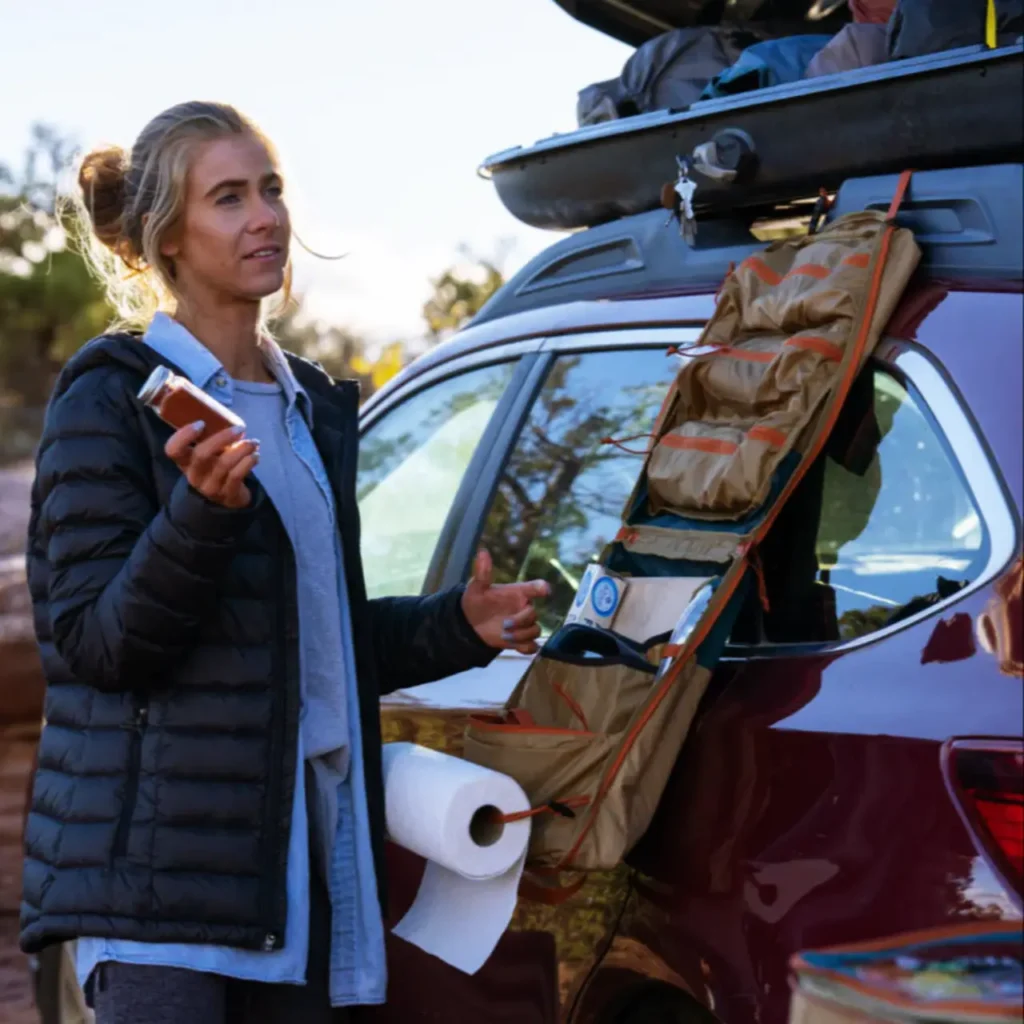
The Kelty Camp Galley Deluxe Bag keeps smaller kitchen essentials together in one hangable organizer. Its 10 pockets provide space for utensils, seasonings, cleaning supplies, foil, towels, and other items that tend to disappear inside larger bins.
The organizer is made from 600-denier polyester and measures approximately 33.5 by 15 by 5.5 inches. It weighs about 1 pound 8 ounces and includes a cord that can hold a paper towel roll or function as a small drying line. A durable water-repellent treatment helps with light moisture, although the bag is not waterproof.
At camp, hang it from an appropriate point on the van, a shelter frame, or another stable support. When dinner is finished, close the organizer and return the entire kitchen kit to its storage location. 🍳
- Material: 600D polyester
- Dimensions: Approximately 33.5 x 15 x 5.5 inches
- Weight: Approximately 1 pound 8 ounces
- Organization: 10 pockets
- Best for: Utensils, spices, towels, cleanup supplies, and compact cookware accessories
- Skip it if: A rigid box is needed for a stove, cast-iron cookware, or fragile dishes
Shop the Kelty Camp Galley Deluxe Bag at REI
Pros:
- Keeps frequently used kitchen items in one place
- Can hang open for easy access while cooking
- Packs flatter than a hard-sided kitchen box
- Multiple pockets reduce time spent searching
- Easy to carry from the van to a picnic table or shelter
Cons:
- Does not provide crush protection
- Not waterproof
- Can become unbalanced when heavy items are packed unevenly
- Less useful for large pots, stoves, and fuel canisters
Thule Motion 3 Roof Box: Best for Bulky and Seasonal Gear
A rooftop box can make the interior feel dramatically more livable by moving occasional-use equipment outside. Folding chairs, skis, snowboards, climbing gear, extra bedding, and duffel bags no longer need to occupy the aisle or sleeping platform.
The Thule Motion 3 replaces the older Motion XT line and keeps the features that make a roof box easier to live with. It opens from either side, uses Thule’s PowerClick mounting system, and includes a SlideLock system that separates the locking and opening functions.
The Motion 3 L offers 16 cubic feet of capacity and measures approximately 76.5 by 34.2 by 16.5 inches. The box itself weighs about 43.6 pounds and has a published maximum load of 165 pounds, but the vehicle roof and crossbar ratings may impose a much lower limit.
This option makes the most sense on lower vans, minivans, and SUVs where the box can be reached safely. On a high-roof camper van, loading and unloading may require a ladder, and the added height can create more inconvenience than the extra capacity solves. 🏔️
- Capacity: 16 cu. ft. for the L size
- Dimensions: Approximately 76.5 x 34.2 x 16.5 inches
- Box weight: Approximately 43.6 pounds
- Best for: Skis, snowboards, chairs, duffels, and seasonal equipment
- Skip it if: The roof is difficult to reach, the vehicle has a low roof-load rating, or overall clearance is already a concern
Shop Thule Motion 3 Roof Boxes at REI
Pros:
- Adds meaningful storage without consuming interior space
- Dual-side opening improves access
- Keeps damp, sandy, or bulky equipment outside the living area
- Lockable design provides more security than an open roof basket
- Aerodynamic shape is more practical than many square cargo boxes
Cons:
- Expensive
- Adds weight and height to the vehicle
- May affect fuel economy and wind noise
- Difficult to access on tall vans
- Requires compatible crossbars and careful load calculations
Van Organization Strategies: Beyond the Bins
Storage products work best when they support a clear routine. Without one, even an expensive system eventually becomes a collection of containers filled with unrelated items.
Give Every Item a Home
Every permanent item in the van should have one dependable location. That includes small things such as lighters, charging cables, trash bags, and keys.
The location should make sense based on where the item is used. Dish soap belongs near the kitchen. Headlamps should be reachable from the bed and the door. Tire tools should remain accessible even when the rear storage area is fully packed.
A label maker can help during the first few trips, especially when several bins look identical. Labels can be removed later once the system becomes familiar.
Build Front-Row and Deep-Storage Zones
Think of van storage like a grocery shelf.
The front row holds items used every day. The middle row contains campsite equipment. The deepest areas hold repair parts, backup supplies, and seasonal gear.
This approach prevents a common mistake: placing rarely used items in prime locations simply because they were packed first. 🗺️
Use Vertical Space Carefully
Walls, doors, and seat backs can hold lightweight organizers without consuming the walking area. Hooks are useful for jackets, keys, towels, and empty daypacks.
Do not allow hanging gear to block windows, ventilation, door handles, or emergency exits. Heavy equipment should remain low in the vehicle, where it is easier to secure and less likely to become dangerous during a sudden stop.
Magnetic strips can be useful for lightweight metal utensils, but sharp knives should be stored in secure sheaths or enclosed compartments while driving.
Create Activity Zones
Group gear according to the task it supports:
- Kitchen zone: Stove, cookware, utensils, food-prep tools, and cleanup supplies
- Sleep zone: Bedding, sleepwear, window covers, and nighttime essentials
- Personal zone: Clothing, toiletries, medication, and laundry
- Outdoor zone: Chairs, hiking gear, footwear, and recreation equipment
- Utility zone: Tools, electrical supplies, recovery gear, and spare parts
- Cockpit zone: Navigation, charging, documents, snacks, and daily-use items
When everything needed for one activity is stored together, setup and cleanup require fewer trips across the van.
Pack to Prevent Rattles
Rattling is usually caused by empty space between hard objects. The solution is not always tighter cabinetry. Often, a few soft barriers are enough.
Use non-slip shelf liner under cookware and bins. Place small towels between pans. Store mugs in sleeves or insulated covers. Use packing cubes to stop loose accessories from shifting inside drawers.
Do not pack glass containers directly against one another. Check cabinet latches periodically, especially after driving on washboard roads. 🔧
Follow the One-In, One-Out Rule
Compact living spaces fill quickly. When a new non-consumable item enters the van, consider removing an older item that performs the same job.
This does not need to become a rigid rule, but it is a useful pause before adding another cup, jacket, lantern, or cooking tool. Every object takes up storage space, adds weight, and eventually needs to be moved or cleaned.
Final Thoughts: Build a System That Fits the Way You Travel
The best van storage organizers are the ones that reduce repeated work. They make it possible to find clothing without emptying a cabinet, prepare dinner without searching through several bins, and turn the sleeping area back into a bed without moving equipment from one seat to another.
For most van travelers, a practical system begins with Patagonia Black Hole Cubes for clothing, the Kelty Camp Galley Deluxe Bag for kitchen tools, and the Lusso Gear Back Seat Organizer for small daily essentials.
Add the YETI LoadOut GoBox 30 when tools or valuable gear need stronger protection. Use the Kaskawise Car Ceiling Cargo Net only for soft, lightweight items. Consider the Thule Motion 3 when bulky seasonal gear is consuming the interior and the vehicle can safely support exterior storage.
The goal is not to fit more possessions into the van. It is to carry the right equipment in a way that keeps the space comfortable, safe, and easy to use when the doors close and camp settles in for the night. 🌙
Frequently Asked Questions
How should storage bins be secured inside a moving van?
Use cam buckle straps attached to appropriate factory cargo anchors, D-rings, or a properly installed mounting system. Heavy boxes should sit low in the vehicle and should not be able to slide forward during sudden braking.
Bungee cords are useful for stabilizing light items, but their elasticity makes them a poor primary restraint for heavy cargo. Never attach storage to seat rails, airbag components, or trim pieces unless the vehicle manufacturer specifically identifies them as load-bearing points.
What is the best way to organize a van kitchen?
Keep the items used during nearly every meal together. A hanging galley organizer can hold utensils, spices, towels, and cleanup supplies, while a separate secured bin carries the stove, fuel, pots, and heavier equipment.
Store food separately from cooking tools whenever possible. Airtight containers help reduce spills and pests, but food-storage rules in bear country may require approved bear-resistant containers or campground food lockers.
Should van storage be custom-built or purchased ready-made?
Custom cabinetry can make excellent use of unusual spaces and may provide integrated drawers, water systems, and electrical compartments. It also requires more money, planning, tools, and commitment to one layout.
Ready-made organizers are easier to replace, rearrange, and move between vehicles. A hybrid setup works well for many travelers: a simple fixed platform or shelf combined with removable cubes, galley bags, and secured storage boxes.
How can rattling be reduced while driving?
Line drawers and shelves with non-slip material. Separate metal cookware with towels or felt protectors. Fill empty gaps inside bins with soft goods, and use small pouches for cables, utensils, and repair parts.
Check that cabinet doors, table hardware, stove components, and roof-rack accessories are tightened correctly. A rattle that suddenly appears may indicate loose hardware rather than poor packing.
Are hard bins or soft organizers better for a van?
Hard bins are better for heavy, dirty, wet, or fragile gear. They stack more securely and provide stronger impact protection.
Soft organizers work better for clothing, bedding, toiletries, and small accessories. They weigh less, conform to irregular spaces, and are easier to carry into tents, hotels, or campground facilities.
Most vans benefit from using both.
Is a rooftop cargo box safe for a van?
It can be safe when the box, crossbars, roof, and mounting system are compatible and remain within all published weight limits. The combined weight of the empty box, mounting hardware, and cargo must be included.
Check the vehicle’s total height after installation and inspect the mounting hardware regularly. Avoid placing excessively heavy items on the roof, since high weight can affect handling and make loading more difficult.
What should never be stored in an overhead cargo net?
Do not store tools, stoves, fuel containers, water bottles, electronics, cookware, or other hard and heavy objects overhead.
Use ceiling nets only for soft, lightweight items such as pillows, blankets, towels, and insulated jackets. Make sure the net does not block visibility, interfere with passengers, or create an obstacle near an emergency exit.
Affiliate Disclosure: GearForTheOutdoors.com participates in affiliate programs, including REI, Amazon, REI Outlet, Garage Grown Gear, evo, and other trusted partners. When you purchase through links on this site, GearForTheOutdoors.com may earn a small commission at no extra cost to you. This helps support practical, useful, and freely accessible outdoor gear content.
Disclaimer: This post is for informational purposes only. Always verify current product details, vehicle compatibility, dimensions, load ratings, availability, safety information, installation requirements, and manufacturer warranties before purchase or use. Outdoor conditions and gear performance can vary depending on setup, weather, terrain, vehicle design, and experience level.