There are few things better than reaching a cold mountain stream after a hot climb. The water looks clear. It sounds clean. It might even be running straight out of snowmelt or a quiet alpine basin.
But clear water is not always safe water. 🥾
Backcountry water can carry bacteria, protozoa, sediment, and other things that are impossible to see. A creek can look perfect and still make a hiker sick. That is why a reliable water filter is one of the most important pieces of hiking gear to carry, whether the plan is a short day hike, a weekend backpacking trip, a family camping trip, or travel somewhere with questionable tap water.
The right filter helps with more than safety. It lets hikers carry less water when reliable sources are available. It makes long days feel more manageable. It helps groups cook, clean, and refill without turning water collection into a chore. And when something goes wrong — heat, delays, dry miles, a broken bottle, or a longer-than-expected route — having a way to treat water can make a big difference.
The best water filter for hiking is not the same for everyone. A solo backpacker may want a lightweight squeeze filter. A trail runner may want a fast soft-bottle filter. A family campsite may need a gravity system. A traveler may need a purifier that can handle viruses.
This guide breaks down the best water filters for hiking, backpacking, camping, and travel in a practical way: what each one does well, where it falls short, and who should actually use it.
Our Top Picks at a Glance
| Product | Type | Best For | Price |
|---|---|---|---|
| Sawyer Squeeze | Squeeze | Best overall value, solo hikers, ultralight backpacking | $$ |
| Katadyn BeFree | Soft Bottle / Squeeze | Fast flow, day hiking, trail running, quick refills | $$ |
| Platypus GravityWorks 4L | Gravity | Groups, basecamp, car camping, family camping | $$$ |
| Katadyn Hiker Pro Clear | Pump | Shallow water, silty sources, reliable all-around use | $$$ |
| LifeStraw Peak Series Straw | Straw | Emergency backup, ultralight personal use | $ |
| Katadyn Steripen Ultra | UV Purifier | International travel, clear water, virus protection | $$$ |
| MSR Guardian Purifier | Pump Purifier | High-risk water, international travel, serious backcountry use | $$$$ |
How to Choose the Best Water Filter for Hiking
Choosing a water filter is easier when the decision starts with the trip, not the product.
Think about where the water will come from. Is it a clear mountain stream, a muddy desert pothole, a lake edge, a campground spigot, or tap water while traveling abroad? Think about how many people need water. One hiker drinking from a soft flask has very different needs than four people cooking pasta at camp.
Also think about how tired everyone will be when it is time to filter. A system that seems fine at home can feel annoying at the end of a 12-mile day, especially when bugs are out, light is fading, and dinner still needs to be made. 🌲
A good water filter should fit naturally into the way the trip actually works.
Water Filter vs. Water Purifier: What’s the Difference?
This is the first thing to understand.
Water filters physically remove common backcountry threats such as bacteria and protozoa. That usually includes organisms like Giardia, Cryptosporidium, E. coli, and Salmonella. For most hiking and backpacking trips in the U.S. and Canada, this is the level of treatment most hikers use.
Water purifiers go a step further. They are designed to treat or remove viruses in addition to bacteria and protozoa. Viruses are usually a bigger concern in areas with more human waste contamination, poor sanitation, heavy agricultural runoff, floodwater, or uncertain tap water.
For typical North American hiking, a quality filter is usually the practical choice. For international travel, disaster-prep kits, or high-risk water sources, a purifier is the better category to consider.
Types of Water Treatment Systems
Each type of water treatment system has a different rhythm. Some are best while moving. Some are better at camp. Some are made for emergency backup. Some are built for higher-risk water.
1. Squeeze Filters
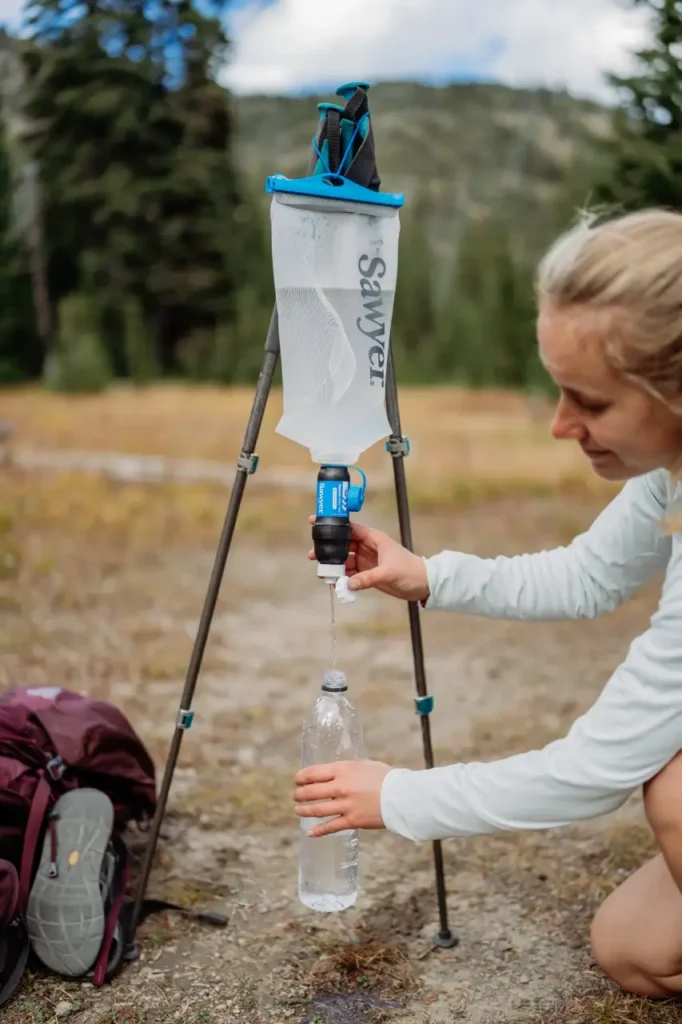
Squeeze filters are lightweight, compact, and popular with backpackers. The basic process is simple: fill a dirty water pouch, attach the filter, and squeeze clean water into a bottle or directly into a drinking container.
They work well because they are easy to pack and versatile. A small squeeze filter can disappear into a side pocket, hip belt pocket, or cook kit. For solo hikers and backpackers, this is often the most balanced option.
Pros: Lightweight, compact, affordable, versatile, easy to pack.
Cons: Soft bags can wear out, flow can slow over time, squeezing several liters can get tiring.
Squeeze filters are a strong choice for solo backpacking, thru-hiking, weekend trips, and general hiking use.
2. Gravity Filters
Gravity filters are built for camp life. Fill the dirty reservoir, hang it from a tree branch, shelter pole, vehicle rack, or sturdy line, and let gravity pull water through the filter into a clean reservoir.
The best part is that no one has to stand there pumping or squeezing. While the filter works, camp can be set up, dinner can get started, or wet socks can be swapped for dry ones. 🏕️
Pros: Great for groups, handles larger volumes, mostly hands-free, excellent for cooking water.
Cons: Bulkier than squeeze filters, needs a place to hang, less convenient while actively hiking.
Gravity systems are ideal for groups, family camping, basecamp setups, and car camping.
3. Pump Filters
Pump filters are old-school in the best way. Drop the intake hose into the water source and manually pump clean water into a bottle or reservoir.
They are heavier and require effort, but they solve a problem many modern soft-bottle filters struggle with: awkward water sources. If the water is shallow, silty, muddy, or tucked between rocks, a pump hose can be easier to manage than trying to scoop water into a floppy bag.
Pros: Good for shallow or awkward water, controlled output, reliable, often field-maintainable.
Cons: Heavier, bulkier, requires effort, has more moving parts.
Pump filters make sense for desert routes, shallow water sources, guided trips, and hikers who prefer a more traditional, durable system.
4. Bottle Filters
Bottle filters build the filter directly into the bottle, soft flask, or cap. Fill the bottle, attach the filter, and drink.
This style is one of the easiest to use because it feels close to drinking from a normal bottle. There is no separate dirty bag, no tubing, and no complicated camp setup.
Pros: Fast, simple, excellent for day hikes and trail running, fewer loose parts.
Cons: Limited to that bottle’s capacity, not ideal for cooking water or groups.
Bottle filters are great for day hikers, trail runners, travelers, and anyone who wants fast personal hydration.
5. UV Purifiers
UV purifiers use ultraviolet light to neutralize microorganisms in clear water. They are especially useful when viruses are a concern.
The important word is clear. UV light needs to pass through the water effectively. If the water is cloudy, silty, or full of sediment, it should be pre-filtered first.
Pros: Treats viruses, fast, no filter clogging, good for travel.
Cons: Requires battery power, does not remove sediment, needs clear water.
UV purifiers are best for travel, hut trips, clear tap water, and situations where virus protection matters.
6. Straw Filters
Straw filters are simple personal filters that allow drinking directly from a water source.
They are light, compact, and inexpensive, but they are not very convenient as a main hiking filter. They do not fill bottles. They do not provide water for cooking. They often require crouching or lying close to the source.
Pros: Light, affordable, simple, good for backup use.
Cons: Awkward for regular use, does not fill bottles or pots, limited for groups.
A straw filter is best as an emergency backup, not the main water plan for most hikes.
Key Features to Compare
Effectiveness
Start with what the filter or purifier is designed to remove. A typical hiking filter should handle bacteria and protozoa. A purifier should also address viruses.
For most U.S. backcountry hiking, bacteria and protozoa are the main concern. For international travel or areas with higher human contamination risk, virus protection becomes much more important.
Weight and Packability
A small squeeze filter is easy to justify on almost any hike. A pump purifier or large gravity system takes more space but may be worth it for specific situations.
For backpacking, weight matters. For car camping or basecamp trips, convenience often matters more.
Flow Rate
Flow rate affects how the filter feels in real use. A slow filter can be frustrating when everyone is thirsty, mosquitoes are out, or dinner depends on clean water.
Fast flow is especially useful for day hiking, trail running, and group camp setups.
Filter Lifespan
Some filters can treat huge amounts of water with proper care. Others are built more for convenience than long-term volume.
A long lifespan matters most for frequent backpackers, thru-hikers, guides, and people who filter water often. For occasional day hikes, ease of use may matter more.
Maintenance
Most hollow-fiber filters need cleaning to restore flow. Some require backflushing. Others can be shaken or swished. Pump filters may have replaceable cartridges. UV purifiers need charged batteries.
The easier the maintenance, the more likely it is to actually happen.
Water Source Compatibility
This is where real-world experience matters. A filter that works beautifully in a deep lake may be annoying in a shallow seep. A soft flask can be frustrating to fill from a trickle. A pump hose can be a gift in muddy or awkward water.
Choose based on the water sources most likely to be found on the trips ahead.
The Best Water Filters of 2026: In-Depth Reviews
Sawyer Squeeze: Best Overall
Check Price at REI | Check Price on Amazon
- Type: Squeeze
- Weight: About 3 oz
- Removes: Bacteria, protozoa, and microplastics
- Filter Life: Very long lifespan with proper care
The Sawyer Squeeze is one of the most trusted backpacking filters because it gets the big things right. It is light enough for long-distance hiking, affordable enough for beginners, simple enough to use without much practice, and versatile enough to work for many different setups.
The process is easy: fill a dirty pouch from a creek, lake, or spring, screw on the filter, and squeeze clean water into a bottle. It can also be used with compatible water bottles and certain reservoir setups, which gives hikers more flexibility than many one-purpose filters.
The Sawyer Squeeze is especially good for solo hikers because it does not take much space and does not add much weight. It works for quick refills during the day and can also handle camp water for one person without much trouble. For two people, it still works fine, though filtering several liters by hand starts to feel slower.
The main weakness is the bag system. Soft squeeze pouches are always the part most likely to become annoying over time. They can be harder to fill in shallow water, and they may wear out if squeezed aggressively trip after trip. Many backpackers eventually pair the Sawyer Squeeze with a sturdier dirty-water bag to make filling and squeezing easier.
Flow rate is also tied closely to maintenance. After silty water or repeated use, the filter can slow down. Backflushing helps restore performance, so it is worth making filter care part of the normal post-trip routine.
The Sawyer Squeeze is not flashy. It is not the fastest. It is not the best for big groups. But for most hikers who want one dependable water filter that can handle a wide range of trips, it is still one of the best places to start. 💧
Pros:
- Excellent value for hikers and backpackers
- Very light and compact
- Long filter lifespan with proper care
- Works with multiple bottle and bag setups
- Easy to pack as a primary or backup filter
Cons:
- Included pouches can wear out
- Flow slows if the filter is not cleaned
- Squeezing several liters gets tiring
- Must be protected from freezing after use
Who It’s Best For: Solo hikers, ultralight backpackers, thru-hikers, weekend campers, and anyone who wants a reliable filter without carrying much weight.
Who Should Skip It: Groups that need several liters at camp, hikers who dislike squeezing bags, or anyone who regularly deals with shallow sources that are hard to scoop.
Katadyn BeFree: Fastest Flow
Check Price at REI | Check Price on Amazon
- Type: Soft Bottle / Squeeze
- Weight: Lightweight personal filter system
- Removes: Bacteria and protozoa
- Filter Life: Shorter than some long-life squeeze filters
The Katadyn BeFree is the filter for hikers who care most about speed and simplicity. It feels less like using a piece of technical gear and more like filling a soft bottle and drinking from it.
That is the appeal.
For day hikes, trail runs, fast overnights, and minimalist backpacking trips, the BeFree makes water treatment feel easy. Fill the soft flask, screw on the cap, and drink. The flow is fast enough that it does not feel like work when the filter is clean, which makes it easier to drink consistently throughout the day.
The cleaning process is also simple. Instead of carrying a syringe or backflush tool, the filter can usually be cleaned by shaking or swishing it in water. That simplicity matters when hands are cold, daylight is fading, or the only goal is to refill and keep moving.
The soft flask is both a strength and a weakness. It packs down small when empty and is comfortable to stash in a vest, hip belt, or side pocket. But it is not as durable as a hard bottle, and it can be awkward to fill from very shallow water. Like most soft-bottle systems, it works best when the water source is deep enough to scoop easily.
The BeFree is not the best choice for filtering water for a whole group or filling a large pot for dinner. It is built around personal hydration. For that use, it is one of the most enjoyable filters to carry.
Pros:
- Fast, easy drinking experience
- Excellent for day hiking and trail running
- Simple cleaning process
- Lightweight and packable
- Great for quick personal hydration
Cons:
- Shorter filter life than some competitors
- Soft flask can be less durable
- Not ideal for filtering large volumes
- Harder to use for cooking water or group water
Who It’s Best For: Day hikers, trail runners, minimalist backpackers, and anyone who wants a fast personal filter with minimal setup.
Who Should Skip It: Group campers, hikers who need to fill several bottles at once, and anyone who wants the longest possible filter lifespan.
Platypus GravityWorks 4L: Best for Groups
Check Price at REI | Check Price on Amazon
- Type: Gravity
- Weight: Heavier than personal filters
- Removes: Bacteria and protozoa
- Filter Life: Replaceable filter cartridge system
The Platypus GravityWorks 4L is the filter that makes the most sense when water becomes a camp task instead of a personal refill.
For one person hiking fast, it is more system than necessary. For two, three, or four people at camp, it starts to feel like a small luxury. Fill the dirty reservoir, hang it, connect the hose, and let gravity do the work while camp comes together.
This is where the GravityWorks shines. Instead of taking turns squeezing water into bottles, a group can filter several liters while setting up tents, organizing food, or starting dinner. Clean water becomes available for drinking, cooking, coffee, oatmeal, cleanup, and topping off bottles for the next morning. ☕
The system is especially useful for family camping, backpacking groups, scout-style trips, and car camping where convenience matters more than shaving every ounce. It also helps reduce the little camp bottlenecks that happen when everyone needs water at the same time.
The downside is bulk and setup. There are bags, hoses, a filter, and connection points to manage. The system also works best when there is somewhere to hang it. A tree branch is ideal, but a vehicle rack, shelter line, or camp pole can work too.
The GravityWorks is not the filter to carry for a quick solo day hike. It is the filter to bring when clean water for multiple people needs to be easy.
Pros:
- Filters larger amounts of water with little effort
- Excellent for groups and families
- Great for basecamp and car camping
- Easier than squeezing several liters by hand
- Helpful for cooking and camp cleanup
Cons:
- Bulkier than personal filters
- More expensive than simple squeeze filters
- Needs a place to hang
- Less convenient for quick refills while hiking
Who It’s Best For: Backpacking groups, family campers, car campers, basecamp setups, and anyone who wants clean water ready at camp without constant pumping or squeezing.
Who Should Skip It: Solo ultralight hikers, fast day hikers, and anyone who only needs quick personal hydration.
Katadyn Hiker Pro Clear: The Reliable Workhorse
Check Price at REI | Check Price on Amazon
- Type: Pump
- Weight: About 11 oz
- Removes: Bacteria and protozoa
- Filter Life: Replaceable cartridge system
The Katadyn Hiker Pro Clear is a practical reminder that not every water source is a perfect stream with easy access.
Sometimes water is shallow. Sometimes it is tucked under grass, pooled between rocks, or sitting at the edge of a muddy lake. Sometimes the only reliable source is a silty trickle late in the season. In those situations, a pump filter can be easier to use than a soft squeeze bag.
The intake hose is the advantage. Instead of trying to scoop water into a floppy pouch, the hose can be placed where the water is deepest or clearest. Then clean water can be pumped directly into a bottle or reservoir.
The Hiker Pro Clear is heavier and bulkier than a squeeze filter, and pumping takes effort. That is the trade-off. But it also feels sturdy, controlled, and dependable. For hikers who prefer a traditional filter with a replaceable cartridge, it still makes a lot of sense.
The clear housing is useful because it gives a visual sense of what is happening inside the filter. The prefilter helps with debris before water reaches the main cartridge. For longer trips or rougher sources, that can be reassuring.
This is not the best filter for ultralight hikers who want the smallest possible kit. It is better for people who value reliability, field serviceability, and better performance in awkward water.
Pros:
- Works well with shallow or tricky water sources
- Reliable and field-maintainable
- Better control than many soft-bottle systems
- Useful in silty or less-than-perfect water
- Replaceable cartridge system
Cons:
- Requires manual pumping
- Heavier and bulkier than squeeze filters
- More moving parts than simpler systems
- Slower for groups than a gravity filter
Who It’s Best For: Backpackers who often encounter shallow, silty, or awkward water sources; guides; and hikers who prefer a traditional pump system.
Who Should Skip It: Ultralight hikers, trail runners, and anyone who wants the simplest possible setup.
LifeStraw Peak Series Straw: Best for Emergencies
Check Price at REI | Check Price on Amazon
- Type: Straw
- Weight: Very lightweight
- Removes: Bacteria, parasites/protozoa, and microplastics depending on model specs
- Filter Life: Long-life personal filter
The LifeStraw Peak Series Straw is best treated as a backup filter, not a main water system.
That is not a criticism. It is exactly why it is useful.
A straw filter is simple, compact, and easy to keep in a daypack, emergency kit, car camping bin, or glove box. If the main filter breaks, clogs, freezes, or gets lost, a small backup can turn a bad situation into a manageable one.
The LifeStraw works by drinking directly from the water source. There is no dirty bag, no bottle attachment, no gravity setup, and no pump. In an emergency, that simplicity is valuable.
For normal hiking use, though, it has real limitations. It does not fill a bottle. It does not provide clean water for cooking. It does not help much when the water source is hard to reach. Drinking directly from a creek can also be awkward, especially on muddy banks or rocky shorelines.
For that reason, the LifeStraw Peak is not the best choice as the only filter on a backpacking trip. But as a low-cost backup, it is a smart piece of insurance. ✅
Pros:
- Lightweight and inexpensive
- Very simple to use
- Great emergency backup
- Easy to keep in a daypack, car kit, or home kit
- No batteries or setup required
Cons:
- Not ideal as a primary hiking filter
- Does not fill bottles or pots
- Awkward to use at some water sources
- Limited usefulness for groups
Who It’s Best For: Hikers, campers, travelers, and families who want a simple backup filter for emergencies.
Who Should Skip It: Anyone looking for a main backpacking filter, group water system, or cooking-water solution.
Katadyn Steripen Ultra: Best for Clear Water and Travel
Check Price at REI | Check Price on Amazon
- Type: UV Purifier
- Weight: Lightweight electronic purifier
- Treats: Bacteria, protozoa, and viruses in clear water
- Battery: USB rechargeable
The Katadyn Steripen Ultra is not a filter in the traditional sense. It does not remove dirt, grit, or sediment. Instead, it uses UV light to treat clear water and neutralize microorganisms.
That makes it especially useful for travel. When the water looks clear but sanitation is uncertain, a UV purifier can be a fast and compact option. It is also helpful for hut trips, international travel, hostels, hotels, and clear tap water where virus protection matters.
The process is simple: fill a bottle with clear water, activate the purifier, place the UV lamp in the water, and stir until the treatment cycle is complete. There is no pumping, no squeezing, and no filter cartridge to clog.
But the Steripen has one major limitation: the water needs to be clear. If water is cloudy, silty, or full of floating debris, UV light may not pass through effectively. In those situations, the water should be pre-filtered first through a cloth, coffee filter, or separate filter.
Battery dependence is the other consideration. For travel, USB charging is convenient. For remote backpacking, it requires a charging plan.
The Steripen Ultra is a strong choice for the right use case. It is not the best all-around hiking filter, but it is one of the more practical options when clear water and virus protection are part of the equation.
Pros:
- Treats viruses, bacteria, and protozoa in clear water
- Fast treatment process
- Useful for international travel
- No filter cartridge to clog
- USB rechargeable
Cons:
- Requires clear water
- Does not remove sediment
- Depends on battery power
- Not ideal as the only treatment method for muddy backcountry sources
Who It’s Best For: International travelers, hut-to-hut hikers, travelers treating clear tap water, and backpackers who want virus protection in clear water.
Who Should Skip It: Hikers who mostly filter silty, muddy, or sediment-heavy water sources.
MSR Guardian Purifier: Best Heavy-Duty Purifier
Check Price at REI | Check Price on Amazon
- Type: Pump purifier
- Weight: Heavier than standard hiking filters
- Removes: Protozoa, bacteria, viruses, and dirt
- Best Use: Backpacking, camping, international travel, high-risk water
The MSR Guardian Purifier is the serious option in this guide. It is not the filter most casual hikers need, but it is one of the strongest choices when water quality is a bigger concern.
Unlike a basic backpacking filter, the Guardian is designed for purifier-level protection, including viruses. Unlike a UV purifier, it physically filters water instead of relying on light, which makes it more useful when water is not perfectly clear.
That matters for international travel, remote routes, emergency preparedness, and high-risk water sources where a standard bacteria-and-protozoa filter may not be enough.
The Guardian is built for demanding use, and that shows in both good and bad ways. It is durable and capable, but it is also expensive and heavy compared with a Sawyer Squeeze or Katadyn BeFree. Pumping also takes effort.
For a weekend hike near reliable mountain streams, it is probably overkill. For international travel, expedition use, disaster prep, or backcountry situations where water risk is higher, the extra protection may be worth the cost and weight.
Pros:
- Purifier-level protection
- Handles viruses, bacteria, protozoa, and dirt
- Strong choice for international travel and high-risk water
- More capable than basic backcountry filters
- Built for demanding use
Cons:
- Expensive
- Much heavier than squeeze filters
- More filter than most casual hikers need
- Pumping takes effort
Who It’s Best For: International travelers, expedition-style hikers, guides, emergency-prep users, and anyone dealing with high-risk water sources.
Who Should Skip It: Casual day hikers, weekend backpackers in lower-risk areas, and anyone mainly looking for a lightweight personal filter.
Practical Tips for Water Filter Care and Maintenance
A water filter is easy to ignore until it slows down, freezes, or fails. A little care keeps it working better and helps avoid problems when clean water matters most.
1. Protect hollow-fiber filters from freezing
This is one of the most important rules. After a hollow-fiber filter has been used, water remains inside the tiny fibers. If that water freezes, it can expand and damage the filter. The damage may be invisible, which makes it especially risky.
In freezing conditions, keep the filter in a jacket pocket during the day and inside a sleeping bag at night. Treat it like a sensitive safety item, not a regular water bottle. ❄️
2. Clean or backflush before flow becomes terrible
Silty water, tannic water, and repeated use can slow a filter down. Backflushing or cleaning helps restore flow and makes the filter much less frustrating to use.
Do not wait until the filter is barely dripping. Cleaning it regularly is easier than trying to revive it when everyone is already thirsty.
3. Keep the clean side clean
The clean outlet should not touch dirty water, muddy hands, the ground, or the outside of a dirty reservoir. Cross-contamination is one of the easiest mistakes to make.
Use caps when available. Keep clean parts away from dirty bags. Set the filter down carefully at camp.
4. Choose the best water source available
A filter is not a magic fix for every source. When possible, choose moving water over stagnant water. Choose clear water over silty water. Avoid water near heavy livestock use, visible algae blooms, mining areas, chemical runoff, or obvious contamination.
Better source selection protects both the hiker and the filter.
5. Pre-filter dirty water when needed
If the water is full of sediment, pour it through a bandana, coffee filter, or clean cloth before using the filter. This does not make the water safe by itself, but it can reduce debris and help prevent clogging.
This is especially helpful in desert areas, glacial streams, muddy lakes, and late-season water sources.
6. Dry and store it properly after the trip
After a trip, clean the filter according to the manufacturer’s instructions and let it dry thoroughly before long-term storage. Damp filters stored in closed bins can develop unpleasant smells, mildew, or performance issues.
Good post-trip care makes the next trip easier.
Final Verdict
The best water filter for hiking depends on the trip, the water source, and how many people need clean water.
For most hikers and backpackers, the Sawyer Squeeze is still the best overall choice. It is light, affordable, proven, and versatile. It works especially well for solo backpackers and anyone who wants a dependable filter that can handle a wide range of trips.
For fast personal hydration, the Katadyn BeFree is the smoother and more convenient option. It is a great fit for day hikes, trail runs, quick overnights, and hikers who want water treatment to feel almost effortless.
For groups and camp setups, the Platypus GravityWorks 4L is the easiest system to live with. It turns filtering into a background task and keeps clean water available for drinking, cooking, and cleanup.
For difficult water sources, the Katadyn Hiker Pro Clear remains a dependable pump filter that handles shallow or awkward water better than many soft-bottle systems.
For backup use, the LifeStraw Peak Series Straw is simple, compact, and easy to keep in an emergency kit.
For virus protection, the Katadyn Steripen Ultra is a strong choice for clear water and travel, while the MSR Guardian Purifier is the heavy-duty option for high-risk water, international travel, and more demanding backcountry use.
Clean water is one of the small things that makes a trip feel smoother, safer, and more comfortable. The right filter helps hikers carry less, drink more, cook easier, and stay focused on the trail ahead. 🌄
Frequently Asked Questions (FAQ)
Q: Can I drink from any water source with a filter?
A: No. A filter reduces common biological risks, but it does not make every water source safe.
Choose the cleanest water available. Moving water is usually better than stagnant water. Clear water is usually better than silty water. Avoid water near livestock, mining areas, heavy agricultural runoff, chemical spills, obvious algae blooms, or places with strong signs of contamination.
Most hiking filters are not designed to remove chemicals, fuel, pesticides, heavy metals, or salt. If the source looks questionable for reasons beyond normal backcountry sediment or microorganisms, find another source whenever possible.
Q: Do hiking water filters remove viruses?
A: Most standard hiking filters do not remove viruses. They are usually designed for bacteria and protozoa, which are the main concern on many U.S. and Canadian backcountry trips.
For virus protection, look for a purifier instead of a basic filter. A UV purifier can work well in clear water. A pump purifier is a better fit when the water may be cloudy or higher risk.
Q: What is the best water filter for most hikers?
A: The Sawyer Squeeze is the best overall choice for most hikers because it is light, affordable, compact, and versatile. It works well for backpacking, weekend hiking, and general outdoor use.
That said, the best choice depends on the trip. The Katadyn BeFree is better for fast personal hydration. The Platypus GravityWorks is better for groups. The MSR Guardian is better for high-risk water and international travel.
Q: What is the best water filter for day hiking?
A: A bottle-style filter or compact squeeze filter usually works best for day hiking. The Katadyn BeFree is especially convenient because it is quick to fill, easy to drink from, and simple to pack.
For short hikes with no reliable water sources, carrying enough water from the start may still be the simplest plan. A small backup filter is useful for longer, hotter, or more remote routes.
Q: What is the best water filter for backpacking groups?
A: A gravity system is usually the best choice for groups. The Platypus GravityWorks 4L is a strong option because it can filter several liters with very little effort.
For two or more people, a gravity filter saves time and reduces camp frustration. It also makes cooking and cleanup easier because clean water is available without constant squeezing or pumping.
Q: How do I know when my filter needs to be replaced?
A: Replace the filter or cartridge when the flow rate becomes poor and cannot be restored by cleaning or backflushing, or when it reaches the manufacturer’s rated lifespan.
Also replace a hollow-fiber filter if it has frozen after use. Freeze damage may not be visible, but it can compromise the filter.
Q: Can a water filter freeze?
A: Yes. Hollow-fiber filters can be damaged if water trapped inside the fibers freezes. This is one of the most common cold-weather filter mistakes.
In freezing conditions, keep the filter close to the body during the day and inside a sleeping bag at night. A frozen filter should not be trusted unless the manufacturer provides a reliable way to verify its integrity.
Q: Are chemical treatments better than filters?
A: Chemical treatments such as chlorine dioxide tablets can be excellent backups. They are light, compact, and useful for emergency kits. Some treatments also address viruses, which many standard hiking filters do not.
The downsides are wait time, taste, and lack of sediment removal. Chemical treatment will not make gritty water pleasant to drink, and some treatments take longer in cold or cloudy water.
Q: Do filters improve the taste of water?
A: Some filters improve taste, especially models with activated carbon. Others mainly focus on removing microorganisms and sediment.
If taste is a big concern, look for a filter with a carbon element or carry electrolyte tablets. Just remember that better-tasting water is not automatically safer water.
Q: Should I carry a backup water treatment method?
A: Yes, especially on longer hikes, remote routes, cold-weather trips, desert hikes, or international travel.
A backup can be as simple as chlorine dioxide tablets or a small straw filter. Filters can clog, freeze, crack, get dropped, or fail. Water is too important to rely on only one fragile system.
Affiliate Disclosure: GearForTheOutdoors.com participates in affiliate programs, including REI, Amazon, REI Outlet, Garage Grown Gear, evo, and other trusted partners. Purchases made through affiliate links may earn GearForTheOutdoors.com a small commission at no extra cost to the reader. That support helps keep the content useful, practical, and free.
Disclaimer: This post is for informational purposes only. Always verify current product details, fit, availability, safety information, and manufacturer warranties before purchase or use. Outdoor conditions and gear performance can vary depending on setup, weather, terrain, and experience level.