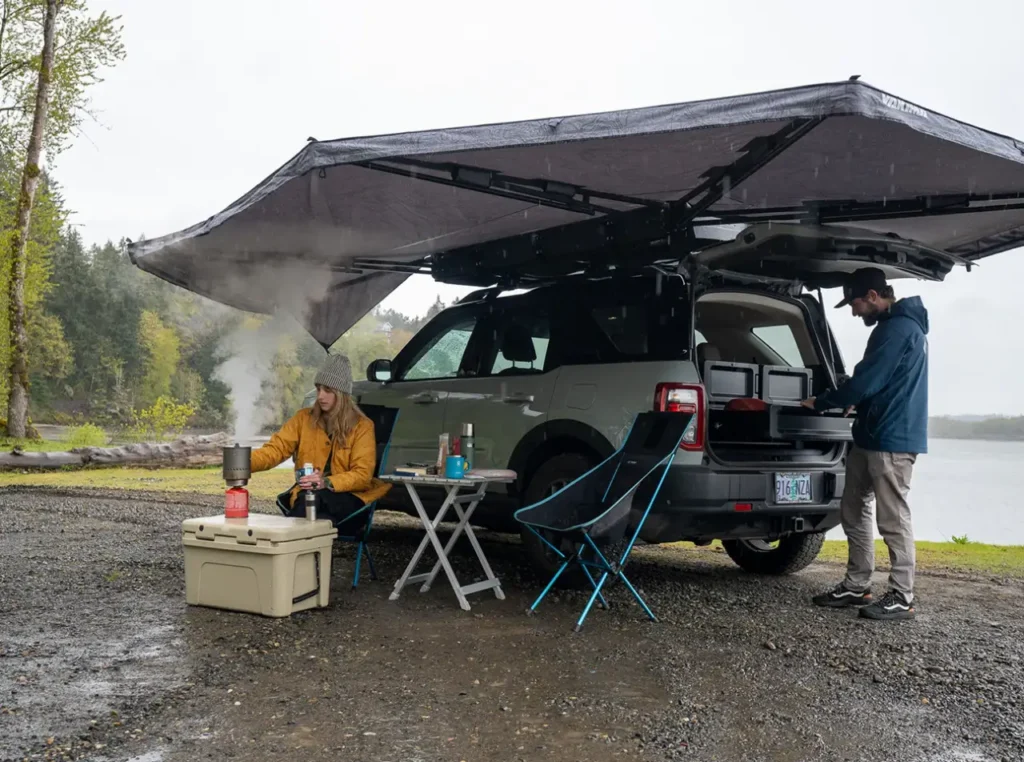
A good campsite feels completely different when there’s a reliable patch of shade next to the vehicle.
Without an awning, camp life often gets pushed into awkward spots: cooking in direct sun, hiding inside the car during a passing shower, or dragging chairs around all afternoon trying to stay cool. A car awning fixes that by turning the side or rear of a vehicle into a more usable outdoor room. ☀️
For car camping, overlanding, van life, and rooftop tent setups, that covered space can become the heart of camp. It’s where coffee gets made in the morning, muddy shoes stay out of the tent, dinner prep happens during light rain, and everyone gathers when the sun is too strong to sit out in the open.
The best car awnings are not all built for the same kind of camper, though. A lightweight portable awning makes more sense for a crossover without a roof rack. A big 270-degree awning is better for a truck or SUV with a rooftop tent and a full overland rack. A zip-on rooftop tent awning is perfect for someone already committed to an iKamper setup.
This guide focuses on practical, real-world awnings that fit the way people actually camp — with special attention to brands that pair well with rooftop tents, overland rigs, trucks, SUVs, and vehicle-based basecamps.
Our Top Car Awning Picks for 2026
Here’s a quick look at the best car awnings for camping, overlanding, and rooftop tent setups.
| Product | Best For | Coverage / Size | Price |
|---|---|---|---|
| Free Spirit Recreation 270 Awning V2 | Best Overall for Rooftop Tent & Overland Setups | 80.7 sq. ft. | $$$$ |
| Roofnest Wing 270 Awning | Best for Roofnest Rooftop Tent Rigs | 80–125 sq. ft. | $$$$ |
| Yakima OverNOut 270 XL Awning | Best Large 270-Degree Awning from REI/Yakima | 132 sq. ft. | $$$$ |
| iKamper Awning 3.0 | Best for iKamper Rooftop Tent Owners | 128.37 sq. ft. | $$$ |
| Overland Vehicle Systems Nomadic 270 Awning | Best Massive Coverage for Overlanding | 129 sq. ft. | $$$$ |
| ROAM Rooftop Awning | Best Classic Side Awning for Camp Rigs | Multiple sizes | $$$ |
| MoonShade Portable Vehicle Awning | Best Portable Awning Without a Roof Rack | 9 ft. x 7 ft. / 63 sq. ft. | $$ |
| Hasika Waterproof SUV Tailgate Tent and Car Awning | Best Budget-Friendly Option | Approx. 60–76 sq. ft. | $ |
Why You Need a Car Awning
A car awning is one of those upgrades that seems optional until the first hot, exposed campsite.
Then it starts to feel essential.
The main benefit is simple: usable outdoor space. A vehicle gives you storage, transportation, and sometimes a sleeping platform, but it does not automatically create a comfortable place to sit, cook, sort gear, or wait out weather. An awning fills that gap. 🌲
For rooftop tent campers, an awning also helps balance the setup. The tent handles sleep, while the awning creates the daytime living space underneath or beside the vehicle. That matters when shoes are muddy, the cooler is under the tailgate, or dinner needs to happen before sunset.
A good vehicle awning can help with:
- Shade during hot afternoons: Especially useful in desert camps, exposed campgrounds, beach lots, and summer road trips.
- Light rain protection: Awnings keep camp kitchens, chairs, and gear bins usable during passing showers.
- Better campsite organization: The covered area naturally becomes the cooking, lounging, and gear-staging zone.
- More comfort with a rooftop tent: The awning creates a ground-level living space while the tent stays clean and reserved for sleeping.
- Less hassle than a freestanding canopy: Many awnings pack smaller, stay attached to the rig, and deploy faster once the system is dialed in.
Awnings are not magic shelters. Wind, heavy rain, storms, and poor staking can damage even expensive models. But in normal camp conditions, a well-chosen awning can make a campsite feel calmer, cooler, and much more livable.
How to Choose the Best Car Awning: A Buyer’s Guide
The best car awning is not always the biggest or most expensive one. It’s the one that matches the vehicle, rack system, camping style, and amount of setup work that feels realistic after a long drive.
Before buying, think about where the awning will mount, how often it will be used, and what the covered space needs to do.
Type of Awning
Car awnings generally fall into a few main categories.
270-degree awnings are the go-to choice for many rooftop tent and overland setups. They swing around the side and rear of the vehicle, creating a large wraparound shelter. These are excellent for truck beds, tailgate kitchens, drawer systems, and camp setups where the vehicle is the center of everything.
Side-mounted roll-out awnings are simpler and usually more compact. They mount to a roof rack and roll straight out from the side of the vehicle. These work well for vans, SUVs, trucks, and campers who want shade without the weight or cost of a huge 270-degree system.
Rooftop tent-specific awnings attach directly to a compatible rooftop tent. These can be excellent when the tent and awning are designed to work together, but they are less universal than standard vehicle awnings.
Portable vehicle awnings attach with suction cups, magnets, straps, or fixed anchor points. They are ideal for vehicles without roof racks, renters, casual campers, and anyone who wants one awning that can move between vehicles.
Tailgate awnings and SUV shelters create shade or a covered room off the rear hatch. These are great for camp kitchens, changing areas, and family campground setups. 🚙
Mounting System and Vehicle Compatibility
This is the first thing to check.
Most 270-degree awnings need a strong roof rack, bed rack, platform rack, or rooftop tent mounting setup. A factory crossbar system may not be enough, especially for heavier awnings in the 40–70 lb. range. Always check both the awning requirements and the rack’s dynamic weight rating.
Mounting side matters too. Many 270-degree awnings come in driver-side and passenger-side versions. For U.S. campers, passenger-side mounting often works well at campgrounds and roadside pullouts, but the best choice depends on the vehicle layout, kitchen location, rooftop tent orientation, and how camp is usually arranged.
For rooftop tent owners, also consider how the awning and tent interact. Check hatch clearance, ladder placement, annex compatibility, and whether the awning blocks tent entry or creates awkward guy-line conflicts.
Size and Coverage
Coverage is measured in square feet, but the shape matters just as much as the number.
A 63-square-foot portable awning may be plenty for two chairs and a small table. An 80-square-foot 270-degree awning can feel more useful because it wraps around the tailgate. A 129-square-foot awning can create a serious basecamp, but it may be too large for tight forest sites or quick overnight stops.
Here’s a practical way to think about coverage:
- 50–70 sq. ft.: Good for solo campers, couples, quick shade, and simple cooking setups.
- 80–100 sq. ft.: A strong sweet spot for rooftop tent rigs, SUVs, and weekend overlanding.
- 120+ sq. ft.: Best for big basecamps, families, tailgate kitchens, and long stays.
Bigger awnings also need more attention in wind. More fabric means more surface area, more leverage on the rack, and more reason to use poles, stakes, and guy lines properly. 🌬️
Materials and Durability
Awnings live a rough life. They sit on the roof in sun, dust, rain, road grime, and vibration, then get stretched out at camp and packed away again.
Look for durable canopy fabrics, reinforced corners, sturdy arms, a tough travel cover, and hardware that fits your rack securely. Poly-cotton and heavy polyester fabrics tend to feel more rugged, while lighter nylon or polyester designs can save weight.
For frequent overland use, the travel cover matters almost as much as the canopy. A weak cover can fail from highway miles, brush, UV exposure, and trail dust long before the awning fabric itself gives out.
Ease of Setup
The easier an awning is to deploy, the more often it gets used.
Freestanding 270-degree awnings can be excellent because they swing open quickly and do not always require poles in calm conditions. Still, support poles and guy lines should be used when wind picks up or rain is expected.
Portable awnings take more hands-on setup but are much easier to store and move between vehicles. Tarp-style and tailgate shelters are usually less expensive, but they require more staking and tensioning.
A good rule: practice at home before relying on the awning at camp. Learn the pole sequence, guy-line angles, and best way to pitch the canopy for rain runoff. That small prep step can save a lot of frustration when the sky gets dark or the bugs come out. 🏕️
The Best Car Awnings of 2026: Detailed Reviews
Free Spirit Recreation 270 Awning V2
Best For: Rooftop Tent Setups, Overlanding, and Fast Wraparound Shade
| Specs | |
| Coverage | 80.7 sq. ft. |
| Weight | 43 lbs. |
| Closed Dimensions | 90.5 x 5.9 x 5.9 in. |
| Materials | 600D Oxford ripstop, PVC exterior cover |
| Mount Type | Roof rack, bed rack, or compatible overland rack system |
The Free Spirit Recreation 270 Awning V2 is one of the strongest fits for campers building a real rooftop tent or overland setup. It delivers wraparound side-and-rear coverage without jumping into the heaviest awning category.
That makes it especially useful for trucks, SUVs, and vans where the camp kitchen lives at the back of the vehicle. Open the awning, and the shaded area naturally covers the tailgate, cooler, drawer system, stove table, and hangout zone. It feels less like a simple shade panel and more like a compact outdoor room.
The 80.7-square-foot coverage area is a smart size. It’s large enough to be useful for cooking and relaxing, but not so massive that it becomes a burden on smaller rigs. The 43-pound weight still requires a proper rack, but it is easier to manage than many full-size 270-degree awnings.
The 600D Oxford ripstop canopy and PVC exterior cover are built with real camp abuse in mind. It’s a good match for people who camp often, drive forest roads, and want a shelter that pairs naturally with a rooftop tent.
Check Price at Free Spirit Recreation
Pros:
- Excellent balance of coverage and weight
- Strong fit for rooftop tent and truck-bed rack setups
- Covers both side and rear camp zones
- Durable 600D ripstop canopy
- Integrated overland-focused design
Cons:
- Requires a strong mounting system
- More expensive than basic side awnings
- Still needs careful staking in wind
Roofnest Wing 270 Awning
Best For: Roofnest Rooftop Tent Rigs and Premium Overland Builds
| Specs | |
| Coverage | 80 sq. ft. Little Wing / 125 sq. ft. Big Wing |
| Weight | 55 lbs. Little Wing / 62 lbs. Big Wing |
| Materials | PU-coated poly-cotton canopy |
| Frame | Aluminum frame |
| Mount Type | Roof rack or overland rack system |
The Roofnest Wing 270 Awning is a natural choice for campers already building around a Roofnest rooftop tent or a premium overland rack system.
It comes in smaller and larger versions, which makes it easier to match the awning to the vehicle. The Little Wing is better for midsize SUVs, trucks, and campers who want wraparound coverage without overwhelming the roof. The Big Wing makes more sense for larger rigs, longer stays, and full basecamp setups where shade around the rear of the vehicle matters.
The appeal here is integration. Roofnest is already known for rooftop tents, so the awning fits the same kind of camper: someone who wants a clean, durable, vehicle-based camp system. The 270-degree layout is especially helpful when the tent, ladder, kitchen, and storage are all tied to the vehicle.
This is not a casual add-on for a lightly used crossover. Even the smaller version is substantial, and the larger version should be treated like serious rack-mounted gear. But for a dedicated rooftop tent rig, the Roofnest Wing adds exactly the kind of shaded living space that makes camp feel more complete.
Pros:
- Excellent match for Roofnest rooftop tent setups
- Available in smaller and larger coverage options
- Wraparound shape works well with vehicle-based kitchens
- Strong overland-style construction
- Clean look on a built-out rig
Cons:
- Heavy compared with portable awnings
- Requires a capable rack system
- More awning than most casual campers need
Yakima OverNOut 270 XL Awning
Best For: Large 270-Degree Coverage from a Major Rack Brand
| Specs | |
| Coverage | 132 sq. ft. |
| Weight | Approx. 68–72 lbs. |
| Fabric | 420D poly-cotton with PU coating |
| Water Rating | 2,000 mm |
| Mount Type | T-slot crossbars, platform racks, and compatible rack systems |
The Yakima OverNOut 270 XL is for campers who want big wraparound coverage from a major roof-rack brand.
With 132 square feet of shade and weather protection, this awning creates a large outdoor living area around the side and rear of the vehicle. That makes it a strong fit for trucks, overland SUVs, camper vans, and rooftop tent rigs that already use a robust rack system.
The freestanding design and heavy-duty support arms are made for quick deployment, while the 420D poly-cotton fabric with PU coating gives it a sturdy, weather-ready feel. It also pairs naturally with Yakima racks, which is useful for campers who already have a Yakima HD Bar, platform, or T-slot-style system.
The biggest tradeoff is weight. This is a large awning, and it needs a serious mounting setup. It is not the right choice for factory rails or casual campground use where a smaller portable shelter would do the job.
For built-out rigs that need a big shaded kitchen, hangout area, and tailgate zone, the OverNOut 270 XL is a strong premium pick.
Pros:
- Huge 132-square-foot coverage area
- Strong fit for trucks, vans, and overland SUVs
- Works well with Yakima rack ecosystems
- Freestanding 270-degree design
- Great for camp kitchens and longer stays
Cons:
- Heavy
- Requires a strong rack
- Expensive for occasional campers
- Too large for tight campsites or quick overnight trips
iKamper Awning 3.0
Best For: iKamper Rooftop Tent Owners
| Specs | |
| Covered Area | 128.37 sq. ft. |
| Weight | 14 lbs. 3.2 oz. |
| Packed Size | 27.9 x 7.8 x 5.1 in. |
| Peak Height | 82.7 in. |
| Canopy Fabric | 150D polyester with 3,000 mm PU coating |
| Mount Type | Zips onto compatible iKamper rooftop tents |
The iKamper Awning 3.0 is different from most car awnings in this guide. It is not a universal rack-mounted awning. It is designed for campers who already own a compatible iKamper rooftop tent and want a shelter that connects directly to the tent system.
That makes it a very specific product — but a very useful one for the right person.
Instead of mounting permanently to a rack and living on the vehicle full time, the Awning 3.0 zips onto the rooftop tent entrance and creates a large sheltered area below. It can protect the ladder zone, create a covered entry, and add usable space for gear, chairs, or changing clothes.
The coverage is impressive for the weight. At a little over 14 pounds, it offers far more covered area than many portable shelters. The packed size is also manageable, which makes it easier to bring only when the forecast or trip style calls for it.
The limitation is compatibility. This is not the awning to buy for a random SUV, truck, or van. It makes sense when the rooftop tent is already an iKamper and the goal is to expand that tent into a more complete camp shelter.
Pros:
- Excellent add-on for compatible iKamper rooftop tents
- Large coverage for the weight
- Creates a protected entry and living space
- Packs smaller than many mounted awnings
- Strong rain and sun protection for tent-based camping
Cons:
- Not universal
- Only makes sense for compatible iKamper setups
- Less convenient for quick roadside shade
- Requires tent setup to use properly
Overland Vehicle Systems Nomadic 270 Awning
Best For: Massive Coverage and Dedicated Overlanding
| Specs | |
| Coverage | 129 sq. ft. |
| Weight | Approx. 70–80 lbs. depending on version/listing |
| Closed Dimensions | Approx. 88 x 7 x 6 in. |
| Materials | Heavy-duty poly-cotton / ripstop-style canopy |
| Mount Type | Roof rack or aftermarket overland rack |
The Overland Vehicle Systems Nomadic 270 Awning is built for campers who want a big, serious shelter around the vehicle.
With 129 square feet of coverage, it creates a large shaded zone that can cover the side of the vehicle, tailgate area, kitchen table, and camp chairs. It is the kind of awning that makes the most sense on a truck, SUV, or trailer that already has drawers, a fridge, a stove setup, and a rooftop tent.
The Nomadic 270 is not trying to be lightweight or minimalist. It is trying to create a reliable overland basecamp. That means more weight, more mounting demand, and more commitment — but also a lot more comfort when the weather is hot, bright, or unsettled.
For frequent campers who spend several nights at a time in one place, the extra coverage can be worth the weight. For quick weekend campers who mainly need shade over two chairs, it may be more awning than necessary.
Pros:
- Massive 129-square-foot coverage area
- Strong fit for overland trucks, trailers, and rooftop tent rigs
- Great for tailgate kitchens and large basecamps
- More affordable than some premium 270-degree awnings
- Optional wall systems may be available depending on model
Cons:
- Very heavy
- Requires a strong rack and careful installation
- Not ideal for small vehicles
- Overkill for casual campground use
ROAM Rooftop Awning
Best For: Classic Side Shade for Rooftop Tent and Overland Rigs
| Specs | |
| Coverage | Varies by size |
| Frame | Aluminum-style frame |
| Materials | Waterproof poly-cotton ripstop-style canopy |
| Mount Type | Roof rack, platform rack, or overland rack |
| Best Use | Side shade, camp kitchens, vehicle-based camping |
The ROAM Rooftop Awning is a strong pick for campers who want a more traditional side awning instead of a large 270-degree wraparound shelter.
That simplicity is part of the appeal. A side awning is easier to understand, easier to fit on many vehicles, and usually less demanding than a full 270-degree system. It creates a clean shaded zone beside the vehicle — perfect for a camp table, chairs, cooler, or simple cooking station.
ROAM’s awning fits naturally into the same ecosystem as its rooftop tents, rugged cases, and overland gear. It works best for campers who already think of the vehicle as the center of camp but do not need a giant wraparound shelter.
The ability to add an awning room to some sizes makes it more versatile for longer stays. That can turn a simple shade awning into a changing room, bug-protected hangout, or enclosed gear area.
For rooftop tent campers who want clean side shade without the cost and weight of a 270-degree awning, this is one of the most sensible options.
Check Price at ROAM Adventure Co.
Pros:
- Simple, proven side-awning design
- Good fit for rooftop tent and overland setups
- Less bulky than many 270-degree awnings
- Pairs well with ROAM vehicle-based gear
- Optional room add-ons may be available for some sizes
Cons:
- Less coverage than a 270-degree awning
- Still requires a rack-mounted setup
- Not as versatile as a portable awning for multiple vehicles
MoonShade Portable Vehicle Awning
Best For: Vehicles Without Roof Racks and Flexible Camp Setups
| Specs | |
| Coverage | 9 ft. x 7 ft. / 63 sq. ft. |
| Weight | 8 lbs. |
| Materials | 420D ripstop polyester-style canopy |
| Packed Size | Compact shoulder-bag style storage |
| Mount Type | Suction cups, magnets, straps, fixed points |
The MoonShade Portable Vehicle Awning is the easiest awning to recommend for campers who do not want a permanent rack-mounted system.
It weighs only 8 pounds, packs small, and can attach to many vehicles using different anchor options. That makes it useful for SUVs, trucks, vans, campers, trailers, and even vehicles without roof racks. It is also a great choice for renters or households that switch between vehicles.
The 9-by-7-foot footprint creates enough shade for two chairs, a small kitchen table, or a relaxed lunch stop. It is not as integrated or storm-ready as a heavy 270-degree awning, but it wins on portability and flexibility.
This is the awning to choose when camp style changes from trip to trip. It can work at a campground, trailhead, beach day, road trip stop, or van camp without permanently adding weight to the roof.
Wind management matters. Because the MoonShade is light and portable, clean attachment points, proper tension, stakes, and guy lines are important. In strong gusts, it should be packed away.
Pros:
- No roof rack required
- Lightweight and easy to store
- Works with many different vehicles
- Great for renters and casual campers
- Strong coverage for the packed size
Cons:
- Less integrated than a mounted awning
- Requires careful anchoring in wind
- Suction cups need clean, smooth surfaces
- Not the best choice for permanent overland builds
Hasika Waterproof SUV Tailgate Tent and Car Awning
Best For: Budget-Friendly Shade and Occasional Camping
| Specs | |
| Coverage | Approx. 60–76 sq. ft. depending on pitch |
| Weight | Varies by model |
| Materials | Polyester-style canopy fabric |
| Mount Type | Straps, poles, suction cups / vehicle attachment |
| Best Use | Occasional camping, tailgating, simple SUV shade |
The Hasika Waterproof SUV Tailgate Tent and Car Awning is the budget pick for campers who want shade without spending premium awning money.
It is not as refined as a Free Spirit Recreation, Roofnest, Yakima, or OVS awning. The materials, hardware, and long-term durability should be viewed with realistic expectations. But for occasional camping, tailgating, beach parking, and beginner car camping, it can still add a very useful covered zone.
The design is simple: attach part of the shelter to the vehicle, support the outer edge with poles, and use guy lines to tension the canopy. It can work with many SUVs, vans, trailers, and hatchback-style vehicles.
This is a good way to test whether a car awning fits your camping routine before investing in a heavier rack-mounted system. It gives you the core benefit — shade and light rain coverage — at a much lower cost.
For frequent overland use, harsh weather, or a built-out rooftop tent rig, upgrade to a stronger awning. For casual weekend trips, this is a practical starter option. ⛺
Pros:
- Very affordable
- Works with many vehicle types
- Good entry point for beginner campers
- Useful for tailgating and occasional camp shade
- Packs smaller than many mounted awnings
Cons:
- Not as durable as premium awnings
- More setup effort than mounted systems
- Less reliable in wind and heavy rain
- Not ideal for frequent overlanding
Best Car Awning by Use Case
The best car awning depends heavily on the vehicle and camp style. A big 270-degree awning can be perfect on a Tacoma with a bed rack and rooftop tent, but completely unnecessary on a small crossover used for two summer campground trips.
Here’s the easiest way to narrow it down.
Best Overall for Rooftop Tent Setups: Free Spirit Recreation 270 Awning V2
The FSR 270 Awning V2 hits a strong sweet spot for rooftop tent rigs. It offers side and rear coverage, a durable canopy, and enough shade for a real vehicle-based camp kitchen without the extreme weight of some larger 270-degree awnings.
Best for Roofnest Owners: Roofnest Wing 270 Awning
For a Roofnest rooftop tent build, the Roofnest Wing is the most natural match. It keeps the setup within the same overland-focused ecosystem and adds the wraparound camp space that rooftop tent users usually want.
Best Large 270-Degree Awning: Yakima OverNOut 270 XL
The Yakima OverNOut 270 XL is the big-coverage pick. It makes sense for larger trucks, vans, and SUVs that already have a serious rack system and need a wide shaded basecamp.
Best for iKamper Owners: iKamper Awning 3.0
The iKamper Awning 3.0 is not universal, but for compatible iKamper rooftop tents, it adds a lot of shelter without permanently mounting a heavy awning to the rack.
Best Classic Side Awning: ROAM Rooftop Awning
The ROAM Rooftop Awning is a cleaner, simpler choice for campers who want reliable side shade without a full 270-degree setup. It pairs especially well with rooftop tent and overland-style vehicles.
Best Portable Option: MoonShade Portable Vehicle Awning
MoonShade is the pick for vehicles without roof racks, renters, and campers who want one awning that can move between different cars.
Best Budget Pick: Hasika Waterproof SUV Tailgate Tent and Car Awning
The Hasika is not the most rugged shelter on the list, but it gives beginner campers useful shade and light weather protection for a low price.
Car Awning Setup Tips
A car awning works best when it is pitched with weather in mind.
For sun, think about direction first. Afternoon shade matters more than morning shade on hot summer trips, so position the vehicle before deploying the awning when possible. In desert or beach conditions, a small change in vehicle angle can make the shaded space much more useful.
For rain, pitch one side slightly lower so water can run off instead of pooling overhead. Even waterproof fabric can sag when water collects, and pooled water adds stress to poles, arms, and mounting points.
For wind, use the guy lines early. Do not wait until the awning starts flapping. A vehicle awning can act like a sail, and even a strong awning can damage itself or the rack if gusts hit at the wrong angle.
Bring better stakes than the tiny ones that come with many shelters. Hard desert ground, loose sand, forest duff, and gravel campsites all need different anchoring strategies. Sand stakes, heavy-duty stakes, and extra cord are worth keeping in the camp kit. 🌧️
Always dry the awning fully before long-term storage. If it has to be packed wet at camp, open it at home as soon as possible. Mildew, trapped moisture, and dirt can shorten the life of the canopy and travel cover.
Common Mistakes to Avoid
The first mistake is buying too much awning.
A huge 270-degree awning looks great on a fully built overland rig, but it can be frustrating on a lightly equipped vehicle. If the rack is not strong enough, the campsites are usually tight, or the trips are mostly quick overnights, a smaller side awning or portable shelter may be smarter.
The second mistake is ignoring weight. A rooftop tent, awning, recovery boards, solar panel, and storage box can add up quickly. Always consider total roof or rack load, not just the awning by itself.
The third mistake is choosing the wrong mounting side. Think about where the kitchen opens, where the tent ladder sits, where the tailgate swings, and how the vehicle usually parks at camp.
The fourth mistake is skipping practice setup. Even easy awnings become easier after two or three dry runs. Practice also helps identify missing brackets, confusing pole sections, or weak stakes before the first real trip.
The fifth mistake is treating a car awning like a storm shelter. Awnings are for shade and manageable weather. In strong wind, lightning, heavy rain, or severe conditions, take it down.
Final Thoughts: Your Campsite, Upgraded
A good car awning makes vehicle-based camping feel more comfortable, organized, and complete.
For rooftop tent and overland setups, the Free Spirit Recreation 270 Awning V2 is the best overall balance of coverage, durability, and real-world usability. For Roofnest owners, the Roofnest Wing 270 Awning is the cleanest ecosystem match. For large rigs that need maximum wraparound shade, the Yakima OverNOut 270 XL and OVS Nomadic 270 both make sense.
For iKamper rooftop tent owners, the iKamper Awning 3.0 is a smart tent-specific shelter that adds a large covered area without turning the vehicle into a permanent awning build. For a simpler side-mounted option, the ROAM Rooftop Awning is a strong fit for classic overland and rooftop tent rigs.
Campers without roof racks should look closely at the MoonShade Portable Vehicle Awning, while budget-focused campers can start with the Hasika Waterproof SUV Tailgate Tent and Car Awning.
The best car awning is the one that fits the vehicle, rack, campsite routine, and the amount of setup effort that feels realistic. Get that match right, and the campsite becomes cooler, drier, cleaner, and a lot more inviting.
Frequently Asked Questions
What is the best car awning for rooftop tents?
For most rooftop tent setups, the Free Spirit Recreation 270 Awning V2 is one of the best overall choices because it offers side and rear coverage without being as massive as some heavy-duty 270-degree awnings. Roofnest owners should also consider the Roofnest Wing, while iKamper owners should look at the iKamper Awning 3.0.
Do I need a roof rack for a car awning?
Usually, yes — especially for 270-degree awnings and side-mounted awnings. These typically need a strong roof rack, platform rack, bed rack, or overland rack. Portable options like MoonShade can work without a roof rack.
Can I mount a car awning to a rooftop tent?
Sometimes. Some awnings can be mounted near or alongside a rooftop tent if the rack system allows it. Some tent-specific awnings, like the iKamper Awning 3.0, are designed to attach directly to compatible rooftop tents. Always check compatibility before buying.
What is the difference between a 270-degree awning and a side awning?
A side awning rolls or folds straight out from one side of the vehicle. A 270-degree awning wraps around the side and rear of the vehicle, creating much more covered space. The tradeoff is that 270-degree awnings are usually heavier, more expensive, and more demanding to mount.
Are car awnings waterproof?
Many car awnings are water-resistant or waterproof enough for light to moderate rain, but performance depends on fabric, coating, pitch, and setup. Always pitch the awning so water runs off instead of pooling.
Can I use a car awning in wind?
Yes, but only with caution. Use poles, stakes, and guy lines when wind is possible. In strong gusts or storms, pack the awning away. Even rugged awnings can be damaged if wind gets underneath the canopy.
What side should a car awning go on?
It depends on the vehicle and camp layout. Passenger-side mounting often works well for U.S. roadside pullouts and campgrounds, but driver-side mounting may be better if the kitchen, ladder, or storage system is arranged that way.
Is a 270-degree awning worth it?
A 270-degree awning is worth it for frequent vehicle-based campers, rooftop tent users, overlanders, and anyone who uses the rear of the vehicle as a kitchen or gear station. For occasional campers, a side awning or portable awning may be more practical.
Can a car awning replace a pop-up canopy?
Sometimes. A car awning is usually easier to integrate with a vehicle campsite and packs smaller than a freestanding canopy. A pop-up canopy may still be better for group sites, picnic tables far from the vehicle, or situations where shade needs to stand away from the car.
What is the best budget car awning?
The Hasika Waterproof SUV Tailgate Tent and Car Awning is a good low-cost option for occasional campers. It is not as durable or refined as premium awnings, but it can provide useful shade and light rain protection for beginner car camping.
Affiliate Disclosure: GearForTheOutdoors.com participates in affiliate programs, including REI, Amazon, REI Outlet, Garage Grown Gear, evo, Free Spirit Recreation, Roofnest, ROAM Adventure Co., and other trusted outdoor partners. When purchases are made through links on this site, GearForTheOutdoors.com may earn a small commission at no extra cost to the reader. That helps support the content and keeps recommendations useful, practical, and free.
Disclaimer: This post is for informational purposes only. Always verify current product details, fit, availability, safety information, rack compatibility, installation requirements, and manufacturer warranties before purchase or use. Outdoor conditions and gear performance can vary depending on setup, weather, terrain, vehicle configuration, and experience level.