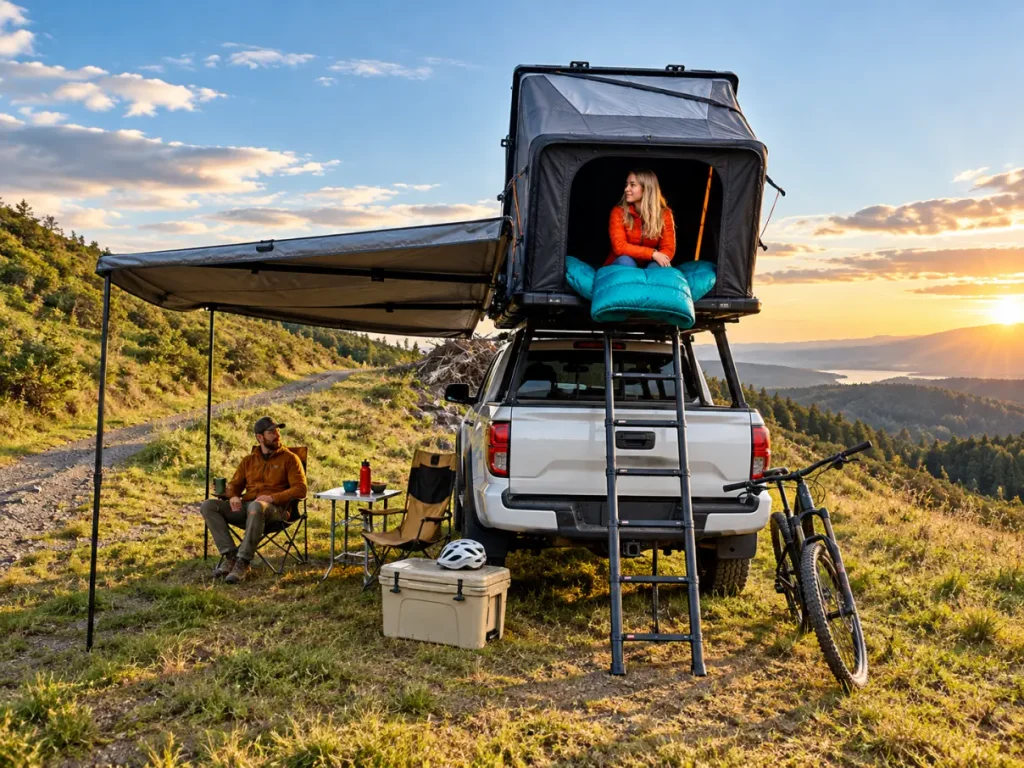
A car awning can turn the space beside your SUV, truck, or van into a comfortable place to cook, relax, and escape the afternoon sun. But the biggest awning isn’t necessarily the best one for your campsite.
For most weekend campers, a rectangular awning like the Yakima OverNOut 6.5′ offers the right balance of shade, manageable weight, and straightforward setup. If you want more coverage along your vehicle, the Yakima OverNOut 180 offers a useful middle ground. And if your camp kitchen is built around the rear hatch, a 270-degree awning can provide shelter where you need it most.
The real decision comes down to five things: vehicle size, roof rack compatibility, coverage, weight, and how often you’ll set up camp.
A lightweight awning that takes little effort to open may be more useful on a road trip than a massive wraparound shelter. On the other hand, campers who spend several nights in one place may appreciate the additional living space of a larger system.
Here are seven of the best car awnings for different camping setups, followed by the details worth checking before buying.
Best Car Awnings at a Glance
| Car Awning | Best For | Type | Coverage | Weight |
|---|---|---|---|---|
| Yakima OverNOut 6.5′ | Best Overall | Standard | 42 sq ft | 28.3 lbs |
| Yakima OverNOut 180 | Best 180° Coverage | 180° | 94 sq ft | 46 lbs |
| OVS HD Nomadic 270 | Best Large Basecamp Awning | 270° | Approx. 129 sq ft* | Model-dependent |
| OVS XD Nomadic 270 LTE | Best Lightweight 270° | 270° | 65 sq ft | 31 lbs |
| Roofnest Little Wing 270° | Best Premium Convenience | 270° | 71 sq ft | 48.5 lbs |
| ARB Touring Awning | Best Traditional Overlanding Awning | Standard | Varies by size | Varies by size |
| Thule OverCast | Best Compact Rack-Mounted Awning | Standard | Approx. 29 sq ft (4.5′ model) | 22 lbs |
Coverage figures are manufacturer specifications or approximate dimensions for the indicated versions. OVS offers several Nomadic 270 configurations, so confirm the exact variant before comparing size and weight.
Quick recommendation: Choose a standard awning if you mainly need shade for chairs or a small camp table. Consider a 180-degree model for wider side coverage, or a 270-degree awning if you regularly use both the side and rear of your vehicle.
1. Yakima OverNOut 6.5′ — Best Overall Car Awning
Best for: Weekend campers, road trippers, and SUV owners who want practical shade without complicated equipment.
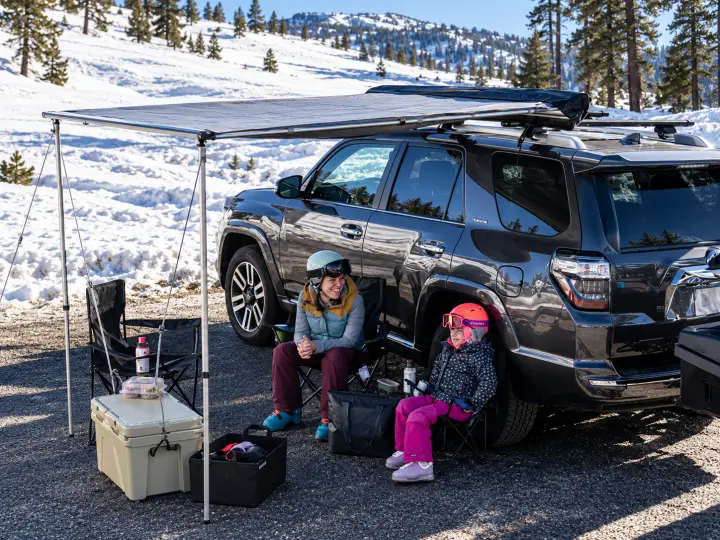
The Yakima OverNOut 6.5′ is a strong choice for campers who want to make the space beside their vehicle more useful without turning the roof rack into a permanent overlanding installation.
Its rectangular canopy extends 6.5 feet outward from the vehicle and provides approximately 42 square feet of overhead protection.
That’s enough room for a couple of camp chairs, a small table, or a compact cooking station.
The appeal is straightforward: it provides useful shelter while remaining relatively manageable to mount, deploy, and pack away.
Why It Works for Everyday Car Camping
The OverNOut uses 420D polyester fabric with a polyurethane coating to resist rain and provide shade.
Its support poles extend to hold the canopy in position, while the fabric rolls into a travel case mounted along the roof rack.
One particularly useful feature is its tool-free mounting system, designed to work with many compatible roof rack crossbars.
That makes it appealing if you don’t want the awning permanently installed throughout the year.
The 6.5-foot model weighs approximately 28.3 pounds and requires a minimum crossbar spread of 24 inches.
It’s also available in smaller and larger configurations, allowing you to match the canopy to your vehicle.
What to Consider
The OverNOut only shelters one side of the vehicle.
If your camp kitchen is arranged around the rear hatch, you’ll still need to step outside the covered area when accessing your cooler or storage drawers.
It also relies on support poles rather than a reinforced freestanding frame.
For many weekend campers, neither limitation is particularly serious.
A rectangular awning is easier to position at smaller campsites, and its simpler design avoids the extra weight and complexity of a large wraparound model.
Key specifications
- Type: Rectangular side awning
- Coverage: 42 sq ft
- Weight: 28.3 lbs
- Canopy dimensions: 6.5 x 6.5 ft
- Fabric: PU-coated 420D polyester
- Minimum crossbar spread: 24 inches
Choose the Yakima OverNOut 6.5′ if you want a practical shelter for cooking, sitting, and relaxing beside your vehicle without paying for coverage you may rarely use.
Check the Yakima OverNOut 6.5′ at Yakima
2. Yakima OverNOut 180 — Best 180° Car Awning
Best for: SUV and truck campers who want considerably more shade than a rectangular awning without committing to a full 270-degree setup.
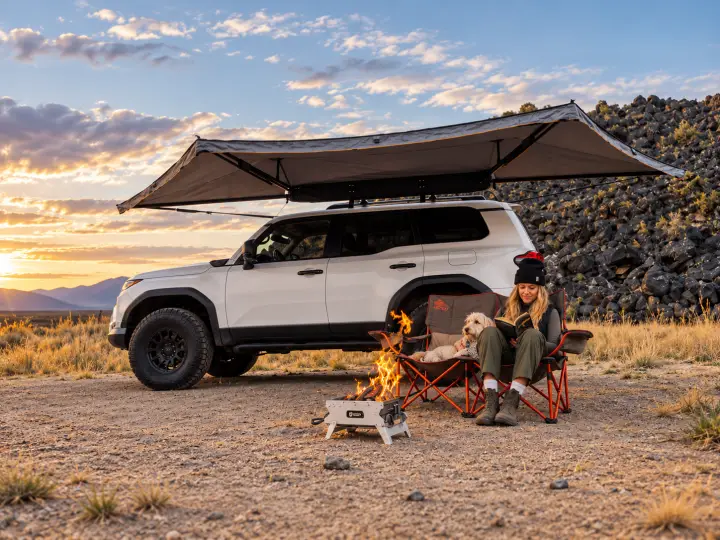
The Yakima OverNOut 180 occupies an interesting middle ground.
A standard awning projects outward from one side of your vehicle. A 270-degree awning usually wraps around the side and rear.
The OverNOut 180 opens into a broad, sweeping canopy that covers a much larger area alongside the vehicle.
With approximately 94 square feet of coverage, it provides more than twice the overhead area of the 6.5-foot rectangular OverNOut.
That additional space can make a meaningful difference if you want to fit several chairs, a cooking table, and other frequently used equipment beneath one shelter.
More Coverage Without a Full Wraparound Layout
The OverNOut 180 uses a freestanding frame supported by pivoting arms.
Its design allows the canopy to take shape without immediately installing vertical support poles, making the initial deployment more convenient.
Two support legs and guy lines are included for additional stability when conditions require them.
The fabric is 420D poly-cotton with a polyurethane coating and a specified 2,000 mm water resistance rating.
For campers who value broader shade but don’t need complete coverage around their tailgate, this design offers a useful compromise.
It can also be an attractive option for campsite layouts where a full 270-degree canopy would extend too far behind the vehicle.
The Main Tradeoff
At 46 pounds, the OverNOut 180 is noticeably heavier than the rectangular 6.5-foot model.
Its packed length is approximately 89 inches, so it needs substantial mounting space along the roof rack.
Yakima specifies a minimum crossbar spread of 26 inches and a maximum of 76 inches for this model.
It includes T-slot mounting brackets for compatible crossbars and platform systems.
Before buying, check both the mounting points and the direction in which the canopy opens.
A 180-degree awning may provide expansive side coverage, but it won’t necessarily create the same sheltered rear-kitchen layout as a 270-degree system.
Key specifications
- Type: 180-degree freestanding awning
- Coverage: 94 sq ft
- Weight: 46 lbs
- Packed length: 89 inches
- Fabric: PU-coated 420D poly-cotton
- Crossbar spread: 26–76 inches
Choose the Yakima OverNOut 180 if you want a larger shaded living area along the side of your SUV or truck without necessarily needing the full rear coverage of a 270-degree awning.
Check the Yakima OverNOut 180 at Yakima
3. Overland Vehicle Systems HD Nomadic 270 — Best Large Basecamp Awning
Best for: Overlanders, families, and campers who use their SUV or truck as the center of an outdoor kitchen and living area.
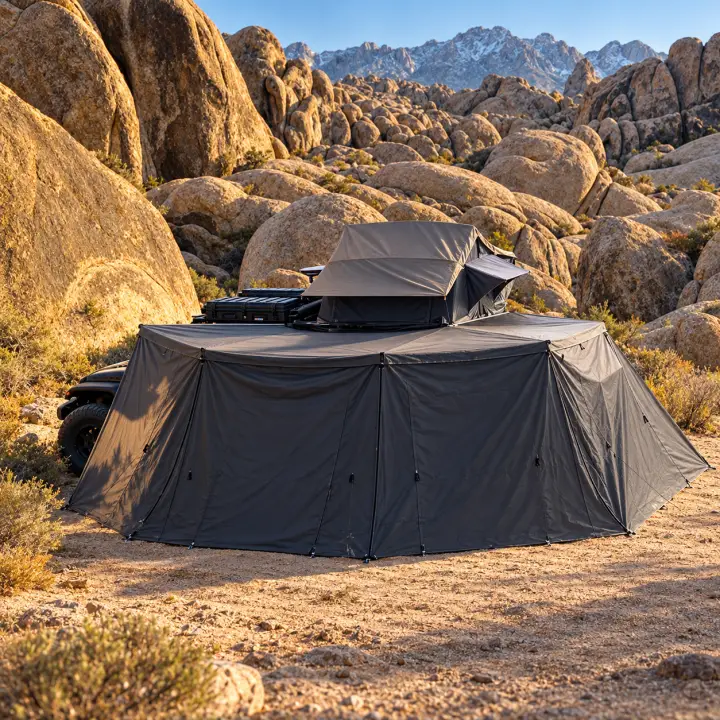
A large 270-degree awning becomes particularly useful when your campsite revolves around your vehicle.
The OVS HD Nomadic 270 is designed for that kind of setup.
Rather than extending straight out from one side, its canopy wraps around the side and rear, allowing you to create connected spaces for cooking, dining, and relaxing.
Full-size Nomadic 270 configurations offer substantially more shelter than conventional rectangular awnings.
That can be especially valuable if your camp kitchen is built around a tailgate, drawer system, or rear-mounted storage area.
Why the Wraparound Design Matters
Imagine setting up a folding kitchen table near your SUV’s rear hatch.
With a standard side awning, the table may be sheltered while your cooler and storage drawers remain exposed.
A 270-degree canopy can connect those areas.
You can access cooking supplies, prepare food, and move between the tailgate and seating area without leaving the same covered zone.
For campers who stay at one campsite for multiple nights, that extra space can make the entire setup more convenient.
The Nomadic range uses reinforced pivoting arms, coated ripstop fabric, and a freestanding deployment design, with support hardware available to stabilize the canopy.
What to Consider Before Installing One
The main drawback is size.
A large wraparound awning needs more rack support, more mounting room, and more unobstructed space around the vehicle.
That becomes particularly important when you already carry a rooftop tent or cargo box.
You’ll also need to choose the appropriate driver-side or passenger-side configuration.
The position of the rear hatch, kitchen drawers, and frequently used doors should influence that decision.
OVS offers multiple Nomadic 270 configurations, including lighter LTE models and larger systems. Their dimensions and construction differ, so compare the exact model rather than relying on specifications from another version.
A freestanding design also doesn’t eliminate the need for proper anchoring. Use the supplied legs, guy lines, and stakes according to the manufacturer’s instructions.
Choose the OVS HD Nomadic 270 if you regularly spend several nights at camp, want a generous sheltered living area, and have a roof rack designed to support the specific awning.
Skip it if you mainly take short weekend trips, have limited rack capacity, or usually camp in tight spaces.
Check the OVS HD Nomadic 270 at Overland Vehicle Systems
4. OVS XD Nomadic 270 LTE — Best Lightweight 270° Car Awning
Best for: Smaller SUVs, crossovers, and travelers who want wraparound shelter with less weight and bulk.
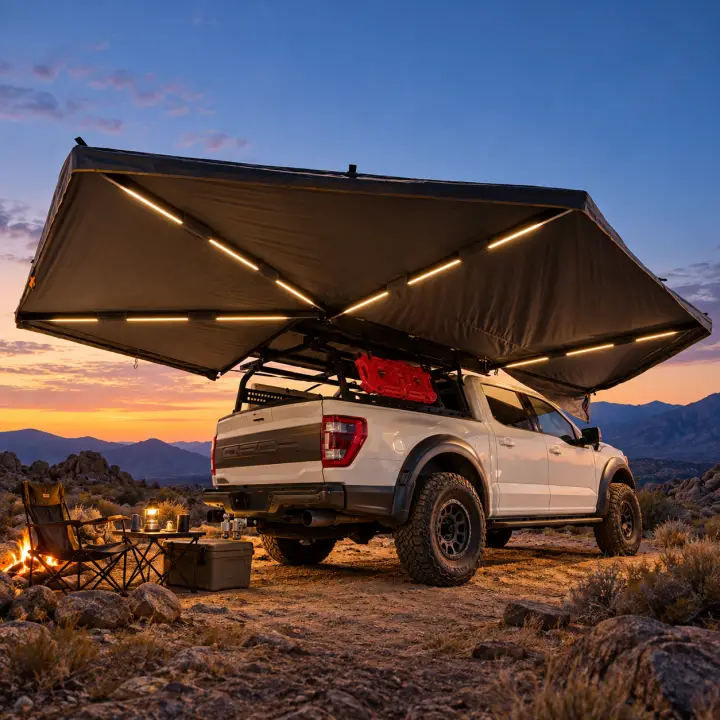
One of the biggest compromises with traditional 270-degree awnings is how much weight they add to the roof.
The OVS XD Nomadic 270 LTE offers a more compact alternative.
At approximately 31 pounds, it weighs considerably less than many large wraparound systems while still providing 65 square feet of coverage.
Its packed dimensions are approximately 69 x 5 x 5.5 inches.
Those numbers make it particularly interesting for campers who want useful side-and-rear coverage without dedicating most of their rack space to one accessory.
A Better Match for Smaller Campsites
The LTE’s smaller footprint can be an advantage rather than a compromise.
If you’re traveling with one other person, you may only need enough shelter for a couple of chairs and a compact cooking table.
In that situation, carrying a much larger awning may not improve your camping experience enough to justify the added weight.
The LTE still provides a wraparound layout, allowing you to position equipment along the side and near the rear of the vehicle.
It also offers a quick-deploying freestanding design, with anchoring equipment included for stabilization.
Where It Falls Short
The obvious tradeoff is coverage.
With 65 square feet of shelter, the LTE cannot accommodate the same large campsite arrangement as a full-size 270-degree awning.
If you’re camping with several people or want a full outdoor kitchen and dining area, you may appreciate a larger canopy.
Its lightweight construction also doesn’t mean it can be installed on any vehicle.
You still need compatible brackets, appropriate mounting points, and sufficient vehicle and roof rack capacity.
Key specifications
- Type: Compact 270-degree awning
- Coverage: 65 sq ft
- Weight: 31 lbs
- Packed dimensions: 69 x 5 x 5.5 inches
- Driver-side and passenger-side configurations available
- Freestanding deployment with anchoring hardware
Choose the OVS XD Nomadic 270 LTE if you want wraparound shade but prefer a lighter, more manageable system for a smaller vehicle or simple campsite.
Check the OVS XD Nomadic 270 LTE at Overland Vehicle Systems
5. Roofnest Little Wing 270° — Best Premium Car Awning for Convenience
Best for: Frequent campers who want a quick-deploying awning with protective hard-shell storage and integrated lighting.
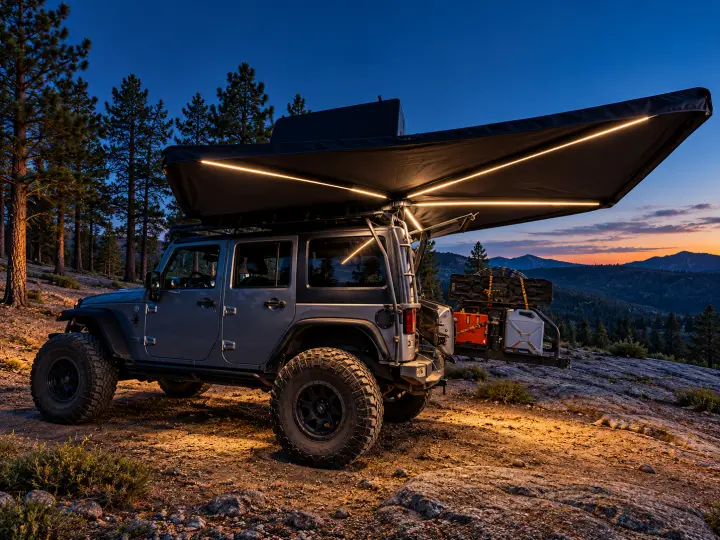
The Roofnest Little Wing 270° stands out because of how it’s stored and deployed.
Most traditional vehicle awnings roll into a long fabric travel cover. The Little Wing instead uses an ABS hard-shell case with latches.
That design eliminates the need to open and close a long zipper each time you set up camp.
For campers who stop frequently or deploy their awning during short breaks, that convenience can make the shelter more appealing to use.
A More Convenient Campsite Setup
The Little Wing provides approximately 71 square feet of wraparound coverage.
Its box-section aluminum support arms pivot on heavy-duty hinges, supporting the canopy as it opens around the vehicle.
The canopy uses coated polyester ripstop fabric, while the hard case protects the packed system during travel.
One of its most practical additions is integrated battery-powered LED lighting.
That means you can illuminate the sheltered area without immediately attaching a separate string of lights.
If you regularly prepare dinner after sunset or organize your gear in the evening, built-in lighting can help simplify camp setup.
Is the Premium Design Worth It?
The Little Wing’s convenience comes at a cost in both price and weight.
At approximately 48.5 pounds, it’s substantially heavier than the OVS XD Nomadic 270 LTE, even though their coverage areas are relatively close.
Its hard-shell case is also approximately 83 inches long.
Another important detail is the mounting system.
The standard kit requires a compatible center channel in the roof crossbars or rack platform.
If your rack doesn’t offer the necessary mounting arrangement, you’ll need to resolve that before installing the awning.
The Little Wing includes vertical support poles, guy lines, and stakes. These remain important for stability, even though the canopy is designed for convenient initial deployment.
Key specifications
- Type: 270-degree awning
- Coverage: 71 sq ft
- Weight: 48.5 lbs
- Case dimensions: 83 x 6 x 7 inches
- Storage: ABS hard-shell case
- Lighting: Integrated battery-powered LEDs
Choose the Roofnest Little Wing if you frequently deploy your awning and value a convenient storage system, integrated lighting, and a relatively compact wraparound canopy.
Skip it if minimizing roof weight or purchase cost is more important than premium convenience features.
Check the Roofnest Little Wing 270° at Roofnest
6. ARB Touring Awning — Best Traditional Overlanding Awning
Best for: Campers who want a straightforward canvas awning with multiple sizes for different SUVs, trucks, and overlanding setups.
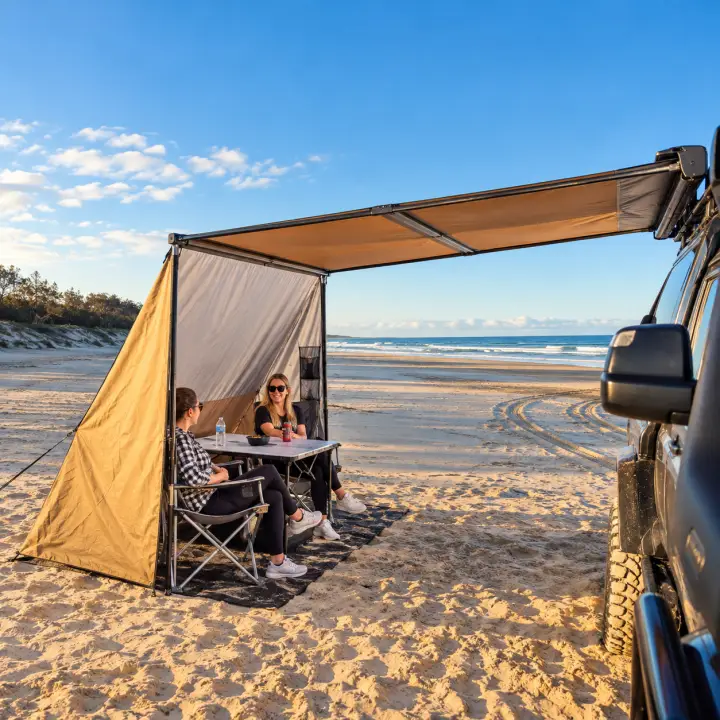
Not everyone needs a freestanding awning or a wraparound shelter.
For many campers, a conventional rectangular awning remains one of the easiest ways to create a functional outdoor space.
The ARB Touring Awning follows that approach.
Its traditional construction combines a poly-cotton canvas canopy, aluminum support poles, and a protective travel bag.
The design is familiar, functional, and well suited to vehicle-based camping.
Choose the Size That Matches Your Vehicle
One advantage of ARB’s traditional awning range is the variety of sizes.
A smaller configuration can work well for a compact campsite, while a larger canopy can provide enough room for chairs, kitchen equipment, and a table.
For example, the familiar 2.5 x 2.5-meter format offers approximately 67 square feet of nominal coverage.
That can be a useful size for a midsize or full-size SUV, provided the mounting system supports it.
However, a larger awning also occupies more roof space and creates a wider canopy that needs proper support.
The best size is one that fits your vehicle and protects the area you’ll actually use.
Why Choose Canvas?
The poly-cotton fabric gives the ARB Touring Awning a more traditional overlanding construction than many lightweight polyester shelters.
Coated canvas offers useful weather protection, but it also has practical maintenance requirements.
If you pack the awning while damp, open it again when you get home and allow it to dry thoroughly before storing it for an extended period.
Like other rectangular awnings, the ARB depends on correctly positioned poles and anchoring.
It won’t provide the same rear-hatch coverage as a 270-degree model, but that’s not necessarily a drawback if your cooking and seating areas sit beside the vehicle.
ARB offers several awning designs and configurations, so confirm the exact dimensions, fabric, hardware, and weight of the version you’re considering.
Choose the ARB Touring Awning if you prefer a conventional canvas shelter and want to select a canopy size that suits your existing overlanding setup.
Check ARB Touring Awning Sizes and Availability
7. Thule OverCast — Best Compact Car Awning for Thule Rack Systems
Best for: Compact SUV owners, casual car campers, and travelers who want a simple rectangular awning with flexible mounting options.
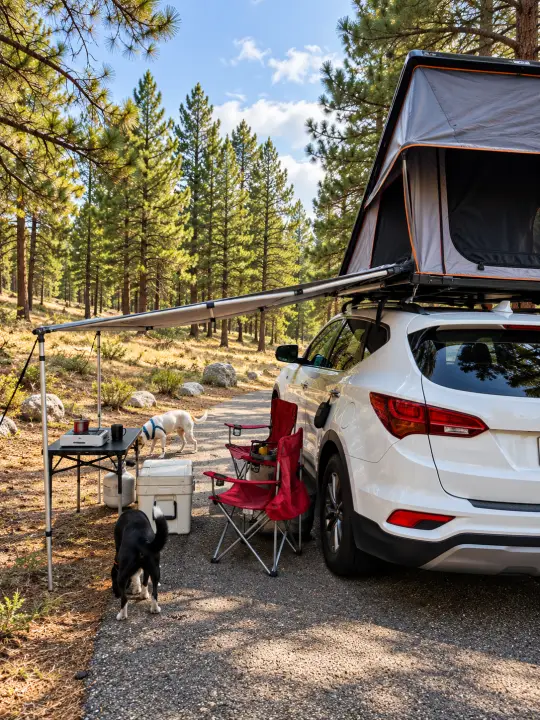
The Thule OverCast is a practical alternative for anyone who wants useful shade without a large or complicated structure.
Available in 4.5-foot and 6.5-foot widths, it projects approximately 6.5 feet outward from the vehicle.
The smaller version provides roughly 29 square feet of overhead coverage and weighs 22 pounds.
That makes it an attractive choice for solo travelers, couples, and campers who mainly need a shaded place for two chairs or a small table.
Straightforward Mounting and Setup
The OverCast includes hardware for compatible T-track and around-the-bar mounting methods.
That flexibility is particularly useful if you already own Thule roof rack components, although it can also work with other compatible aftermarket systems.
The canopy rolls into a protective soft travel cover.
Two height-adjustable support poles hold the awning open, and the included guy lines help stabilize it.
The mounting hardware also features locking covers.
These details make the OverCast a convenient option for campers who prefer simple, familiar equipment rather than a large freestanding system.
The Main Limitation
The smaller 4.5-foot model doesn’t offer much room for a large camp kitchen or several people.
It’s better suited to a compact seating area, short breaks, or simple weekend camping.
If you want to shelter more equipment, consider the wider 6.5-foot version.
The other limitation is familiar: because the OverCast is rectangular, it doesn’t extend around the vehicle’s rear hatch.
For campers who cook beside the passenger doors, that may not matter.
For those using a tailgate kitchen, a compact 270-degree awning could provide a more useful layout.
Key specifications — 4.5-foot model
- Type: Rectangular side awning
- Coverage: Approximately 29 sq ft
- Weight: 22 lbs
- Width: 4.5 ft
- Projection: 6.5 ft
- Mounting: Compatible T-track or around-the-bar systems
Choose the Thule OverCast if you want an uncomplicated awning for a smaller camping setup, especially if you already own compatible Thule roof rack equipment.
Check the Thule OverCast at Thule
Standard vs. 180° vs. 270° Car Awnings: Which Is Better?
The difference between awning styles isn’t just how much fabric extends from the vehicle.
It changes where you can sit, how you arrange your kitchen, and how much room you need to deploy the shelter.
| Awning Type | Best Use | Main Advantage | Main Drawback |
|---|---|---|---|
| Standard rectangular | Weekend car camping, short breaks | Simple setup and manageable size | Side coverage only |
| 180° | Larger seating or cooking areas alongside a vehicle | Wider shade footprint | Greater weight and mounting requirements |
| 270° | Overlanding, tailgate kitchens, extended camps | Connected side and rear shelter | More complicated fitment and a larger footprint |
When a Standard Awning Makes More Sense
A rectangular awning is often the most sensible choice if you spend much of your trip hiking, sightseeing, or exploring and only return to camp in the evening.
You can deploy it when you need shelter, then pack it away without handling a large frame.
It also makes sense when your campsite layout is simple.
Two chairs, a folding table, and a compact camp stove don’t necessarily require a sprawling canopy.
The Yakima OverNOut 6.5′ and Thule OverCast are particularly appealing for these situations.
When a 180° Awning Is Worth Considering
A 180-degree awning becomes more attractive when you want a broad shaded area alongside the vehicle.
It can provide room for seating and cooking equipment without necessarily wrapping around the entire rear.
This can be a useful arrangement for campers who prefer to keep the tailgate clear or who have campsite layouts that don’t accommodate a full wraparound canopy.
The Yakima OverNOut 180 is a good example of this approach.
Its 94-square-foot canopy offers considerably more coverage than a compact rectangular model.
However, that extra shade comes with greater weight, packed length, and mounting requirements.
When a 270° Awning Is the Better Choice
A 270-degree awning makes the most sense when the rear of your vehicle is an important part of your campsite.
Maybe your cooler sits inside the cargo area. Maybe you have a slide-out kitchen, storage drawers, or a tailgate table.
With a rectangular awning, you may need to walk between sheltered and exposed areas.
A wraparound canopy can connect those spaces.
The larger OVS Nomadic 270 works well for more elaborate vehicle-based camps, while the lighter OVS XD Nomadic 270 LTE offers a more compact alternative.
One detail worth remembering: a 270-degree designation doesn’t guarantee the same rear coverage on every model.
Canopy geometry, mounting position, and rear-hatch clearance can all differ.
Check the deployed dimensions and installation diagrams rather than assuming every 270-degree awning provides identical shelter.
Which Car Awning Fits Your Vehicle?
Vehicle size is a helpful starting point, but it doesn’t determine compatibility by itself.
Two SUVs of similar dimensions may have different roof load limits, crossbar spacing, and available mounting points.
Use the vehicle categories below to narrow your search, then verify your actual roof rack setup.
| Vehicle Type | Practical Starting Point | Main Fitment Concern |
|---|---|---|
| Small crossover | Compact standard or lightweight 270° awning | Roof load and rack length |
| Midsize SUV | Standard, 180°, or compact 270° | Crossbar spacing and rear-hatch clearance |
| Full-size SUV | Larger standard, 180°, or 270° | Combined roof equipment and mounting strength |
| Pickup truck | Standard or 270° awning | Bed rack height and mounting geometry |
| Camper van | Vehicle-compatible side awning | Sliding doors, roof accessories, and mounting height |
Small SUVs and Crossovers
Smaller vehicles benefit from an awning that doesn’t add unnecessary weight or extend too far beyond the available rack space.
A compact rectangular model is often the easiest place to start.
For example, the 4.5-foot Thule OverCast provides basic shade without the dimensions of a large overlanding awning.
If you want wraparound coverage, the OVS XD Nomadic 270 LTE is worth considering because of its relatively low weight.
But never assume a 31-pound awning will fit just because the vehicle is an SUV.
Bracket compatibility, rack strength, and mounting geometry still need to be checked.
Midsize SUVs
Midsize SUVs offer more flexibility.
A rectangular 6.5-foot awning often provides enough shelter for a typical weekend setup.
A 180-degree model may make sense if you frequently camp with several people and want a wider shaded area.
A compact 270-degree awning becomes particularly useful if the cargo area functions as your main kitchen.
Before installing a wraparound model, check how the rear hatch opens.
Some hatch designs can interfere with the canopy or support arms when the awning is mounted too low or too far toward the rear.
Full-Size SUVs and Trucks
Larger vehicles may offer enough mounting length for broader awnings, but vehicle size alone doesn’t guarantee that the rack can support them.
For overlanding setups with a compatible platform or bed rack, a large 270-degree awning can create a useful outdoor living area.
It’s especially valuable when multiple people share the campsite or when cooking equipment is stored around the rear of the vehicle.
However, the awning’s extended frame creates leverage on its mounting points.
The rack and brackets must be suitable for those forces, not simply capable of carrying the awning’s static weight.
Camper Vans
For camper vans, door clearance is often more important than maximum coverage.
A long canopy may interfere with a sliding door, roof-mounted accessories, or existing equipment.
Mounting height also affects how comfortably you can move beneath the shelter.
Many vans benefit from a dedicated vehicle-compatible awning system rather than a generic SUV roof rack awning.
Measure the available mounting space and check the manufacturer’s application guide before choosing a model.
Roof Rack Compatibility: What to Check Before Buying
This is the most important technical part of the decision.
A vehicle awning needs more than a strong-looking roof rack.
The mounting system must be compatible with the specific awning and capable of supporting it under the conditions permitted by the manufacturer.
1. Check Your Dynamic Roof Load Limit
Your vehicle’s dynamic roof load limit is the maximum roof load allowed while driving, subject to the manufacturer’s conditions.
That load includes the roof rack and everything attached to it.
For example, if a vehicle’s permitted dynamic roof load is 165 pounds and the rack itself weighs 45 pounds, only 120 pounds remain for attached equipment before accounting for any additional restrictions.
A 50-pound awning would use part of that allowance.
Other accessories, including rooftop tents, cargo boxes, recovery boards, and mounting hardware, must also be considered.
Do not exceed the lowest applicable limit from the vehicle, rack, or mounting system.
2. Verify Bracket Compatibility
Awnings may attach through several mounting systems, including:
- T-slot crossbars
- Around-the-bar brackets
- Platform rack channels
- Purpose-built side mounts
- Compatible truck bed rack brackets
Not every mounting kit works with every rack profile.
A Yakima rack and a Thule rack may both use T-slot channels, but that doesn’t guarantee compatibility with every accessory bracket.
Confirm the exact rack model, channel dimensions, attachment method, and awning manufacturer’s installation requirements.
3. Check Crossbar Spacing and Support
A long awning places loads across its mounting points.
Crossbars that are too close together may not provide the support required by a particular manufacturer.
Some models specify minimum and maximum mounting distances, while others recommend additional mounting brackets for heavier configurations.
The Yakima OverNOut 180, for example, specifies crossbar spacing between 26 and 76 inches.
For heavier awnings, follow the manufacturer’s bracket quantity and spacing requirements rather than choosing attachment points solely for convenience.
4. Measure Door and Hatch Clearance
An awning might fit the roof rack but still interfere with normal vehicle access.
Before installation, check:
- Whether the rear hatch can open fully
- Whether side doors have adequate clearance
- Whether the packed awning extends beyond the available mounting area
- Whether rooftop accessories obstruct the deployed frame
- Whether the mounting height provides usable standing room beneath the canopy
These measurements are particularly important for rear-opening 270-degree awnings.
It’s much easier to address a clearance issue before purchasing the equipment.
How Much Awning Coverage Do You Really Need?
Coverage figures are useful for comparing products, but they don’t tell the entire story.
A 100-square-foot canopy doesn’t always create 100 square feet of usable shade.
The sun’s angle changes throughout the day, and low-angle sunlight can reach beneath the canopy.
Rain can also blow underneath the edges, particularly when wind direction changes.
Instead of choosing the largest advertised coverage area, think about what needs to fit beneath the shelter.
For Solo Campers and Couples
A compact rectangular awning is usually enough for two chairs and a small table.
It keeps the setup manageable and leaves more roof rack space for other gear.
The Thule OverCast 4.5′ and Yakima OverNOut 6.5′ are good starting points.
For Campers With a Larger Kitchen Setup
If you regularly use a folding table, cooler, food storage boxes, and other cooking equipment, a wider canopy provides more flexibility.
A 180-degree awning can create room for separate cooking and seating areas.
A 270-degree model becomes especially useful when food and equipment are stored inside the vehicle’s rear cargo area.
For a more organized kitchen, see our guide to Best Camp Kitchen Boxes and Organizers for Car Camping.
For Families and Extended Camps
More people usually means more chairs, larger tables, and additional gear.
A larger 270-degree awning can create a central gathering area without requiring a separate pop-up shelter.
However, consider how often you’ll move camp.
A large canopy may be worthwhile for a three-night stay but less appealing when packing everything up each morning.
Freestanding vs. Pole-Supported Awnings
The term freestanding can make a vehicle awning sound almost effortless.
In practice, it’s important to understand what that feature means.
A freestanding awning uses a reinforced frame that can hold the canopy open without immediately installing vertical support poles.
This makes initial deployment more convenient.
It’s particularly useful for campers who stop frequently or need shade for short periods.
But there is a critical distinction:
Freestanding does not mean the awning can safely remain open in strong wind without support.
The canopy still creates a large surface that can catch wind and transfer substantial forces to the arms, hinges, mounting brackets, and roof rack.
Manufacturers provide different instructions for anchoring, support poles, and weather limitations.
Follow the requirements for your exact model.
| Setup Feature | Rectangular Pole-Supported | Freestanding 180° or 270° |
|---|---|---|
| Initial deployment | Unroll canopy and position poles | Open and position pivoting arms |
| Support legs | Normally essential | May be optional for initial deployment in permitted conditions |
| Setup complexity | Simple, but involves more pole handling | Convenient once installed; larger frame to manage |
| Mounting demands | Often lower, depending on model | Can be substantially higher |
| Best for | Simple weekend setups | Frequent deployment and broader shelter |
There’s another useful distinction: installation time and campsite setup time aren’t the same thing.
An awning that opens quickly may still require considerable work to install onto the vehicle initially.
For heavy models, mounting brackets, alignment, and tightening hardware can be the more difficult part of ownership.
If you rarely remove your awning from the rack, deployment convenience may be the deciding factor.
If you plan to remove it regularly, weight and attachment design matter just as much.
Weather Protection: Rain, Wind, and Sun
A vehicle awning should make outdoor conditions more comfortable, but it shouldn’t be treated like a permanent weatherproof structure.
Sun Protection
A coated canopy can provide useful shade during hot days.
However, the amount of shade depends on canopy dimensions, mounting height, and the sun’s position.
A larger awning may be helpful during midday, while optional sidewalls can improve protection when the sun is low.
For hot-weather camping, consider where you’ll place chairs and cooking equipment throughout the day rather than assuming the canopy will shade the same area continuously.
Rain Protection
Many car awnings use waterproof or water-resistant coated fabrics.
The fabric may shed rain effectively, but water can still enter from the sides or collect on sections of the canopy.
When the design allows, adjust the shelter to encourage drainage.
Avoid configurations that allow water to pool, because accumulated water places additional strain on the frame and mounting hardware.
For extended wet-weather camping, compatible sidewalls may improve comfort, but they also add packed weight and can increase wind loads.
Wind Protection
Wind is one of the biggest limitations of vehicle awnings.
Even a relatively lightweight canopy presents a large surface for gusts to catch.
A sturdy frame doesn’t eliminate this risk.
Use support poles, guy lines, and stakes as required, and retract the awning when conditions exceed the manufacturer’s limits.
Never assume that a freestanding model is safe in any wind simply because it can remain open without vertical poles during calm conditions.
Cooking Under a Car Awning
A sheltered camp kitchen is convenient, but heat and ventilation require attention.
Keep stoves and grills at the clearances required by their manufacturers. Avoid allowing flames or heat to contact the canopy or other combustible materials.
Fuel-burning cooking appliances should never be operated inside an enclosed awning room or another inadequately ventilated space.
The awning should provide shade and overhead shelter without creating unsafe conditions around your cooking equipment.
Is a Car Awning Worth It?
A car awning makes the most sense when you regularly spend time beside your vehicle.
For example, it can be valuable if you often:
- Cook at a tailgate or folding camp table.
- Relax outside your SUV during warm afternoons.
- Camp in locations with limited natural shade.
- Spend several nights at the same campsite.
- Want a more organized outdoor living area.
For campers who mostly arrive late, sleep in a tent, and leave early the next morning, an awning may be less important.
It adds weight, occupies roof rack space, and requires some setup and maintenance.
A freestanding tarp or compact portable shelter might be more versatile if you don’t always park next to your campsite.
The key question isn’t whether a car awning makes camping better in general.
It’s whether you spend enough time around your vehicle to benefit from having shelter permanently available there.
Frequently Asked Questions
Can you install a car awning on factory roof racks?
Sometimes. Certain lightweight awnings can be installed on compatible factory crossbars, but compatibility depends on the vehicle’s roof load rating, rack construction, attachment method, and awning manufacturer’s requirements.
Never assume that factory crossbars are suitable for a heavy 180-degree or 270-degree awning without confirming their limitations.
What is the best car awning for a small SUV?
For a smaller SUV, a compact rectangular model such as the Thule OverCast 4.5′ is a practical starting point.
If you want wraparound coverage, the OVS XD Nomadic 270 LTE is worth considering because of its comparatively low weight.
The correct choice still depends on your vehicle’s roof capacity and mounting arrangement.
Is a 270-degree awning better than a standard awning?
A 270-degree awning provides more connected coverage around the side and rear of a vehicle, making it useful for tailgate kitchens and larger campsites.
A standard rectangular awning is generally simpler and may be more convenient for weekend trips or smaller vehicles.
Neither design is automatically better.
Can you use a car awning with a rooftop tent?
Yes, provided the roof rack and mounting system support both accessories.
You’ll need to consider their combined weight, attachment points, available rack space, and clearance when opening the rooftop tent or extending its ladder.
Some awning brackets are specifically designed to work around rooftop tent installations.
How do you keep a car awning from blowing away?
Install the awning using the correct mounting hardware, deploy the required support legs, and secure the canopy with appropriate guy lines and stakes.
Follow the manufacturer’s weather limits and retract the awning if wind conditions become unsafe.
Anchoring is important, but it doesn’t make the shelter suitable for every weather condition.
Can you leave a car awning up overnight?
Only when the manufacturer’s instructions and expected weather conditions permit it.
Wind and rain can change unexpectedly overnight, particularly in exposed areas.
If strong winds or storms are possible, retracting the canopy is usually the safer option.
Do car awnings need to be dried before storage?
Yes. If you pack an awning while damp, open it again when possible and let the fabric, seams, and cover dry thoroughly.
Extended damp storage can contribute to mildew, odors, and premature material deterioration.
This is particularly important for poly-cotton and canvas awnings.
Final Verdict: Which Car Awning Should You Buy?
For most weekend campers, the Yakima OverNOut 6.5′ is the most balanced choice. It provides useful shade, straightforward mounting, and enough coverage for a simple campsite without requiring a large roof rack installation.
If you want more space alongside your vehicle, the Yakima OverNOut 180 offers a meaningful increase in coverage without committing to a full wraparound layout.
For a dedicated overlanding basecamp, the OVS HD Nomadic 270 is worth considering when you have a suitable rack and regularly use your rear hatch as part of the campsite.
The OVS XD Nomadic 270 LTE makes more sense when you want the benefits of a wraparound canopy in a lighter, more compact package.
And if convenient deployment, hard-shell storage, and built-in lighting are priorities, the Roofnest Little Wing 270° offers an appealing premium alternative.
Before making your final choice, confirm the awning’s mounting requirements, roof rack capacity, packed dimensions, and clearance around your vehicle.
The best car awning isn’t the one with the most coverage. It’s the one that gives you enough shelter for the way you actually camp—and is easy enough to use that you’ll open it whenever you need it.
Affiliate Disclosure: GearForTheOutdoors.com participates in affiliate programs, including REI, Amazon, REI Outlet, Garage Grown Gear, evo, and other trusted partners. When you purchase through our links, we may earn a small commission at no extra cost to you. That helps support our content and keeps our recommendations useful, practical, and free.
Disclaimer: This post is for informational purposes only. Always verify current product details, fit, compatibility, availability, safety information, and manufacturer instructions before purchase or use. Outdoor conditions and gear performance can vary depending on setup, weather, terrain, vehicle, and experience level.