Wondering how to keep camping gear from sliding in an SUV? From heavy coolers shifting during sharp turns to storage bins rattling on rough roads, loose equipment can quickly turn an organized cargo area into a mess.
If you’ve packed an SUV for a camping trip, you probably know how quickly a neatly organized cargo area can turn into a mess.
The problem isn’t just annoying noise. Loose camping equipment can damage your vehicle, crush smaller supplies, and become dangerous during sudden braking.
The best way to keep camping gear from sliding around in an SUV is to combine a non-slip cargo surface, organized storage containers, and properly secured tie-down straps.
A rubber cargo mat helps reduce everyday movement. Storage bins keep loose equipment contained. Cam straps secure heavier items, while cargo nets can help manage lighter, bulky gear.
You don’t need an expensive drawer system or a complete vehicle conversion. A few well-chosen accessories and a smarter packing layout can make your cargo area quieter, easier to use, and more secure.
Here’s how to choose the right solutions for your SUV and the equipment you actually carry.
What Works Best to Keep Camping Gear From Sliding?
Different types of camping equipment require different solutions. A loaded cooler needs more secure restraint than a sleeping bag, while loose kitchen accessories are easier to manage inside an organizer.
The simplest approach is to match each problem with the right type of equipment.
| Solution | Best For | Main Limitation |
|---|---|---|
| Non-slip cargo mat | Reducing everyday sliding and rattling | Doesn’t secure heavy equipment |
| Trunk organizer | Keeping smaller accessories contained | Limited support for heavy items |
| Modular storage bins | Organizing kitchen gear, tools, and supplies | Bins can still slide or tip |
| Cam buckle straps | Securing coolers, water jugs, and heavier equipment | Requires suitable cargo anchors |
| Cargo net | Containing lightweight, bulky camping gear | Many aren’t rated for heavy loads |
For most SUV campers, start with a cargo mat, a couple of storage bins, and properly rated cam straps. Add a trunk organizer or cargo net when your packing setup actually needs one.
The key is understanding the difference between reducing minor movement and securing cargo against sudden vehicle movements.
A rubber mat might keep a plastic bin from rattling during normal driving, but it won’t necessarily prevent that same bin from moving during hard braking.
That’s why a combination of solutions works better than relying on a single accessory.
1. Use a Non-Slip Cargo Mat to Reduce Sliding
The first place to look is underneath your equipment.
Many SUVs have carpeted cargo floors that offer limited grip for smooth plastic storage bins, coolers, and other hard-sided containers.
A textured cargo liner or rubber mat creates a more stable surface while protecting your vehicle from dirt, moisture, and spills.
Best option: WeatherTech CargoLiner
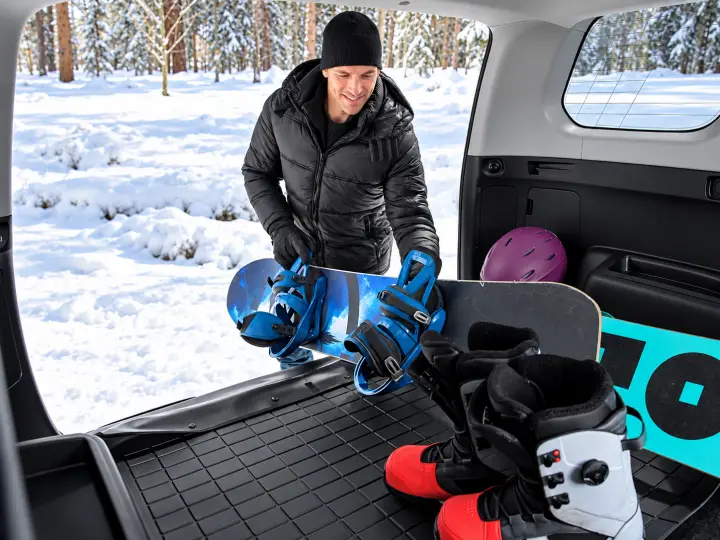
The WeatherTech CargoLiner is a practical option for campers who want a vehicle-specific cargo surface rather than a loose universal mat.
Its molded design follows the shape of compatible SUV cargo areas, while the textured surface helps reduce movement during ordinary driving.
Raised edges also help contain moisture from muddy boots, damp tents, or a leaking cooler.
Why it works well for camping:
- Vehicle-specific fit reduces exposed carpet and awkward gaps.
- Textured surface helps limit minor sliding.
- Raised edges make post-trip cleanup easier.
- Removable construction allows you to clean the liner outside the vehicle.
The main consideration is compatibility. You’ll need to choose a version designed for your exact SUV, model year, and seating configuration.
Also, a textured CargoLiner isn’t a substitute for securing heavier items with straps.
Best for: SUV owners who camp regularly and want better floor protection along with reduced sliding.
Consider a universal rubber mat instead if: You camp occasionally, have a limited budget, or need something transferable between vehicles.
Check WeatherTech CargoLiner options
Is a universal rubber mat enough?
For occasional car camping, it often makes sense to start with a basic rubber cargo mat instead of a more expensive fitted liner.
Look for a textured, durable surface that lies flat and covers the main cargo floor without obstructing tie-down points.
Trim-to-fit mats can be convenient, but a poorly fitted mat may curl at the edges or move around with the equipment placed on top.
If you already have a good all-weather cargo liner, there’s no reason to replace it just for camping. Focus your budget on securing the items that actually move.
2. Choose Storage Bins That Fit Your SUV
Loose cooking equipment, tent accessories, lanterns, and food supplies are difficult to keep organized when they’re scattered throughout the cargo area.
Grouping them into storage bins makes packing easier and gives you fewer individual items to manage.
However, not every camping storage box is a good fit for an SUV.
The most useful bins are sturdy enough for their contents, easy to carry, and sized to fit your vehicle without wasting valuable floor space.
Best for organized camping equipment: Gregory Alpaca Gear Boxes
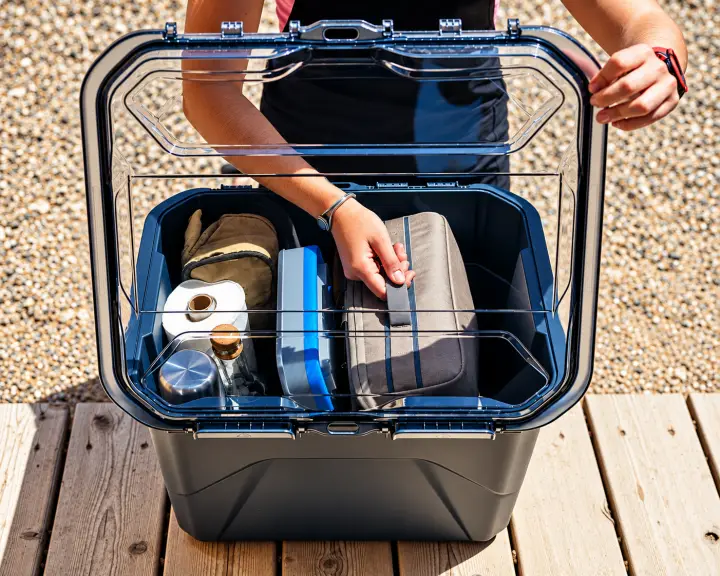
Gregory Alpaca Gear Boxes are worth considering if you want rigid containers designed around outdoor equipment rather than ordinary household storage.
The Alpaca Gear Box 25 offers a compact option for smaller accessories, while the 50 L Alpaca Camp Box provides more room for bulkier camping supplies.
Their rigid construction makes them useful for separating items such as cooking equipment, camp tools, and miscellaneous accessories.
The practical advantage isn’t simply durability. It’s having consistent containers that are easier to arrange, unpack, and carry between your vehicle and campsite.
A couple of appropriately sized boxes can be more useful than one enormous container that becomes awkward to lift when fully loaded.
Best for: Campers who want structured, reusable storage for equipment that needs protection.
Main limitation: Rigid boxes still need suitable restraints when transported. Their sturdy construction doesn’t prevent them from sliding during sudden braking.
Check Gregory Alpaca Gear Boxes at REI.
A softer alternative: REI Co-op Trailgate Gear Bin
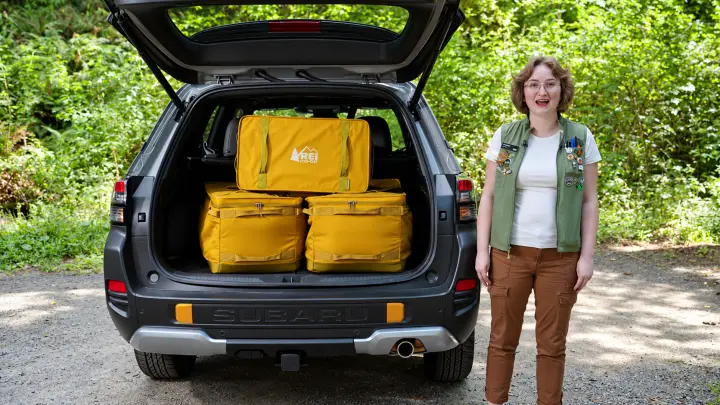
Not everyone needs hard-sided storage boxes.
The REI Co-op Trailgate Gear Bin is a useful alternative for campers who prefer a flexible, collapsible storage system.
Available in multiple capacities, it can accommodate larger items such as sleeping bags, tents, and other bulky equipment. Its compatible organizational cubes can help separate smaller supplies.
The soft-sided construction also makes it easier to store the bin when it’s not being used.
The tradeoff is protection. A collapsible gear bin isn’t the best choice for equipment that needs a rigid shell or for supporting heavy stacked loads.
And like a rigid container, it still needs to be properly secured inside the vehicle.
Best for: Bulky camping supplies, removable camp storage, and campers who want containers that can be packed away between trips.
See the REI Co-op Trailgate Gear Bin.
How many storage bins should you use?
More bins don’t necessarily mean better organization.
For a simple weekend trip, two or three medium-sized containers may be sufficient:
- One for camp kitchen equipment.
- One for shelter accessories and general supplies.
- One for smaller miscellaneous items, if needed.
Keeping categories separate makes it easier to find equipment without unpacking the entire vehicle.
Before purchasing bins, measure your SUV’s usable cargo floor, especially the space between the wheel wells and the depth behind the rear seats.
Also check the height of your cargo cover and the clearance needed to open the tailgate.
A useful rule: Choose bins based on what needs to fit inside them and how they’ll fit together in the vehicle—not simply on the largest advertised storage capacity.
3. Use a Trunk Organizer for Smaller Camping Essentials
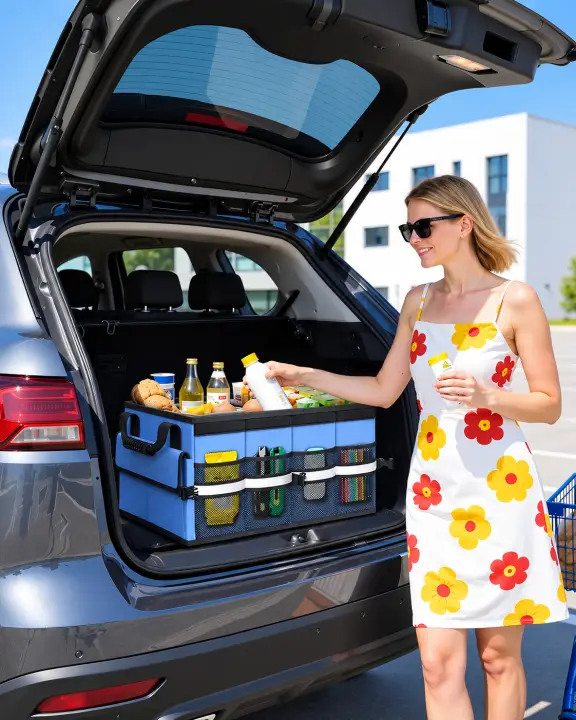
A trunk organizer serves a different purpose from a storage bin.
Instead of protecting bulky gear, it provides easy access to the smaller things you might need throughout a trip.
Think headlamps, sunscreen, first-aid supplies, dog accessories, charging cables, and other items that often disappear beneath larger equipment.
A collapsible organizer with separate compartments can keep these supplies together without requiring you to open several storage boxes.
What makes a good SUV trunk organizer?
Look for:
- A reinforced bottom: Helps the organizer maintain its shape.
- Sturdy dividers: Keeps smaller items separated.
- Attachment straps: Allows the organizer to be restrained where compatible attachment points are available.
- Practical dimensions: Fits your available cargo space without blocking access to larger gear.
- Collapsible construction: Makes it easier to remove and store when the SUV isn’t packed for camping.
Some organizers use hook-and-loop strips underneath to grip carpeted cargo floors. That feature may be less effective on rubber liners, so don’t assume it will work with every SUV.
For camping, an organizer that can be attached appropriately is generally more versatile than one that relies entirely on friction.
When a trunk organizer isn’t enough
A soft-sided organizer isn’t the right solution for a loaded cooler, heavy tools, a large water jug, or a portable power station.
Those items need appropriate cargo restraints, not just compartments.
If your main problem is small accessories rolling around, a trunk organizer may solve it immediately. If heavy equipment shifts when you brake, move on to straps.
Our guide to the best trunk organizers for car camping gear covers more options for different storage needs.
4. Use Cam Straps to Secure Heavy Coolers and Equipment
If there’s one accessory that deserves particular attention in a camping SUV, it’s a reliable cargo tie-down system.
Heavy equipment is where sliding becomes more than an inconvenience.
A loaded cooler, large water container, or portable power station can move with considerable force during sudden braking.
Even if the cargo floor has a textured liner, friction alone may not keep these items in place.
For heavy camping equipment, use suitable, appropriately rated restraints attached to vehicle-approved cargo anchor points.
Best option to consider: NRS 1″ HD Tie-Down Straps
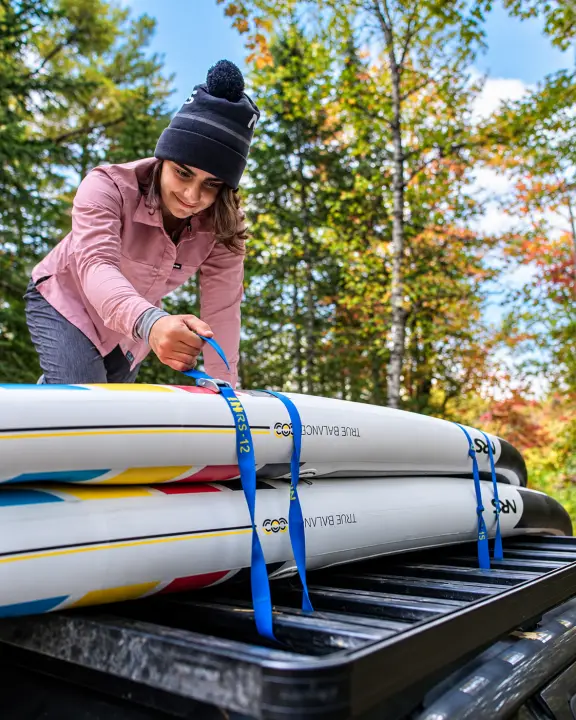
NRS 1″ HD Tie-Down Straps are a practical option for campers looking for straightforward cam buckle straps.
They use polypropylene webbing and a metal cam buckle that allows controlled tension without the mechanical leverage of a ratchet.
The 1-inch HD model has a specified working load limit of 500 pounds.
That rating applies to the strap itself, not automatically to your SUV’s cargo anchors or every possible tie-down arrangement.
The actual capability of a cargo restraint system depends on its weakest component, attachment geometry, equipment being secured, and the manufacturer’s instructions.
Why consider them:
- Simple cam buckle adjustment.
- Available in different lengths.
- Polypropylene webbing that resists stretching when wet.
- Convenient for repeatedly securing and removing camping equipment.
For everyday car camping, a suitable cam strap can be easier to manage than a ratchet strap, particularly around containers that could be damaged by excessive tension.
Best for: Securing compatible coolers, storage containers, and other equipment using approved tie-down configurations.
Main limitation: Straps need suitable attachment points, proper routing, and a load within the complete restraint system’s capacity.
Check NRS 1″ HD Tie-Down Straps at REI.
How to keep a cooler from sliding in your SUV
Start by placing the cooler low in the cargo area where it can sit flat and stable.
Next, check your vehicle’s owner’s manual to identify approved cargo tie-down points and any applicable limitations.
Use appropriately rated straps and follow the strap and cooler manufacturers’ instructions for safe attachment. Not every cooler handle or molded accessory is designed to withstand restraint forces.
Arrange the straps so they prevent the cooler from moving forward, backward, sideways, or tipping.
A single strap may not control movement in every direction, so use a suitable configuration for the load.
Tension the straps until the cooler is securely restrained without deforming the cooler body or overstressing the attachment points.
Before driving, check the cooler for movement and inspect the restraint system.
If the cooler still shifts, don’t simply pull one strap tighter. Reevaluate the strap routing, the attachment points, and whether the cooler needs additional restraint.
What about ratchet straps and bungee cords?
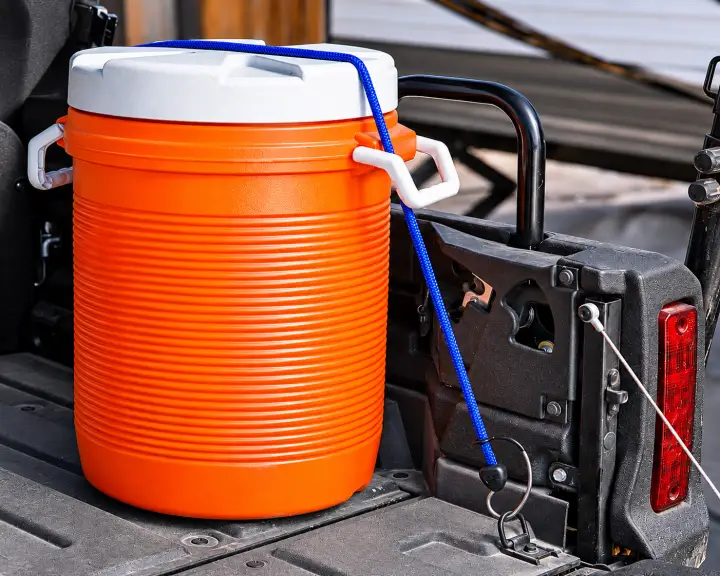
Ratchet straps can be useful for properly rated cargo applications, but their mechanical advantage makes it easier to apply excessive tension.
That can be a problem with plastic coolers or storage boxes.
Bungee cords are a different story. Their elasticity can be helpful for organizing lightweight items, but they aren’t suitable as the sole restraint for heavy camping equipment.
For many removable camping setups, appropriately rated cam straps offer a useful balance of simplicity and control.
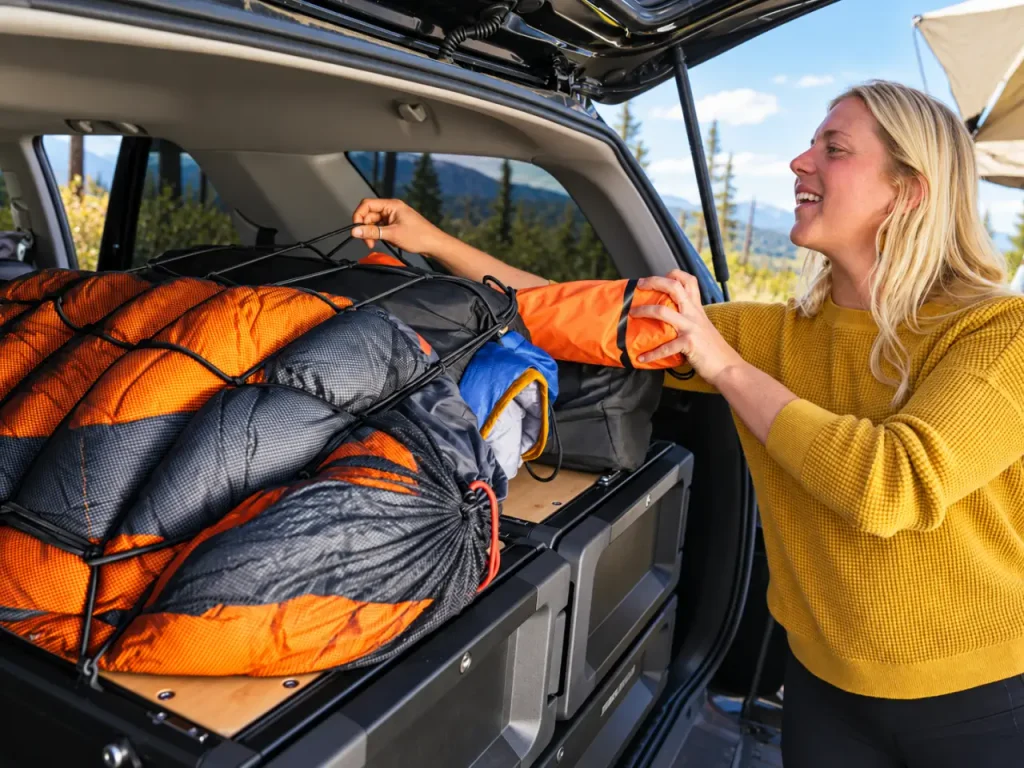
5. Use Cargo Nets for Lightweight, Bulky Gear
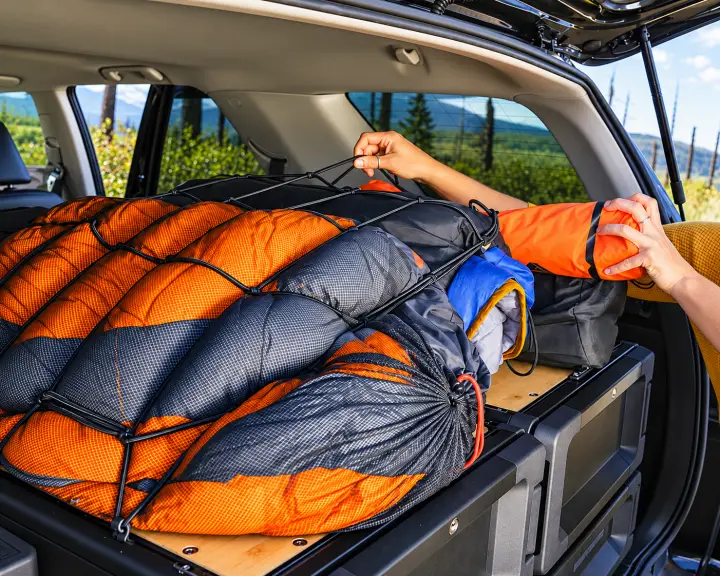
Cargo nets are convenient when your SUV carries equipment that doesn’t pack neatly into rigid boxes.
Sleeping bags, jackets, lightweight duffels, and other soft items can occupy awkward spaces and shift during normal driving.
A suitable cargo net helps keep these items contained.
But choosing the right type matters.
Floor-mounted cargo nets
A floor-mounted net stretches over equipment and connects to approved cargo-area attachment points.
It’s useful for managing lighter, bulky gear that would otherwise shift or pile up.
Choose a net designed for your vehicle or intended cargo application, and check its attachment hardware and any stated load limits.
Avoid assuming that an ordinary elastic net can safely restrain heavy storage boxes.
Vertical trunk nets
Vertical nets are typically positioned toward the rear of the cargo area.
They’re useful for keeping smaller items from moving toward the tailgate or falling out when you open the hatch.
For example, a vertical net might be convenient for jackets, small travel bags, or miscellaneous supplies.
However, an organizer net isn’t a substitute for a rated tie-down system.
When a cargo barrier makes more sense
If you routinely fill the back of your SUV with camping equipment, a vehicle-compatible cargo barrier may be worth considering.
A properly designed and installed barrier can provide additional separation between passengers and cargo.
Its protective capability depends on the barrier’s design, installation, ratings, and compatibility with the vehicle.
For a lightly packed weekend trip, a large barrier may be unnecessary. For frequent trips with substantial cargo, it can be worth evaluating.
Explore SUV cargo nets and organizers.
6. Pack Your SUV to Prevent Gear From Shifting
The best organizers won’t solve every problem if your cargo layout works against you.
A few changes in how you position equipment can make the vehicle easier to pack and reduce unnecessary movement.
Keep heavy equipment low
Coolers, water containers, power stations, and heavy storage boxes should generally be positioned low, following your vehicle manufacturer’s loading recommendations.
Avoid placing heavy containers on top of lighter bins or building tall stacks that could topple.
Also pay attention to the vehicle’s payload limit. Passengers, luggage, water, camping supplies, and accessories all contribute to the total load.
Put equipment near the right part of the vehicle
The heaviest cargo should be positioned according to your SUV’s loading instructions and secured against movement.
For lighter equipment, choose locations that make sense for how you’ll use it at camp.
Camp chairs and sleeping bags can be grouped together, while smaller essentials can stay in an organizer close to the rear hatch.
Don’t depend on the rear seatback alone to restrain heavy unsecured objects.
Use soft gear to reduce rattling
Once larger items are properly secured, smaller gaps between containers can create annoying noise on rough roads.
Soft items such as jackets, blankets, or padded bags can help prevent hard surfaces from knocking against each other.
For example, wrapping a metal camp stove or cookware in an appropriate padded bag can reduce rattling inside its storage box.
This is a useful finishing touch, not a replacement for cargo restraints.
Keep essential items accessible
A well-packed SUV shouldn’t require a complete unload every time you need something.
Consider keeping a small collection of frequently used items near an accessible area:
- Headlamps and flashlights.
- Rain jackets.
- First-aid supplies.
- Dog leashes and accessories.
- Small snacks and travel essentials.
Secure these items appropriately and avoid placing them where they could spill out when the hatch opens.
7. Two Simple SUV Camping Storage Setups
You don’t need the same organization system for a two-person weekend trip and a fully loaded family camping vacation.
The most efficient setup is one that matches your equipment and the space available.
The weekend camper setup
Best for: One or two people camping for a few nights.
Start with a fitted cargo liner or non-slip mat.
Use two medium-sized storage bins: one for kitchen equipment and another for general camping supplies.
Place the cooler low in the cargo area and secure it with an appropriate tie-down system.
Keep sleeping bags and clothing in soft bags, and add a small organizer only if you regularly carry enough loose accessories to justify one.
This arrangement keeps equipment easy to load and remove without requiring permanent modifications.
It’s also a practical option if you use your SUV for commuting or everyday family transportation between camping trips.
The family camping setup
Best for: Larger loads with several people sharing equipment.
Start by grouping supplies into separate storage categories.
Use appropriately sized bins for camp kitchen equipment, shelter accessories, dry food, and miscellaneous camping supplies.
Position heavier containers low and secure them appropriately. Keep lightweight equipment in soft storage bags or under a suitable cargo net.
Use a small trunk organizer for frequently needed accessories rather than burying them inside the larger boxes.
If the load extends above the rear seatback, consider whether an appropriate, vehicle-compatible cargo barrier or other restraint system is needed.
For families, this approach makes a major difference when unloading at the campsite. Instead of searching through mixed bags, each container has a specific purpose.
If cooking gear is taking up too much space, our guide to the best camp kitchen boxes and organizers can help you build a more manageable system.
How to Fix Common SUV Cargo Problems
Sometimes the best solution is easier to understand when you start with what’s actually going wrong.
My cooler still slides on a rubber cargo mat
The mat isn’t providing enough restraint for the cooler’s weight and the forces involved.
Use appropriately rated straps and approved cargo anchors rather than adding another layer of non-slip material.
Also check that the cooler sits flat and that its restraint arrangement prevents movement in multiple directions.
My storage bins slide forward when I brake
First, make sure the bins are positioned low and that their lids are secure.
Then use appropriate cargo restraints to prevent them from moving toward the passenger compartment.
A cargo net may help contain certain lightweight items, but don’t rely on a basic elastic organizer net for heavy, fully loaded bins.
My SUV doesn’t have useful tie-down points
Check the vehicle owner’s manual before adding accessories.
Some SUVs have factory attachment points that are easy to overlook. Others have hooks intended only for shopping bags or lightweight convenience items.
Don’t assume every hook is suitable for securing heavy equipment.
If your vehicle lacks suitable anchors, look into manufacturer-approved cargo management accessories or a compatible restraint system.
Avoid drilling new attachment points into the vehicle without an approved installation method.
My camping equipment rattles even when the bins are secure
The noise may be coming from loose items inside the containers.
Separate metal utensils, tent stakes, cookware, and other hard objects with padded bags or small dividers.
Make sure lids close securely and that equipment can’t repeatedly strike the sides of its container.
My cargo area is too small for several storage bins
Instead of buying larger containers, rethink how your equipment is divided.
Use fewer rigid boxes for items needing protection and softer bags for clothing, sleeping equipment, and other compressible supplies.
Consider using a smaller trunk organizer for loose accessories rather than another full-sized storage bin.
The goal isn’t to fill every inch of space. It’s to use the space efficiently while keeping the load properly restrained.
Common Mistakes That Make Camping Gear Slide Around
A few packing habits can undermine an otherwise good cargo setup.
Relying entirely on a non-slip mat. Rubber liners help with minor movement, but heavy equipment still needs proper restraint.
Using oversized bins. Large boxes are tempting, but they become difficult to lift, organize, and secure when overloaded.
Stacking heavy containers high. Tall, unstable stacks create unnecessary movement and can increase risk during sudden braking.
Using ordinary bungee cords for heavy cargo. Elastic cords aren’t an appropriate substitute for rated cargo restraints.
Attaching straps to random hooks. Convenience hooks, plastic trim, and unsuitable hardware may not be designed for cargo restraint forces.
Overtightening straps. Excess tension can damage coolers, storage bins, and attachment hardware.
Ignoring the weight of the entire load. Even a carefully organized cargo area can exceed the vehicle’s payload rating.
The best cargo setup addresses movement, weight distribution, restraint, and access—not just appearance.
Quick SUV Camping Cargo Checklist
Before leaving for your next camping trip, make sure:
- Heavy coolers, power stations, and water containers are appropriately secured.
- Storage bins are stable, closed, and restrained where necessary.
- Straps are in good condition and attached to approved anchor points.
- Cargo mats lie flat and don’t obstruct attachment points.
- Loose accessories are contained in bags or organizers.
- Heavy equipment isn’t stacked dangerously high.
- Essential equipment remains accessible.
- The load doesn’t interfere with seats, seatbelts, airbags, or vehicle operation.
- The vehicle remains within its permitted load limits.
Once everything is packed, check for movement before departure. Inspect the load again during a safe stop if equipment has settled or the restraints may have loosened.
Frequently Asked Questions
What’s the best way to stop camping gear from sliding around in an SUV?
Use a combination of a textured cargo mat, storage bins, and suitable tie-down straps. The mat reduces everyday sliding, bins contain smaller supplies, and straps restrain heavier equipment.
A cargo net can help organize lighter, bulky items when used within its intended limits.
Are rubber cargo mats enough to keep coolers in place?
No. A rubber cargo mat may reduce sliding during normal driving, but it doesn’t replace properly rated restraints for heavy coolers.
Use the mat for floor protection and additional grip, then secure the cooler according to the vehicle and equipment manufacturers’ instructions.
Are trunk organizers better than storage bins for camping?
Trunk organizers are better for smaller accessories you want to reach quickly.
Hard-sided storage bins are generally more suitable for bulky equipment and supplies that need protection.
Using both can make sense, but you don’t need both if one already solves your storage problem.
Can I secure a cooler with bungee cords?
Bungee cords shouldn’t be the sole restraint for a heavy loaded cooler.
Use appropriate cargo tie-down equipment designed for the load and compatible with approved vehicle anchors.
What’s the best way to keep camping bins from tipping over?
Keep bins low, avoid unstable stacking, and use properly rated restraints where needed.
Choosing boxes with flat bases and compatible dimensions also makes packing easier, but tightly arranged containers shouldn’t be mistaken for securely restrained cargo.
Is an SUV drawer system worth it for camping?
It can be worthwhile if you camp frequently and want a consistent storage layout.
However, drawer systems add weight, occupy cargo space, and require appropriate mounting.
For occasional camping trips, removable storage bins and suitable tie-downs are generally more flexible and less complicated.
The Best Way to Keep Your SUV Camping Gear Secure
For most car campers, the solution doesn’t need to be complicated.
Start with a non-slip cargo liner to reduce minor sliding. Use manageable storage bins for larger supplies and a trunk organizer for smaller accessories.
Then focus on what matters most: properly securing heavy equipment with suitable restraints and approved cargo anchors.
Add a cargo net when lightweight, bulky items need extra organization, but don’t rely on it to restrain heavy containers unless it’s specifically rated and installed for that purpose.
A well-planned setup makes packing easier, reduces unnecessary noise, and helps keep everything where it belongs.
That means less time rearranging equipment at every stop—and more time enjoying the trip once you reach camp.
Affiliate Disclosure: GearForTheOutdoors.com participates in affiliate programs, including REI, Amazon, REI Outlet, Garage Grown Gear, evo, and other trusted partners. When you purchase through our links, we may earn a small commission at no extra cost to you. That helps support our content and keeps our recommendations useful, practical, and free.
Disclaimer: This post is for informational purposes only. Always verify current product details, fit, compatibility, availability, safety information, and manufacturer instructions before purchase or use. Outdoor conditions and gear performance can vary depending on setup, weather, terrain, vehicle, and experience level.