A good car camping storage system should solve three problems: keep loose gear from moving around, make important items easy to find, and fit the way you actually pack your vehicle.
That sounds simple until you start comparing organizers. A rigid camp box protects gear and stacks well but takes up the same space when empty. A large fabric bin swallows sleeping bags and tents but can become awkward if you fill it with heavy cookware. A compartment organizer keeps small items under control but may be frustrating for bulky gear.
For most car campers, the REI Co-op Trailgate Gear Bin is the most versatile place to start because it comes in several sizes, holds its shape while loading, collapses for storage, and can be paired with smaller gear cubes when you need more organization.
The Gregory 50 L Alpaca Camp Box is the better choice if you want rigid, stackable protection. The Front Runner Wolf Pack Pro makes more sense for modular overlanding setups, while the RUX 70L is worth considering when the same gear container frequently moves between your garage, vehicle, and campsite.
Here’s how the strongest options compare.
Best Car Camping Trunk Organizers at a Glance
| Product | Size / Capacity | Structure | Compartments | Stability & Securing | Best For |
|---|---|---|---|---|---|
| REI Co-op Trailgate Gear Bin | 60L, 100L, 140L | Structured soft-sided | Open interior; compatible with Trailgate Gear Cubes | Foam panels help it hold shape; broad footprint on larger sizes | Best overall system for most car campers |
| Gregory 50 L Alpaca Camp Box | 50L | Hard-sided | Open interior; works with Gregory kitchen organization | Rigid, stackable body | Camp kitchens, food and protected gear |
| Front Runner Wolf Pack Pro | 30.3L | Hard-sided | Open interior; optional dividers available | Nesting design; compatible with vehicle mounting systems | Overlanding and modular vehicle storage |
| RUX 70L | 70L | Semi-rigid collapsible | Open interior; optional organization accessories | Lash points help secure it during transport | Premium portable gear storage |
| Thule Go Box Large | 24 x 18 x 12 in. | Structured soft-sided | Main compartment plus side pocket | Wide rectangular footprint; designed primarily for interior vehicle storage | Simple trunk organization and lighter camp gear |
There is no single organizer that handles every category of camping gear equally well. The goal is to match the container to what you carry and how often you need to access it.
REI Co-op Trailgate Gear Bin
Best Overall for Car Camping
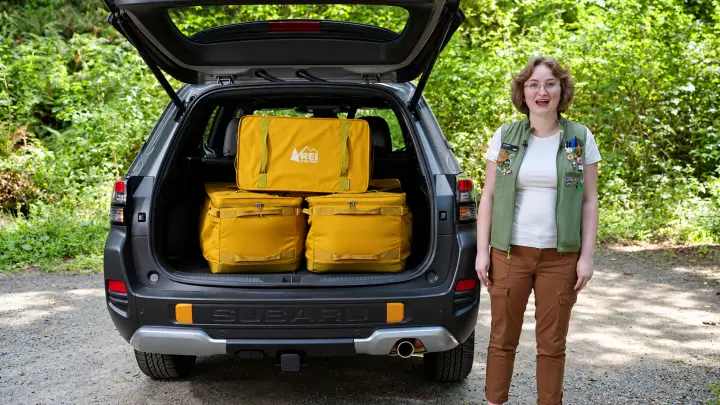
The REI Co-op Trailgate Gear Bin is less like a traditional automotive trunk organizer and more like a modular home for camping gear.
That distinction is useful.
Instead of forcing camp equipment into several narrow compartments, the Trailgate gives you a large open space for tents, sleeping bags, cookware, lanterns, food, or other awkward gear. Foam-structured side panels help the bin stay upright while you load it, but the entire container can collapse flat when the trip is over.
Three sizes let you build around the cargo space you actually have:
- 60L: 24 x 13.5 x 14 in.
- 100L: 27 x 16 x 14 in.
- 140L: 33 x 18 x 14 in.
The 60L is the easiest place to start for many SUVs and crossovers. It is large enough to organize a useful amount of camping equipment without dominating the entire cargo area.
The 100L works well when you want one dedicated container for a larger gear category, while the 140L is designed for bulky equipment such as tents, sleeping bags, chairs, and other high-volume items.
Why it works so well for car camping
The open interior gives you flexibility, but REI also offers Trailgate Gear Cubes that fit inside the bins.
That means you can build two very different systems from the same container.
For bulky gear, leave the interior open.
For smaller items, add cubes to separate categories such as:
- kitchen tools
- lighting and electronics
- first aid
- toiletries
- coffee gear
- campsite accessories
This is often more useful than buying a trunk organizer with permanently divided compartments because the layout can change from trip to trip.
What about stability?
The structured panels help the bin retain its shape even when it is not completely full. That makes it easier to pack tightly against another bin, cooler, or flat-sided piece of gear.
But this is still a fabric storage system rather than a rigid vehicle-mounted box. If preventing movement is the highest priority, pack the Trailgate snugly within your cargo layout or secure the overall load using the vehicle’s factory cargo points where appropriate.
Who should choose it?
Choose the Trailgate if you want one adaptable storage system for a wide range of normal car camping gear.
The biggest decision is not whether to buy it, but which size fits your vehicle and equipment.
Pros
- Three useful sizes
- Structured sides simplify packing
- Collapses when not in use
- Heavy-duty bottom
- Works with smaller organizational cubes
- Excellent for irregularly shaped camping equipment
Cons
- Gear cubes cost extra
- Not a hard protective case
- The 140L version can consume a large portion of an SUV cargo area
- Large versions become difficult to move if overloaded with dense gear
Check the REI Co-op Trailgate Gear Bin
Gregory 50 L Alpaca Camp Box
Best Hard-Sided Camp Storage Box
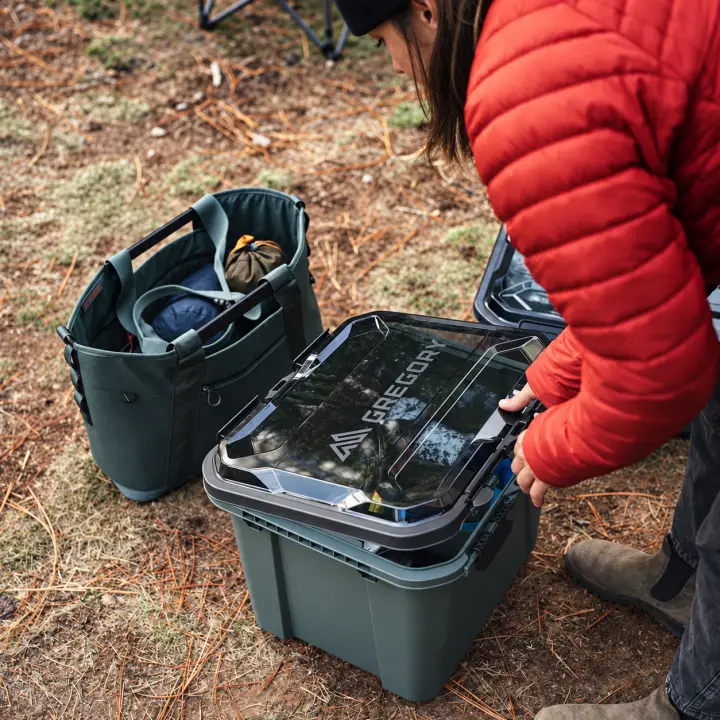
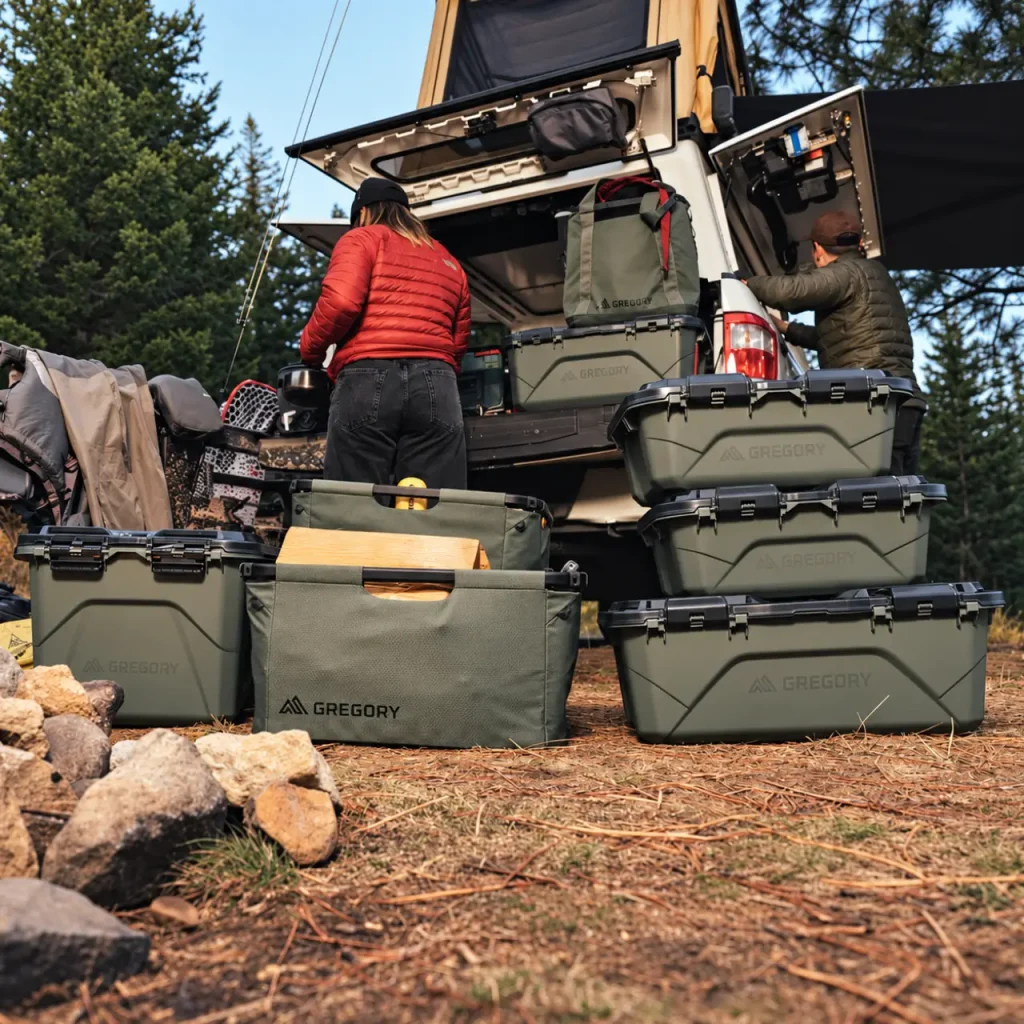
The Gregory 50 L Alpaca Camp Box is the better choice when you want storage that behaves like a box rather than a collapsible organizer.
Its 50-liter polypropylene body measures roughly 19.9 x 17.3 x 15.2 inches, giving it enough depth for pantry items, cookware, bottles, and other equipment that can be awkward to arrange in shallower containers.
The clear polycarbonate lid is especially useful in a packed vehicle because you can identify the contents without opening every box.
Better yet, the lid can open from either side.
That may sound like a minor design detail, but it solves a common problem with car camping storage: boxes rarely remain oriented exactly the way you planned once the vehicle is full. Being able to access the box from either direction gives you more freedom when arranging the cargo area.
Where the Gregory makes more sense than a soft bin
Rigid walls are useful for:
- camp kitchen gear
- cookware
- pantry supplies
- lanterns
- bottles
- electronics
- equipment that should not be crushed
The box is also stackable, so multiple Alpaca boxes can make better use of vertical cargo space than several unstructured bags.
Its gasketed lid has an IP65 rating for dust and water protection. That makes it significantly better suited to dirty or wet environments than an open fabric organizer, though it should still be packed and secured appropriately for however you transport it.
The main tradeoff
A hard-sided box never gets smaller.
Even when almost empty, the Gregory occupies roughly the same space in your vehicle and garage. That is the price you pay for predictable dimensions, crush protection, and stackability.
If you only camp occasionally and storage space at home is tight, a collapsible system may be easier to live with.
Pros
- 50L capacity
- Rigid and stackable
- Clear lid makes contents easy to identify
- Lid can open from either side
- IP65-rated protection against water and dust
- Useful depth for taller kitchen and pantry items
Cons
- Does not collapse
- No built-in compartment system
- Heavier than comparable fabric bins
- Internal organization may require smaller cases or containers
Check the Gregory 50 L Alpaca Camp Box
Front Runner Wolf Pack Pro
Best for Overlanding and Modular Vehicle Storage
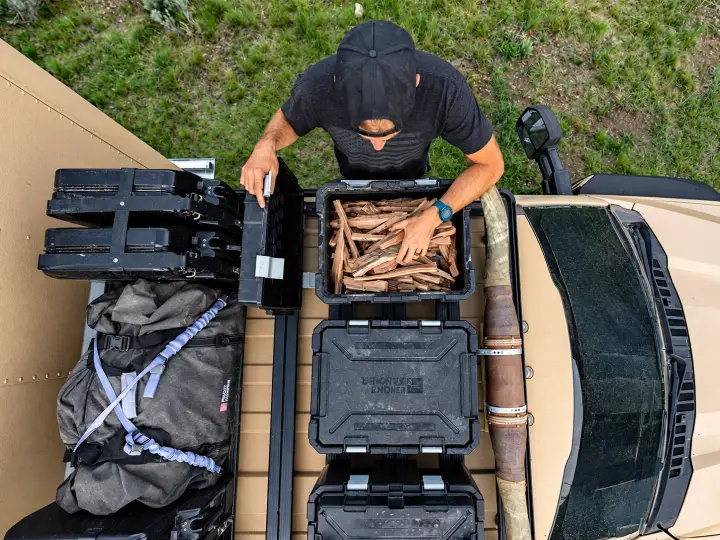
The Front Runner Wolf Pack Pro is much smaller than the big storage totes commonly used for car camping—and that is exactly the point.
At approximately 30.3 liters, with external dimensions around 20.1 x 15.7 x 9.1 inches, it is designed to work as a compact module rather than one giant catch-all container.
That makes it especially useful for dividing equipment by function.
One Wolf Pack Pro might hold:
- camp kitchen equipment
Another could hold:
- tools and repair equipment
A third might contain:
- recovery accessories
- spare parts
- smaller vehicle gear
Instead of unloading a massive bin to find one item, you can pull out the module you actually need.
Better stability through predictable shapes
The rigid polypropylene construction gives every box the same footprint whether it is full or nearly empty.
Wolf Pack Pros are designed to nest securely when stacked, which is valuable in vehicles where vertical storage is part of the packing strategy.
Front Runner also offers compatible rack-mounting and tie-down accessories. That makes this system more appropriate than a basic trunk organizer when storage needs to become part of the vehicle setup rather than simply sit inside the cargo area.
What you give up
Capacity.
A 30.3L Wolf Pack Pro holds far less than a 70L RUX or a large Trailgate bin. Building a full storage system may therefore require several boxes.
The boxes also weigh about 8 pounds each before you put anything inside them.
For occasional weekend car camping, that can be unnecessary complexity. For an overlanding setup that stays packed and organized between trips, modular boxes make much more sense.
Pros
- Rigid protective construction
- Stackable modular shape
- Compact footprint
- Water- and dust-resistant design
- Optional dividers and mounting accessories
- Good for separating gear into dedicated categories
Cons
- Only about 30L per box
- Does not collapse
- Relatively heavy for its capacity
- Building a multi-box system can become expensive
Check the Front Runner Wolf Pack Pro
RUX 70L
Best Premium Portable Gear Organizer
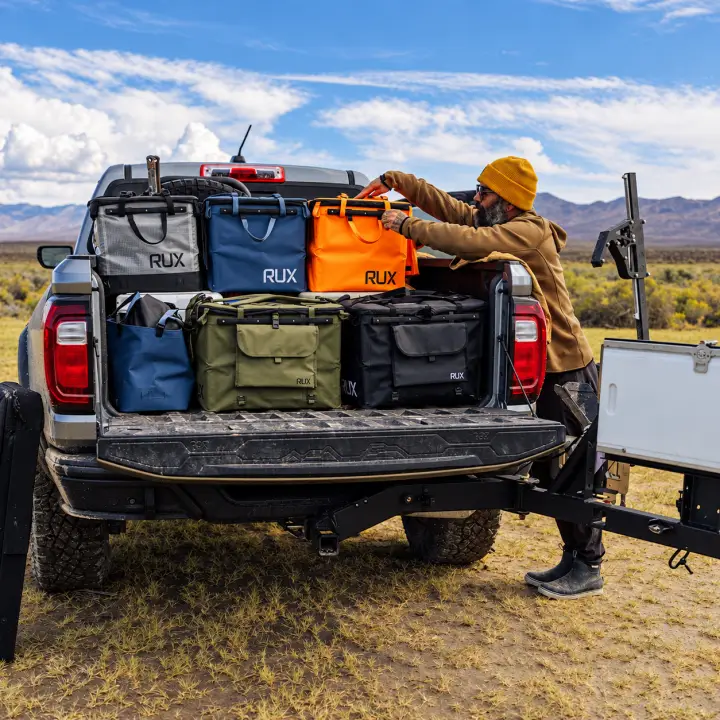
The RUX 70L takes a different approach to car camping storage.
It gives you a 70-liter semi-rigid container with the access of a gear box but the portability and collapsibility of a bag.
The RUX measures roughly 19.5 x 15.7 x 13.8 inches and has a 50-pound load limit. A rigid rim keeps the opening accessible while packing, while the flexible body can collapse down dramatically when empty.
That makes it particularly useful for campers who do not want storage containers that permanently occupy garage space.
Where the RUX earns its premium
The real advantage is not simply that it holds gear.
It is how easily that gear can move through the entire trip:
garage → vehicle → campsite → cabin → boat → home
Utility rails and lash points also give you options for securing the RUX rather than relying entirely on friction between bags and boxes to prevent movement.
The body uses waterproof TPU-coated nylon, making it much better suited to wet gear and outdoor environments than a typical automotive fabric organizer.
Compartments are optional rather than permanent
Like the Trailgate, the RUX starts with a large open interior.
That is an advantage for tents, shoes, climbing equipment, kitchen gear, or other oddly shaped items, but campers who want many small dedicated compartments will need additional organizers or accessories.
Again, that is not necessarily a weakness.
A large open container plus a few smaller removable pouches often gives you more flexibility than permanent fabric dividers.
Watch the weight
The 70L capacity can tempt you to fill the RUX with every dense piece of gear in the garage.
Its load limit is 50 pounds, but even approaching that number can create an awkward container to repeatedly lift in and out of an SUV.
Use the volume intelligently.
Bulky gear is often a better match than cast iron, canned food, tools, and batteries all packed together.
Pros
- 70L capacity
- Collapses when empty
- Wide structured opening
- Waterproof materials
- Lash points for securing the container
- Multiple carrying configurations
- Strong choice for gear that frequently moves between locations
Cons
- Expensive
- Internal organization usually requires accessories
- Easy to make unnecessarily heavy
- More capability than many casual campers need
Thule Go Box Large
Best Simple Collapsible Trunk Organizer
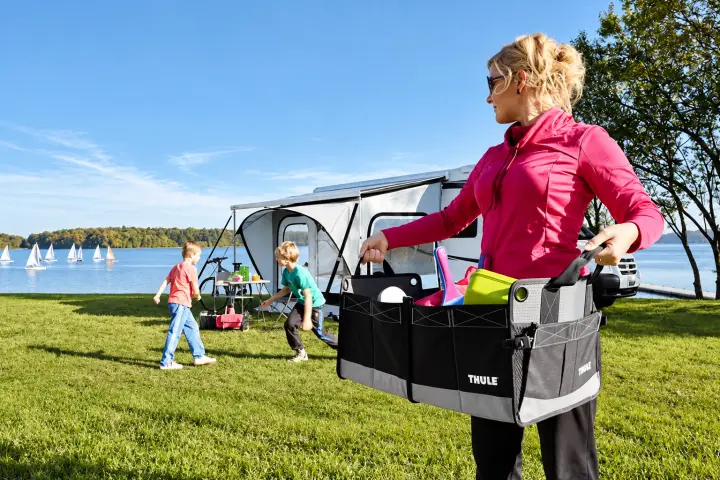
The Thule Go Box Large is a simpler solution for campers who want to contain loose equipment without building an entire modular storage system.
At about 24 x 18 x 12 inches, its rectangular shape works well in the back of an SUV, crossover, wagon, or van. The polyester body is water resistant, the organizer folds for storage, and an exterior side pocket gives smaller items somewhere separate from the main compartment.
It is particularly useful for equipment such as:
- towels
- cookware
- dry food
- lighting
- footwear
- campsite games
- cleaning supplies
- miscellaneous camp accessories
Unlike the Gregory or Front Runner boxes, it does not provide rigid protection. But it also does not leave you storing a large plastic box between trips.
Simple organization has advantages
There is a tendency to assume that more pockets and dividers automatically make an organizer better.
For camping, that is not always true.
A big open compartment handles awkward equipment more easily and lets you change its purpose from one trip to another. The side pocket can hold the handful of small items that would otherwise disappear at the bottom.
The wide rectangular footprint also helps it sit predictably in a normal cargo layout, especially when packed next to similarly shaped objects.
It is still smart to prevent any loaded organizer from sliding around by packing the cargo area tightly and using the vehicle’s cargo restraints where appropriate.
One thing to consider
Availability can fluctuate, so it may not always be the easiest option to find.
If the Go Box Large is unavailable, the REI Trailgate 60L fills much of the same role while offering a broader modular organization system.
Pros
- Straightforward design
- Folds for home storage
- Water-resistant material
- Useful side pocket
- Manageable size for normal SUV cargo areas
- Easy to repurpose between camping and everyday use
Cons
- Minimal compartment organization
- Not a rigid protective box
- Limited securing features compared with dedicated overland systems
- Availability may vary
How to Choose a Trunk Organizer for Car Camping
Do not start by asking how many liters you need.
Start by asking:
What problem is happening in the back of the vehicle?
Different problems point toward very different storage systems.
If Small Gear Keeps Getting Lost
Look for compartments, removable cubes, pockets, or smaller containers that fit inside a larger bin.
This works well for:
- headlamps
- batteries
- cooking utensils
- lighters
- power banks
- toiletries
- repair items
- first-aid supplies
The Trailgate system is particularly adaptable here because you can use the bin by itself or add different-size cubes.
If Gear Slides Around While Driving
Structure and securing matter more than pockets.
Loose soft bags change shape, tip over, and leave gaps in the cargo area. A structured rectangular organizer is easier to pack tightly against:
- coolers
- water containers
- other storage bins
- drawer systems
- flat cargo-area walls
For more demanding driving or exposed storage, use the vehicle’s proper tie-down points and a storage system designed to be secured.
The Front Runner and RUX systems offer more dedicated securing options than ordinary trunk organizers.
Never rely on an organizer alone to restrain heavy equipment during sudden braking or a collision.
If Sleeping Gear Takes Over the Trunk
Do not buy a highly divided organizer.
Sleeping bags, pillows, blankets, tents, and some sleeping pads are easier to manage in a large open bin.
That is where the 100L or 140L Trailgate makes more sense.
The goal is containment, not micro-organization.
If You Carry Heavy or Fragile Equipment
A rigid box is usually the better starting point.
Hard-sided storage protects equipment from being crushed and remains stable when other gear is stacked around it.
The Gregory Alpaca Camp Box works well when you want more capacity and easy visibility.
The Wolf Pack Pro works better when you prefer several smaller dedicated modules.
If Storage Space at Home Is Limited
Collapsible organizers have a major advantage that is easy to overlook while shopping.
A rigid 50L box still occupies roughly 50 liters of physical space when you are not camping.
The Trailgate, RUX, and Thule systems compress or fold down between trips.
For apartment dwellers or anyone with limited garage storage, that may matter as much as what the organizer does at the campsite.
Measure Your Vehicle Before Buying Storage
Storage capacity tells you how much fits inside an organizer.
External dimensions tell you whether the organizer fits inside your car.
The second measurement is often more important.
Before buying anything, measure the usable cargo width, depth, and height of your vehicle with the seats in their normal travel position.
Then account for items that already have fixed locations:
- cooler
- water jug
- portable power station
- refrigerator
- sleeping platform
- camp table
- recovery equipment
- dog crate
- stroller or family gear
Now determine where the organizers fit around them.
This prevents a surprisingly common packing problem: buying a great gear bin and discovering that it forces the cooler to sit behind everything else.
Think in Footprints, Not Just Liters
Two containers with similar capacity can behave very differently inside an SUV.
A long, low box may fit beneath a cargo cover or sleeping platform.
A taller box may make better use of vertical space.
Several compact boxes can fill small gaps better than one huge tote.
There is no universally ideal shape.
The best dimensions are the ones that work with your cargo layout.
Don’t Ignore Loaded Weight
A larger organizer is not always more useful.
Fill a 100L bin with:
- sleeping bags
- blankets
- pillows
and it may still be relatively manageable.
Fill the same space with:
- canned food
- cookware
- cast iron
- tools
- batteries
and moving it may become a two-person job.
For dense equipment, smaller containers often work better.
They also make the campsite easier to organize because you can unload only what you need.
Compartments vs. Open Storage
Neither design is automatically better.
Compartments Are Better For:
- small accessories
- kitchen utensils
- electronics
- repair gear
- frequently used items
Open Bins Are Better For:
- tents
- sleeping bags
- blankets
- camp chairs
- large cookware
- oddly shaped equipment
A useful compromise is a large open bin with removable cubes or pouches inside.
That gives you organization without permanently deciding how every inch of space must be used.
Hard-Sided vs. Soft-Sided vs. Semi-Rigid Organizers
Hard-Sided
Best when protection, stacking, and consistent dimensions matter.
Choose one for:
- kitchen equipment
- tools
- recovery gear
- pantry supplies
- fragile equipment
- modular vehicle systems
The drawback is bulk when empty.
Soft-Sided
Best for bulky gear and maximum packability.
They are lighter and often collapse much smaller, but they provide less crush protection and can be harder to stack.
Semi-Rigid
For many car campers, this is the most useful compromise.
The organizer holds enough shape to pack cleanly while remaining easier to store when empty.
The Trailgate, RUX, and Thule approaches all use this basic idea differently.
The Best Car Camping Storage System Usually Uses More Than One Organizer
Trying to make one giant container hold every piece of camping gear often creates a different kind of mess.
A better approach is to divide equipment by where and when you use it.
For example:
Camp Kitchen
Use a rigid or structured container for:
- stove accessories
- cookware
- utensils
- plates and cups
- cleaning supplies
- coffee equipment
Sleeping and Shelter Gear
Use a larger lightweight bin for:
- tent
- sleeping bags
- pillows
- blankets
Vehicle and Recovery Gear
Keep these items in a smaller dedicated box:
- tools
- tire equipment
- gloves
- recovery straps
- spare parts
Frequently Used Small Gear
Use a cube or small pouch for:
- headlamps
- chargers
- batteries
- first aid
- sunscreen
- bug repellent
Now everything has a destination.
More importantly, everything has a reason to be grouped together.
When you reach camp, the kitchen container goes toward the cooking area. Sleeping gear goes to the tent. Recovery equipment stays in the vehicle.
You are not unloading the entire trunk to find one headlamp.
A Simple Way to Stop Camping Gear From Sliding Around
Buying organizers helps, but the way you load them matters just as much.
Start with the large, heavy objects that already have a predictable footprint.
That might be:
- cooler or refrigerator
- water container
- power station
- rigid storage boxes
- larger gear bins
Fit those together as tightly and logically as possible.
Then use smaller organizers to fill the remaining usable spaces.
Avoid leaving heavy containers free to move across a large empty cargo floor. Use factory tie-down points and appropriate restraints when needed, especially for dense equipment.
Keep the items you might need during the drive or immediately after arrival accessible rather than buried beneath the entire storage system.
A perfectly organized trunk is not useful if the rain jacket is underneath six boxes when the weather changes.
Which Car Camping Trunk Organizer Should You Choose?
Start with the type of gear creating the problem.
For a flexible system that can handle everything from sleeping gear to kitchen equipment, the REI Co-op Trailgate Gear Bin is the strongest starting point. The 60L version works well for more compact setups, while the 100L and 140L versions make more sense when bulky gear is the problem.
Choose the Gregory 50 L Alpaca Camp Box when protection, stackability, and easy access matter more than collapsibility.
The Front Runner Wolf Pack Pro is the more specialized choice for an overlanding setup built around smaller modular boxes and secure vehicle integration.
The RUX 70L makes sense when you are willing to spend more for a container that is equally useful for packing, carrying, securing, and storing gear.
And the Thule Go Box Large remains a straightforward option if what you really need is a simple collapsible organizer to keep everyday camping gear from spreading throughout the cargo area.
The goal is not to fit every piece of gear into the biggest container you can buy.
It is to open the back of your vehicle at camp and immediately know where everything is, what needs to come out, and what can stay exactly where it is.
Affiliate Disclosure: GearForTheOutdoors.com participates in affiliate programs, including REI, Amazon, REI Outlet, Garage Grown Gear, evo, and other trusted partners. When you purchase through our links, we may earn a small commission at no extra cost to you. That helps support our content and keeps our recommendations useful, practical, and free.
Disclaimer: This post is for informational purposes only. Always verify current product details, fit, compatibility, availability, safety information, and manufacturer instructions before purchase or use. Outdoor conditions and gear performance can vary depending on setup, weather, terrain, vehicle, and experience level.